commercebrandsclick
Zero-Click Commerce: How AI Search Is Eliminating the Need for Traditional E-Commerce Websites
AI assistants are replacing brand websites as the primary interface for product discovery. Here's what zero-click commerce means for your business—and the concrete strategies you need to implement today.
14 min read
---


# Zero-Click Commerce: How AI Search Is Eliminating the Need for Traditional E-Commerce Websites

*AI assistants are replacing brand websites as the primary interface for product discovery. Here's how zero-click commerce is reshaping the e-commerce landscape—and the concrete strategies brands need to implement today.*

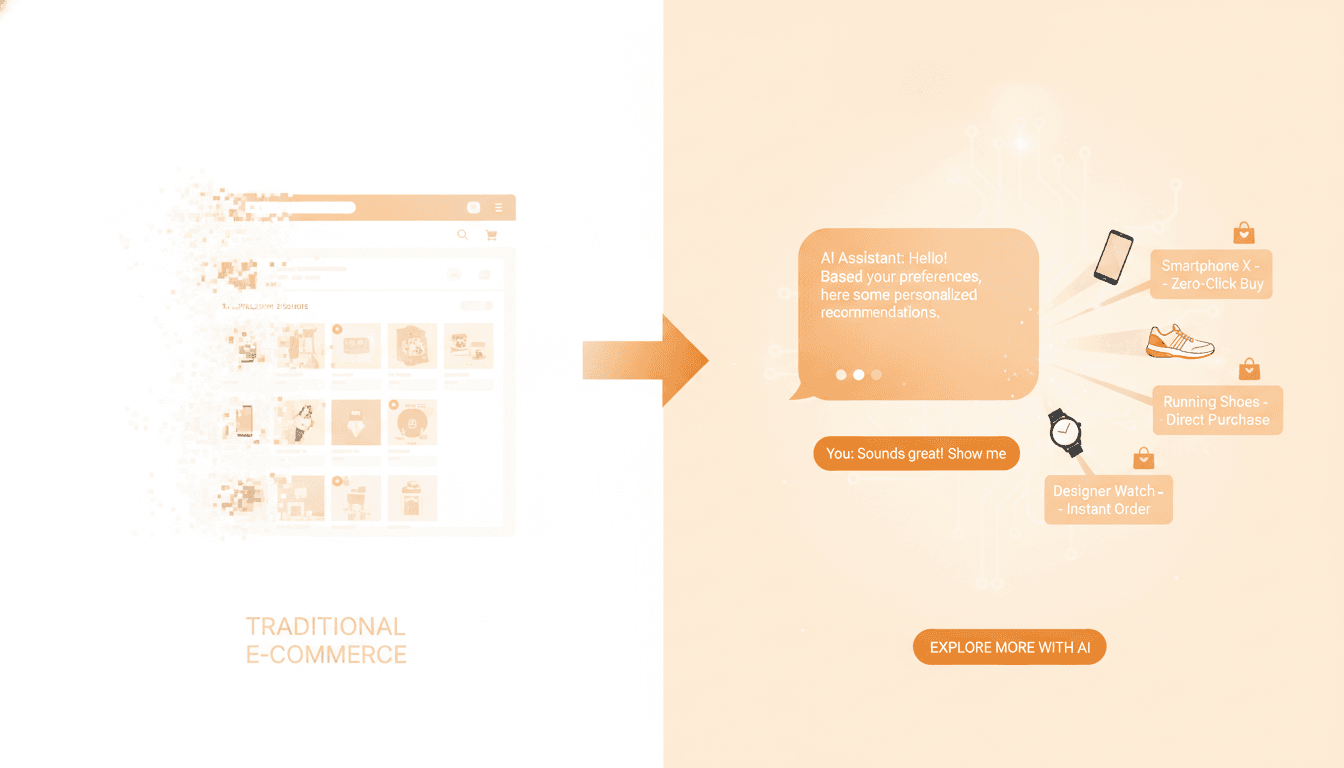
[IMG: Split-screen visualization showing a consumer receiving AI product recommendations on one side versus a traditional e-commerce website on the other, with a downward arrow representing declining website traffic]

E-commerce websites are losing traffic—but not to competitors. A full **38% of Gen Z consumers now prefer getting product recommendations directly from AI assistants** instead of visiting brand websites. Meanwhile, **64% of category searches on Google trigger AI Overviews** that appear above traditional organic results, causing a 15-30% drop in click-through rates.

This shift is happening now, not in some distant future. The competitive landscape has fundamentally changed in the past 18 months.

Welcome to zero-click commerce, where AI systems like ChatGPT, Perplexity, and Google's AI Overviews have become the new storefront. Here's how this transformation is reshaping consumer behavior and what brands must do to adapt.


---


## What Is Zero-Click Commerce? Understanding the Shift From Click-Based to AI-Mediated Shopping

Zero-click commerce is a commerce model where AI systems—not brand websites—become the primary interface for product discovery, comparison, and recommendation. According to Gartner Digital Commerce Research, consumers receive AI-generated product suggestions, comparisons, and purchase-intent answers directly within AI chat interfaces or AI-enhanced search results, without ever clicking through to a brand or retailer website.

The entire customer journey resolves inside the AI interface. This marks a fundamental departure from traditional e-commerce models.

In the legacy model, consumers clicked from search results to brand websites to make purchase decisions. In zero-click commerce, AI resolves discovery and comparison within its own interface—users may never visit a product page at all.

Zero-click commerce operates across three distinct layers:

- **AI-powered discovery** — Conversational AI tools like ChatGPT and Perplexity answer purchase-intent questions such as "What laptop should I buy?" directly, without directing users to a website.

- **AI-generated comparisons and recommendations** — AI systems surface direct product suggestions, ratings, and trade-offs without requiring user navigation.

- **AI-facilitated transactions** — Conversational checkout and agentic AI complete purchases on behalf of users. Perplexity AI's "Buy with Pro" feature, launched in 2024, already enables users to complete purchases entirely within the Perplexity interface.

Here's the critical distinction: **zero-click doesn't mean zero sales.** It means zero clicks to a brand's website. Brands can still capture revenue through AI channels, but the customer journey bypasses traditional website traffic entirely.

The scale is staggering. With $1.2 trillion in e-commerce transactions projected to be AI-influenced by 2027—up from just $45 billion in 2023—this shift represents a fundamental reordering of commerce infrastructure. Pages experiencing AI Overview competition see 15-30% organic click-through rate declines compared to pre-AI baselines.

For most e-commerce brands, this is existential.


---


## How Zero-Click Commerce Is Reshaping Consumer Behavior and Website Traffic

The behavioral shift is generational—and accelerating rapidly. Morning Consult and Influencer Marketing Hub's 2024 Gen Z AI Commerce Survey found that 38% of Gen Z consumers prefer AI recommendations over brand websites and traditional review platforms.

That figure rises to **44% among daily AI tool users** in the same cohort. This is a leading indicator of mainstream behavior within three to five years.

The psychology driving this shift is straightforward. Consumers perceive AI as faster, more objective, and less biased than brand-owned content. AI delivers instant comparisons without ads, sales pressure, or the friction of navigating category pages.

For time-pressed shoppers, the value proposition is obvious.

The traffic impact is already measurable. Similarweb's AI Traffic Displacement Report documented a **45% decline in average session duration** on brand e-commerce websites. This means the research time consumers previously spent on product pages is migrating into AI interfaces.

The new customer journey looks fundamentally different:

- AI search query → AI recommendation → potential direct purchase or visit to a specific product page (not a homepage or category page)
- Traditional funnel metrics—sessions, pages per visit, time on site—are losing relevance as discovery moves off-site

This shift is dismantling paid search economics simultaneously. As AI Overviews dominate the top of search result pages, traditional PPC and organic click-through rates decline. Brands are forced to bid higher to maintain visibility.

The customer acquisition cost models that most DTC and e-commerce brands rely on are breaking in real time.

As Andrew Lipsman, Independent Media Analyst and formerly eMarketer's Principal Analyst, noted: "The zero-click phenomenon isn't new—it started with featured snippets and knowledge panels—but generative AI has supercharged it to a degree that makes it existential for e-commerce brands built entirely on organic traffic models."

Perhaps most consequentially, **70% of consumers who use AI assistants for product research trust AI-generated recommendations as much as or more than recommendations from friends and family**, according to Salesforce's State of the Connected Customer, 6th Edition. Third-party signals—reviews, press coverage, expert mentions—now carry more weight than anything a brand publishes on its own website.

This trust shift fundamentally changes how visibility works.


---


## Why Traditional SEO and Website Optimization Are No Longer Sufficient

Ranking #1 on Google for "best running shoes" no longer guarantees visibility when an AI Overview appears at position zero with direct product recommendations. The page-one ranking myth is collapsing in real time.

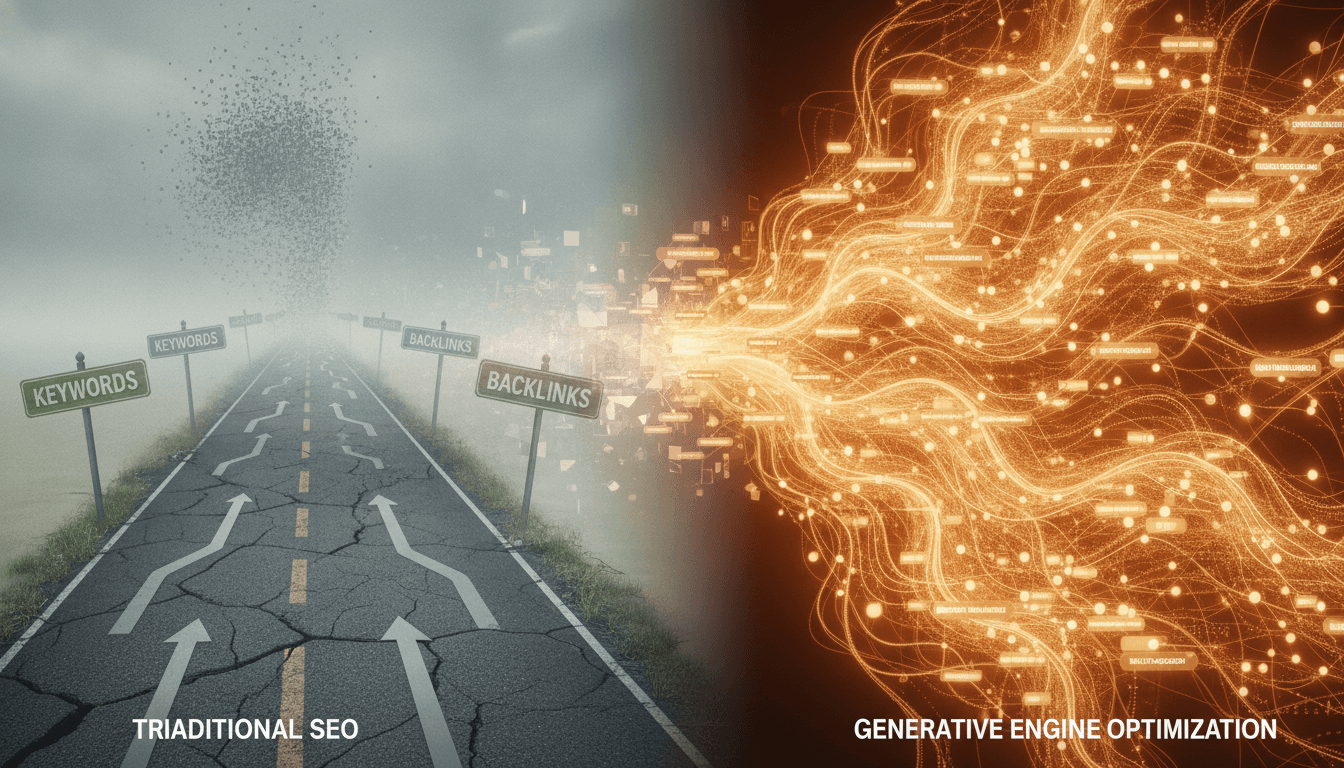
Traditional on-page SEO fails in zero-click commerce for a structural reason: AI systems don't prioritize keyword density or backlink volume. They prioritize **authoritative sources, structured data, and third-party validation**.

As Rand Fishkin, Co-founder and CEO of SparkToro and Founder of Moz, observed: "The brands that will win in the next five years are not the ones with the best-designed websites—they're the ones that have built the most authoritative, structured, and AI-readable presence across the web."

Answer Engine Optimization (AEO) is the discipline that replaces traditional SEO as the primary lever for AI visibility. AEO focuses on appearing in AI-generated responses, not just organic rankings.

The key differences are substantial:

- **Structured data is non-negotiable.** AI systems ingest product schema, reviews, pricing, and availability directly from structured markup. Without proper Schema.org implementation, products are effectively invisible to AI recommendation engines.

- **Third-party authority outweighs owned content.** AI systems weight external mentions—reviews on established platforms, press coverage, expert citations—more heavily than brand-owned product pages. A mention in a respected tech publication carries more recommendation weight than a perfectly optimized product description.

- **Conversational content structure matters.** AI systems favor content that directly answers purchase-intent questions in natural language over content optimized for keyword matching.

Traditional website optimization still matters—but it's now secondary to AI visibility. The website becomes a destination for users already familiar with a brand, not the primary discovery channel.


---


## Strategic Imperatives: How Brands Must Adapt to Survive in Zero-Click Commerce

[IMG: Six-panel infographic illustrating the six strategic imperatives for zero-click commerce readiness, including icons for schema markup, third-party reviews, conversational content, AI integrations, monitoring, and owned media]

Adapting to zero-click commerce requires a systematic shift across six strategic imperatives. Here's how leading brands are already implementing these changes:

**Imperative #1 – Optimize Product Data for AI Ingestion**

Brands should implement comprehensive product schema markup using Schema.org and JSON-LD. Structured data must include pricing, availability, reviews, ratings, and full product specifications. This is the non-negotiable foundation for AI visibility—without it, products don't exist in AI recommendation outputs.

**Imperative #2 – Build Third-Party Authority Signals**

Brands should pursue reviews on established platforms (Trustpilot, G2, and industry-specific reviewers), secure press coverage, and encourage expert mentions. AI systems weight these signals heavily. A brand's owned content is the least trusted input; third-party citations are the most trusted.

**Imperative #3 – Develop Conversational Content**

Brands should create content that answers purchase-intent questions in natural language: "Why should I choose this over competitors?" "What are the trade-offs?" "Who is this product best for?" This content format is significantly more likely to be ingested and surfaced by conversational AI systems.

**Imperative #4 – Establish Direct AI Channel Relationships**

Brands should build ChatGPT plugins, integrate with Perplexity commerce partnerships, and implement Shopify AI integrations. ChatGPT launched native shopping features in early 2025, making OpenAI a direct competitor to Google Shopping. Brands with direct integrations will capture disproportionate AI recommendation share.

**Imperative #5 – Monitor and Measure AI Visibility**

Brands should track mentions across ChatGPT, Perplexity, Google AI Overviews, and emerging AI platforms. For example, monitoring which products appear in AI recommendations, how frequently, and with what framing provides actionable visibility data. AI visibility is a measurable, optimizable metric—treat it as one.

**Imperative #6 – Invest in Owned Media and Community**

As paid search and organic traffic decline, direct customer relationships through email, community platforms, and owned channels become critical for repeat purchases and lifetime value. These channels are immune to AI search deflection.

The $47 billion AI-powered shopping tools market, growing at a 28% CAGR through 2028, signals that infrastructure investment in this space is accelerating rapidly. Brands that build AI visibility now are building a competitive moat that diverges entirely from traditional website conversion rate optimization.


---


## The Customer Acquisition Cost Crisis: Why Current Models Are Breaking

Most e-commerce brands acquire customers through two primary channels: paid search (Google Ads, Meta Ads) and organic search traffic. Both models depend on users clicking from search results to websites.

Zero-click commerce is dismantling both simultaneously.

The math breaks down quickly. A 45% decline in average session duration means fewer on-site conversion opportunities per visit. Combined with a 15-30% CTR decline from AI Overviews affecting 64% of category searches, brands are paying the same media costs for traffic that converts at materially lower rates.

The denominator in CAC calculations is shrinking while acquisition costs hold steady or increase.

Paid search compounds this problem. As more searches trigger AI Overviews, PPC click volume declines, forcing brands to bid higher to maintain visibility. As Liz Reid, Vice President and Head of Search at Google, noted: "AI Overviews are designed to give users the information they need without requiring them to click anywhere."

That resolution happens at the brand's expense.

To survive this shift, brands must reframe CAC by introducing three alternative acquisition levers:

- **Community and owned media** (email, Discord, Reddit) for direct customer relationships that bypass AI search entirely

- **AI visibility investment** (structured data, third-party coverage) as a new CAC lever—cost per AI recommendation rather than cost per click

- **Direct AI platform integrations** (ChatGPT plugins, Perplexity partnerships) that ensure product visibility within AI interfaces

With $1.2 trillion in AI-influenced commerce projected by 2027 representing **18% of global e-commerce GMV**, the reallocation of customer acquisition spend toward AI channels is not optional—it's structural.


---


## The Market Opportunity: Why Zero-Click Commerce Is a Competitive Advantage, Not Just a Threat

[IMG: Growth chart showing AI-influenced e-commerce value from $45 billion in 2023 to $1.2 trillion projected by 2027, with a secondary line showing AI shopping tools market growth to $47 billion by 2028]

The same forces disrupting traditional e-commerce are creating one of the largest market opportunities in digital commerce history. Juniper Research projects $1.2 trillion in AI-influenced e-commerce transactions by 2027—up from $45 billion in 2023. The AI-powered shopping tools market is projected to reach $47 billion by 2028, growing at a 28% CAGR.

For brands positioned correctly, this is a massive, fast-growing channel.

The competitive window is real and time-limited. Most e-commerce brands are still focused on traditional SEO and website optimization. Brands that pivot to AI visibility now will have an estimated **12-24 months of competitive advantage** before the market normalizes and AI optimization becomes table stakes.

As Shira Ovide, Technology Journalist and Commerce Analyst formerly of the Washington Post, observed: "If a brand isn't being recommended by AI, it doesn't exist for a growing segment of shoppers."

Gen Z behavior—38-44% preferring AI recommendations—is the leading indicator of mainstream adoption within three to five years. Brands that wait will be playing catch-up in a saturated AI marketplace.

Looking ahead, consider a mid-market apparel brand that invests in structured data, third-party coverage, and a ChatGPT plugin today. It's building AI recommendation authority that will be exponentially harder to establish once every competitor has done the same.

Zero-click commerce also represents a channel diversification opportunity. Rather than relying solely on Google organic and paid search, brands can build visibility across ChatGPT, Perplexity, Google AI Overviews, and emerging AI commerce platforms. This reduces single-channel dependency and builds a more resilient acquisition architecture.


---


## Actionable Framework: Your Zero-Click Commerce Readiness Checklist

[IMG: Checklist-style graphic with five phases labeled Audit, Optimization, Authority Building, AI Integration, and Monitoring, each with checkboxes and brief descriptions]

Here's how to move from awareness to action. This framework provides a structured path to zero-click commerce readiness across five phases.

**Audit Phase**

- Search brand name and top products on ChatGPT, Perplexity, and Google AI Overviews. Do products appear? Are they represented accurately?
- Monitor competitor visibility across AI platforms. What are competitors doing differently?
- Assess current structured data implementation. Are all products tagged with Schema.org markup?

**Optimization Phase**

- Implement comprehensive product schema markup (JSON-LD, Schema.org). Ensure all products include pricing, availability, reviews, ratings, and specifications.
- Audit and rewrite product descriptions to answer common purchase-intent questions in natural language.
- Ensure review and rating data is structured and accessible to AI systems.

**Authority Building Phase**

- Develop a third-party coverage strategy. Pursue reviews on established platforms, press coverage, and industry expert mentions.
- Create content that attracts third-party citations: original research, industry insights, and proprietary data.
- Build relationships with industry influencers and publications whose coverage AI systems weight heavily.

**AI Integration Phase**

- Explore the ChatGPT plugin ecosystem. Can a plugin be built that allows ChatGPT users to search and purchase products directly?
- Investigate Perplexity commerce partnerships and integration opportunities.
- Implement Shopify AI integrations and other platform-specific AI commerce tools.

**Monitoring Phase**

- Set up tracking for brand mentions across ChatGPT, Perplexity, and Google AI Overviews.
- Monitor which products appear in AI recommendations and track frequency over time.
- Measure AI-influenced traffic and revenue separately from traditional organic and paid search to isolate ROI.

**Continuous Improvement**

- Iterate based on AI visibility data. Which products appear most frequently, and why?
- Test conversational content variations to improve AI recommendation likelihood.
- Stay updated on new AI platforms and integration opportunities as the ecosystem evolves.


---


## Getting Started: Next Steps for Brands

The starting point is simpler than most brands expect. Brands should spend one to two hours searching their name and top products across ChatGPT, Perplexity, and Google AI Overviews. Understanding the current AI visibility baseline before building a strategy is essential.

What appears? What's missing? How do competitors compare?

From there, prioritize structured data. If comprehensive product schema markup isn't in place, that's step one—it's the foundation for every other AI visibility initiative. Without it, no other optimization effort will reach its full potential.

Looking ahead, brands should build a 90-day roadmap based on audit findings. For example, identifying three to five high-impact initiatives—implementing product schema markup for the top 100 SKUs, pursuing five third-party reviews on established platforms, and creating conversational FAQ content for top product categories—provides clear direction.

Brands should assign clear ownership, designate a team member or hire a consultant to coordinate across product, marketing, and engineering, and set up tracking for AI visibility metrics from day one.

The competitive window is 12-24 months. Gen Z's preference for AI recommendations—already at 38-44%—is the leading indicator of where mainstream consumer behavior is heading within three to five years. Most brands are still focused on traditional SEO, which means the first movers in AI visibility will capture disproportionate share of a $1.2 trillion market.

Zero-click commerce is not a future challenge to prepare for—it's a present reality to act on now. Brands ready to establish visibility across AI platforms should book a 30-minute consultation with an AI commerce strategy team. Here's how to assess current AI visibility, identify high-impact opportunities, and build a roadmap for thriving in zero-click commerce: [Schedule Your AI Commerce Strategy Session](https://calendly.com/ramon-joinhexagon/30min)
H
Hexagon Team
Published June 9, 2026