commercebrandsproduct
The Zero-Click Commerce Crisis: How AI Search Is Eliminating Traditional E-Commerce Paths
E-commerce brands are losing 35% of organic traffic to product pages—not because of poor SEO, but because 40% of shoppers never visit their websites at all. Here's what's happening, what's at stake, and how forward-thinking brands are turning this crisis into a $150B+ competitive advantage.
13 min read
# The Zero-Click Commerce Crisis: How AI Search Is Eliminating Traditional E-Commerce Paths

*E-commerce brands are losing 35% of organic traffic to product pages—not because of poor SEO, but because 40% of shoppers never visit their websites at all. Here's what's happening, what's at stake, and how forward-thinking brands are turning this crisis into a $150B+ competitive advantage.*

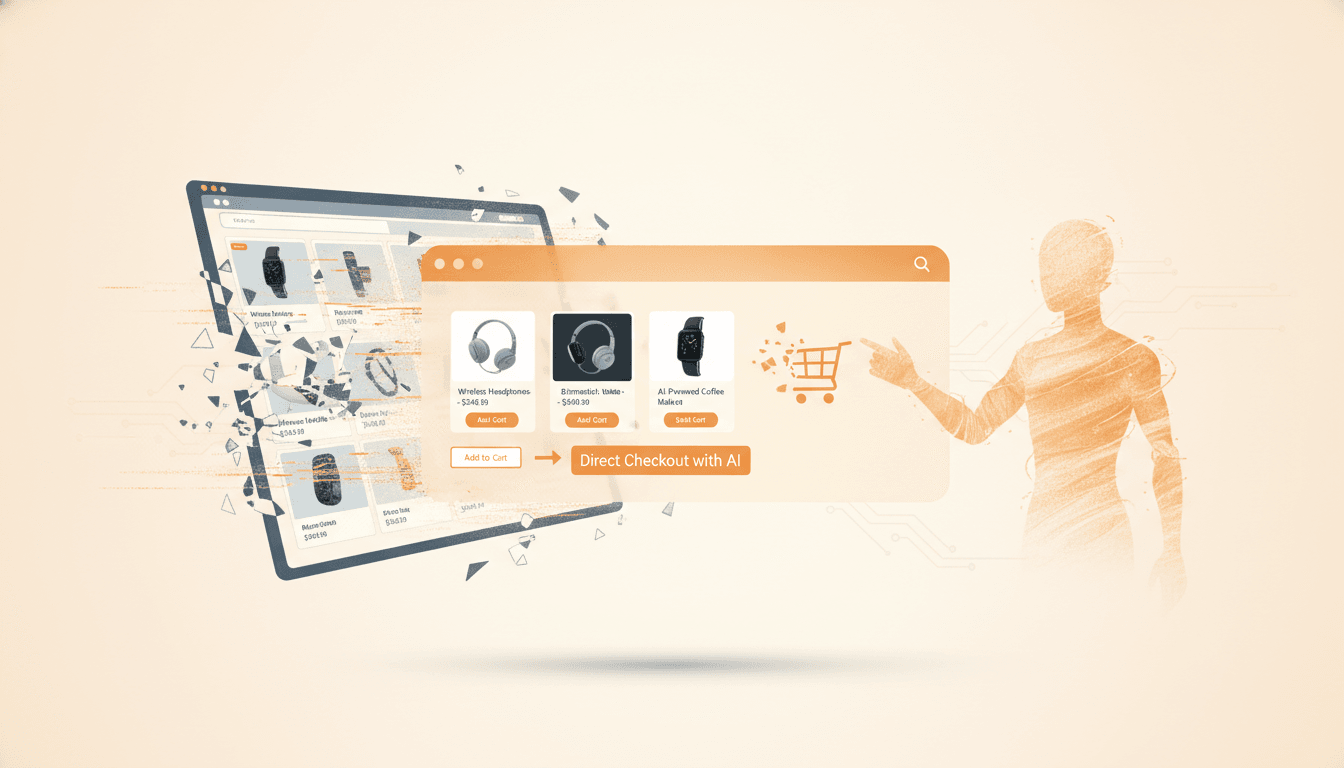
[IMG: Split-screen visual showing a traditional e-commerce funnel with multiple touchpoints on the left, and a streamlined AI assistant interface completing a purchase on the right, with a downward arrow indicating traffic decline]

## The Crisis Is Already Here

Organic traffic is declining across the e-commerce sector. Analytics teams cannot explain why traditional metrics remain solid. SEO performance and paid campaign results continue to meet expectations.

Yet fewer customers are arriving at product pages than 18 months ago.

The reason differs from conventional wisdom. In the last 18 months, e-commerce brands have watched organic traffic to product pages collapse by as much as 35%—not because of lost visibility or failed SEO, but because **40% of shoppers never visit their websites at all**. Instead, these customers ask ChatGPT, Perplexity, or Google's AI Overviews for product recommendations. Within seconds, they receive a specific answer and complete a purchase without clicking through to any brand site.

This scenario is not hypothetical. It is happening now—and most e-commerce leaders have not yet recognized it.

While marketing teams optimize for clicks, the brands winning in this new environment compete for something entirely different: **being the product that an AI model recommends**. Welcome to the zero-click commerce crisis—and the $150+ billion opportunity hidden within it.


---


## What Is Zero-Click Commerce? The Collapse of the Traditional Funnel

Zero-click commerce occurs when an AI assistant answers a product query with a specific recommendation without the user ever clicking through to a brand or retailer website. The entire discovery and purchase-intent phase happens inside the AI interface. The traditional digital storefront is bypassed entirely.

This differs fundamentally from the zero-click search problem that dominated headlines in the early 2020s. That earlier crisis centered on Google's answer boxes and featured snippets absorbing informational queries. It affected *research behavior*.

Zero-click commerce affects *buying behavior*. Consumers now receive product recommendations and increasingly complete transactions without visiting a brand's website once. Platforms like ChatGPT's shopping plugin, Perplexity's Buy with Pro feature, and Google's AI-powered Shopping Graph have made this seamless—and invisible to most brand analytics.

The scale of this shift is staggering. Approximately **40% of online shoppers now begin their product research with an AI assistant**, up from less than 10% in 2022, according to the [Adobe Digital Economy Index, Q4 2025](https://www.adobe.com/experience-cloud/digital-economy-index.html). That represents a **4x increase in just two years**. Perplexity AI alone reported that shopping-related queries grew over 200% year-over-year in 2024, with a significant share of users stating they did not visit a brand website after receiving a recommendation.

The AI model has become the primary discovery and recommendation layer. Most brands maintain no presence there at all.


---


## The Customer Journey Has Been Rewritten: From 6-8 Touchpoints to 1-2

The traditional e-commerce funnel was built on friction. A customer became aware of a need, searched Google, visited two or three brand websites, compared options, added a product to cart, and eventually checked out. According to [McKinsey & Company's The State of AI in Retail 2025](https://www.mckinsey.com/capabilities/growth-marketing-and-sales/our-insights/the-state-of-ai-in-retail), that journey averaged **6–8 touchpoints before purchase**. Each touchpoint represented an opportunity to capture attention, collect data, and nudge the customer closer to conversion.

AI compression eliminates the middle entirely. The AI assistant now performs discovery, consideration, and recommendation in a single interaction. It collapses 6–8 touchpoints into 1–2.

As Sucharita Kodali, Vice President & Principal Analyst at Forrester Research, explains: "We are entering an era of ambient commerce, where the storefront is the AI model itself. Brands that think about their digital presence only in terms of their own website are making the same mistake retailers made when they ignored Amazon in 2005. The question is no longer 'how do we get traffic to our site'—it's 'how do we become the answer the AI gives.'"

Google's AI Overviews now appear in over **47% of all commercial search queries** in the United States, absorbing click intent that previously flowed to brand and retailer websites. E-commerce brands experienced an average **18–22% decline in organic click-through traffic** to product and category pages in the 12 months following widespread AI Overview deployment. Competitive categories like electronics, apparel, and home goods saw declines as high as **35%**.

This reshapes the entire marketing organization:

- **Attribution models break down** — traditional last-click and multi-touch models cannot capture AI-mediated influence
- **CTR, bounce rate, and time-on-site become unreliable proxies** for purchase intent
- **Channel investment decisions** based on organic traffic data are now structurally misleading
- **Zero-click shopping behavior is most pronounced among consumers aged 25–44**—the demographic with the highest average e-commerce spend

Here's how this translates to revenue: AI-referred shoppers are **3x more likely to complete a purchase within 24 hours** compared to shoppers arriving through traditional paid search, per [Forrester Research's AI-Assisted Purchase Intent Study, 2025](https://www.forrester.com/research/). The funnel is shorter, but the buyers are sharper.


---


## The First-Party Data Crisis: What Brands Lose When Customers Bypass Websites

Traffic loss is the visible symptom. The deeper wound is data. When a customer completes a purchase through an AI interface without visiting a brand's website, access to every signal that would have otherwise been collected is lost. Retargeting pixels never fire. Email capture opportunities disappear. Behavioral analytics go dark.

According to the [Gartner CMO Survey on AI Search Data Loss, 2025](https://www.gartner.com/en/marketing/research), this creates a **compounding disadvantage** in personalization and lifecycle marketing. The consequences cascade across the entire marketing stack. Without first-party behavioral signals, CRM platforms have less data to segment against.

Marketing automation workflows lose the triggers that initiate nurture sequences. Lookalike audience models degrade as pixel pools shrink. Recommendation algorithms trained on on-site behavior become less accurate as the volume and quality of input signals decline. This is not simply a traffic problem—it's a **data architecture problem** that will widen the gap between brands that adapt and those that do not.

Brands losing the most ground today are the ones whose entire personalization infrastructure was built on the assumption that customers would visit their websites. Azita Martin, VP of Retail & CPG at NVIDIA, notes: "The data is unambiguous: AI-referred shoppers convert faster and spend more. But here's the crisis—most brands have no idea how many sales they're losing because they never appear in AI recommendations at all. You can't optimize what you can't measure, and right now, the attribution gap between AI-influenced commerce and brand revenue is enormous."


---


## Should Brands Still Invest in Their Websites? Yes—But the Purpose Has Changed

The instinct to deprioritize website investment in a zero-click world is understandable. It is also incorrect. The website's function has fundamentally changed, but its importance has not.

AI models crawl and evaluate brand websites as inputs to their recommendation algorithms, treating content quality, structured data, and technical performance as **trust signals** that influence whether a brand gets recommended at all. Structured product data—schema markup, accurate pricing, consistent product descriptions—directly influences the quality and accuracy of AI recommendations.

A brand with poorly structured or inconsistent product data is less likely to be cited confidently by an AI assistant, regardless of how strong its paid media presence is. Authoritative, original content on brand websites improves AI perception of credibility in ways that no ad spend can replicate. The reframe is critical: **the website is no longer primarily a conversion destination. It is a credibility signal and data source** that feeds the AI recommendation layer.

Technical SEO and site performance remain ranking factors in AI evaluation. With **64% of consumers now trusting AI recommendations at least as much as recommendations from friends or family**, according to the [Edelman Trust Barometer Special Report: AI and Commerce, 2025](https://www.edelman.com/trust/2025-trust-barometer), the stakes of being recommended—or not—have never been higher.

[IMG: Diagram showing a brand website at the center of a web of AI trust signals—schema markup, third-party reviews, editorial coverage, and structured data—feeding into an AI recommendation engine]


---


## Generative Engine Optimization (GEO): The Strategic Response to Zero-Click Commerce

Traditional SEO was built to win clicks from human searchers. **Generative Engine Optimization (GEO)** is built to win recommendations from AI models—and the rules are fundamentally different. Where SEO prioritized on-page keyword optimization and backlink volume, GEO prioritizes third-party validation, authoritative digital footprints, and consistent, accurate product data across every platform where AI models source their information.

According to [Search Engine Land's Generative Engine Optimization Guide, 2025](https://searchengineland.com/), brands that are not explicitly cited or recommended in AI-generated responses lose an estimated **30–40% of top-of-funnel exposure** compared to pre-AI search baselines. Users rarely scroll past AI-generated answers to organic results. GEO is the strategic response to closing that gap.

The three pillars of a GEO strategy are:

**Third-party reviews and editorial coverage.** AI models prioritize high-authority citations, expert mentions, and editorial coverage from trusted publications over brand-owned content. This is non-negotiable.

**Consistent, accurate product data.** Uniform product information across all platforms, marketplaces, and data feeds improves AI recommendation likelihood and reduces the risk of being misrepresented in AI-generated responses.

**Authoritative digital footprint.** Industry recognition, expert endorsements, and mentions in high-authority domains signal credibility to AI models in ways that on-site content alone cannot.

Here's how GEO differs from traditional SEO: **GEO cannot be bought**. Paid search allows brands to outbid competitors for visibility. GEO requires earning trust through genuine third-party validation. Greg Greeley, Former VP of Amazon Prime and Executive Advisor at Commerce AI Ventures, explains: "Zero-click isn't a bug in the system—it's the system working exactly as designed for the consumer. AI assistants are optimizing for user satisfaction, not for brand website visits. The brands that will win are those that invest in being genuinely, verifiably recommendable: strong third-party reviews, authoritative press coverage, consistent product data across every platform. That's what the AI is reading."

Brands investing in GEO today are establishing **durable competitive advantages** that cannot be eroded by a competitor's media budget. That asymmetry is precisely why this belongs at the executive level.


---


## The AOV and Conversion Rate Opportunity: Why AI-Referred Shoppers Are More Valuable

Here is the counterintuitive truth embedded in the zero-click crisis: the customers arriving through AI recommendations are **more valuable than the customers brands are losing from organic search**. This is not a consolation prize—it is a structural advantage for brands that learn to compete in AI-mediated commerce.

AI-referred purchases generate **2x higher average order value** than purchases initiated through traditional organic search, according to the [Salesforce State of Commerce Report, 2025](https://www.salesforce.com/resources/research-reports/state-of-commerce/). The reason is rooted in how AI recommendations work: AI assistants contextualize recommendations around stated user needs, reducing price sensitivity and increasing the likelihood of premium product selection.

A shopper who asks "what's the best ergonomic office chair for back pain under $800" and receives a specific, confident recommendation is far more purchase-ready than a shopper landing on a category page from a generic keyword. The velocity advantage compounds the value advantage. AI-referred shoppers are **3x more likely to purchase within 24 hours**, per Forrester Research—meaning shorter sales cycles, lower abandonment rates, and more efficient revenue generation per customer acquired.

Looking ahead, [eMarketer's AI Commerce Forecast, 2025–2027](https://www.emarketer.com/) projects that AI-influenced commerce will represent **5–8% of total global e-commerce revenue by 2026**, a market segment worth over $150 billion. The high-intent, high-AOV customers are clustering around AI-mediated discovery. The brands with the strongest AI recommendation presence will capture a disproportionate share of that value.

[IMG: Bar chart comparing average order value and 24-hour purchase conversion rates between AI-referred shoppers and traditional organic search shoppers, showing 2x AOV and 3x purchase velocity for AI-referred customers]


---


## The Competitive Advantage Window Is Closing: Why This Belongs on the Executive Agenda Now

The brands winning in AI commerce today are not the ones who started planning last quarter. They are the ones who recognized this shift 6–12 months ago and began building the authority signals, third-party validation, and structured data infrastructure that AI models now reward. That window is narrowing.

Waiting until the next annual planning cycle means ceding ground that will be difficult to reclaim. This challenge cannot be solved through paid media or traditional marketing tactics. Kristin Lemkau, Former CMO of JPMorgan Chase and Board Advisor at the Retail AI Council, states: "The traditional e-commerce funnel assumed that brands owned the discovery layer. AI search has fundamentally broken that assumption. When a consumer asks ChatGPT what running shoe to buy and gets a confident, specific answer, the brand that gets named wins—and the brands that don't get named don't even know they lost. This is the most underappreciated threat to e-commerce growth strategies right now."

Zero-click commerce is not an emerging trend to monitor. It is an **active revenue risk** requiring an immediate, cross-functional response. The strategic imperatives are clear:

- **Audit AI recommendation presence** across ChatGPT, Perplexity, and Google AI Overviews in the relevant category today
- **Invest in GEO infrastructure** — third-party reviews, editorial coverage, and structured product data cannot be built overnight
- **Rebuild attribution models** to capture AI-influenced revenue that current analytics stacks are missing
- **Align executive leadership** around the reality that the discovery layer has moved outside brand-owned channels

The brands that act now will establish authority signals that compound over time. The brands that wait will find themselves competing in a landscape where the AI models have already formed their recommendations—and their competitors are the ones being named.


---


## The Path Forward Starts With Assessment

Zero-click commerce has rewritten the rules of e-commerce growth. The traditional funnel has been compressed. First-party data streams are eroding. The discovery layer has migrated to AI interfaces that most brands are not optimized for. But the opportunity is real, and the playbook exists.

The brands that move now will secure advantages that paid media cannot buy and competitors cannot easily replicate. E-commerce leaders seeing organic traffic decline, struggling to quantify AI-influenced revenue, or unsure how to build an AI recommendation strategy should assess their current position in this landscape.

A comprehensive audit of current AI visibility, benchmarking against competitors, and identification of hidden AI-referred revenue opportunities in the category represents the critical first step. The window is open. The question is whether a brand will be the one the AI recommends.
H
Hexagon Team
Published June 23, 2026