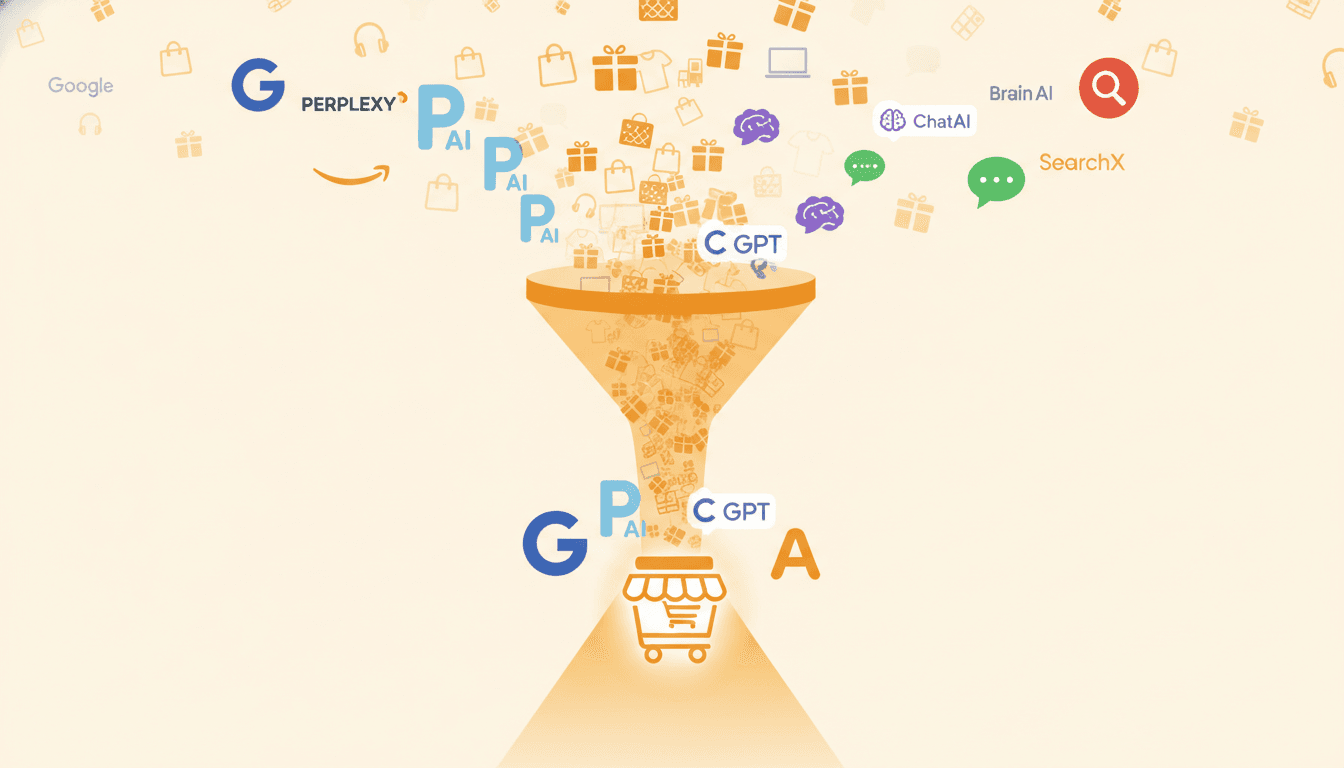
searchgooglebrands
The Complete Beginner's Guide to Understanding AI Search Engines vs Traditional Google Search
The search landscape is undergoing its most significant transformation since Google launched. AI-powered answer engines are reshaping how consumers discover products—and most e-commerce brands aren't ready. Here's everything you need to know.
15 min read
---


# The Complete Beginner's Guide to Understanding AI Search Engines vs Traditional Google Search

*The search landscape is undergoing its most significant transformation since Google launched. AI-powered answer engines are reshaping how consumers discover products—and most e-commerce brands aren't ready. Here's everything brands need to know.*

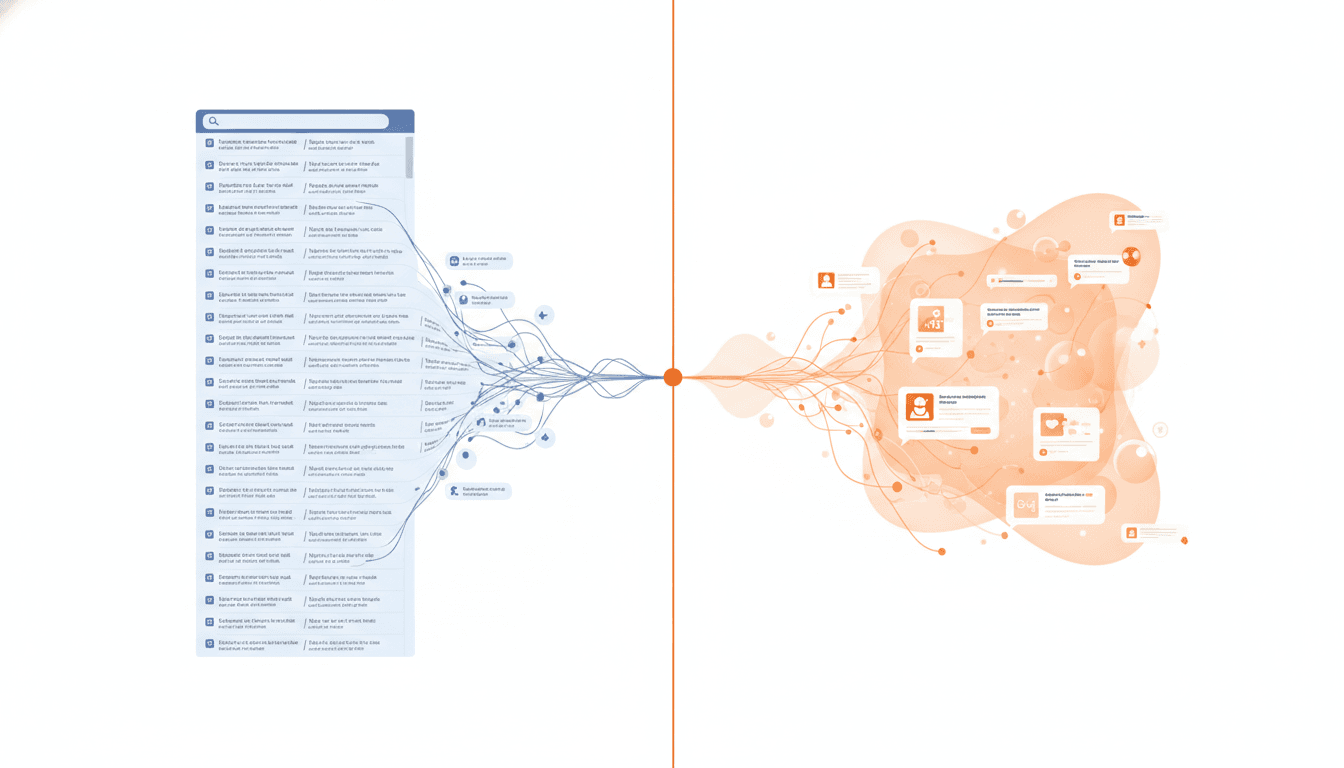
[IMG: Split-screen visual showing a person using ChatGPT on one side and traditional Google search on the other, symbolizing the shift in consumer search behavior]

## The Shift Is Happening Now

Six months ago, a consumer named Sarah wanted to buy wireless headphones. She opened Google, scrolled through ten blue links, and clicked through five product pages before making a decision. Today, she opens ChatGPT, asks for a recommendation, and receives a synthesized answer with three specific models—complete with reasons why—in under 30 seconds.

This isn't a minor shift in user behavior. It's a fundamental restructuring of how millions of people discover and buy products.

According to [Gartner](https://www.gartner.com/en/newsroom/press-releases/2024-02-19-gartner-predicts-search-engine-volume-will-drop-25-percent-by-2026-due-to-ai-chatbots-and-other-virtual-agents), traditional search engine volume will drop by 25% by 2026 as AI chatbots take over. That's not a distant projection—it's a business reality unfolding within current planning cycles. If an e-commerce brand isn't visible in AI search results, it's about to become invisible to a rapidly growing audience.

This guide explains why this shift matters, how AI search works differently from Google, and what brands should do about it.


---


## What Is an AI Search Engine? (And How Is It Different from Google?)

To understand the disruption ahead, brands need to grasp how AI search engines fundamentally differ from traditional search.

**Traditional Google Search** operates on a crawl-index-rank model. [Googlebot crawls web pages](https://developers.google.com/search/docs/fundamentals/how-search-works), indexes their content, and ranks them using over 200 signals including PageRank, relevance, and user engagement. The result is the familiar "ten blue links"—a ranked list of pages that users must then evaluate and click through individually.

**AI search engines work differently.** Platforms like ChatGPT, Perplexity, Claude, Google AI Overviews, and Bing Copilot don't return a ranked list of documents. Instead, they synthesize original answers by pulling from multiple sources and presenting them as a single, coherent response.

This architecture—known as **Retrieval-Augmented Generation (RAG)**—retrieves live web content at query time and feeds it into a large language model to generate a cited, conversational answer. The user experience difference is striking: AI search feels more conversational, faster, and more tailored to the specific question being asked.

According to [eMarketer](https://www.emarketer.com/), **13% of U.S. adults now use AI chatbots as their primary search tool for product research**—a number that was negligible just two years ago. Meanwhile, [BrightEdge research](https://www.brightedge.com/) confirms that Google AI Overviews now appear in **47% of all Google search results**, making AI-generated answers the dominant format for a large portion of commercial searches.

Here's the core distinction:

- **Google:** Returns documents and lets users decide
- **AI search engines:** Return decisions, synthesized from multiple sources
- **The implication:** AI search is an *answer engine*, not a search engine—and that changes everything for product discovery

As [Aravind Srinivas, CEO of Perplexity AI](https://www.perplexity.ai/), put it: "Brands are moving from a world where search engines return documents to a world where AI returns decisions. For e-commerce, that's a profound difference—because a decision is the last step before a purchase."


---


## The Five Major AI Search Platforms: A Comparison

Not all AI search platforms are built the same. Each has distinct data sources, citation behavior, and relevance to e-commerce product discovery.

[IMG: Comparison table graphic showing ChatGPT, Perplexity, Claude, Google AI Overviews, and Bing Copilot across key dimensions]

| Platform | Data Sources | Citations | Shopping Integration | Best For |
|---|---|---|---|---|
| **ChatGPT** | Training data + web browsing | Limited | Launched 2024 | Broad consumer discovery |
| **Perplexity** | Real-time web (RAG) | Strong | Perplexity Shopping (2024) | Research-driven buyers |
| **Claude** | Training data + web browsing | Moderate | Limited | Enterprise/B2B queries |
| **Google AI Overviews** | Google index + Knowledge Graph | Moderate | Strong (Google Shopping) | High-intent commercial searches |
| **Bing Copilot** | Bing index + Microsoft ecosystem | Strong | Moderate | B2B and Microsoft users |

**Perplexity AI** is the most significant growth story in this space. The platform grew from 10 million to **100 million monthly active users in a single year** (2023–2024), according to statements from CEO Aravind Srinivas. That 10x growth trajectory signals market acceleration that e-commerce brands cannot afford to ignore.

Each platform deserves specific attention:

- **ChatGPT** is the largest AI search platform by user base but historically lacked real-time shopping integration—a gap its 2024 Shopping feature began to close
- **Perplexity's** emphasis on citations and source transparency correlates directly with higher consumer trust and purchase intent
- **Google AI Overviews** appear in 47% of SERPs, making them impossible to ignore for any brand with an existing Google presence
- **Claude** has strong enterprise adoption but lower consumer product discovery usage—relevant for B2B e-commerce
- **Bing Copilot** integrates deeply with the Microsoft ecosystem, giving it unique advantages for B2B and professional searches


---


## How Do AI Search Engines Decide Which Products to Recommend?

Understanding the ranking signals behind AI recommendations is essential for any e-commerce brand. AI search engines evaluate products across four primary dimensions: **training data, real-time retrieval, review aggregation, and structured product data**.

**Training data** reflects what the model learned during pre-training—the vast corpus of web content ingested before the model launched. **Real-time retrieval (RAG)** is what the model pulls from the web at query time, meaning a brand's current web presence, recent press coverage, and up-to-date product pages all influence recommendations dynamically.

Both [Anthropic](https://www.anthropic.com/) and [OpenAI](https://openai.com/) have confirmed that their models now support real-time browsing, making current content quality a live ranking factor.

Review sentiment and editorial mentions are core signals. AI search engines perform sentiment analysis across review platforms, editorial content, and community discussions (including Reddit and industry forums) to assess brand authority. Consistent editorial mentions across authoritative sources improve AI visibility in ways that traditional backlink profiles don't fully capture.

Here's how the signals break down:

- **Brand mention frequency** across authoritative sources signals trustworthiness to AI models
- **Review sentiment** is analyzed across platforms—positive aggregated sentiment improves recommendation likelihood
- **Structured product data** (JSON-LD schema, product feeds) is increasingly indexed by AI search engines
- **Entity clarity**—clear, consistent product descriptions and brand identity—helps AI systems disambiguate products accurately and prevents confusion with competitors

The most important dynamic to understand is the **"winner-take-most" effect**. Unlike Google's distributed long tail of results, AI search engines typically recommend only 1–5 products in a conversational format. According to [Gartner Digital Commerce Research](https://www.gartner.com/), this means the stakes for appearing in AI results are dramatically higher than in traditional search.

Brands optimized for AI search visibility see **3–5x more mentions in AI-generated recommendations** compared to unoptimized competitors, according to [Search Engine Land case studies](https://searchengineland.com/). Here's how: the concentrated recommendation format means fewer brands get visibility, but those that do receive exponentially more traffic.


---


## The Consumer Trust Factor: Why Transparency Matters in AI Search

Consumer trust in AI recommendations isn't automatic—it's conditional and earned. A [2024 Salesforce State of the Connected Customer report](https://www.salesforce.com/resources/research-reports/state-of-the-connected-customer/) found that **58% of consumers say they would trust an AI recommendation if it provided clear reasoning** for why a product was chosen. That single finding has major strategic implications for which platforms e-commerce brands should prioritize.

The difference between platforms that cite sources (Perplexity, Google AI Overviews) and those that don't creates measurable differences in purchase intent. AI search engines that cite sources see higher conversion rates than those that simply assert recommendations without explanation. Perplexity's citation-first architecture isn't just a UX feature—it's a competitive advantage in consumer trust.

The "black box" problem is real. Consumers are increasingly skeptical of recommendations that don't explain their reasoning, and that skepticism translates directly into lower conversion rates for brands recommended without supporting evidence.

For e-commerce brands, this means:

- **Review visibility** in AI citations directly impacts brand credibility
- **Editorial mentions** from authoritative sources serve as trust signals that AI platforms surface to users
- **Transparency in AI recommendations** is becoming both a regulatory priority and a competitive differentiator
- Brands with rich, publicly available review profiles are systematically advantaged in citation-based AI platforms


---


## Why E-Commerce Brands Need to Care About AI Search Now

The numbers tell an urgent story. [Gartner's landmark 2024 prediction](https://www.gartner.com/en/newsroom/press-releases/2024-02-19-gartner-predicts-search-engine-volume-will-drop-25-percent-by-2026-due-to-ai-chatbots-and-other-virtual-agents) places a 25% drop in traditional search volume by 2026. Alan Antin, VP Analyst at Gartner, framed the urgency directly: "By 2026, we expect that 25% of traditional search queries will be handled by AI-powered assistants. This isn't a distant future scenario—brands need to be building their AI search presence now, the same way smart brands were building their Google presence in 2004."

The adoption trajectory is steep. AI search went from negligible usage in 2022 to 13% of U.S. adults using it as a primary product research tool in 2024, with that number projected to reach **24% by 2026** according to [eMarketer](https://www.emarketer.com/). Perplexity's 10x growth in a single year is not an anomaly—it's a signal of market acceleration that is moving faster than most e-commerce marketing budgets account for.

The business implication is straightforward:

- **If a brand isn't visible in AI search**, it's losing a growing share of product discovery traffic to competitors who are
- **Traditional Google SEO is necessary but no longer sufficient** as a standalone strategy
- **Early movers have a compounding advantage**—brands that build AI search visibility now will be harder to displace as adoption accelerates
- The shift is happening within current planning cycles, not in some distant future


---


## Traditional SEO Metrics vs. AI Search Signals: What's Changed?

Domain authority and backlinks don't disappear in AI search—they just get weighted differently. Traditional SEO metrics remain part of the foundation, but they are insufficient on their own for AI search visibility. The emerging discipline of **Answer Engine Optimization (AEO)** addresses the gap, focusing on making brand and product information easily synthesizable by AI models.

As [Lily Ray, VP of SEO Strategy and Research at Amsive Digital](https://www.amsive.com/), explained: "Traditional SEO optimizes for crawlers. AI search optimization requires thinking about how a language model reasons about a brand—is it consistently described as an authority? Do third-party sources corroborate its claims? That's a fundamentally different challenge."

Here's how the signal sets compare:

- **Traditional SEO priorities:** Domain authority, backlink count, keyword rankings, Core Web Vitals, HTTPS, E-E-A-T
- **AI search priorities:** Brand mention consistency, review sentiment, entity clarity, structured data richness, editorial authority, narrative consistency across Reddit, review sites, and news outlets
- **The key difference:** Google weights technical factors; AI engines weight *narrative consistency*—how authoritatively and consistently a brand is described across the open web

[IMG: Side-by-side infographic comparing traditional SEO signals vs. AEO signals for AI search visibility]

The good news is that traditional SEO and AEO are complementary, not competing strategies. Improving structured data (schema markup) benefits both Google crawling and AI indexing simultaneously. Building editorial relationships that generate authoritative mentions improves both backlink profiles and AI brand authority signals. Brands can—and should—optimize for both simultaneously.


---


## Practical Steps for E-Commerce Brands: The AI Search Optimization Checklist

Optimizing for AI search doesn't require starting from scratch. Here's how to structure the work across three time horizons:

[IMG: Three-tier checklist graphic showing quick wins, medium-term improvements, and strategic initiatives for AI search optimization]

**Quick Wins (0–30 Days)**

Start here to establish baseline visibility and make immediate improvements:

- Audit and implement **structured data (JSON-LD schema)** for all product pages—this is the fastest ROI improvement for AI search visibility
- Verify that product descriptions are clear, specific, and unambiguous (entity clarity matters for AI disambiguation)
- Claim and optimize profiles on major review platforms (Google, Trustpilot, G2, industry-specific sites)
- Run a brand mention audit: search for the brand in ChatGPT, Perplexity, and Google AI Overviews to establish a baseline

**Medium-Term Improvements (1–3 Months)**

Build on quick wins with deeper optimizations:

- Prioritize **review aggregation and sentiment optimization**—respond to reviews, address negative sentiment, and actively generate fresh positive reviews
- Implement FAQ schema across product and category pages to align with conversational AI query formats
- Audit NAP (Name, Address, Phone) consistency across all web directories and listings
- Begin tracking AI search brand mentions using specialized monitoring tools

**Strategic Initiatives (3–6 Months)**

Establish long-term competitive advantages:

- Build **editorial relationships** with authoritative publications in the category—consistent third-party mentions are a high-impact long-term signal
- Develop a content strategy targeting the specific question formats AI search engines surface for the product category
- Integrate AI search monitoring into existing SEO reporting workflows and dashboards
- Align marketing budget allocation to reflect the growing share of discovery traffic coming from AI platforms

As [Rand Fishkin, CEO of SparkToro](https://sparktoro.com/), observed: "The brands that win won't be the ones with the most backlinks—they'll be the ones that AI models have learned to trust." Building that trust is a systematic process, and the checklist above is where it starts.


---


## The Timeline: How AI Search Is Evolving (2022–2026)

The speed of AI search adoption is unlike anything the digital marketing industry has seen since the early days of Google. Understanding this timeline helps clarify why action matters now:

- **November 2022:** ChatGPT launches—reaches 100 million users in 2 months, the fastest app adoption in history
- **February 2023:** Bing AI (powered by GPT-4) launches, bringing AI search into Microsoft's ecosystem
- **March 2023:** Google Bard launches as Google's initial response to AI search competition
- **End of 2023:** Perplexity reaches 10 million monthly active users
- **May 2024:** Google rebrands SGE as **AI Overviews**, now appearing in 47% of SERPs
- **Q4 2024:** Perplexity reaches 100 million MAU (10x growth in one year); Perplexity Shopping launches
- **2024:** ChatGPT Shopping feature launches; all major AI assistants integrate product recommendations
- **2026 (projected):** AI search accounts for 25% of traditional search volume (Gartner)

[IMG: Timeline graphic showing AI search evolution milestones from 2022 to projected 2026]

Each milestone represents a shift in where product discovery traffic flows. The 2024–2026 window is the critical period for brand positioning. Looking ahead, shopping integration within AI platforms will deepen, moving AI search from a discovery tool to a full-funnel commerce platform.


---


## Common Questions About AI Search (FAQ)

**Will AI search replace Google?**

AI search will not replace Google entirely, but it will capture a significant share of product discovery queries. Gartner's 25% volume drop prediction reflects diversion, not replacement—Google itself is adapting with AI Overviews, ensuring it remains a major channel even as behavior shifts.

**How do brands know if they're visible in AI search?**

The most direct method is manual testing: query ChatGPT, Perplexity, and Google AI Overviews with product category questions relevant to the brand and note whether products appear. Specialized brand monitoring tools are also emerging that track AI search mentions at scale.

**Is AI search optimization expensive?**

Many AI search optimization tactics—structured data implementation, review management, entity clarity improvements—overlap directly with traditional SEO best practices. This makes dual optimization cost-effective, as the same investments improve visibility across both channels simultaneously.

**Can brands optimize for both traditional SEO and AI search at the same time?**

Yes—and brands should. Traditional SEO and AEO are complementary strategies. Improvements to structured data, content quality, and editorial authority benefit both Google rankings and AI search visibility. The workflows can and should be integrated into a unified strategy.

**What if an industry isn't covered by AI search yet?**

Even niche industries are being indexed by AI search engines through web scraping, training data, and real-time retrieval. The question isn't whether AI search will reach a given industry—it's when. Building AI search visibility now, before competitors do, is the lower-risk strategic position.


---


## Conclusion: The Window for Early Movers Is Open Now

The shift from traditional search to AI-powered answer engines is not a distant disruption—it's a present-day business reality. From Gartner's 25% volume drop prediction to Perplexity's 10x growth in a single year, every major data point points in the same direction. The brands that adapt early will compound their advantage; the brands that wait will find themselves optimized for a shrinking channel.

The path forward is clear. Structured data, review visibility, editorial authority, and entity clarity are the foundations of AI search optimization—and they're buildable today. Traditional SEO investments don't go to waste; they become the foundation on which AEO is layered.

**The landscape is changing fast, and early movers are already seeing 3–5x more brand mentions in AI-generated recommendations.** Brands that remain invisible in the channels where tomorrow's customers are searching risk losing competitive advantage while competitors establish dominance.


---


*Sources: [Gartner](https://www.gartner.com) | [eMarketer](https://www.emarketer.com) | [BrightEdge](https://www.brightedge.com) | [Salesforce](https://www.salesforce.com/resources/research-reports/state-of-the-connected-customer/) | [Search Engine Land](https://searchengineland.com) | [SparkToro](https://sparktoro.com) | [Perplexity AI](https://www.perplexity.ai) | [OpenAI](https://openai.com) | [Anthropic](https://www.anthropic.com)*
H
Hexagon Team
Published July 6, 2026