searchgooglebrand
AI Search vs Traditional SEO: Why Your Current E-Commerce Strategy Won't Work for Generative Engines
Your brand ranks on page one of Google—but 60% of top-ranking e-commerce pages are completely invisible to AI search engines. With 35% of product research now happening through AI assistants and $1.2 trillion in sales projected to flow through AI-assisted discovery by 2027, the gap between Google rankings and AI visibility is no longer a future problem. It's a present commercial crisis.
12 min read
---


# AI Search vs Traditional SEO: Why Current E-Commerce Strategies Won't Work for Generative Engines

*Brands rank on page one of Google—but 60% of top-ranking e-commerce pages are completely invisible to AI search engines. With 35% of product research now happening through AI assistants and $1.2 trillion in sales projected to flow through AI-assisted discovery by 2027, the gap between Google rankings and AI visibility is no longer a future problem. It's a present commercial crisis.*

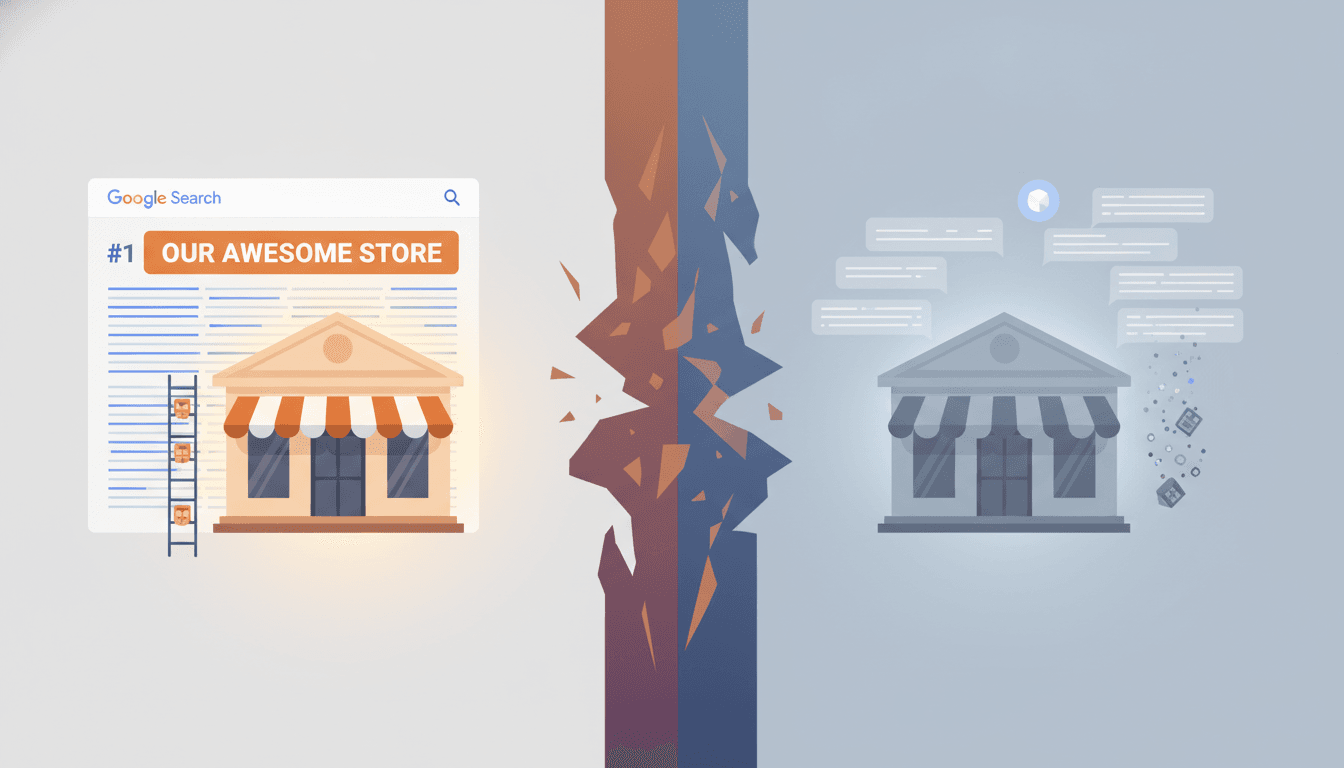
[IMG: Split-screen visualization showing a Google search results page on the left versus a ChatGPT/AI assistant recommendation panel on the right, with the same product query but different brand results appearing in each]


---


## The Uncomfortable Reality: Google Success Doesn't Translate to AI Visibility

A homepage ranks #3 on Google for "best wireless headphones." A competitor's homepage doesn't appear in Google's top 20. Yet when someone asks ChatGPT the same question, the competitor gets the recommendation—and the first brand doesn't.

This isn't a hypothetical scenario. It's happening right now across e-commerce: **60% of pages ranking in Google's top 10 for product queries are completely absent from AI-generated answers**. Meanwhile, 35% of all e-commerce product research now involves AI assistants, and shoppers who discover brands through AI recommendations show 3x higher purchase intent than those arriving through traditional organic search.

The uncomfortable truth cuts deeper: traditional SEO strategies—the ones that achieved page-one Google rankings—are almost entirely irrelevant to AI search engines. With $1.2 trillion in e-commerce sales projected to flow through AI-assisted discovery by 2027, this gap represents a problem that cannot be ignored.


---


## The Architecture Problem: Why Google Rankings Don't Equal AI Visibility

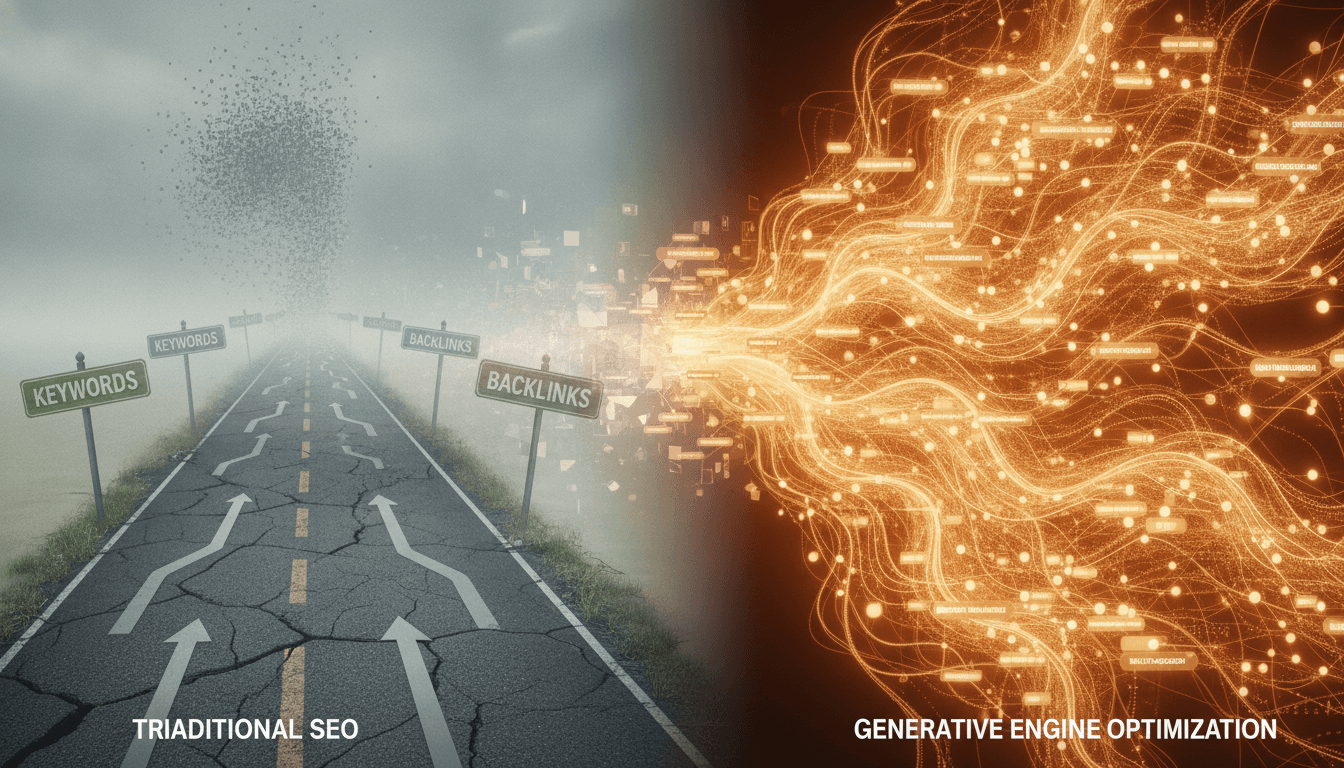
Google and AI search engines operate on fundamentally different architectures. Google crawls, indexes, and ranks individual pages based on signals like backlinks, keyword relevance, and page authority. AI engines like ChatGPT and Perplexity synthesize brand recommendations from semantic authority, training data, and real-time retrieval systems that have no direct relationship to Google's ranking algorithm.

The cornerstone of traditional SEO—backlink building—is largely irrelevant in AI search environments. According to a [Moz analysis of AI search vs. traditional SEO](https://moz.com), backlinks are not directly readable by most generative AI models during inference. This means a brand with thousands of high-authority links but weak topical content may be entirely ignored by AI assistants.

AI engines think in terms of **entities**—brands, products, and concepts—not individual pages. As the [Wharton School of Business Digital Commerce and AI Report](https://wharton.upenn.edu) notes, brand-level authority and entity recognition matter far more to AI recommendation systems than any individual page's optimization. The [Hexagon AI Search Visibility Benchmark Study](https://joinhexagon.com) confirms this disconnect: 60% of top Google results are absent from AI-generated recommendations for equivalent queries.


---


## The 60/40 Visibility Gap: What It Means for Revenue

The 60/40 visibility gap is not a rounding error—it's a structural divergence between two distinct discovery systems. Sixty percent of pages ranking #1–10 on Google for e-commerce queries don't appear in AI-generated answers, according to the [Hexagon AI Search Visibility Benchmark Study](https://joinhexagon.com). This means most brands investing in traditional SEO are building visibility in a channel that a growing segment of customers no longer uses first.

The competitive environment inside AI search is dramatically more selective. [Hexagon's Generative Engine Citation Analysis](https://joinhexagon.com) found that AI engines cite **40% fewer unique sources** per query than the number of pages Google surfaces in its top 20 results. Fewer citations mean fewer brands represented—and the brands that do appear receive disproportionate commercial attention from high-intent shoppers.

The stakes become clearer when examining who's using AI search. According to the [Salesforce State of the Connected Customer Report](https://salesforce.com), shoppers who discover a brand through an AI assistant recommendation show purchase intent rates approximately **3x higher** than those arriving via traditional organic search. Yet [Forrester Research's E-Commerce Marketing Priorities Survey](https://forrester.com) found that **72% of marketing directors** at e-commerce brands report their team has not yet developed a specific strategy for AI search visibility.

[IMG: Bar chart comparing Google top-10 visibility versus AI citation rates across major e-commerce product categories, illustrating the 60/40 gap]


---


## How AI Search Ranking Factors Differ from Traditional SEO

Understanding why AI search works differently requires understanding what AI engines actually reward. **Semantic authority and citation-worthiness** replace keyword optimization and page authority as the primary ranking signals. As [Aleyda Solis, International SEO Consultant and Founder of Orainti](https://orainti.com), explains: "The brands winning in AI search are not necessarily the ones with the highest domain authority or the most backlinks. They're the ones whose content is structured to directly answer specific questions, supported by third-party validation and rich entity data."

Structured data has transformed from a marginal ranking boost to a direct communication layer with AI engines. According to the [Semrush State of Search 2025](https://semrush.com), e-commerce brands with rich Schema.org markup, product feeds, and FAQ schemas are significantly more likely to be cited by AI engines than brands relying solely on unstructured content. Structured data helps AI engines understand, categorize, and confidently recommend a brand when a relevant query is asked.

Third-party editorial mentions and brand citations carry weight in AI search that backlinks cannot replicate. The [Content Marketing Institute's GEO Emerging Practices Report](https://contentmarketinginstitute.com) identifies a clear pattern: AI engines heavily weight third-party editorial mentions, review aggregators, and authoritative publisher citations when forming brand recommendations. This dynamic is far closer to PR and earned media than traditional link building.

Here's how this plays out in practice:

- **Entity recognition** is the primary unit of AI search optimization, not individual page rankings
- **Conversational content architecture** addresses the complex, multi-condition queries that keyword-optimized landing pages cannot answer
- **Structured data implementation** signals brand information directly to AI retrieval systems
- **Third-party validation** through reviews, media mentions, and editorial citations builds the credibility AI engines require before recommending a brand

The [Nielsen Norman Group's Conversational Search Behavior Study](https://nngroup.com) confirms that AI search users ask fundamentally different questions. Multi-step, nuanced queries like "What is the best sustainable running shoe for wide feet under $150?" require content that traditional keyword-based SEO is structurally unprepared to answer comprehensively.


---


## Why Current SEO Strategies Fail in AI Search

The tactics that built Google rankings are not just insufficient for AI search—in some cases, they actively misallocate resources. Link building campaigns, keyword density optimization, and meta tag refinement have **little to no direct influence** on whether an AI engine recommends a brand, according to the [Search Engine Journal AI Search Ranking Factors Report](https://searchenginejournal.com). Every dollar spent optimizing for Google's PageRank algorithm is a dollar not invested in the signals AI engines actually use.

Keyword-optimized landing pages present a structural problem in AI search environments. As [Andrew Ng, Founder of DeepLearning.AI](https://deeplearning.ai), frames it: "Traditional SEO optimizes for a ranking algorithm. GEO optimizes for a recommendation system. In a recommendation system, trust, comprehensiveness, and entity clarity are the currency—not keyword density or link equity." Landing pages built around keyword clusters cannot adequately answer the conversational, multi-condition queries that AI search users submit.

Here's how the tactical comparison breaks down:

| Signal Type | Google Rewards | AI Engines Reward |
|---|---|---|
| **Primary Focus** | Page-level signals, backlink profiles, keyword relevance | Brand-level entity clarity, structured data, editorial citations |
| **What's Failing** | Individual page optimization, link building campaigns, keyword density targeting | Keyword-clustered landing pages, siloed SEO strategies |
| **What's Working** | Entity management, PR-earned media, question-answering content hubs, structured data | Comprehensive Q&A content, cross-functional coordination |

The [HubSpot State of Marketing 2025](https://hubspot.com) found that brands successfully optimizing for AI search visibility have moved from keyword-clustered landing pages toward comprehensive, question-answering resource hubs. This shift requires cross-functional coordination across marketing, content, PR, and product teams that traditional SEO workflows were never designed to support.

[IMG: Side-by-side comparison table showing traditional SEO tactics versus GEO tactics, with signal types, team ownership, and impact on AI citation rates]


---


## The Urgency: 35% of E-Commerce Queries Now Involve AI—And It's Growing Fast

The window for early-mover advantage is open, but it won't stay open indefinitely. According to the [eMarketer AI Commerce Adoption Report](https://emarketer.com), **35% of e-commerce product research queries now involve an AI-assisted component**—whether through ChatGPT, Perplexity, Google AI Overviews, or AI-powered shopping assistants. This figure has more than doubled since 2023.

The financial stakes are concrete and growing. The [McKinsey Global Institute's The AI Commerce Opportunity](https://mckinsey.com) projects that global e-commerce sales influenced by AI-assisted search and recommendation engines will reach **$1.2 trillion by 2027**. Brands absent from AI recommendations are not just losing visibility—they are being structurally excluded from a growing share of high-intent purchase journeys.

The competitive landscape makes urgency even more acute. With [72% of marketing directors](https://forrester.com) reporting no specific AI search strategy, the brands that move now will face significantly less competition for AI citations than those who wait. As [Rand Fishkin, Co-founder of SparkToro](https://sparktoro.com), states: "Brands that conflate traditional SEO with Generative Engine Optimization will find themselves invisible to an increasingly large segment of their potential customers."


---


## From Siloed SEO to Cross-Functional GEO: What Teams Need to Do Now

Traditional SEO can be owned by a single team with a defined workflow. Generative Engine Optimization cannot. GEO requires coordinated action across marketing, content, PR, and product teams—because the signals AI engines use to evaluate brands are generated across all of these functions simultaneously. An SEO team working in isolation cannot build the external credibility signals, structured data infrastructure, and entity clarity that AI search visibility demands.

The interdependencies are significant and non-negotiable. PR-earned media generates the third-party editorial mentions that AI engines weight heavily. Content strategy produces the comprehensive Q&A hubs that answer conversational queries. Product and engineering teams implement the structured data markup that communicates brand information directly to AI retrieval systems.

Here's how GEO cross-functional ownership breaks down:

- **PR and Communications:** Earned media placements, editorial citations, review aggregator presence
- **Content Strategy:** Question-answering resource hubs, conversational content architecture, FAQ schema development
- **Product and Engineering:** Schema.org implementation, product feed optimization, structured data auditing
- **Brand Management:** Entity consistency across platforms, brand description standardization, knowledge panel management
- **SEO/GEO Specialists:** AI citation auditing, entity gap analysis, cross-channel visibility monitoring

[Sundar Pichai, CEO of Alphabet and Google](https://abc.xyz), has described the shift from keyword search to conversational AI search as a platform transition comparable to mobile surpassing desktop. That transition required organizational restructuring across the industry. The transition to AI search demands the same level of organizational response—not just a new checklist for the existing SEO team.

[IMG: Organizational chart showing GEO cross-functional team structure, with PR, content, product/engineering, brand management, and GEO specialists connected through a central AI visibility governance function]


---


## Action Steps: Transitioning from SEO to GEO Strategy

The path from traditional SEO to GEO begins with an honest assessment of where a brand currently stands in AI search—not where it stands on Google. Here's how e-commerce brands should approach the transition:

**Step 1: Audit AI Search Visibility**

Brands should query ChatGPT, Perplexity, and Google AI Overviews with their highest-priority product and category queries. Document which competitors are cited and which sources AI engines reference. Identify the specific queries where the brand is absent despite strong Google rankings.

**Step 2: Map Brand Entity**

Audit how the brand is described, categorized, and referenced across third-party sources. Identify inconsistencies in brand entity representation that may confuse AI retrieval systems. Prioritize knowledge panel accuracy and entity disambiguation across major platforms.

**Step 3: Inventory Structured Data**

Audit current Schema.org implementation against AI engine requirements. Identify missing product schemas, FAQ schemas, and review markup. Coordinate with product and engineering teams to close structured data gaps, as this is the direct communication channel with AI systems.

**Step 4: Build PR and Earned Media Strategy for AI Visibility**

Identify high-authority publishers and review platforms that AI engines cite frequently in the category. Develop a targeted outreach strategy to generate editorial mentions and third-party citations. Monitor and track earned media placements for their impact on AI citation rates.

**Step 5: Develop Comprehensive Question-Answering Content Hubs**

Identify the high-intent conversational queries that current content cannot answer comprehensively. Build resource hubs structured around specific questions, not keyword clusters. Implement FAQ schema markup to increase AI retrieval likelihood.

**Step 6: Establish Cross-Functional GEO Governance**

Assign clear ownership for each GEO dependency across PR, content, product, and brand teams. Create a shared GEO roadmap with defined milestones and accountability structures. Establish regular AI citation auditing as a standing business metric alongside traditional SEO reporting.


---


## The Bottom Line: AI Search Visibility Is Not Optional

Google rankings are no longer a reliable proxy for discoverability. The [Hexagon AI Search Visibility Benchmark Study](https://joinhexagon.com) makes this unambiguous: 60% of Google's top 10 results are absent from AI-generated answers for equivalent queries. The channel where 35% of e-commerce product research now happens operates by entirely different rules—and the brands that haven't adapted are already losing ground.

Looking ahead, the trajectory is clear. AI adoption in e-commerce product research has more than doubled since 2023. The $1.2 trillion in projected AI-assisted e-commerce sales by 2027 will not be distributed evenly—it will flow disproportionately to brands that have built AI search visibility while the majority of competitors remain unprepared. The 3x higher purchase intent from AI-referred shoppers means that AI search visibility is a revenue multiplier, not just a reach metric.

The brands that win in 2025 through 2027 will not be those with the most backlinks or the highest domain authority. They will be the brands that recognized AI search as a distinct discipline, restructured their teams accordingly, and built the entity clarity, structured data, and editorial credibility that generative engines require before recommending a brand.

**Next steps:** Most e-commerce brands are still operating on outdated SEO playbooks. Brands ready to audit their current AI search visibility and map a path to visibility in ChatGPT, Perplexity, and other generative engines should [book a free 30-minute strategy call with AI search specialists](https://calendly.com/ramon-joinhexagon/30min)—they'll receive a detailed analysis of exactly where the brand is missing from AI answers, and exactly how to fix it.
H
Hexagon Team
Published June 20, 2026