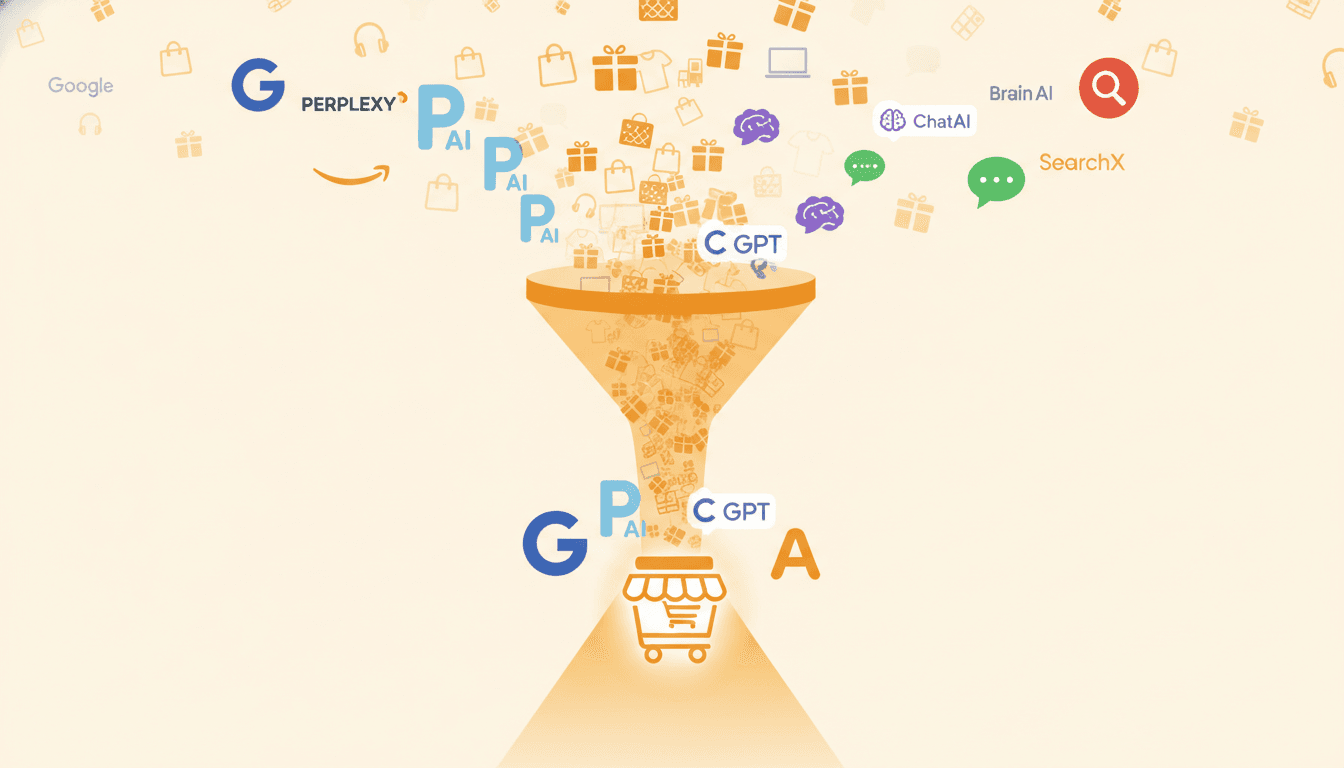
recommendationauthoritybrands
The Hidden Economics of AI Search: How Generative Recommendations Are Reshaping E-Commerce Margins in 2026
AI-recommended customers convert at 2.8x the rate of organic search visitors, arrive with a CAC 70-82% lower than paid search, and spend 34% more per order. Here's what every e-commerce CFO needs to understand about the financial model that's already reshaping competitive margins—and why every month of inaction compounds the cost.
18 min read

# The Hidden Economics of AI Search: How Generative Recommendations Are Reshaping E-Commerce Margins in 2026

*AI-recommended customers convert at 2.8x the rate of organic search visitors, arrive with a CAC 70-82% lower than paid search, and spend 34% more per order. Here's what every e-commerce CFO needs to understand about the financial model that's already reshaping competitive margins—and why every month of inaction compounds the cost.*

[IMG: Split-screen visualization showing traditional Google search funnel on the left versus AI recommendation engine funnel on the right, with conversion rate and CAC metrics overlaid, dark blue and electric teal color palette]

E-commerce margins are being reshaped by an economics that most brands don't yet understand. While brands have been optimizing for Google's algorithm, a parallel financial reality has emerged: AI-recommended customers convert at 2.8x the rate of organic search visitors, arrive with a customer acquisition cost 70-82% lower than paid search, and spend 34% more per order. But here's what keeps CFOs awake at night: every month a brand remains invisible to AI recommendation systems, it's not just losing current revenue—it's training AI models to exclude it more definitively from future recommendations.

This is the hidden economics of AI search, and 2026 is the year it stops being hidden.


---


## The Economics of AI Search Are Structurally Different From Everything Before

The financial model underlying AI recommendation commerce isn't an incremental improvement on existing channels. It's a structural reconfiguration—one that combines the best economic characteristics of three separate acquisition channels into a single, compounding advantage.

Consider the numbers. According to [Forrester Research's "The Generative Commerce Conversion Gap"](https://www.forrester.com), AI-recommended visitors convert at **2.8x the rate of traditional organic search visitors**—approaching email marketing conversion performance. Meanwhile, [Klaviyo and Shopify Partner Ecosystem data](https://www.klaviyo.com) reveals that customer acquisition cost for GEO-optimized brands runs just **$8-$14 per converted customer**, compared to $45-$78 for paid search and $22-$38 for traditional SEO.

That's a 70-82% CAC reduction at email-level conversion rates. The order value picture is equally compelling. The [BigCommerce State of E-Commerce Intelligence Report](https://www.bigcommerce.com) documents that AI-influenced purchases carry an **average order value 34% higher** than paid social-driven purchases and 19% higher than traditional organic search.

This premium exists because AI assistants are disproportionately consulted for complex, higher-consideration buying decisions. Customers are already deep in their research when they reach the recommendation. What makes this financially distinct from traditional search economics is the winner-take-most dynamic.

Traditional SEO distributes traffic across multiple ranking positions with gradual drop-off. AI recommendation economics concentrate value at the top position with dramatically steeper falloff—creating a competitive moat that early movers are already building.

**The structural advantage breaks down across four dimensions:**

- Email-level conversion rates (2.8x organic search baseline)
- Paid-search-level purchase intent and consideration completion
- Organic-search-level acquisition costs ($8-$14 CAC)
- 34% higher AOV than paid social benchmarks

This isn't a marginal improvement in channel performance. It's a new financial category—and the brands that recognize it first are building advantages that will be difficult to overcome.

[IMG: Three-column infographic comparing CAC, conversion rate, and AOV across paid search, traditional SEO, and AI recommendation channels, with AI column highlighted showing superior economics across all three metrics]


---


## The AI Invisibility Tax: Why Every Month of Absence Compounds Disadvantage

Absence from AI recommendations isn't a static revenue loss. It's an exponential one—and the mechanism behind that compounding is what makes this a CFO-level strategic issue, not just a marketing concern.

AI recommendation systems learn from engagement signals. When a brand isn't recommended, it doesn't generate the clicks, dwell time, and purchase completions that train models toward future inclusion. According to [Bain & Company's "The Compounding Cost of AI Invisibility in Retail"](https://www.bain.com), **the AI invisibility tax compounds at 28-35% annually through 2028** as AI-influenced commerce grows.

That means a brand sitting out GEO investment today isn't just missing 2026 revenue—it's building an increasingly steep hill to climb in 2027 and 2028. The position primacy data makes the financial stakes concrete. [Search Engine Land and SparkToro's AI Recommendation Share Study](https://searchengineland.com) found that **the first brand mentioned in an AI recommendation captures 61% of click-through activity**.

The second-mentioned brand captures 31%. Third position and below account for under 8% combined. This drop-off is steeper than Google's position one to two differential—meaning AI recommendation position is *more* economically consequential than traditional search ranking, not less.

The invisibility tax is quantifiable. Brands can measure it by comparing their current AI recommendation frequency against category leader benchmarks—then applying the conversion rate, CAC, and AOV differentials documented above. For most mid-market e-commerce brands, that number is significant enough to change budget allocation decisions immediately.

**The compounding mechanics are unforgiving:**

- Absence trains AI models to exclude brands more definitively over time
- Engagement signals compound exponentially, not linearly
- 28-35% annual compounding rate of competitive disadvantage through 2028
- First-mover authority signals become progressively harder to overcome
- The invisibility tax is quantifiable—and the math is unfavorable for late movers

**The strategic question isn't whether to invest in GEO. It's how much competitive ground a brand can afford to concede before doing so.**


---


## The Zero-Click Commerce Blind Spot: Why Analytics Are Hiding AI's True Revenue Impact

There's a category of AI-driven revenue that current analytics stacks cannot see—and it's larger than most brands realize. According to [Gartner's Digital Commerce Trends Report](https://www.gartner.com), **approximately 23% of AI-influenced purchase decisions result in zero-click commerce**: the consumer receives complete product information, pricing, and retailer direction within the AI response itself, makes a purchase decision, and navigates directly to checkout without ever visiting the brand's website.

Traditional analytics platforms are entirely blind to this revenue category. No session is recorded. No referral source is captured. No conversion is attributed. The purchase simply appears as direct traffic—or doesn't appear in digital analytics at all if it occurs through an AI-integrated checkout experience like Perplexity's shopping layer.

Here's how this scenario plays out: A consumer asks ChatGPT for the best standing desk under $800. The AI recommends a specific model with price, key features, and a direct retailer link. The consumer purchases immediately. That transaction generates zero data in the brand's Google Analytics account—yet it was entirely AI-influenced.

This misattribution problem creates a systematically false picture of which acquisition channels are performing. The financial consequence is strategic misallocation. CFOs reviewing channel performance data see paid search delivering attributable conversions and organic channels showing flat or declining contribution.

The rational budget response is to increase paid search spend and reduce investment in channels that appear to be underperforming. But the 23% of AI-influenced revenue that's invisible to analytics is precisely the revenue that GEO investment would amplify.

**This measurement gap distorts budget decisions:**

- 23% of AI-influenced purchases leave no trace in traditional analytics
- Revenue appears as direct traffic or is entirely unattributed
- This creates a false picture of paid vs. organic channel profitability
- Budget decisions made on incomplete data systematically under-invest in GEO
- Capturing this revenue requires custom measurement infrastructure

[IMG: Analytics dashboard mockup showing the "missing" AI-attributed revenue category as a grayed-out segment, with annotation showing 23% blind spot in traditional attribution models]


---


## AI Hallucinations as Financial Risk: The $180K-$2.4M Hidden Cost of Invisibility

The financial risk of AI recommendation systems isn't limited to missed revenue from absence. For brands that are recommended—but recommended inaccurately—there's a quantifiable liability that most finance teams haven't yet modeled.

[McKinsey & Company's "The Cost of AI Misinformation in Retail"](https://www.mckinsey.com) estimates that **AI hallucinations cost mid-market e-commerce brands between $180,000 and $2.4 million annually** in lost conversions, customer service escalations, and brand trust erosion. The most common hallucinations involve incorrect pricing, discontinued SKU references, and fabricated product features—each triggering a distinct cost cascade.

Consider the mechanics. A customer arrives expecting a price the AI quoted, finds a higher actual price, and abandons—that's a lost conversion plus a damaged trust signal. A customer purchases based on a fabricated feature description, receives a product that doesn't match expectations, and initiates a return—that's a refund, a service escalation, and a negative review that suppresses future recommendations.

This is a financial controls issue, not just a marketing concern. The risk scales directly with recommendation frequency—more visibility in AI systems means more opportunities for hallucination-driven costs. Proactive AI content accuracy management, including maintaining updated product knowledge graphs, structured pricing data, and accurate availability signals, directly reduces this liability.

Frame it this way: the cost of maintaining AI-accurate product data is a fraction of the $180K-$2.4M annual hallucination exposure it prevents.

**Hallucination costs cascade across multiple channels:**

- Incorrect pricing hallucinations drive abandonment and trust erosion
- Discontinued SKU references create customer service escalations
- Fabricated feature descriptions generate returns and negative reviews
- Hallucination risk scales with recommendation frequency
- AI content accuracy management is a measurable risk mitigation investment


---


## Position Primacy in AI: Why This Is a Winner-Take-Most Game

The economic structure of AI recommendation position is more extreme than anything traditional search has produced. [Search Engine Land and SparkToro's AI Recommendation Share Study](https://searchengineland.com) quantifies the dynamic precisely: **first-mentioned brands capture 61% of click-share; second-mentioned brands capture 31%; third position and below account for under 8% combined**.

For context, Google's position one to two click-share differential is significant but gradual. AI recommendation position creates a cliff. The drop from first to second position is a 30-percentage-point gap. The drop from second to third is a 23-percentage-point gap.

Brands in third position or lower are functionally invisible from a revenue contribution standpoint—capturing less click-share than a page-two Google result. Looking ahead, this dynamic will intensify as AI recommendation interfaces become more conversational and single-answer oriented. The financial imperative for position primacy in AI is therefore not just current—it's structural.

Brands that achieve and maintain first-mention status in their product categories will build revenue advantages that compound as AI commerce grows.

**The position economics are binary in most categories:**

- First position: 61% click-share
- Second position: 31% click-share
- Third position and below: under 8% combined
- Drop-off between positions is steeper than Google's equivalent differential
- Position primacy requires proactive authority signal investment, not reactive optimization


---


## Third-Party Authority Signals: The New Currency of AI Recommendation Algorithms

Understanding what drives AI recommendation inclusion is essential to building a GEO strategy with measurable financial returns. The answer, according to a [joint study by Ahrefs and Semrush](https://ahrefs.com), is third-party authority signals—not owned-channel content optimization.

In a blind audit of 200 product categories across ChatGPT-4o, Perplexity Pro, and Claude 3.5, **brands with Wikipedia entries, high-authority editorial coverage, and structured review data were recommended 4.2x more frequently** than brands with equivalent product quality but weaker digital authority signals. Content quality on owned channels mattered—but it was a secondary factor.

The primary driver of recommendation inclusion was the breadth and quality of authoritative third-party references to the brand. This finding inverts the traditional digital marketing playbook. Where conventional strategy prioritizes owned-channel content creation, paid distribution, and on-site optimization, the GEO playbook prioritizes earned authority accumulation.

Wikipedia presence, editorial coverage in high-authority publications, structured review data across major platforms, and citations in industry reference materials become the highest-ROI activities. For example, a brand that invests in a comprehensive Wikipedia entry, earns editorial coverage in three high-authority trade publications, and structures its review data for AI extraction will see measurably higher recommendation frequency within 90-180 days.

The [Moz and Conductor GEO Impact Study](https://moz.com) confirms that brands implementing structured GEO strategies see recommendation frequency improve by an average of **3.7x within six months**.

**Authority signals compound in influence:**

- Wikipedia presence is a primary AI recommendation inclusion signal
- High-authority editorial coverage drives 4.2x recommendation frequency multiplier
- Structured review data enables AI extraction and citation
- Owned-channel content is necessary but insufficient alone
- Authority signal ROI is measurable within 90-180 days

[IMG: Authority signal ecosystem diagram showing Wikipedia, editorial coverage, structured reviews, and product knowledge graphs as interconnected nodes feeding into AI recommendation engines including ChatGPT, Perplexity, and Claude]


---


## GEO Implementation ROI: 40-70% Revenue Uplift in 6-18 Months

The financial case for GEO investment is no longer theoretical. The [Hexagon GEO Performance Benchmark Report 2026](https://calendly.com/ramon-joinhexagon/30min) documents that **e-commerce brands implementing comprehensive GEO strategies—structured data, AI-readable content architecture, and authority signal building—achieved average revenue uplifts of 40-70% from AI-sourced traffic channels over 18-24 months** compared to pre-GEO baselines.

The timeline is faster than traditional SEO. Measurable recommendation frequency improvements typically appear within 90-180 days of structured data and authority signal implementation. Revenue impact materializes at the 6-18 month mark—roughly half the timeline of traditional SEO's 12-24 month payback period.

This acceleration exists because authority signals and structured data have immediate effects on AI recommendation algorithms, whereas Google's ranking algorithms require more time to reindex and reassess. The revenue uplift compounds because AI-sourced customers aren't just higher-value at first purchase—they exhibit higher repeat purchase rates and lower service costs, reflecting the AI's pre-completion of the consideration and comparison phase.

An analysis of 50,000+ AI product recommendations across ChatGPT, Perplexity, and Claude by [Hexagon's AI Visibility Index](https://calendly.com/ramon-joinhexagon/30min) found that fewer than **12% of e-commerce brands in any given product category appear consistently across all three platforms**—meaning 88% of brands have significant GEO upside available.

**The ROI timeline compresses significantly:**

- Structured data and authority signals drive 3.7x recommendation frequency improvement
- Measurable results appear within 90-180 days
- Revenue impact materializes at 6-18 months (faster than traditional SEO)
- 40-70% revenue uplift benchmark over 18-24 months
- Only 12% of brands currently appear consistently across all major AI platforms


---


## Lifetime Value Economics: Why AI-Sourced Customers Are 3-5x More Profitable

The revenue uplift numbers from GEO implementation become even more compelling when modeled on lifetime value rather than session revenue. AI-sourced customers are structurally more valuable across every LTV dimension—and the math changes the investment calculus significantly.

The AOV advantage is the most immediate: **34% higher than paid social-driven purchases and 19% higher than traditional organic search**, per the [BigCommerce State of E-Commerce Intelligence Report](https://www.bigcommerce.com). But the repeat purchase rate differential is where the LTV gap widens substantially.

AI-recommended customers arrive with higher product-fit confidence—the AI has already matched their stated requirements to specific products—which translates to lower return rates, higher satisfaction scores, and higher second-purchase probability. The service cost differential compounds the advantage further.

Customers who arrive pre-educated by AI recommendations require less customer service intervention, generate fewer pre-purchase inquiries, and produce fewer post-purchase escalations. When the full LTV picture is modeled—higher AOV, higher repeat purchase rate, lower service cost, and $8-$14 CAC—the **LTV-to-CAC ratio for AI-sourced customers runs 3-5x superior to paid acquisition over a 24-month period**.

**LTV advantages compound across multiple dimensions:**

- 34% higher AOV than paid social at point of acquisition
- Higher repeat purchase rates driven by superior product-fit matching
- Lower service costs due to AI pre-completion of consideration phase
- LTV-to-CAC ratio 3-5x superior to paid acquisition over 24 months
- The financial case for GEO shifts from "nice to have" to "must have" at LTV scale


---


## The Strategic Imperative: Building GEO Strategy Before Competitors Do

The window for establishing first-mover advantage in AI recommendation economics is narrowing. Early movers are already accumulating the authority signals that AI systems weight most heavily—and those signals compound over time in ways that make late-entry progressively more expensive and less effective.

The compounding nature of AI recommendation algorithms is the key strategic variable. Brands that appear consistently in recommendations generate engagement signals that reinforce future inclusion. Brands that are absent generate exclusion signals that reinforce future omission.

The [Bain & Company analysis](https://www.bain.com) projects this dynamic compounds at 28-35% annually—meaning a brand that delays GEO investment by 12 months faces a disadvantage that's 28-35% larger than the one it faces today, not the same size. Looking ahead, the position primacy data creates the most concrete urgency.

The 61% vs. 31% click-share differential between first and second position means that in most product categories, there's effectively one dominant AI-recommended brand and one marginal competitor. The brands establishing first-position authority today are building competitive moats that will be expensive to displace.

Decisions made in the next 90 days directly impact 2026-2027 profitability—the 6-18 month ROI timeline makes the math straightforward.

**The competitive timeline is accelerating:**

- Early authority signals compound into durable competitive moats
- 28-35% annual compounding rate of competitive disadvantage for late movers
- 61% vs. 31% click-share dynamic makes category position binary in most markets
- 6-18 month ROI timeline means Q1 2026 decisions impact 2027 profitability
- The strategic question is timing, not whether

[IMG: Timeline graphic showing competitive divergence between early GEO movers and late entrants from 2025-2028, with revenue gap widening exponentially over time, annotated with key milestones]


---


## Implementation Roadmap: From Strategy to Financial Impact

Building a GEO strategy that delivers measurable financial impact requires execution across four interconnected workstreams—each with a distinct timeline and ROI contribution. The sequence matters; structured data must precede authority signal building to ensure accuracy.

**Foundation: Structured Data Implementation (Days 1-90)**

Structured data is the prerequisite for AI recommendation inclusion. This means implementing comprehensive schema markup across product pages, maintaining accurate pricing and availability signals in real time, and building product knowledge graphs that AI systems can extract reliably.

Structured data errors are among the primary causes of AI hallucinations—and hallucination prevention is itself a financial ROI driver given the $180K-$2.4M annual exposure documented by McKinsey. Start with product schema, pricing schema, and review schema.

Audit existing markup for accuracy and completeness. Implement real-time inventory synchronization to prevent discontinued product hallucinations. This foundation takes 60-90 days for most mid-market brands and is non-negotiable.

**Authority Signal Building (Months 3-12)**

Wikipedia presence, editorial coverage in high-authority publications, and structured review data across major platforms are the levers that drive the 4.2x recommendation frequency multiplier. This workstream requires a 6-12 month commitment because authority signals accumulate over time—but measurable recommendation frequency improvements typically appear within 90-180 days of initial implementation.

Prioritize in this order: Wikipedia entry first (if the brand doesn't have one), then two to three high-authority editorial placements in the category, then structured review aggregation across platforms like G2, Capterra, or industry-specific review sites. Each authority signal reinforces the others, creating a compounding effect.

**AI-Readable Content Architecture (Months 1-6)**

AI systems extract product information differently than Google's crawler. Content architecture must be optimized for AI information extraction—clear, factual product descriptions, structured comparison data, and explicit feature-benefit language that AI assistants can cite accurately.

This workstream directly reduces hallucination risk and improves recommendation accuracy. Audit product pages for clarity, factual accuracy, and AI-extractable structure. Remove marketing hyperbole in favor of specific, verifiable claims.

Create structured comparison tables that AI can reference when differentiating products from competitors. This work runs parallel to structured data implementation.

**Measurement and Optimization (Ongoing)**

Capturing the full financial impact of GEO requires custom analytics infrastructure to address the 23% zero-click commerce blind spot. This means implementing direct-to-cart tracking, AI referral source tagging where available, and revenue attribution modeling that accounts for AI-influenced purchases that don't generate traditional session data.

Set up custom events in analytics platforms to track AI-sourced traffic where possible. Implement UTM parameters on AI-linked product pages. Build LTV cohort analysis comparing AI-sourced customers to other acquisition channels. This ongoing work is essential for understanding true ROI and optimizing budget allocation.

**Implementation workstreams with clear dependencies:**

- Structured data: schema markup, pricing accuracy, product knowledge graphs (Days 1-90)
- Authority signals: Wikipedia, editorial coverage, structured reviews (Months 3-12)
- AI-readable content architecture: factual, extractable, hallucination-resistant (Months 1-6)
- Custom measurement: zero-click attribution, AI referral tracking, LTV modeling (Ongoing)
- Full ROI realization: 40-70% revenue uplift benchmark at 18-24 months

[IMG: Four-quadrant implementation roadmap with timeline, showing structured data, authority signals, content architecture, and measurement workstreams on a 24-month horizon with key milestones and expected ROI inflection points marked]


---


## The Path Forward: Acting Before the Advantage Becomes Unattainable

The economics of AI search are no longer emerging—they're operative. The brands achieving 40-70% revenue uplift from GEO implementation aren't accessing a future advantage; they're capturing a present one while competitors remain invisible to the AI systems that are reshaping e-commerce margins in real time.

The compounding invisibility tax is real, measurable, and growing at 28-35% annually. The financial case for GEO investment is clear. The only remaining variable is how much competitive ground a brand is willing to concede before acting.

The 6-18 month ROI timeline means decisions made today directly impact 2026-2027 profitability. The 61% vs. 31% position primacy dynamic means there's effectively one winner per category. The 28-35% annual compounding rate means delay compounds cost exponentially, not linearly.

For CFOs, the question is straightforward: Can the organization afford not to act?
H
Hexagon Team
Published June 24, 2026