recommendationbrandrecommendations
How AI Search Engines Decide Which Products to Recommend: The 2026 Algorithm Breakdown
When a customer asks an AI assistant which product to buy, your brand either appears in the answer—or it doesn't. This guide reverse-engineers the multi-factor recommendation algorithm that determines which products win in AI search, and what marketing teams need to do right now to be among them.
18 min read

placeholders exactly as written" ]
---


# How AI Search Engines Decide Which Products to Recommend: The 2026 Algorithm Breakdown

*When a customer asks an AI assistant which product to buy, a brand either appears in the answer—or it doesn't. This guide reverse-engineers the multi-factor recommendation algorithm that determines which products win in AI search, and what marketing teams need to do right now to be among them.*

[IMG: Split-screen visual showing a customer asking ChatGPT for a product recommendation on one side, and a brand appearing vs. disappearing from results on the other]


---


## Why AI Product Recommendations Matter More Than Traditional Search Results

When a customer asks ChatGPT, "What's the best project management tool for remote teams?", a product either appears in the answer—or it doesn't. That decision isn't made by a paid algorithm. It's made by a multi-factor system that weighs brand authority, trust signals, community sentiment, and technical visibility in ways most marketing teams don't yet understand.

The numbers tell a compelling story. In 2026, **62% of consumers** who use AI assistants for product research are actually purchasing—or seriously considering purchasing—based on those recommendations, up from just 38% in 2023, according to the [Salesforce State of the Connected Customer Report](https://www.salesforce.com/resources/research-reports/state-of-the-connected-customer/). Yet 58% of marketing directors still have no strategy to influence them, despite 71% acknowledging that AI already shapes their customers' purchase decisions, per the [Gartner CMO Spend & Strategy Survey](https://www.gartner.com/en/marketing/research/cmo-spend-survey).

This disconnect represents both a crisis and an opportunity. The brands that understand how AI recommendation algorithms actually work will establish dominance before the market saturates. The window for first-mover advantage is closing rapidly.

Here's what makes this shift so critical:

- AI recommendations drive a **62% conversion consideration rate**—higher than most paid channels
- The shift from "search results" to "trusted recommendations" fundamentally changes buyer psychology
- AI recommendations bypass traditional ad spend and paid placement mechanisms entirely
- **71% of marketing directors** acknowledge AI's influence, but only 42% have an active strategy to address it


---


## The Multi-Factor Algorithm: What Actually Drives AI Recommendations

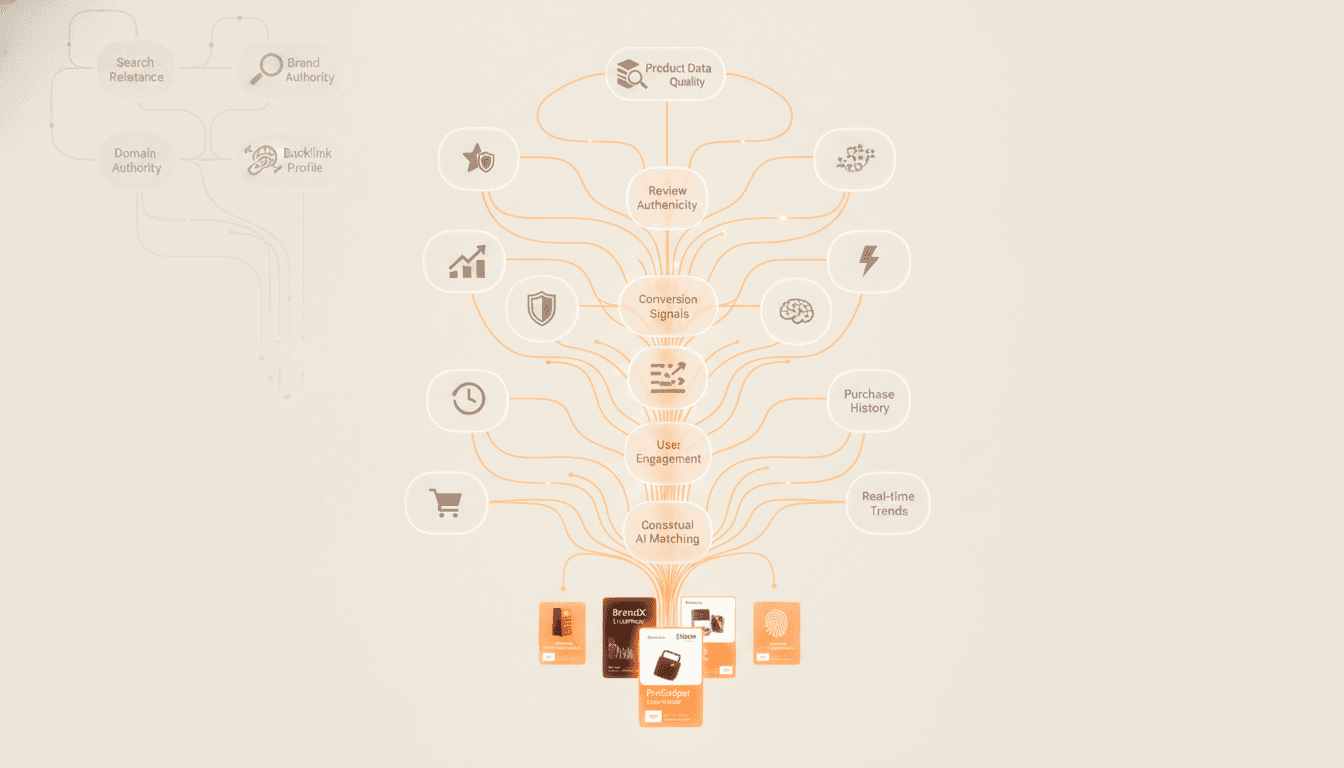
The first misconception most marketing teams need to abandon is that AI product recommendations operate on a single ranking factor. They don't. The algorithm combines six primary signal clusters, each contributing differently to whether a brand surfaces in a recommendation.

Understanding how these signals interact is what separates brands that consistently appear from those that remain statistically invisible. According to [Hexagon's AI Search Ranking Report](https://joinhexagon.com), **E-E-A-T signals account for approximately 40% of AI recommendation weight in 2026**, making trust architecture the single largest factor cluster. The remaining weight distributes across training data exposure, retrieval-augmented generation (RAG) freshness, third-party citations, community sentiment, and structured data implementation.

No single factor guarantees recommendation—it's the combination and reinforcement of all six that creates consistent visibility. Lily Ray, VP of SEO Strategy & Research at Amsive, frames it this way: "Large language models don't have opinions—they have patterns. When a model recommends a product, it's reflecting the aggregate signal of everything it has been trained on and retrieved."

If a brand doesn't appear in the authoritative, high-trust corners of the internet, it becomes statistically invisible to these systems, regardless of how good the product actually is. The six primary signal clusters are:

- **E-E-A-T signals** — Expertise, Experience, Authoritativeness, Trustworthiness (~40% weight)
- **Training data exposure** — Presence in authoritative, heavily-indexed publications
- **RAG pipeline freshness** — Recency and authority of currently indexed content
- **Third-party citations** — Editorial mentions and earned media placements
- **Community sentiment** — Reddit, Quora, Trustpilot, Amazon review signals
- **Structured data** — Schema markup enabling accurate entity recognition

[IMG: Hexagonal diagram showing the six AI recommendation signal clusters with approximate weighting percentages]


---


## Factor 1: Brand Authority & Editorial Presence (40% Weight: E-E-A-T Signals)

E-E-A-T—Expertise, Experience, Authoritativeness, and Trustworthiness—is the single largest factor cluster in AI recommendation systems, accounting for an estimated 40% of recommendation weight in 2026. Originally developed by Google for human search quality raters, this framework has become the de facto proxy for how AI models evaluate content credibility.

Here's the critical distinction: authority is built through earned media, not owned channels. This fundamentally changes where marketing investment should flow. The data is striking: brands cited in three or more authoritative third-party publications are **4.7x more likely** to receive an unprompted AI product recommendation, according to [Hexagon's analysis of 100,000 AI citations](https://joinhexagon.com) across ChatGPT, Perplexity, Claude, and Gemini.

More specifically, **78% of products recommended by ChatGPT** in "best [product category]" queries appeared in at least one Wirecutter, Forbes Advisor, or similarly authoritative editorial list. This isn't coincidence—editorial "best of" lists disproportionately influence AI training data because these publications are heavily weighted in LLM training corpora.

Rand Fishkin, Co-founder & CEO of SparkToro, puts it plainly: "The brands winning in AI search aren't necessarily the ones with the biggest ad budgets—they're the ones that have built genuine authority across the web." When an AI model has seen a brand consistently praised by credible sources, mentioned in expert guides, and validated by real user communities, it treats that brand as the default answer.

Building E-E-A-T authority requires a systematic approach:

- **Prioritize PR placements** in publications heavily represented in AI training data—Wirecutter, Forbes Advisor, TechRadar, Good Housekeeping
- **Pursue expert authorship** opportunities, including bylines, expert quotes, and co-authored content with recognized industry voices
- **Build authority backlinks** from credible editorial sources, which carry more weight than direct brand mentions
- **Create a strategic PR calendar** tied to product launches and category trend cycles to maximize editorial timing

PR and content partnerships with authoritative publishers should be treated as strategic priorities, not optional marketing extras. A single placement in Wirecutter or Forbes Advisor can influence recommendations across multiple AI platforms simultaneously—making the ROI calculation dramatically different from traditional PR measurement.


---


**Transform understanding of AI visibility into action. An AI Visibility Audit analyzes a brand's recommendation potential across ChatGPT, Perplexity, and Claude—identifying the specific authority gaps, schema opportunities, and community signals that are costing recommendations today. [Book a 30-minute session with the AI strategy team](https://calendly.com/ramon-joinhexagon/30min) to see competitive position and get a personalized roadmap.**


---


## Factor 2: Customer Reviews & Community Sentiment (Real-Time Trust Signals)

Third-party review platforms function as real-time trust signals that AI systems actively monitor and incorporate into their recommendations. This is where many brands unknowingly suppress their own visibility. AI systems, including Perplexity's product recommendation layer, explicitly surface review aggregates from Reddit, Trustpilot, Amazon, and Quora to inform their generative summaries, according to [Perplexity AI's product documentation](https://www.perplexity.ai).

The implication is direct: what customers say about a brand on third-party platforms is now a technical input to an algorithm. Negative sentiment clusters are particularly damaging—brands with recurring complaints on Reddit threads or review platforms can have recommendations actively suppressed, as models are designed to avoid recommending products associated with widespread user dissatisfaction, per [Hexagon's AI Citation Analysis](https://joinhexagon.com).

This can occur even when a brand's authority signals are otherwise strong—meaning strong PR presence cannot fully compensate for a toxic review environment. Why does community sentiment carry such weight? User-generated content has structural AI visibility advantages because LLMs are extensively trained on community platforms.

[SparkToro's AI Training Data & Brand Visibility Study](https://sparktoro.com) confirms that Reddit, Quora, and niche community forums have emerged as high-weight signals precisely because models treat peer consensus as a trust proxy. When potential customers see a brand discussed authentically by real users, AI systems recognize that as a stronger signal than any marketing message.

To strengthen community sentiment profile:

- **Maintain complete, verified review profiles** on Trustpilot, G2, Capterra, and Amazon to increase recommendation frequency
- **Monitor Reddit and Quora** for brand sentiment clusters and engage proactively with community concerns
- **Respond to negative reviews** systematically—AI systems recognize engagement patterns alongside raw sentiment scores
- **Encourage authentic reviews** from satisfied customers across multiple platforms, not just one
- Understand that community presence is now a **prerequisite for AI visibility**, not a nice-to-have

[IMG: Dashboard screenshot mockup showing brand sentiment monitoring across Reddit, Trustpilot, and Amazon with AI recommendation correlation metrics]


---


## Factor 3: Structured Data & Technical Visibility (3x Multiplier Effect)

Structured data is the most immediately actionable factor in AI recommendation optimization—and the most commonly overlooked by marketing teams. Brands with complete structured data markup (Product, Review, and FAQ schema) receive **3x higher AI recommendation frequency** compared to brands with equivalent domain authority but no schema implementation, according to a [Moz/Schema & AI Visibility Report](https://moz.com) analyzing 5,000 e-commerce brands.

Schema markup enables AI systems to accurately understand product attributes, pricing, availability, and verified reviews. Without it, a brand's identity becomes ambiguous to entity recognition systems. This matters because AI recommendation engines use entity recognition to build a "brand knowledge graph," associating a brand with specific product categories, use cases, and quality tiers.

Brands with inconsistent or thin online descriptions suffer from entity ambiguity, reducing recommendation frequency regardless of other signals, as noted by [Search Engine Land's Structured Data & AI Search Report](https://searchengineland.com). Missing schema creates a technical visibility ceiling that no amount of authority can fully overcome.

The good news? Schema implementation is relatively low-cost compared to other optimization efforts, making it the highest ROI starting point for most brands:

- **Implement Product schema** with complete attributes: name, description, SKU, pricing, availability, and brand
- **Add Review schema** to aggregate and display verified customer ratings in a machine-readable format
- **Deploy FAQ schema** on key product and category pages to capture conversational query intent
- **Validate implementation** using Google's Rich Results Test and Schema.org validators regularly


---


## Factor 4: Context-Specific Positioning & Query Intent Matching

AI engines don't recommend a single "best" brand for an entire product category—they recommend different brands for different query intents within that category. A query for "best CRM for startups" triggers entirely different recommendations than "best CRM for enterprise," according to [BrightEdge's Generative AI Search Study](https://www.brightedge.com).

One-size-fits-all positioning is one of the most common and costly mistakes brands make when optimizing for AI visibility. Brands that create targeted content addressing specific use cases rank measurably higher for those intents. Long-tail intent positioning is less competitive but equally valuable in AI recommendations—and it's where many mid-market brands can realistically compete with category leaders.

This requires mapping customer intent clusters first, then building dedicated content around each one. Here's how a project management software brand might structure its positioning:

- **Remote teams** ("best project management tool for distributed teams")
- **Agencies** ("best client project management software for agencies")
- **Enterprise** ("enterprise-grade project management with SSO and compliance features")
- **Solopreneurs** ("simple project management for freelancers")

Each intent triggers a different recommendation set. Brands that own one or two intent clusters with deep, authoritative content will consistently outperform brands with broad, shallow positioning across all of them. This is a strategic choice, not a limitation—focus beats breadth in AI recommendations.

[IMG: Intent mapping diagram showing how the same product category generates different AI recommendations for different query intents]


---


## Factor 5: Retrieval-Augmented Generation (RAG) & Training Data Freshness

AI search engines do not crawl the web in real time for most product recommendations. Instead, they draw on a combination of pre-trained knowledge, retrieval-augmented generation (RAG) pipelines, and indexed web content, meaning a brand's historical digital footprint is as important as its current presence, per [Anthropic's technical documentation](https://www.anthropic.com) and [OpenAI's research blog](https://openai.com/research).

RAG systems prioritize recent, authoritative content in recommendation generation—which is why brands featured in recently published "best of" lists receive immediate recommendation boosts. Training data freshness matters particularly in fast-moving sectors. [Search Engine Journal's Generative AI Ranking Factors report](https://www.searchenginejournal.com) confirms that AI search engines apply recency weighting in categories like consumer electronics and software, meaning old authority signals decay if not reinforced with current citations.

This creates an interesting dynamic: newer brands can compete with legacy players if they move quickly to establish authoritative, indexed content. Strategic PR timing becomes increasingly important in this context:

- **Time PR campaigns** around product launches to leverage RAG freshness windows
- **Pursue "best of [year]" editorial placements** as these carry strong recency signals
- **Refresh existing content** on authoritative platforms rather than only creating new assets
- **Monitor training data cutoffs** for major AI platforms to understand when new content becomes incorporated


---


## The Authority Multiplier: Why PR & Earned Media Are Now Essential

PR has traditionally been treated as a brand-building exercise with soft, difficult-to-measure ROI. In 2026, that framing is obsolete. Earned media placement in authoritative publications now creates exponential recommendation advantages—and the ROI is directly measurable through AI recommendation tracking.

Brands with consistent presence in authoritative publications receive **4.7x higher recommendation odds**, and a single placement in Wirecutter or Forbes Advisor can influence recommendations across multiple AI platforms simultaneously. Amanda Natividad, VP of Marketing at SparkToro, articulates the strategic shift: "Brand reputation isn't just a marketing KPI—it's a technical input to an algorithm."

The review sentiment on Reddit, the citations in industry publications, the consistency of product descriptions across the web—all of it feeds into whether an AI recommends one brand or a competitor. CMOs need to start thinking like knowledge graph engineers.

This requires integrating PR strategy with product and content strategy, not siloing it as a separate communications function. Editorial partnerships should specifically target publications that are heavily represented in AI training data—not just those with high human readership.

- **Map target publications** against known AI training data sources (Wirecutter, Forbes, MIT Technology Review, TechCrunch)
- **Build journalist relationships** with writers who cover "best of" and buyer's guide content in the category
- **Align PR timing** with product updates and category trend cycles for maximum training data freshness
- **Track AI recommendation changes** following major PR placements to build direct attribution models


---


## What This Means for Marketing Strategy: The AI Visibility Roadmap

With 58% of marketing directors lacking a dedicated AI visibility strategy, the first-mover advantage is significant—but the window is narrowing. The encouraging news is that AI visibility optimization integrates naturally with existing marketing efforts rather than requiring a separate, parallel initiative.

**Immediate actions (0–30 days):**

- Audit and implement Product, Review, and FAQ schema markup across all key product pages
- Claim and complete brand profiles on Trustpilot, G2, Reddit, and Amazon
- Run manual recommendation tests on ChatGPT, Perplexity, and Claude for top 10 target queries
- Benchmark current AI recommendation position against 3–5 key competitors

**Medium-term actions (30–90 days):**

- Launch a targeted earned media campaign focused on authoritative "best of" publications in the category
- Map customer intent clusters and create dedicated landing pages for each priority use case
- Implement a systematic review generation and response program across all platforms
- Begin tracking AI recommendation frequency as a standalone marketing KPI

**Long-term actions (90+ days):**

- Build sustained community presence on Reddit and Quora through genuine engagement, not promotional content
- Establish expert authorship credentials through bylines, podcast appearances, and industry conference presence
- Develop a PR calendar tied to product roadmap milestones and category trend cycles
- Create an attribution model connecting AI recommendations to downstream conversions

Earned media strategy should be data-driven and tied to specific recommendation tracking from the outset—not measured by impressions or reach alone.


---


**Transform understanding of AI visibility into action. An AI Visibility Audit analyzes a brand's recommendation potential across ChatGPT, Perplexity, and Claude—identifying the specific authority gaps, schema opportunities, and community signals that are costing recommendations today. [Book a 30-minute session with the AI strategy team](https://calendly.com/ramon-joinhexagon/30min) to see competitive position and get a personalized roadmap.**


---


## Common Misconceptions About AI Recommendations (And Why They're Costing You)

Several persistent misconceptions are causing marketing teams to invest in the wrong places—or worse, to engage in tactics that actively harm their AI recommendation standing. Understanding what doesn't work is as important as understanding what does.

**Myth 1: AI recommendations can be "gamed" like traditional SEO.**

Reality: Attempts to manipulate recommendations through keyword stuffing, review manipulation, or artificial link schemes are detected and penalized. AI recommendation systems are consensus engines, not keyword-matching systems—they surface what the most trusted, most repeated sources agree upon. Manipulation tactics backfire.

**Myth 2: Paid placement influences AI product recommendations.**

Reality: AI recommendations are based on algorithmic trust signals, not ad spend or paid placement. Unlike traditional search, there is no sponsored slot in a ChatGPT recommendation. Brands that invest in paid search expecting it to lift AI visibility will find no correlation between the two channels.

**Myth 3: A brand's website content is the primary ranking factor.**

Reality: AI recommendations are heavily weighted toward third-party authority, not owned content. A brand's website is one signal among many—and a relatively weak one compared to editorial citations and community sentiment. The [MIT Technology Review's AI Search Behavior Study](https://www.technologyreview.com) confirms that editorial "best of" lists from high-authority publishers are disproportionately represented in AI recommendations.

**Myth 4: AI recommendations are purely algorithmic with no editorial influence.**

Reality: Editorial training data from publications like Wirecutter and Forbes Advisor has outsized influence on recommendations precisely because human editorial judgment is baked into the training corpus. The algorithm reflects human editorial consensus at scale—it's not independent of editorial influence.

[IMG: Myth vs. reality comparison graphic showing the four common misconceptions alongside the actual algorithmic reality]


---


## Tracking AI Visibility: Metrics That Matter in 2026

Measurement is where many AI visibility strategies fall short—not because the data doesn't exist, but because teams haven't yet built the tracking infrastructure. Tools like Semrush, Moz, and Ahrefs are actively adding AI recommendation tracking capabilities, making systematic measurement increasingly accessible.

Manual tracking of ChatGPT, Perplexity, and Claude recommendations for key queries remains essential in the interim. Focus on these core metrics:

- **AI recommendation frequency** — How often does a brand appear for target queries across ChatGPT, Perplexity, and Claude?
- **Editorial citation count** — How many authoritative third-party publications mention a brand in "best of" contexts?
- **Review sentiment score** — What is the aggregate sentiment across Reddit, Trustpilot, G2, and Amazon?
- **Schema implementation completeness** — What percentage of product pages have complete, validated structured data?
- **Competitive recommendation gap** — How often are competitors recommended instead of a brand for target queries?

Attribution modeling should connect AI recommendations to downstream conversions—tracking whether customers who cite AI assistants as a discovery channel convert at higher rates. (Spoiler: they do, at 62%.) Competitive benchmarking against 3–5 key competitors helps identify the specific gaps that represent the highest-priority optimization opportunities.


---


## The 2026 AI Visibility Competitive Advantage

The Hexagon Research Team's core finding from their 100,000-citation study frames the opportunity clearly: "AI recommendation systems are, at their core, consensus engines. They surface what the most trusted, most repeated sources agree upon." That means the path to AI visibility is the same as the path to genuine brand authority—except now the stakes are much higher and the feedback loop is much faster.

With 58% of marketing directors lacking an AI visibility strategy, the competitive landscape remains wide open for brands that move now. Brands that establish authority today will benefit from compounding effects as AI search continues to grow as a primary discovery channel.

The cost of entry is measurably lower now than it will be in 12–24 months when competitors catch up and the market for authoritative editorial placements becomes more competitive. Sustainable competitive advantage comes from earned authority, not temporary tactics. The brands that will dominate AI recommendations in 2027 and beyond are those building genuine trust architecture today—through editorial presence, community engagement, technical visibility, and consistent quality signals across every platform where AI systems look.


---


## Conclusion: The Window Is Open—But Not for Long

The AI recommendation algorithm is not a black box that brands must simply hope to appear in. It is a multi-factor system with identifiable, addressable signals—E-E-A-T authority, community sentiment, structured data, intent-specific positioning, RAG freshness, and earned media presence.

Each of these signals is buildable. Each represents a lever that marketing teams can pull with the right strategy and execution. The commercial stakes are real: 62% of consumers who use AI for product research are converting based on those recommendations.

The competitive gap is real: 58% of marketing directors have no strategy to address it. And the first-mover advantage is real—but it has a shelf life. The brands that understand these signals now will establish recommendation dominance before the market saturates. The time to act is not next quarter or next year. It's today.

**Transform understanding of AI visibility into action. An AI Visibility Audit analyzes a brand's recommendation potential across ChatGPT, Perplexity, and Claude—identifying the specific authority gaps, schema opportunities, and community signals that are costing recommendations today. [Book a 30-minute session with the AI strategy team](https://calendly.com/ramon-joinhexagon/30min) to see competitive position and get a personalized roadmap.**
H
Hexagon Team
Published July 11, 2026