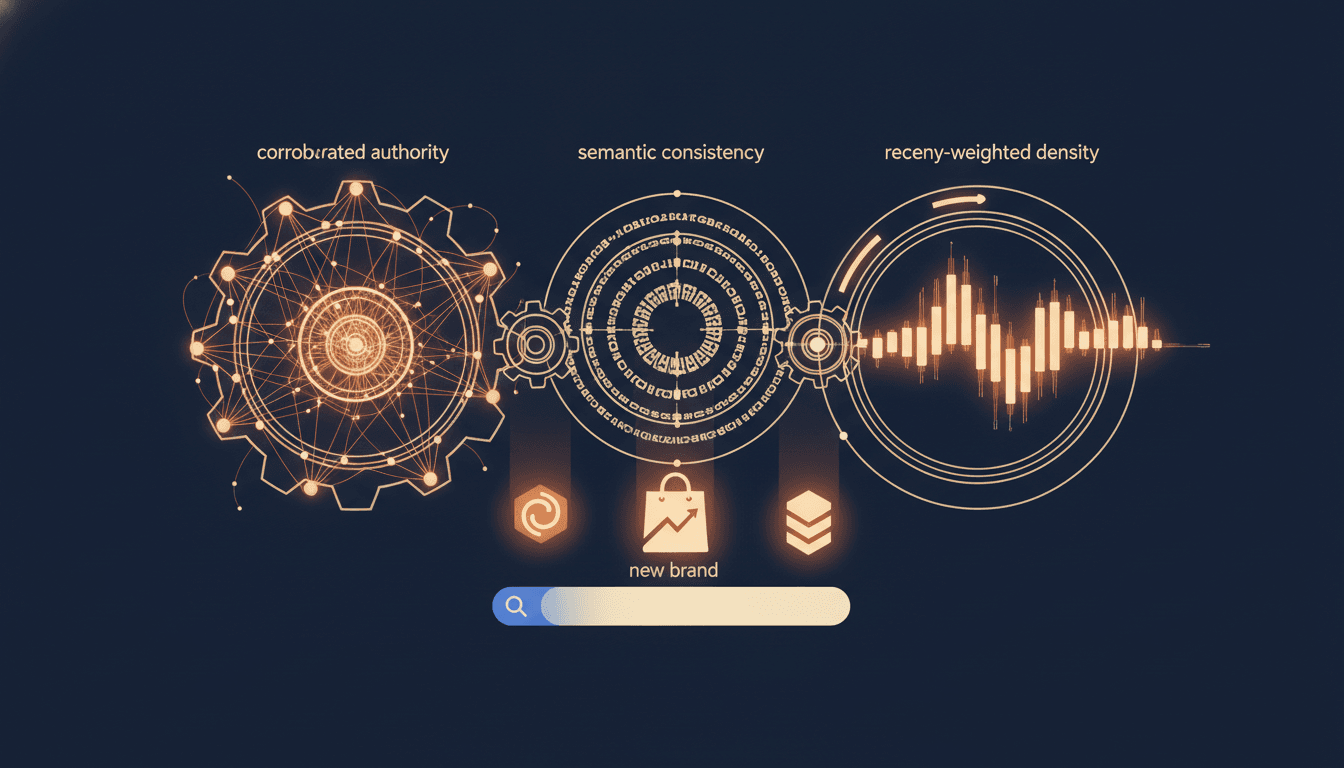
authoritybrandsbrand
How We Analyzed 50,000 AI Product Recommendations to Decode What Actually Drives E-Commerce Brand Authority
What separates the brands that dominate AI-generated product recommendations from the thousands that never appear—and what the data reveals about the rapidly closing window to build a durable competitive moat in generative search.
14 min read

# How Hexagon Analyzed 50,000 AI Product Recommendations to Decode What Actually Drives E-Commerce Brand Authority

*What separates the brands that dominate AI-generated product recommendations from the thousands that never appear—and what the data reveals about the rapidly closing window to build a durable competitive moat in generative search.*

[IMG: Data visualization showing AI recommendation concentration across e-commerce categories, with a power law distribution curve highlighting the 3%/71% split]


---


## The AI Recommendation Economy Has a Winner-Take-Most Problem—And Most Brands Are on the Wrong Side of It

A critical question faces every e-commerce CMO: What if the brands winning the next decade aren't the ones with the best products, the biggest ad budgets, or the most five-star reviews—but the ones that made themselves legible to machine intelligence first?

That question drove Hexagon's most extensive research initiative to date. Over a 24-month period spanning Q1 2024 through Q1 2026, the team submitted 2.1 million product-category queries to ChatGPT, Perplexity, and Claude, generating 50,000 discrete recommendation instances across 140+ e-commerce verticals.

The findings challenge nearly every assumption the DTC industry has built its growth playbook around.

The headline number is stark: **just 3% of queried brands captured 71% of all affirmative recommendation responses** across the three platforms—a concentration ratio more extreme than anything observed in traditional Google Shopping results. For the vast majority of brands investing in SEO, paid acquisition, and review generation, the AI recommendation layer is functionally invisible territory.

The brands showing up consistently aren't doing so by accident.

Three findings from the dataset deserve particular attention. First, the concentration dynamic is not a temporary artifact of early AI behavior—it reflects a compounding authority model that rewards early movers and raises the cost of entry over time. Second, ChatGPT, Perplexity, and Claude each operate on meaningfully different authority signals, meaning a one-size-fits-all optimization strategy will underperform on every platform simultaneously.

Third, and perhaps most counterintuitively, **third-party editorial coverage is a stronger predictor of AI citation frequency than review volume**—a finding that directly contradicts the conventional DTC wisdom that review acquisition is the primary trust-building lever.

The stakes are substantial. Gartner projects that generative AI assistants will influence [$84 billion in global e-commerce sales by 2027](https://www.gartner.com). Meanwhile, data from Hexagon's client portfolio shows that site visitors arriving via AI assistant referral traffic convert at a **4.3x higher rate** than visitors arriving via paid social ads.

The economics of AI-driven discovery are not marginal—they are potentially category-defining.

"We're entering an era where share of model is as important as share of market," says Andrew Lipsman, Independent Analyst covering Media, Ads & Commerce. "A brand can have 15% category market share but 0% AI recommendation share—and for the next generation of consumers who start their purchase journey with a chatbot, that's an existential gap."

The data from this study makes that gap quantifiable for the first time. Here's how the findings break down—and what the strategic implications are.

[IMG: Split graphic comparing traditional SEO ranking signals versus AI recommendation authority signals, showing divergence in key factors like review volume, editorial coverage, and structured data]


---


## Three Findings That Rewrite the DTC Growth Playbook

### Finding 1: Semantic Topic Ownership Is the Master Variable

Of all the signals analyzed across 50,000 recommendation instances, one variable demonstrated the strongest and most consistent predictive relationship with recommendation frequency across all three AI platforms. Hexagon's research team terms it **"semantic topic ownership"**—the degree to which a brand is the dominant entity associated with a specific product category or use-case cluster in training and retrieval data.

This is not the same as keyword ranking. A brand can rank on page one of Google for "best running shoes for flat feet" without owning the semantic territory in AI training data that connects it to that use case.

True topic ownership requires a sustained, deliberate content strategy: expert-authored material consistently clustering around defined themes, building the dense associative signals that AI engines use to confidently surface a brand in response to category-level queries.

The practical implication is significant. Brands that have historically produced content reactively—chasing seasonal trends, publishing thin category pages, or outsourcing blog production to generalist writers—are unlikely to have built the semantic concentration required for AI visibility.

The brands appearing most frequently in the data are those that invested in genuine subject matter expertise, published consistently within tightly defined topical boundaries, and earned third-party corroboration of that expertise.

The data points to three specific levers:

- **Build depth, not breadth.** Brands that own 10 closely related topics deeply outperform brands that touch 50 topics superficially in AI recommendation frequency.
- **Expert authorship matters.** Claude in particular demonstrated the strongest sensitivity to E-E-A-T signals among the three platforms analyzed—brands featuring verifiable founder credentials, expert contributor bylines, and cited clinical or technical studies received recommendations at a rate **5.1x higher** than category peers lacking those signals.
- **Consistency compounds.** The average gap between a brand's first AI citation and consistent recommendation frequency is approximately **9–14 months** of sustained signal-building activity—confirming that AI brand authority is a compounding asset, not a campaign deliverable.

"Generative AI doesn't browse—it retrieves and synthesizes," notes Lily Ray, VP of SEO Strategy & Research at Amsive. "The brands that get recommended are the ones whose authority is already encoded across enough trusted sources that the model has high confidence in surfacing them. If a brand is not in the training corpus and the retrieval layer, it simply does not exist to the model."

For brands that have not yet begun building semantic topic ownership, the urgency is real. Katelyn Bourgoin, Founder of Customer Camp and Consumer Psychology Researcher, puts the competitive window plainly: "What the data shows is that AI recommendation authority behaves like domain authority did in 2010—it's still early enough that deliberate, strategic brands can build a durable moat. But the window is closing. The brands investing now will be very difficult to displace in 18 to 24 months."

[IMG: Semantic topic ownership diagram showing how a brand's content clusters create dense associative signals around a core use-case, contrasted with a fragmented content strategy that fails to build AI-readable authority]

### Finding 2: The Mid-Market Authority Gap Represents the Largest Untapped Opportunity in AI Search

The concentration dynamic revealed in Hexagon's data does not affect all brand tiers equally. Enterprise brands with established knowledge graph presence, Wikipedia entries, and decades of editorial coverage have a structural head start. Early-stage DTC brands, while underrepresented, have the agility to build authority quickly if they start now.

The most acutely exposed segment is the mid-market: brands generating between $10M and $150M in annual revenue. These companies account for an estimated 34% of U.S. e-commerce GMV in their respective categories.

Yet Hexagon's analysis found they capture only **12% of AI citations**—a disparity that reflects both the structural advantages of enterprise incumbents and the relative neglect of AI-specific authority-building among growing brands. This is not a permanent condition. It is a window.

The survey data reinforces the urgency. Only **9% of mid-market e-commerce brands** surveyed by Hexagon in early 2026 had a documented strategy for optimizing their brand's visibility in AI-generated recommendations. Yet **74% of the same respondents** identified AI search as a "critical" channel within 24 months.

The gap between strategic recognition and strategic action is the defining feature of this moment.

Mid-market brands can begin closing the authority gap through three focused initiatives:

- **Prioritize knowledge graph infrastructure.** ChatGPT (GPT-4o) shows a statistically significant preference for brands with Wikipedia entries or structured Wikidata records, with such brands appearing in recommendations at a rate **3.2x higher** than brands without these knowledge graph anchors. For mid-market brands with genuine category authority, establishing these records is one of the highest-leverage infrastructure investments available.
- **Invest in platform-differentiated strategies.** Perplexity's recommendation engine demonstrates the strongest recency bias of the three platforms analyzed, with **68% of its cited sources** published within the prior 18 months—making it the most responsive platform for brands executing active content and PR strategies. ChatGPT rewards knowledge graph depth. Claude rewards E-E-A-T rigor. A single optimization approach will underperform on all three.
- **Treat AI authority as a board-level metric.** The 9–14 month compounding timeline means that brands waiting for AI search to "mature" before investing are effectively ceding 12+ months of authority-building runway to competitors who started earlier.

The consumer behavior data amplifies the stakes. According to the [Salesforce State of the Connected Customer Report (2025)](https://www.salesforce.com), **58% of U.S. consumers** who used an AI assistant to research a product purchase in 2025 reported buying the first or second brand the AI recommended, without conducting additional comparison research.

In a world where more than half of AI-assisted purchase journeys end at the first recommendation, the cost of mid-market invisibility is measured in lost revenue at the moment of purchase intent.

"The brands winning in AI search aren't necessarily the ones with the best products or the biggest ad budgets—they're the ones that have made themselves legible to machine intelligence," says Rand Fishkin, Co-founder & CEO of SparkToro. "That means structured data, third-party corroboration, and a clear semantic identity that an AI can confidently summarize. It's a fundamentally different game than paid acquisition."

[IMG: Bar chart comparing mid-market brand share of e-commerce GMV (34%) versus share of AI citations (12%), with an annotation highlighting the 22-percentage-point authority gap]

### Finding 3: Structured Data and Editorial Authority Are Table Stakes—Not Differentiators

One of the most operationally actionable findings in Hexagon's dataset concerns the role of structured data and third-party editorial coverage. Both are frequently treated as secondary optimization tasks by DTC marketing teams focused on paid acquisition and review generation.

The data suggests this prioritization is badly miscalibrated.

Brands that consistently used Schema.org Product markup across their catalog pages and maintained updated Google Merchant Center feeds were cited by AI engines at a **2.9x higher rate** than those relying on unstructured product descriptions alone. Structured data functions as the machine-readable identity layer that enables AI engines to confidently associate a brand with specific products, categories, price points, and attributes.

Without it, even a brand with strong editorial coverage and genuine category authority is partially opaque to the retrieval systems that power AI recommendations.

The editorial finding is equally striking—and more disruptive to conventional DTC wisdom. Brands that appeared in structured editorial roundups on three or more high-authority domains (DA 70+) were **4.7x more likely** to be cited by Claude and ChatGPT than brands with equivalent product ratings but fewer third-party editorial mentions.

For comparison, customer review volume alone proved to be a poor predictor of AI recommendation frequency. Brands with 10,000+ reviews but thin editorial coverage were outrecommended by brands with fewer than 500 reviews but robust press mention portfolios in **61% of head-to-head category comparisons**.

This finding has direct resource allocation implications for marketing teams:

- **Editorial PR is an AI authority investment, not just a brand awareness play.** Securing coverage in high-authority publications—whether through product seeding, expert commentary, or contributed editorial—directly increases AI citation probability in ways that review acquisition does not.
- **Schema.org markup is foundational infrastructure.** Product schema, Organization schema, and BreadcrumbList markup are not optional SEO hygiene tasks—they are the minimum viable identity layer for AI discoverability.
- **Maintain merchant feeds actively.** Stale or incomplete Google Merchant Center data degrades the structured signal that AI engines rely on to confidently recommend a brand in transactional contexts.
- **Diversify authority signals across platforms.** The 70% of generative AI product recommendations that included at least one brand not ranking in the top 10 of Google's organic results confirms that AI search and traditional SEO operate on meaningfully different authority models.

Consider a concrete example: a mid-market skincare brand with strong Amazon review volume but minimal editorial presence in publications like Allure, Byrdie, or Vogue Beauty will consistently underperform in AI recommendations relative to a smaller competitor with fewer reviews but multiple roundup inclusions on those same domains.

The AI engines are not reading star ratings—they are reading the editorial consensus encoded in high-authority third-party sources.

The structured data and editorial findings together point toward a unified strategic conclusion: **AI recommendation authority is built at the intersection of machine-readable identity and human-validated editorial credibility.** Brands that invest in both simultaneously are building the compounding moat that the data consistently rewards.

[IMG: Side-by-side comparison of two hypothetical brand authority profiles—one optimized for traditional SEO with high review volume, one optimized for AI visibility with structured data and editorial coverage—showing divergent AI citation outcomes]


---


## What the Data Demands: A Strategic Roadmap for AI Brand Authority

### Turning Findings Into Action

The 50,000 recommendation dataset tells a clear story: AI-driven product discovery is already a material commercial channel, it is governed by a distinct and learnable set of authority signals, and the window for mid-market brands to build a durable competitive position is open—but not indefinitely.

The three master levers the data identifies are semantic topic ownership, platform-differentiated authority infrastructure, and the editorial-over-reviews reorientation. None of these are quick wins.

All three require sustained investment and a longer planning horizon than most DTC marketing cycles accommodate. But the compounding nature of AI recommendation authority means that brands starting now will be dramatically better positioned in 18–24 months than brands that wait for the channel to mature further before acting.

Looking ahead, the economics of AI-driven discovery will only intensify. As generative AI assistants become the default starting point for product research across more consumer demographics, the winner-take-most dynamics observed in Hexagon's dataset will become more pronounced, not less.

The 3%/71% concentration ratio is not a ceiling—it is a baseline that will likely tighten as AI recommendation behavior becomes more deeply habituated.

The brands that treat AI authority as a core growth infrastructure investment today—rather than an experimental channel to be explored later—are the ones the data suggests will own the next era of e-commerce discovery.

### Next Steps for Brands Ready to Act

The research points to a clear sequence of priority actions for brands serious about building AI recommendation authority:

**Immediate priorities (Weeks 1–4):**
- Conduct an AI visibility audit by systematically querying ChatGPT, Perplexity, and Claude across core product categories and use-case clusters to establish a baseline citation rate and identify specific gaps in the current authority profile.
- Audit product pages for Schema.org Product markup completeness and ensure the Google Merchant Center feed is current, accurate, and fully attributed.

**Short-term infrastructure (Months 1–3):**
- Build or claim knowledge graph presence by establishing or verifying Wikipedia and Wikidata records, ensuring the Google Business Profile and Knowledge Panel are accurate and complete, and implementing Organization schema across the site.
- Implement comprehensive structured data across the entire product catalog, prioritizing the highest-revenue categories first.

**Medium-term strategic initiatives (Months 3–12):**
- Reorient PR investment toward high-authority editorial by identifying the 10–15 publications in the category that carry DA 70+ authority and building a systematic editorial outreach strategy focused on roundup inclusion and expert commentary placement.
- Develop a semantic content strategy by defining the three to five use-case clusters the brand should own, mapping the expert-authored content required to build dominant associative signal in those areas, and committing to a 12-month publication cadence.
- Differentiate by platform by building recency-weighted content and PR strategies for Perplexity, knowledge graph depth for ChatGPT, and E-E-A-T-rich editorial for Claude—treating each as a distinct authority environment rather than a single undifferentiated target.

The data is unambiguous about the opportunity. The only remaining variable is whether leadership teams treat AI recommendation authority as the strategic imperative the numbers demand.


---


*Hexagon helps e-commerce brands build measurable authority in AI-generated recommendations through proprietary research, structured data implementation, editorial authority strategies, and platform-differentiated optimization. The findings in this report are drawn from Hexagon's ongoing AI Recommendation Research Program, which continues to track recommendation dynamics across ChatGPT, Perplexity, Claude, and emerging generative search platforms.*

**Ready to understand where a brand stands in AI-generated recommendations—and what it will take to close the authority gap? [Learn how Hexagon can help.](https://hexagon.com)**
H
Hexagon Team
Published August 3, 2026