brandssearchrecommendation
The Hidden Economics of AI Recommendations: How Generative Search Is Reshaping E-Commerce Margins
AI-powered product discovery is no longer a marketing experiment—it's a structural shift in e-commerce unit economics. Brands achieving top-3 AI recommendation positioning report 72% lower customer acquisition costs, 3.5x higher average order values, and customer cohorts that stay 28–35% longer. Here's what CFOs and growth leaders need to understand before the 2027 inflection point arrives.
15 min read
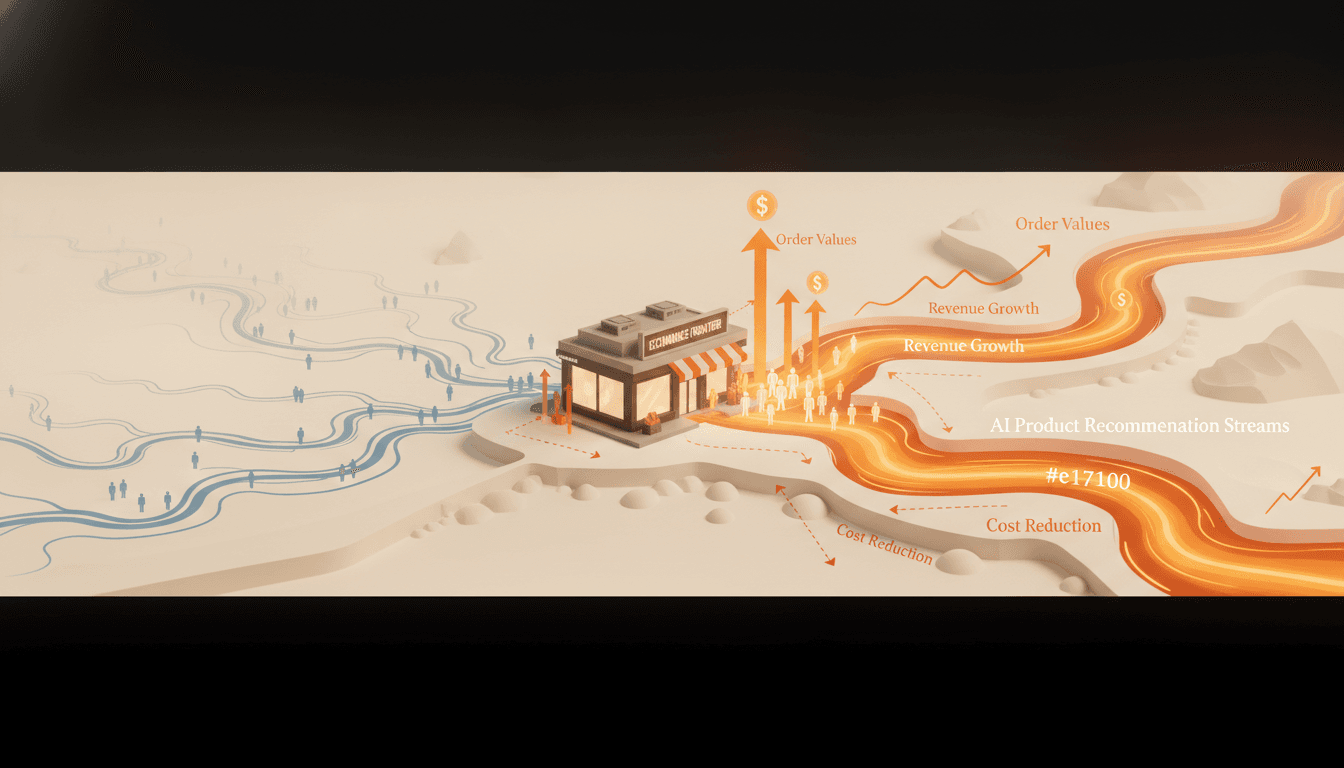
---


# The Hidden Economics of AI Recommendations: How Generative Search Is Reshaping E-Commerce Margins

*AI-powered product discovery is no longer a marketing experiment—it's a structural shift in e-commerce unit economics. Brands achieving top-3 AI recommendation positioning report 72% lower customer acquisition costs, 3.5x higher average order values, and customer cohorts that stay 28–35% longer. Here's what CFOs and growth leaders need to understand before the 2027 inflection point arrives.*

[IMG: Split visual showing a treadmill labeled "Paid Search Budget" on the left and a compounding growth curve labeled "AI Recommendation Visibility" on the right, with dollar signs flowing toward the curve]


---


## The Treadmill Stops When Brands Step Off

Paid search budgets function as treadmills that stop the moment spending ceases. By 2027, [40% of all product searches will route through AI interfaces](https://www.gartner.com/en/documents/5227263)—and brands that haven't built visibility in those systems face not just lost market share, but structural invisibility.

The economics tell the story clearly. E-commerce brands achieving top-3 AI recommendation positioning report **72% reductions in customer acquisition costs** compared to paid search equivalents. Their customers spend 3.5x more per order and stay 28–35% longer.

The question isn't whether AI will reshape margins. It's whether brands capture the upside or cede it to competitors who move first.


---


## The Margin Crisis No One's Talking About: Why Paid Search Economics Are Breaking

E-commerce brands collectively spent [$246 billion on paid search and social advertising in 2024](https://www.warc.com/content/article/warc-data/warc-global-ad-spend-outlook-2024-25/en-gb/150343), and the returns are eroding. In high-competition categories—consumer electronics, supplements, beauty—cost-per-click inflation has made paid acquisition structurally unsustainable for all but the most capitalized players. The average paid search CAC is now **2.8–3.2x higher** than AI-referred CAC in mature generative engine optimization (GEO) programs.

The core problem isn't overspending. It's the architecture of the spend itself.

Paid ads function as pure operating expenses. The moment budgets are cut, traffic vanishes, pipelines dry up, and CAC spikes again when spending resumes. There is no residual asset, no compounding return, no equity being built in the channel.

Meanwhile, the audience has already shifted. [58% of U.S. consumers aged 18–44 have used a generative AI tool to research a product purchase in the past 90 days](https://morningconsult.com/2024/09/ai-consumer-behavior-tracker/), according to Morning Consult's AI Consumer Behavior Tracker. That figure represents mainstream adoption, not early-adopter behavior.

Traditional marketing ROI frameworks—built around impression share, quality scores, and ROAS—don't account for this shift. CFOs are currently making budget decisions with an incomplete unit economics model. The cost of inaction isn't measured in missed clicks—it's measured in structural exclusion from the discovery layer where purchase decisions are increasingly being made.


---


## The AI Recommendation Advantage: 72% CAC Reduction and Why It Matters to EBITDA

The 72% CAC reduction isn't a projection or best-case scenario. It's the average result reported by e-commerce brands that achieved top-3 AI recommendation positioning for their primary product categories, according to [Forrester Consulting's GEO Impact on E-Commerce Unit Economics report](https://www.forrester.com/report/geo-impact-ecommerce-unit-economics/). That reduction flows directly to EBITDA—not to a vanity marketing metric.

The mechanism is straightforward: AI-referred customers arrive with pre-validated purchase intent. As Rob Garf, VP & GM of Retail at Salesforce, explains: *"Consumers who discover a brand through an AI recommendation have a fundamentally different relationship with that brand from day one. They arrive pre-sold. The AI has done the consideration work. The resulting LTV differential is not marginal—it's transformational for unit economics."*

The AI has already performed the awareness, consideration, and comparison work that brands typically pay for across multiple touchpoints.

The downstream economics compound further:

- **3.5x higher AOV**: Purchases initiated through AI assistant recommendations carry a 3.5x higher average order value across beauty, home goods, and consumer electronics, per [Salesforce Commerce Cloud AI Shopping Insights](https://www.salesforce.com/resources/articles/ai-shopping-insights/)
- **28–35% higher LTV**: AI-sourced customer cohorts show materially higher lifetime value, because the AI recommendation functions as a trusted third-party endorsement that reduces post-purchase cognitive dissonance
- **Lower return rates**: AI recommendations drive considered purchases, not impulse buys—reducing the hidden margin cost of returns and restocking
- **Zero marginal referral cost**: Unlike paid search, each additional AI-referred customer costs nothing incrementally once authority is established


---


## Compounding Assets vs. Cost Treadmills: Why GEO Investment Appreciates Over Time

Scott Galloway, Professor of Marketing at NYU Stern School of Business, frames the structural difference precisely: *"Generative AI is collapsing the traditional marketing funnel. Awareness, consideration, and decision are happening simultaneously inside a single AI conversation. Brands that structure their content and data to participate in that conversation will capture customers at a fraction of the cost of brands still fighting for attention in a crowded paid auction."*

That structural difference is what separates GEO from every other marketing channel investment.

Paid ad spend is a depreciating operating expense. GEO builds a durable, compounding asset. AI models prioritize authoritative, recently-updated brand content—and once a brand establishes that authority, the AI continues citing it as new users ask new questions, without any additional spend per referral.

This creates a fundamentally different economic curve than paid advertising.

[IMG: Bar chart showing "AI Recommendation Share by Brand Quartile" with top quartile receiving 3x more AI mentions than bottom quartile, with a widening gap arrow between 2024 and 2027]

The winner-take-most dynamics are already visible. According to [Semrush's AI Visibility Report](https://www.semrush.com/blog/ai-visibility-report/), brands in the top quartile of AI search visibility are capturing **3x more AI-referred revenue** than bottom-quartile brands—and that disparity is growing as AI models increasingly favor established authoritative sources. The gap is widening by approximately 15–20% annually, which means the compounding advantage of early movers is accelerating, not plateauing.

Unlike paid search, where a competitor's budget increase immediately erodes position, AI recommendation authority is durable. It doesn't evaporate when a competitor bids higher. It deepens as content libraries grow and AI models continue training on authoritative data.


---


## The 2027 Inflection Point: What Happens When 40% of Searches Go Through AI

The 40% figure from [Gartner's Predicts 2025: Search and AI Disruption Report](https://www.gartner.com/en/documents/5227263) is not a distant forecast—it's a near-term operational reality. AI assistants already handle an estimated [13% of all product research queries in the United States](https://www.gartner.com/en/digital-markets), a figure that will reach 30–40% by 2027 as consumers normalize conversational commerce discovery. The infrastructure is already in place: [Perplexity AI surpassed 100 million weekly active users by early 2025](https://www.perplexity.ai/), and [Google's AI Overviews now appear in approximately 47% of all search results pages](https://www.brightedge.com/resources/research-reports/ai-search-report).

The revenue at stake is not marginal. McKinsey Global Institute projects **$1.2 trillion in global e-commerce revenue will be influenced by AI recommendations by 2030**, representing approximately 45% of total e-commerce transactions—up from an estimated 6% in 2023. Brands without AI visibility strategies are not facing a headwind—they're facing structural exclusion from nearly half of future commerce.

Looking ahead, the inflection is already underway in the highest-velocity categories. Consumer electronics brands are already reporting 15–25% of revenue from AI-referred sources. Beauty and skincare customers arriving via AI convert at 2–4x the rate of paid search visitors. Home goods and supplements are seeing AI recommendation influence expand quarter over quarter.

Brands that treat 2025 as a transition year—rather than a wait-and-see year—will enter 2027 with compounded authority that late movers cannot replicate quickly.


---


## The Budget Reallocation Framework: How to Shift 15–25% of Paid Spend Toward GEO

The reallocation doesn't require abandoning paid search. It requires a phased, data-driven shift that maintains market coverage while building a parallel compounding asset. Early-mover GEO brands have demonstrated that **15–25% of paid search budgets can be reallocated to GEO without losing market coverage**—particularly in high-CPC categories where the margin relief is greatest.

Here's how the framework operates across three parallel workstreams:

**Content Authority Building**

Publishing AI-optimized product content, comparison guides, and expert resources that establish a brand as a primary reference source for AI systems. ROI typically emerges in **4–6 months** and compounds for 24+ months.

**Structured Data Optimization**

Implementing schema markup, product feeds, and structured metadata that enable AI systems to extract and cite brand data accurately. This is foundational, low-cost, and deployable in weeks.

**AI Citation Tracking**

Monitoring which AI systems are citing a brand, for which queries, and at what frequency—enabling iterative optimization of content and data strategy.

[IMG: Three-column framework graphic showing "Content Authority," "Structured Data," and "Citation Tracking" as pillars with timeline indicators beneath each]

The margin relief is most pronounced in high-CPC categories. Consumer electronics brands paying $8–15 per click in Google Shopping are the clearest beneficiaries. Supplements and beauty brands—where [ROAS for Google Shopping has declined from 4.2x in 2021 to 3.1x in 2024](https://www.tinuiti.com/blog/paid-search/google-ads-benchmark-report/)—have the most urgent case for reallocation.

The 12–18 month transition timeline is conservative; revenue impact is typically visible by months 4–6, providing the data needed to accelerate reallocation with confidence.


---


## Measuring GEO ROI: The Metrics That Actually Matter

GEO performance requires a new measurement framework. Traditional paid search metrics—impression share, quality score, ROAS—don't capture the unit economics of AI-referred acquisition. The metrics that matter are different in structure and more directly connected to P&L outcomes.

The five core GEO metrics are:

**AI Citation Rate**

The percentage of relevant AI queries where a brand is mentioned—the primary leading indicator of AI recommendation visibility.

**AI-Referred Revenue Per Session**

Direct attribution from AI recommendation sources, typically **2.8–3.2x higher** than paid search equivalents per [Salesforce State of Commerce data](https://www.salesforce.com/resources/research/state-of-commerce/).

**CAC by Channel**

Comparative analysis of AI vs. paid vs. organic acquisition costs—essential for budget reallocation decisions.

**AI-Influenced LTV Cohort Analysis**

Lifetime value of customers acquired via AI recommendations, revealing the true unit economics of AI-sourced cohorts.

**Content Authority Score**

Tracking a brand's standing in AI model citations and training data references over time.

[IMG: Dashboard mockup showing GEO metrics panel with AI citation rate trending up, CAC comparison bar chart, and LTV cohort comparison between AI-referred and paid-search-referred customers]

Approximately [60% of ChatGPT users who receive a product recommendation report clicking through to purchase within 24 hours](https://www.insiderintelligence.com/content/ai-commerce-behavior-study), compared to a 3–7 day click-to-purchase window for traditional display advertising. That velocity difference has material implications for inventory planning, cash flow timing, and attribution window configuration—all of which belong in the CFO's analytical framework, not just the marketing dashboard.


---


## Category-Specific Economics: Where the Margin Impact Is Largest

The GEO margin opportunity is not uniform across categories. The highest-impact categories are those where paid search CPCs are highest and AI recommendation authority is most influential on purchase decisions.

**Consumer Electronics**

CPCs of $8–15 per click in paid search versus an effective $2–4 CPC equivalent in AI recommendations make this the highest-relief category. AI visibility offers the greatest structural margin improvement for brands in this space.

**Supplements and Wellness**

The 72% CAC reduction is most pronounced here, driven by high-intent consumers seeking trusted authority on health-adjacent purchases. AI models show strong recommendation bias toward established, credible brands.

**Beauty and Skincare**

The 3.5x AOV lift is highest in beauty, where AI recommendations drive considered, multi-product purchases rather than single-item impulse buys.

**Home Goods and Furniture**

Long consideration cycles—often weeks or months—make AI-assisted research the dominant discovery mode. Brands with strong AI visibility capture disproportionate share of these high-ticket decisions.

**Apparel and Fashion**

Immediate margin impact is lower, but AI integration in virtual try-on and styling recommendations is accelerating. Early investment is strategically sound for forward-looking brands.

The [average cost-per-click in Google Shopping ads increased 31% between 2022 and 2024](https://www.wordstream.com/google-ads-benchmarks), driven by auction competition. In the highest-CPC categories, GEO investment doesn't just improve margins—it changes the competitive structure of customer acquisition entirely.


---


## Building a GEO Strategy: The Three Pillars of AI Visibility

Avinash Kaushik, VP of Marketing Analytics & Data Science at Google, captures the strategic framing: *"We are witnessing the most significant shift in customer acquisition economics since the invention of the click. AI recommendations are not just a new channel—they are a new trust infrastructure. The brands that earn a place in AI answers will enjoy customer acquisition economics that paid-media-dependent competitors simply cannot match. This is a margin story, not just a marketing story."*

Building that position requires three foundational pillars, each with distinct timelines and dependencies.

**Pillar 1: Content Authority**

Establishing a brand as a primary reference source for AI systems requires consistent, AI-optimized publishing across product categories. This means expert-level product guides, comparison content, and technical specifications that AI models can cite with confidence. Content authority requires **3–6 months of consistent publishing** to establish meaningful citation frequency, but the compounding returns extend well beyond that window.

**Pillar 2: Structured Data Optimization**

Schema markup, product feeds, and structured metadata enable AI systems to extract and accurately represent brand data in recommendation outputs. This is the most technically precise pillar and the most foundational—structured data implementation can be deployed in **2–4 weeks** and immediately improves AI system legibility of brand content.

It also amplifies the impact of every content authority investment made in Pillar 1.

**Pillar 3: Citation Tracking and Optimization**

Real-time visibility into which AI systems are citing a brand, for which queries, and at what frequency enables iterative optimization. Citation tracking tools provide the feedback loop that turns GEO from a publishing exercise into a performance marketing discipline. Early-mover brands are already using citation data to identify content gaps, prioritize category expansion, and benchmark competitive AI visibility.

Note that GEO amplifies rather than replaces traditional SEO. Brands with strong organic search foundations will find GEO investment accelerates faster because AI models draw heavily on the same authority signals that drive organic rankings.


---


## The Competitive Urgency: Why Speed of Implementation Matters

Shira Ovide, Technology Columnist at The Washington Post, draws the historical parallel directly: *"The CFO who dismisses GEO as a marketing department experiment is making the same mistake CFOs made when they dismissed SEO in 2003 or mobile commerce in 2011. The compounding economics of organic AI visibility versus the perpetual cost treadmill of paid ads will define e-commerce P&Ls for the next decade."*

The pattern of dismissal followed by urgent catch-up is a predictable and costly cycle.

The winner-take-most dynamics of AI recommendation systems make speed of implementation a strategic variable, not just an operational one. Top quartile brands already receive **3x more AI recommendations** than bottom quartile brands, and the gap is widening by approximately 15–20% annually. Brands that start GEO in 2025 will hold a **2–3 year competitive advantage** over late movers—an advantage that compounds as AI models continue training on established authoritative content.

[Spending on AI search optimization and GEO services is forecast to grow at 42% CAGR through 2027](https://www.emarketer.com/forecasts/ai-search-optimization), compared to just 5% CAGR for traditional paid search spend. That reallocation signal reflects where sophisticated marketing organizations are already placing their bets. Brands that delay 12 months or more risk not just a visibility gap—they risk structural exclusion from AI recommendation systems that are increasingly difficult to break into once authority hierarchies are established.


---


## From Strategy to Execution: A 90-Day GEO Roadmap

[IMG: Horizontal timeline graphic showing four phases: Days 1–30 (Audit & Baseline), Days 31–60 (Implementation), Days 61–90 (Tracking & Optimization), Months 4–6 (Scale & Reallocation), with key milestones marked at each phase]

Execution begins with clarity on current position. Here's how the first 90 days should be structured:

**Days 1–30: Audit and Baseline**

- Audit current AI visibility across ChatGPT, Perplexity, Claude, and Google AI Overviews for primary product categories
- Establish baseline metrics: AI citation rate, AI-referred traffic volume, and CAC by channel
- Identify high-opportunity product categories where AI recommendation positioning is weakest relative to commercial importance

**Days 31–60: Structured Data and Content Launch**

- Deploy schema markup and structured product data—implementable in **2–4 weeks** with standard development resources
- Launch authority content program with consistent publishing cadence across priority categories
- Begin competitive AI visibility benchmarking to identify gaps and opportunities

**Days 61–90: Citation Tracking and Optimization**

- Deploy citation tracking tools for real-time AI recommendation monitoring
- Optimize existing content based on early citation performance data
- Measure conversion rates and session value from AI-referred traffic against paid search equivalents

**Months 4–6: Scale and Reallocation**

Revenue impact typically emerges in months 4–6, providing the performance data needed to begin systematic paid search budget reallocation. Scale content production in highest-performing categories, expand structured data coverage, and begin compounding the authority established in the first 90 days.

Critical success factors throughout this process include executive alignment on the unit economics case, cross-functional coordination between marketing, product, and finance, and consistent measurement against the five core GEO metrics.


---


## Conclusion: The Margin Opportunity Is Open—But Not Indefinitely

The economics of AI-powered product discovery represent the most significant structural shift in e-commerce customer acquisition since Google AdWords transformed digital marketing two decades ago. Brands that act in 2025 will compound advantages that late movers in 2027 and beyond simply cannot replicate through spending alone.

The 72% CAC reduction, 3.5x AOV premium, and 28–35% LTV lift aren't projections—they're documented outcomes from brands that have already made the transition. The window for first-mover advantage is measurable in months, not years.

Every quarter of delay is a quarter of compounding authority that competitors are building instead. The cost of inaction is not zero—it's the cumulative CAC premium of every customer acquired through paid channels while AI recommendation authority remains unbuilt. The choice is clear: build GEO now, or pay the margin penalty for years to come.

Ready to model the margin impact of GEO? Schedule a 30-minute strategy session with AI commerce specialists to see how brands in the same category are capturing the 72% CAC advantage. The session will walk through the math, show competitive benchmarks, and build a custom 90-day roadmap tailored to product mix and current marketing spend. [Schedule a session here](https://calendly.com/ramon-joinhexagon/30min)—no prep required, just bring current CAC and LTV data.
H
Hexagon Team
Published August 9, 2026