authoritybrandsbrand
Decoded: How AI Search Engines Actually Evaluate E-Commerce Brand Authority—The E-E-A-T Framework for Generative Commerce
AI search engines don't rank brands the way Google does—they encode authority statically during training, creating a winner-take-most dynamic where 85% of product recommendations come from just 20 domains per category. This guide decodes the four pillars of E-E-A-T for generative commerce and shows e-commerce brands exactly how to build AI citation authority before the 2024-2025 window closes.
18 min readRecently updated

# Decoded: How AI Search Engines Actually Evaluate E-Commerce Brand Authority—The E-E-A-T Framework for Generative Commerce

*AI search engines don't rank brands the way Google does—they encode authority statically during training, creating a winner-take-most dynamic where 85% of product recommendations come from just 20 domains per category. This guide decodes the four pillars of E-E-A-T for generative commerce and shows e-commerce brands exactly how to build AI citation authority before the 2024-2025 window closes.*

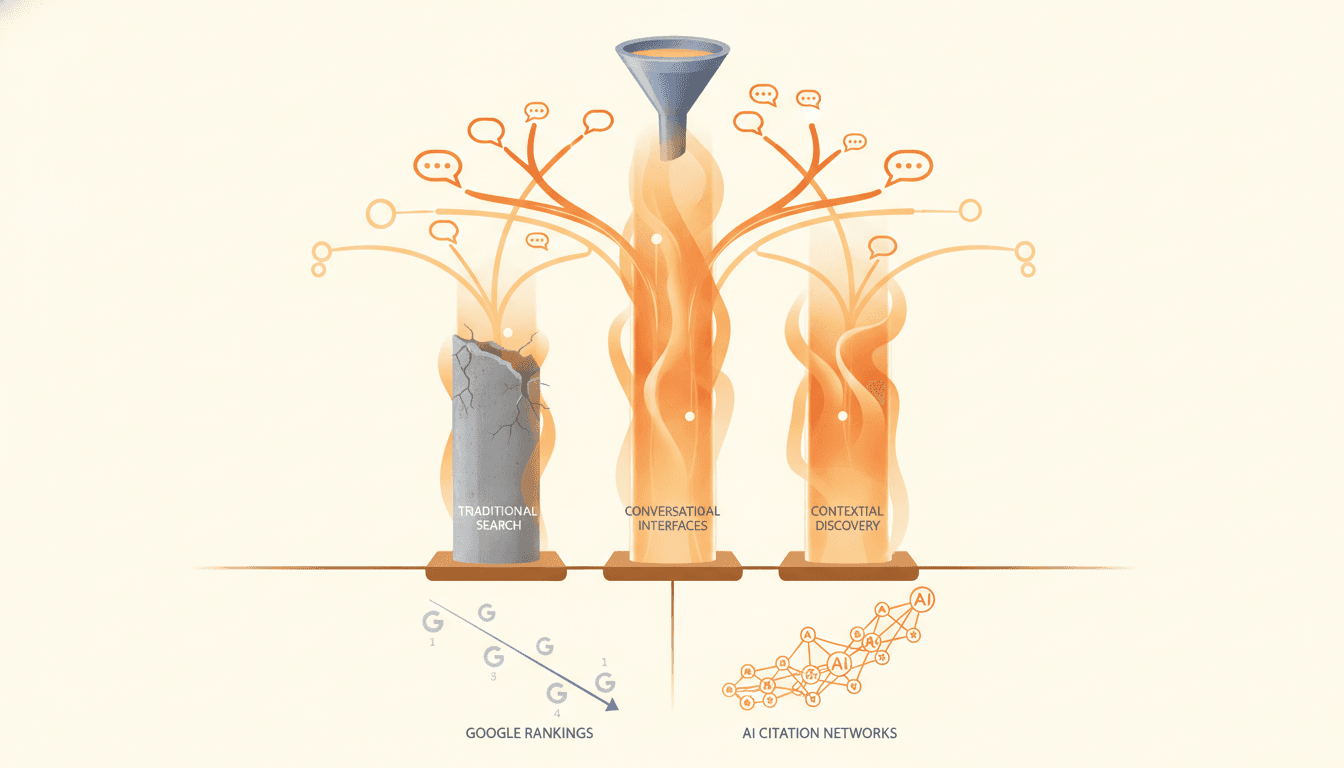
[IMG: Split-screen visualization showing traditional Google search results on one side and an AI-generated product recommendation panel on the other, with brand authority signals highlighted]

## The AI Search Reckoning: Why Google Rankings No Longer Guarantee Discovery

Being ranked #1 on Google means almost nothing if a brand isn't cited in ChatGPT, Perplexity, or Claude. This fundamental shift represents a seismic change in how e-commerce brands should approach discoverability. The traditional SEO playbook no longer guarantees visibility in the channels where consumers increasingly discover products.

In 2024, over 70% of AI-generated answer queries end without a click. That statistic matters less than what it reveals: AI search engines operate on fundamentally different authority mechanisms than Google. While Google crawls links and dynamically scores E-E-A-T in real time, generative AI engines encode brand authority statically during training—meaning optimization timelines shifted from weeks to 6-18 months.

The consequences are severe. [85% of AI product recommendations come from only the top 20 domains per category](https://www.brightedge.com/research/generative-ai-search-visibility), creating a winner-take-most authority dynamic that makes early investment not just valuable—it's existential. Brands outside this elite tier may receive zero AI-mediated referrals, regardless of traditional SEO performance.

This guide decodes exactly how AI engines evaluate brand expertise, authority, and trustworthiness. More importantly, it shows the four pillars of E-E-A-T that actually matter for generative commerce—and how to build them before the competitive window closes.


---


## Why E-E-A-T for AI Search Is Architecturally Different From Traditional SEO

Google evaluates E-E-A-T dynamically. Every new backlink, press mention, and on-page signal gets crawled, indexed, and factored into rankings within days or weeks. That real-time feedback loop is what makes traditional SEO a relatively fast-feedback discipline.

[Large language models don't work that way.](https://openai.com/research/gpt-4-technical-report) They rely on pre-trained knowledge from curated corpora, meaning brand authority is baked into a model during training, not dynamically updated with each new backlink or press mention. If a brand isn't well-represented in the sources that trained GPT-4, Claude, or Gemini, no amount of last-minute optimization will change what those models say about it today.

This architectural difference reshapes everything about how brands should approach AI authority:

- **Optimization timelines diverge sharply.** Traditional SEO gains can appear in weeks; AI authority gains typically require 6-18 months of sustained entity-building before they manifest in recommendation patterns.

- **Entity salience replaces PageRank.** Unlike Google's link-based evaluation, [LLMs weight how prominently and consistently a brand entity appears across multiple independent, high-authority text sources](https://deepmind.google/research/)—Wikipedia, major publications, industry reports.

- **The 2024-2025 window is critical.** As AI search consolidates, brands building corpus presence now will compound that authority advantage through every subsequent training cycle.

As Rand Fishkin, Co-Founder of SparkToro, explains: "The question isn't 'do brands rank on page one?' but 'does the AI know who they are, and does it trust them enough to say their name?' For e-commerce brands, that distinction is worth billions in future revenue."

With [58.5% of all Google searches already ending without a click](https://sparktoro.com/blog/zero-click-searches-on-google), AI citation authority has become the new discoverability metric. Brands that treat GEO as a long-game investment—not a quick tactical win—are the ones that will own generative commerce.


---


## The Four Pillars of E-E-A-T for AI: Experience, Expertise, Authoritativeness, and Trust

Google's E-E-A-T framework was designed for human quality raters evaluating web pages. Its AI equivalent operates on fundamentally different signals—ones that machines can parse, verify, and weight during training. Each pillar maps to distinct, measurable signals that differ sharply from Google's implementation.

Here's how the four pillars translate for generative commerce:

- **Experience** = Verified UGC and use-case-rich owned content that demonstrates real-world product application. LLMs extract this as evidence that actual customers have used and validated products.

- **Expertise** = Topical content depth and structured data completeness that machines can parse and verify without human interpretation. This is where technical SEO becomes genuinely critical.

- **Authoritativeness** = Third-party citation density in high-authority corpora—Wikipedia, major publications, industry reports—that functions as an implicit citation graph within LLM training data.

- **Trust** = Cross-platform entity consistency and epistemic corroboration from non-promotional sources that LLMs recognize as independent validation.

The data confirms this framework works. According to a [2024 GEO benchmarking study by Search Engine Journal and Semrush](https://www.semrush.com/blog/geo-benchmarking-report/), brands that combined Schema.org markup with consistent entity presence across three or more authoritative platforms saw a **40% increase in AI-cited brand recommendations** compared to brands relying solely on traditional on-page SEO signals.

Marie Haynes, Founder of Marie Haynes Consulting, explains the shift clearly: "E-E-A-T for generative AI is less about proving expertise to an algorithm and more about becoming part of the knowledge ecosystem that the algorithm was built on. Structured data is the handshake with the machine."


---


## Pillar 1: Experience—How AI Engines Evaluate Real-World Brand Proof

[IMG: Diagram showing how LLMs extract and weight customer experience signals from review platforms, case studies, and UGC across the web]

The Experience pillar of E-E-A-T was originally designed to reward first-hand product knowledge. In AI search, it translates to something more specific: the presence of verified user-generated content, authentic customer reviews with specific use-case detail, and expert-authored how-to content. LLMs extract this as evidence of real-world product application.

Brand-written marketing copy, no matter how polished, carries far less weight than third-party verification. This is the most important shift in how AI engines evaluate brands differently from traditional search. The distinction between self-promotion and independent validation has become a primary authority signal.

Here's what matters most for the Experience pillar:

- **Verified reviews outperform volume.** LLMs distinguish between high-volume, generic reviews and verified, use-case-specific reviews that describe actual product experiences. A single detailed review from a verified purchaser carries more weight than ten generic five-star ratings.

- **Review platform diversity matters.** Consistency across Amazon, industry-specific review sites, and Google Reviews signals authentic experience—not manufactured social proof. Brands that appear credibly on multiple platforms are significantly more likely to be recommended by AI assistants.

- **[Review Schema markup](https://schema.org/Review) is machine-readable proof.** For RAG-based AI engines like Perplexity, structured review data is a direct trust signal that supplements training corpus authority with real-time verification.

This matters because [63% of consumers trust AI product recommendations as much as or more than recommendations from human experts](https://www.edelman.com/trust/trust-barometer), according to the Edelman Trust Barometer Special Report on AI and Consumer Trust. When an AI recommends a product, that recommendation carries expert-level persuasive weight.


---


## Pillar 2: Expertise—Structured Data as the Authority Layer for Machines

[IMG: Technical diagram of Schema.org markup types (Product, Review, Organization, FAQPage, BreadcrumbList) and how they connect to AI recommendation engines]

Structured data is the single highest-leverage technical GEO investment available to e-commerce brands today. Unlike traditional backlinks, which signal authority through human editorial decisions, Schema.org markup speaks directly to machines—creating a machine-readable authority layer. [Perplexity AI's retrieval-augmented generation architecture](https://blog.perplexity.ai/blog/technical-faq) pulls live web content to supplement LLM responses.

This means brands must satisfy both static training-corpus authority and real-time structured data standards simultaneously. It's not an either-or proposition—it's a both-and requirement. RAG-based systems actively parse structured data when generating recommendations.

The core markup types that matter most for GEO are:

- **Product schema** — Communicates product specifications, pricing, and availability in machine-readable format
- **Review schema** — Aggregates verified customer ratings as a direct trust signal
- **Organization schema** — Establishes brand entity identity, founding information, and official contact data
- **FAQPage schema** — Makes Q&A content directly extractable for AI answer generation
- **BreadcrumbList schema** — Signals topical content hierarchy and domain expertise to LLMs

Content depth across topical clusters amplifies these signals further. [LLMs evaluate brand-level expertise through the quality and depth of topical content clusters](https://www.searchenginejournal.com/geo-research-roundup/)—a brand that owns comprehensive, interlinked content on a specific product category signals domain authority in a way that isolated high-DA backlinks cannot replicate.

The 40% increase in AI recommendations observed when brands implemented complete Schema.org markup confirms that structured data has no equivalent in traditional SEO. It's a GEO-native advantage that competitors without technical resources will struggle to replicate quickly.


---


## Pillar 3: Authoritativeness—Why Wikipedia and High-Authority Sources Matter More Than Expected

[IMG: Visual showing the disproportionate weight of Wikipedia and major publications in LLM training corpora versus their share of total web traffic]

Most e-commerce marketers think of Wikipedia as a reference tool, not a marketing channel. For GEO, that framing is a costly mistake. [Wikipedia is one of the most heavily weighted corpora in models like GPT-4, Llama, and Claude](https://commoncrawl.org/the-data/)—meaning a well-sourced Wikipedia brand page generates more AI citation authority than hundreds of standard backlinks.

The math is straightforward: if LLMs learned from Wikipedia disproportionately, brands present in Wikipedia are disproportionately likely to be cited. A well-maintained, independently sourced Wikipedia page generates more AI citation authority than hundreds of standard backlinks.

Brands with a well-maintained Wikipedia page were **3.5 times more likely to be named in ChatGPT and Claude product recommendation responses** than comparable brands without one, according to a [Profound AI Brand Analytics report analyzing 200 e-commerce categories](https://www.profound.com/research/). That multiplier makes Wikipedia page development one of the highest-ROI GEO investments available.

Here's how to build authoritativeness across the AI-relevant authority stack:

- **Earn features in major publications.** Coverage in outlets like Forbes, TechCrunch, or industry trade publications carries outsized weight in LLM training corpora. One feature in a major publication can be worth months of owned content creation.

- **Pursue industry report citations.** Being cited in analyst reports from Gartner, Forrester, or category-specific research firms functions as an implicit authority endorsement within LLM training data.

- **Establish entity disambiguation profiles.** Verified profiles on [Crunchbase](https://www.crunchbase.com), [Wikidata](https://www.wikidata.org), LinkedIn, and Google Business Profile prevent AI engines from confusing brands with competitors.

Looking ahead, earned media and brand PR are no longer just brand awareness plays—they are core GEO tactics. With [85% of AI recommendations citing sources from only the top 20 domains per category](https://www.brightedge.com/research/generative-ai-search-visibility), brands investing in high-authority third-party coverage now are building the corpus presence that will define AI recommendation patterns for years.


---


## Pillar 4: Trust—Epistemic Corroboration and Cross-Platform Entity Consistency

Trust in AI search operates on a mechanism that has no direct equivalent in traditional SEO: **epistemic corroboration**. [Stanford HAI research on AI source credibility](https://hai.stanford.edu/research) defines this as whether the claims a brand makes about its products are corroborated by independent, non-promotional third-party sources that LLMs recognize as authoritative.

Self-asserted brand claims—marketing copy, owned blog posts, product descriptions—are weighted far lower than independent third-party verification, regardless of how well-written or technically optimized they are. This is perhaps the most counterintuitive shift from traditional SEO, where on-page optimization still carries significant weight.

For e-commerce brands, this shifts the strategic emphasis from broadcast marketing to earned validation. Here's what epistemic corroboration looks like in practice:

- **Regulatory compliance documentation and certifications** are machine-readable trust signals. ISO certifications, FDA clearances, and industry accreditations signal verified credibility that LLMs can extract and weight.

- **Consistent NAP data** (Name, Address, Phone) across Google Business Profile, LinkedIn, Crunchbase, and major retail aggregators is a foundational entity legitimacy signal. [Brands that maintain consistent entity data are significantly more likely to be correctly identified and recommended by AI assistants](https://www.brightlocal.com/research/local-seo-ai-search-study/).

- **Editorial coverage and verified reviews** function as corroboration nodes. Each independent mention of a brand in a non-promotional context adds weight to the probabilistic trust calculation LLMs run when deciding whether to recommend it.

As Ethan Mollick, Associate Professor at The Wharton School, explains: "When a large language model decides whether to recommend a brand, it's essentially running a probabilistic trust calculation based on everything it learned during training. If a brand appears frequently in high-quality, non-promotional contexts—news coverage, expert reviews, industry reports—it has built what I'd call 'LLM credibility.'"


---


## The Winner-Take-Most Authority Dynamic: Why 85% of AI Recommendations Come From 20 Domains

[IMG: Bar chart comparing AI recommendation concentration (top 20 domains) versus traditional SEO first-page concentration, showing the steeper drop-off in AI search]

Traditional SEO has a first-page concentration problem. AI search has a first-twenty-domains concentration problem—and the drop-off is far steeper. According to [Brightedge's Generative AI Search Visibility Study](https://www.brightedge.com/research/generative-ai-search-visibility), 85% of AI-generated product recommendations cite sources from only the top 20 domains in any given product category.

That's not a first-page effect—it's near-total exclusion of everyone else. This dynamic has direct implications for mid-market and emerging e-commerce brands. The cost of delayed investment is exclusion, not lower rankings.

This winner-take-most dynamic creates several critical implications:

- **The cost of delayed investment is exclusion, not lower rankings.** Unlike traditional SEO where page 2 still generates some traffic, brands outside the top 20 AI-cited domains may receive zero AI-mediated referrals.

- **Authority signals compound over time.** Each training cycle reinforces existing authority patterns. Brands with strong corpus presence in 2024 will have compounding advantages in 2025 and 2026.

- **The transactional stakes are higher in AI search.** [27% of product-related queries on Perplexity AI trigger a direct brand or product recommendation](https://www.similarweb.com/blog/insights/ai-search-report/), compared to less than 5% on traditional Google Search.

Looking ahead, this mirrors the "rich get richer" effect in machine learning. Early authority compounds over time, and the 2024-2025 window represents the last realistic opportunity for most e-commerce brands to establish AI authority before market consolidation makes entry prohibitively expensive.


---


## Content Strategy for GEO: Answer-Ready Formatting and Dual-Audience Design

[IMG: Side-by-side comparison of a traditionally formatted product page versus an answer-ready GEO-optimized page, with machine-extractable elements highlighted]

Content optimized for GEO must serve two audiences simultaneously: human readers who evaluate quality and relevance, and machine extraction systems that parse structure and factual density. These audiences have different needs, and GEO-effective content satisfies both without compromising either.

The same E-E-A-T content that builds trust with a human reader must also be architecturally optimized for LLM extraction. Clear structure and factual density are equally important as persuasive messaging.

Here's how to structure content for dual-audience effectiveness:

- **Use clear, descriptive headers** that function as navigational signals for both humans and LLMs parsing content structure. Headers should be specific enough that they could stand alone as content summaries.

- **Write in concise, factual statements** rather than marketing prose. LLMs extract declarative statements more reliably than persuasive copy. "This product weighs 2.5 pounds" is more extractable than "This lightweight product is perfect for travel."

- **Include comparative data and feature matrices** that AI engines can extract and synthesize into recommendation responses. Structured comparisons are gold for AI extraction.

- **Structure Q&A sections with [FAQPage schema](https://schema.org/FAQPage)** to make content directly extractable for answer generation. This is one of the highest-leverage GEO content tactics available.

For example, a product comparison article structured with clear headers, bullet-point feature lists, and FAQ schema is significantly more likely to be cited in an AI recommendation than an equivalent article written in flowing prose without structural markup. AI assistants are more likely to recommend brands with active, verified profiles on platforms that are part of LLM training pipelines—Reddit communities, Trustpilot, G2, and major news outlets.


---


## Tactical GEO Playbook: 6-Month Authority-Building Roadmap for E-Commerce Brands

[IMG: Timeline graphic showing the 6-month GEO authority-building roadmap with phases, key actions, and expected milestones]

Building AI authority requires a phased, sustained investment—not a one-time technical fix. Here's how e-commerce brands should structure their first six months of GEO implementation.

### Months 1-2: Foundation and Technical Audit

- Audit entity consistency across all platforms (Google Business Profile, LinkedIn, Crunchbase, major retail aggregators)
- Implement complete Schema.org markup: Product, Review, Organization, FAQPage, and BreadcrumbList
- Validate schema implementation using [Google's Rich Results Test](https://search.google.com/test/rich-results) and Schema.org validators
- Identify entity disambiguation issues (brand name conflicts, inconsistent NAP data)

### Months 2-3: Content and Review Density

- Build verified review density across Amazon, Google Reviews, and industry-specific platforms
- Create use-case-rich owned content with answer-ready formatting and FAQ schema
- Develop topical content clusters that signal domain expertise to LLMs
- Audit existing content for AI-readiness and restructure high-priority pages

### Months 3-4: Earned Media and Wikipedia

- Pursue earned media placements in high-authority publications relevant to the category
- Create or update the Wikipedia brand page with independently sourced, third-party citations
- Pitch industry analysts and report authors for brand inclusion in category research
- Build relationships with editorial teams at trade publications in the vertical

### Months 4-6: Entity Verification and Monitoring

- Establish verified profiles on Wikidata, Crunchbase, and industry-specific authoritative platforms
- Begin monitoring AI recommendation frequency across ChatGPT, Claude, Perplexity, and Bing Copilot
- Track entity consistency scores and citation authority growth
- Accumulate third-party certifications and compliance documentation as machine-readable trust signals

**Ongoing:** Maintain cross-platform entity consistency, continue accumulating third-party validations, and feed high-authority content into training corpora through consistent publication in indexed, authoritative channels. [GEO is an emerging discipline with its own best practices](https://searchengineland.com/the-rise-of-geo/)—early adopters are already reporting measurable gains in AI-driven referral traffic.


---


## Measuring GEO Success: Metrics That Matter Beyond Traditional Rankings

Traditional SEO metrics—keyword rankings, organic traffic, domain authority—are lagging indicators in generative commerce. By the time those metrics reflect AI authority changes, the competitive window may have already closed. GEO requires a different measurement framework built around leading indicators of AI-mediated discoverability.

Here's how to build a GEO measurement stack:

- **AI recommendation frequency** — Query ChatGPT, Claude, Perplexity, and Bing Copilot with category-relevant product questions weekly. Track how often a brand is cited versus competitors. This is the primary leading indicator.

- **Entity consistency scores** — Use tools like [BrightLocal](https://www.brightlocal.com) and Moz Local to audit NAP consistency across platforms. Inconsistencies are active deprioritization signals that compound over time.

- **Schema validation completeness** — Run monthly audits using Google's Rich Results Test to ensure markup is complete, valid, and error-free. Partial schema implementation can be worse than no implementation.

- **Citation authority in high-authority corpora** — Track Wikipedia page quality metrics, major publication mention frequency, and industry report citations quarterly. These are the most important long-term authority indicators.

Benchmarking against the top 20 competitors in the AI recommendation category provides the most actionable context for these metrics. Setting realistic targets—for example, appearing in 20% of relevant AI product queries within 6 months and 50% within 12 months—creates accountability and helps justify GEO investment.


---


## Common GEO Mistakes and How to Avoid Them

[IMG: Warning sign graphic with the five most common GEO mistakes listed, each with a brief diagnostic question]

Most e-commerce brands entering GEO make the same mistakes. Recognizing them early saves months of misdirected investment and prevents authority-building efforts from backfiring.

### Mistake 1: Treating GEO as Traditional SEO With Minor Tweaks

GEO is a fundamentally different discipline. Tactics that improve Google rankings—exact-match anchor text, link velocity, on-page keyword density—have diminishing or zero returns for AI authority. The optimization target is corpus presence and entity salience, not crawler signals.

Diagnostic question: Is the focus on Google rankings or on AI recommendation frequency? If the primary focus is still traditional SEO metrics, investment is likely being misdirected. Here's how to adjust:

- Shift from ranking-focused metrics to AI citation frequency metrics
- Deprioritize link-building tactics in favor of earned media and corpus presence
- Focus on entity salience rather than keyword density
- Invest in third-party validation rather than on-page optimization

### Mistake 2: Neglecting Wikipedia and High-Authority Corpus Presence

Wikipedia carries disproportionate weight in LLM training data. Brands without a well-maintained Wikipedia page are at a significant disadvantage. Here's how to correct this:

- Audit whether a Wikipedia page exists and assess its quality
- If no page exists, develop a strategy for creating one with independent sourcing
- If a page exists, ensure it's regularly updated with third-party citations
- Prioritize Wikipedia presence as a top-tier GEO investment

### Mistake 3: Implementing Incomplete Schema Markup

Partial schema implementation can actually harm AI recommendation performance. Incomplete or incorrect markup signals inconsistency to LLMs. Here's how to avoid this:

- Conduct a complete schema audit across all product pages
- Implement all relevant markup types (Product, Review, Organization, FAQPage, BreadcrumbList)
- Validate markup using Google's Rich Results Test monthly
- Treat schema maintenance as an ongoing operational requirement

### Mistake 4: Ignoring Entity Consistency Across Platforms

Inconsistent NAP data and entity information across platforms confuses AI systems and actively deprioritizes brands. Here's how to fix this:

- Audit entity data across Google Business Profile, LinkedIn, Crunchbase, and retail aggregators
- Standardize all entity information (Name, Address, Phone, business description)
- Establish a quarterly audit schedule to catch inconsistencies early
- Use tools like BrightLocal to monitor entity consistency automatically

### Mistake 5: Focusing Only on Owned Content

Self-asserted brand claims carry minimal weight with LL
H
Hexagon Team
Published September 25, 2026