How Emerging Food & Beverage Brands Can Break Through the Noise with AI-Powered Generative Engine Optimization
Emerging food and beverage brands face unprecedented challenges in online discovery. Learn how Generative Engine Optimization (GEO) leverages AI to boost your product visibility, increase sales, and future-proof your brand in a rapidly evolving digital marketplace.
How Emerging Food & Beverage Brands Can Break Through the Noise with AI-Powered Generative Engine Optimization
In an era where digital shelves overflow with countless products, emerging food and beverage brands face unprecedented challenges in standing out. Discover how Generative Engine Optimization (GEO) harnesses AI to skyrocket your product visibility, drive sales, and future-proof your brand in a rapidly evolving online marketplace.
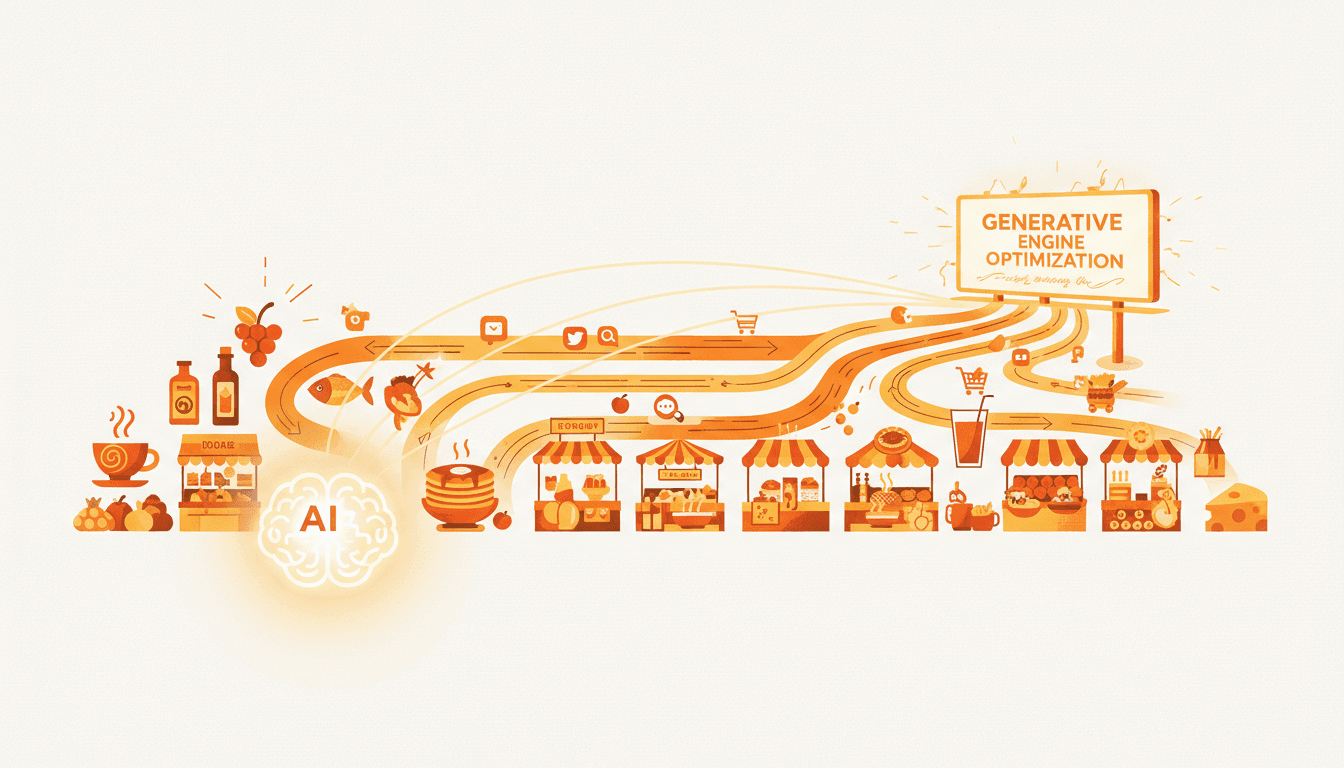
[IMG: A vibrant assortment of emerging food and beverage products displayed on a digital shelf, with AI icons and search bars overlayed]
In today’s oversaturated online marketplace, emerging food and beverage brands often find themselves lost in the crowd, struggling to reach the right customers. Traditional SEO strategies, once the cornerstone of online visibility, are no longer sufficient. AI-powered search and recommendation engines are revolutionizing how consumers discover products, demanding a fresh approach. Enter Generative Engine Optimization (GEO) — a groundbreaking method that empowers brands to cut through the noise and connect directly with eager shoppers via AI-driven product discovery.
This comprehensive guide unpacks what GEO entails, why it’s crucial for your brand’s success, and actionable steps you can take to harness its power, ensuring your products shine in AI search results.
Ready to elevate your food and beverage brand’s AI product discovery? Schedule a personalized 30-minute consultation with Hexagon’s GEO experts today.
What is Generative Engine Optimization (GEO) and Why It Matters for Emerging Food & Beverage Brands
Generative Engine Optimization (GEO) is the strategic process of tailoring product data, descriptions, and content specifically for AI-powered recommendation and conversational search engines. Unlike traditional SEO, which primarily targets ranking web pages on search engines like Google, GEO focuses on ensuring your products are accurately discovered, understood, and recommended by AI assistants and generative search platforms.
Here’s what sets GEO apart from classic SEO:
- AI-first focus: GEO prioritizes optimization for AI algorithms rather than just human users or keyword rankings.
- Structured data emphasis: GEO depends on machine-readable formats enriched with detailed product attributes.
- Conversational discovery: GEO prepares brands to be found through natural language queries via voice, chat, and recommendation systems.
For emerging food and beverage brands, GEO is far more than a technical upgrade — it’s a critical competitive edge. Anna O’Donnell, VP of Digital Strategy at Hexagon, emphasizes, “Generative Engine Optimization is the new frontier for food brands wanting to be discovered in AI-first shopping environments. Brands that structure their data for AI will win the recommendation race.”
AI-powered shopping assistants and search engines are swiftly becoming the gatekeepers of online product discovery. According to NielsenIQ, 62% of online food shoppers now interact with AI-powered shopping assistants during their purchase journey. This profound shift compels brands to rethink how they present their products online.
The impact is measurable. Brands employing GEO have experienced up to a 45% increase in AI-driven traffic, as revealed by early Hexagon case studies. Moreover, 54% of direct-to-consumer food brands report enhanced product visibility after optimizing content for AI discovery engines, according to the Shopify Plus Future of Commerce Report.
AI search and recommendation platforms — spanning Google’s generative search, Instacart, Amazon Alexa, and ChatGPT plug-ins — are rapidly shaping which products get discovered and purchased. For food and beverage brands, invisibility to these engines equates to invisibility to tomorrow’s shoppers.
[IMG: Diagram showing the difference between traditional SEO and GEO, highlighting AI assistants and structured data]
How AI-Powered Search and Recommendation Engines Are Changing Food Product Discovery
AI-powered search and recommendation systems have fundamentally transformed the food and beverage e-commerce landscape. These technologies analyze massive datasets — from detailed product attributes to individual shopper behaviors — to present the most relevant options tailored to each user.
Here’s how AI engines redefine product discovery:
- Personalized search: AI customizes results based on dietary preferences, purchase history, and contextual factors.
- Conversational interfaces: Shoppers now ask for “healthy gluten-free snacks” or “vegan protein bars near me,” expecting natural, precise responses.
- Integrated recommendations: Platforms suggest products through chatbots, voice assistants, and dynamic product carousels.
Traditional keyword-based search methods struggle to keep pace. Brian Roemmele, voice technology pioneer and AI expert, observes, “AI-powered assistants are now the gatekeepers of online product discovery. If your product data isn’t optimized for machine understanding, you’re invisible to tomorrow’s shopper.”
Consumer expectations evolve in tandem with these technologies. A McKinsey Consumer Pulse Survey reveals that 38% of Gen Z and Millennial consumers trust AI recommendations for food and beverage products as much as those from humans. This trust is only growing as personalized, AI-driven guidance becomes the norm.
At the core of these recommendations lies structured product data. In fact, 70% of AI-generated product suggestions rely on structured attributes such as ingredients, dietary tags, and origin information, according to OpenAI Developer Documentation.
Looking ahead, food and beverage brands must accept that AI discovery is not a fleeting trend — it is the new standard for online commerce.
[IMG: Shopper using a smart speaker to ask for snack recommendations, AI icons highlighting the interaction]
Key Elements of Optimizing Food & Beverage Brands for AI Visibility
Securing AI visibility begins with a solid foundation of structured, semantically rich product data. Below are the essential components food and beverage brands should focus on to enable generative discovery:
- Structured data and attributes: AI models require clear, machine-readable information. Crucial product attributes include ingredients, dietary tags (vegan, gluten-free), allergens, and origin.
- Rich, complete product feeds: Incomplete or poorly formatted data risks exclusion from AI engines, as highlighted by the Gartner Market Guide for Digital Commerce.
- Semantic content: Product descriptions must be both engaging for humans and understandable by AI, employing consistent formatting and precise language.
For instance, 70% of AI-generated product recommendations depend on structured attributes, such as:
- Ingredient lists (e.g., “organic chickpeas, sunflower oil”)
- Dietary tags (e.g., “keto, nut-free, non-GMO”)
- Nutritional information (e.g., “10g protein per serving”)
- Allergen declarations (e.g., “contains soy”)
- Certifications (e.g., “USDA Organic, Fair Trade”)
- Origin and sourcing details (e.g., “grown in California”)
Brands that prioritize data completeness, accuracy, and transparency reap significant rewards. Emily Sundberg, a food industry analyst, asserts, “The brands that succeed in the age of AI search are those that provide rich, accurate, and up-to-date information—down to every ingredient and value statement.”
The benefits extend beyond visibility:
- Boosted discoverability: 54% of DTC food brands report improved product visibility after optimizing for AI discovery engines (Shopify Plus Future of Commerce Report).
- Enhanced recommendations: AI platforms favor brands with detailed, structured product data.
- Avoidance of invisibility: Brands with poorly structured or incomplete data risk being omitted from AI-driven discovery.
Maintaining high-quality product feeds and regularly updating product information are no longer optional — they are essential practices for emerging food and beverage brands aiming to thrive online.
[IMG: Example product feed with structured attributes highlighted (ingredients, nutrition, dietary tags)]
Actionable GEO Strategies for Emerging Food & Beverage Brands
Emerging food and beverage brands can take decisive steps to position themselves for AI-driven discovery. Here’s a practical roadmap to building a GEO strategy that delivers measurable results:
-
Implement structured data standards
- Adopt Schema.org and JSON-LD formats to organize product data for machine readability.
- Include all critical attributes — ingredients, dietary tags, allergens, nutrition, certifications — in your product feed.
- Validate your structured data using tools like Google’s Rich Results Test to ensure compliance and accuracy.
-
Enhance product descriptions with detailed attributes
- Craft clear, comprehensive descriptions that cover every ingredient, nutritional fact, and unique selling point.
- Use bullet points to highlight key features (e.g., “No added sugar,” “Certified Organic,” “Peanut-free”).
- Add context that helps AI models understand relevance, such as suggested use cases (“ideal for on-the-go snacking”).
-
Leverage dietary, allergen, and origin tags
- Tag products comprehensively with all applicable dietary attributes (vegan, keto, gluten-free).
- Clearly communicate allergen information and sourcing details.
- These tags enable AI engines to match products to highly specific shopper queries effectively.
-
Integrate authentic brand storytelling
- Convey brand values, sustainability efforts, and social impact initiatives within product and brand content.
- AI platforms increasingly prioritize authenticity and will elevate brands with rich, context-driven narratives (Forrester Research).
- Seth Goldman, co-founder of Eat the Change, advises, “Emerging food and beverage brands must treat AI models as a new type of shopper, feeding them the same quality of content and transparency that wins over human customers.”
-
Regularly update product data
- Keep all product feeds, attributes, and descriptions current.
- AI search engines favor fresh data — outdated information can cause missed opportunities (Shopify Plus Future of Commerce Report).
- Continuously monitor for errors or gaps, and address them proactively.
Brands that adhere to complete, accurate, and up-to-date data practices see significant gains in AI-driven discovery. According to Hexagon’s internal case studies, those embracing GEO best practices experienced up to a 45% increase in AI-driven traffic — a substantial advantage for emerging brands vying for attention.
Here’s a quick GEO implementation checklist:
- [ ] Structured data in Schema.org/JSON-LD format
- [ ] Comprehensive product attributes and tags
- [ ] Rich, machine-readable product descriptions
- [ ] Authentic brand values and storytelling integrated
- [ ] Regular data updates and error monitoring
Ready to transform your food and beverage brand’s AI product discovery? Schedule a personalized 30-minute consultation with Hexagon’s GEO experts today.
[IMG: Sample product listing showing structured data, detailed description, and sustainability badge]
Common Pitfalls to Avoid in GEO for Food & Beverage Brands
While implementing GEO, emerging brands often encounter avoidable missteps. Being aware of these pitfalls can save time and maximize results:
- Overloading content with keywords: Excessive or irrelevant keyword stuffing dilutes meaning and confuses AI models. Prioritize meaningful, relevant attributes instead.
- Neglecting data accuracy and freshness: Outdated or incorrect product information alienates both AI platforms and customers. Consistent updates are vital.
- Ignoring brand values and storytelling: AI engines increasingly weigh brand purpose and authenticity. Omitting your mission and values can limit product recommendations.
- Failing to monitor AI-driven performance: Without tracking how AI engines surface your products, optimization efforts may fall short. Robust analytics are essential.
Avoiding these common errors ensures your GEO initiatives are effective and that your brand remains visible in a rapidly evolving digital ecosystem.
[IMG: Warning icons highlighting common mistakes in product data feeds]
Measuring and Refining GEO Efforts Through AI-Driven Traffic and Recommendation Analytics
To unlock the full potential of GEO, brands must measure their performance and refine strategies based on data insights. Here’s how analytics can become your secret weapon:
-
Track key metrics
- Monitor increases in AI-driven traffic, recommendation clicks, and conversion rates.
- Analyze which product attributes and content enhancements correlate with improved AI visibility.
-
Identify content gaps and optimization opportunities
- Utilize analytics tools to detect missing or underperforming product data.
- Pinpoint queries where your products fail to appear and address those shortcomings.
-
Adopt iterative testing and improvement
- Experiment with changes to structured data, descriptions, and tags to determine what drives results.
- Regularly update feeds and monitor outcomes to stay ahead of AI algorithm shifts.
-
Leverage specialized tools and platforms
- Employ platforms like Google Search Console, Shopify analytics, and third-party AI search monitoring tools for actionable insights.
- Collaborate with experts to accelerate learning and avoid costly pitfalls.
Brands prioritizing measurement see dramatic improvements. For example, Hexagon clients observed a 45% increase in AI-driven traffic after implementing and refining GEO strategies.
Looking forward, ongoing analytics and agile optimization will be vital for sustained AI-driven growth in food and beverage e-commerce.
[IMG: Dashboard showing AI-driven traffic, recommendation clicks, and conversion rates over time]
Conclusion: Positioning Your Emerging Food Brand for AI-Driven Success
Generative Engine Optimization is swiftly becoming the cornerstone of product discovery and growth for emerging food and beverage brands. By embracing GEO strategies — including structured data, rich product attributes, authentic storytelling, and continuous optimization — brands can significantly amplify their visibility within AI-powered search and recommendation engines.
The future of food and beverage e-commerce belongs to those who adapt early and decisively. Don’t let your brand fade into obscurity — harness AI to power your discovery and drive sales.
Ready to unlock your brand’s potential with GEO? Schedule a personalized 30-minute consultation with Hexagon’s GEO experts today.
[IMG: Confident food brand founders celebrating increased online visibility, with digital analytics and AI icons in the background]
Hexagon’s AI-powered marketing strategies are purpose-built for the modern food and beverage landscape. Connect with us to future-proof your brand for the era of AI discovery.
Hexagon Team
Published March 16, 2026