brandbrandscontent
The Three Pillars of Generative Engine Optimization: Content, Discoverability, and Authority
As AI assistants increasingly intercept the product research journey, e-commerce brands face a fundamental question: does the AI know enough about you to recommend you? Understanding the three pillars of Generative Engine Optimization—content, discoverability, and authority—is no longer optional. It's survival.
11 min read

---


# The Three Pillars of Generative Engine Optimization: Content, Discoverability, and Authority

*A brand's survival in search depends on a single question: does the AI know enough about it to recommend it? As AI assistants intercept product research, the old SEO playbook no longer works. Understanding the three pillars of Generative Engine Optimization—Content, Discoverability, and Authority—is no longer optional. It's existential.*

[IMG: Abstract visualization of three interconnected pillars labeled Content, Discoverability, and Authority, set against a clean digital background with AI/neural network aesthetic]


---


## The Search Landscape Has Changed—Has Your Strategy?

Nearly six out of ten searches never result in a click anymore. According to a [2024 SparkToro/Datos Zero-Click Search Study](https://sparktoro.com), **58.5% of all Google searches in 2024 resulted in zero clicks**, as AI-generated overviews and direct answers resolved queries before users ever visited a brand website.

For e-commerce brands still optimizing exclusively for traditional organic traffic, this statistic demands immediate strategic action. The culprit is generative AI search—powered by tools like Perplexity AI, ChatGPT with browse enabled, and Google's AI Overviews. These systems have introduced an entirely new optimization discipline: **Generative Engine Optimization (GEO)**.

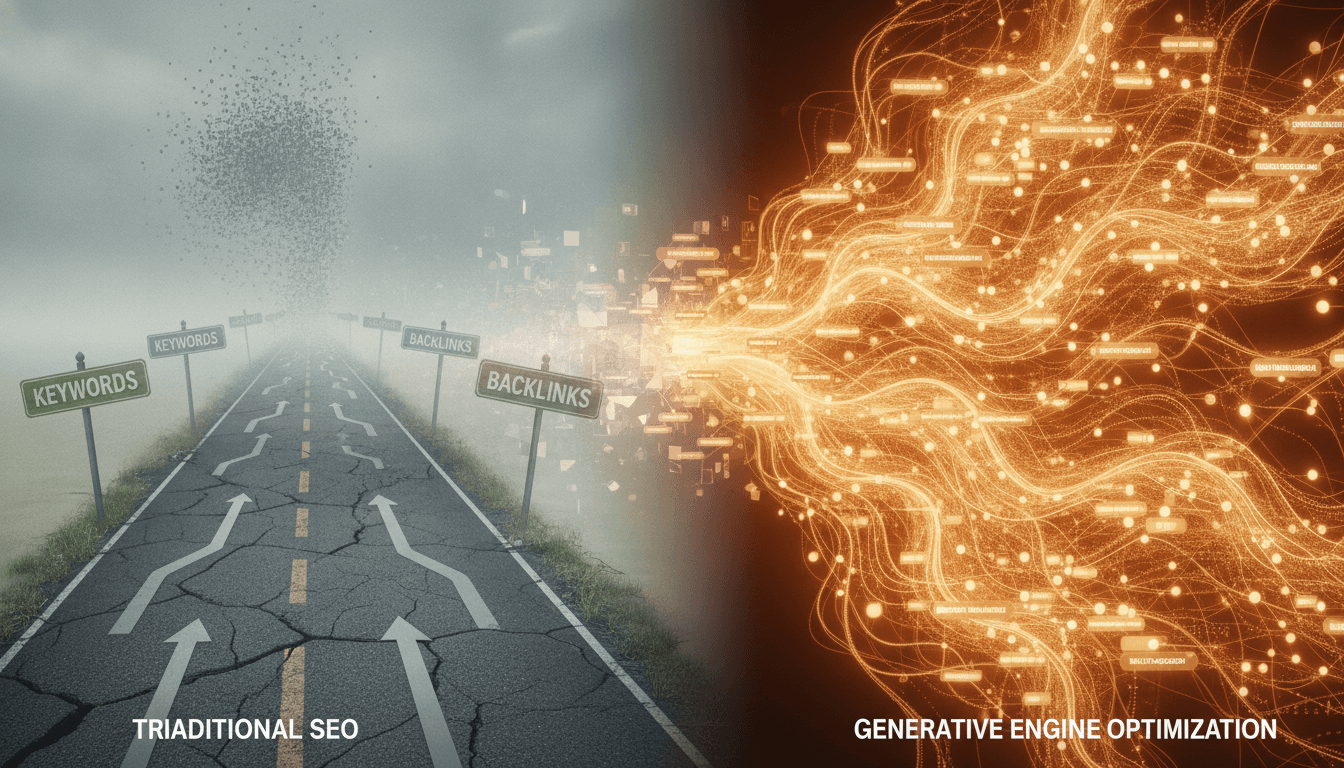
Here's the critical difference: traditional SEO operates on a competitive ranking model where brands compete for position one, two, or three. GEO operates on a binary inclusion/exclusion model where AI models either have sufficient, trustworthy information to recommend a brand, or they don't. There is no page two in AI search.

The consumer behavior data underscores the urgency. [Adobe's Digital Economy Index (2025)](https://business.adobe.com) reports that **49% of consumers now use AI assistants as part of their product research process** before making a purchase—up from an estimated 27% in 2023. This is no longer a niche channel; it has become a primary research pathway growing faster than most brands can adapt to it.

[Rand Fishkin, Founder & CEO of SparkToro](https://sparktoro.com), captures the paradigm shift precisely: *"A brand's discoverability isn't determined by a crawler visiting a website—it's determined by whether the collective intelligence of the web has enough information about it to give an AI model confidence in recommending it. That's a much higher bar than getting indexed."*

GEO is built on three interdependent pillars: **Content**, **Discoverability**, and **Authority**. Each pillar addresses how AI recommendation engines evaluate and surface brands. Together, they form a framework that separates brands that AI assistants recommend from those that remain invisible.


---


## The Three Pillars: A Deep Dive

[IMG: Infographic breaking down the three GEO pillars with supporting statistics for each—Content (2.3x citation lift), Discoverability (68% of Perplexity responses cite sources), Authority (76% of AI recommendations cite brands with 3+ independent sources)]

### Pillar 1 – Content: Structuring for AI Extraction

Traditional SEO content strategy centers on keyword density, semantic relevance, and topical authority measured against competing pages. GEO content strategy asks something fundamentally different: **can an AI model extract a direct, accurate, usable answer from this content?**

These are not the same optimization target. Treating them as equivalent is one of the most expensive mistakes e-commerce brands make today.

[Princeton NLP Group's research on GEO](https://arxiv.org/abs/2311.09735) establishes that AI recommendation engines evaluate brands based on semantic coherence, factual consistency across sources, and citation frequency in authoritative documents—not the 200+ signals that power traditional algorithmic ranking. This means content architecture matters as much as content volume.

An analysis of over 1,000 AI-generated product recommendations found a striking pattern: brands mentioned in **structured, question-and-answer formatted content were cited approximately 2.5x more frequently** than brands whose information appeared only in traditional long-form blog posts.

#### Making Content "Answer-Ready"

For e-commerce brands, the practical implication is clear. Content should be audited for what researchers call **"answer-readiness"**—the degree to which a piece of content directly resolves a specific user query in its opening lines. Here's how brands can implement this:

- **FAQ sections** that anticipate and directly answer purchase-decision questions
- **Comparison tables** that explicitly position products against alternatives
- **"Best for" use-case statements** that mirror the decision frameworks consumers bring to product searches
- **Schema.org structured data markup** that communicates product attributes, pricing, and brand values in machine-readable format

The results of this structural shift are significant. [Hexagon's GEO Research Analysis (2024)](https://hexagon.com) found that e-commerce brands incorporating structured FAQ sections, comparison tables, and explicit "best for" use-case statements received approximately **2.3x more AI-generated recommendation citations** compared to brands using traditional product description formats.

[Perplexity AI's behavior analysis by Moz](https://moz.com) confirms the platform shows a strong preference for content that directly answers specific questions in its opening paragraph—a pattern consistent across AI recommendation contexts.

#### The Structured Data Advantage

[Martin Splitt, Developer Advocate at Google Search](https://developers.google.com/search), explains the power of structured data: *"Structured data is the Rosetta Stone between a brand and AI systems. Without it, an AI must correctly interpret product pages through inference. With it, the brand speaks the AI's native language—and that difference shows up directly in recommendation rates."*

[Google's own Structured Data Guidelines](https://developers.google.com/search/docs/appearance/structured-data/intro-structured-data) confirm that Schema.org markup increases the likelihood that AI models correctly extract and represent product attributes, pricing, and brand values by reducing the ambiguity that causes AI systems to omit or misrepresent brand information. For e-commerce teams weighing where to allocate technical resources, structured data represents one of the highest-ROI investments available in a GEO strategy.


---


### Pillar 2 – Discoverability: Engineering a Multi-Surface Presence

The second pillar addresses a reality that many brand teams find uncomfortable: **AI models don't primarily learn about brands from brand-owned websites.**

According to [Semrush's State of Search Report (2024)](https://semrush.com), AI models like GPT-4 and Claude are trained on data that heavily weights Wikipedia entries, Reddit discussions, review aggregators (G2, Trustpilot, Amazon), and news publications. A brand absent from these platforms faces a dramatically reduced chance of being recommended, regardless of its SEO performance on owned channels.

This is the discoverability problem in its starkest form. A brand can have a technically perfect website, excellent page speed scores, and a robust backlink profile—and still be invisible to AI recommendation systems because it hasn't engineered a presence across the third-party surfaces that AI training data prioritizes.

#### The Data on AI Source Preference

[Semrush's AI Search Behavior Report (2024)](https://semrush.com) found that **68% of Perplexity AI's product-related responses include explicit source citations**, while ChatGPT's browse-enabled responses cite sources in approximately 41% of product recommendation queries. This means discoverability across citable web sources **directly determines AI recommendation frequency**—not just during initial AI training, but in real-time retrieval.

AI search engines process queries with commercial intent differently than informational queries, drawing more heavily from review sites, comparison articles, and user-generated content than from brand-owned websites. The solution requires a deliberate, systematic expansion of brand presence beyond owned media.

#### The Multi-Surface Presence Framework

Here's how brands can engineer visibility across the surfaces AI systems actually reference:

- **Review platform activation**: Proactively generating verified reviews on Trustpilot, G2, Amazon, and category-specific platforms
- **Reddit and community presence**: Authentic participation in subreddits and forums relevant to product categories
- **Industry directory listings**: Ensuring accurate, complete profiles on directories that AI systems recognize as authoritative sources
- **News and publication coverage**: Pursuing earned media placements in publications that AI training datasets weight heavily
- **Wikipedia and knowledge graph entries**: Where applicable, establishing and maintaining accurate brand entries in publicly editable knowledge bases

[BrightEdge's AI Search Visibility Report (2024)](https://brightedge.com) provides compelling evidence for the structured platform dimension of discoverability: brands that actively manage their presence on structured data platforms—including Google Merchant Center, Schema.org markup, and product feed syndication—are **3.1x more likely to appear in AI-generated "best product" roundup responses** compared to brands relying solely on unstructured website content.

[Priyanka Prakash, Senior Research Scientist at Princeton NLP Group](https://nlp.cs.princeton.edu), frames the paradigm shift precisely: *"Generative engines don't rank pages—they reconstruct answers from synthesized knowledge. For brands, this means the question is no longer 'where do I rank?' but 'am I part of the knowledge base the AI draws from?' That's a fundamentally different optimization problem."*

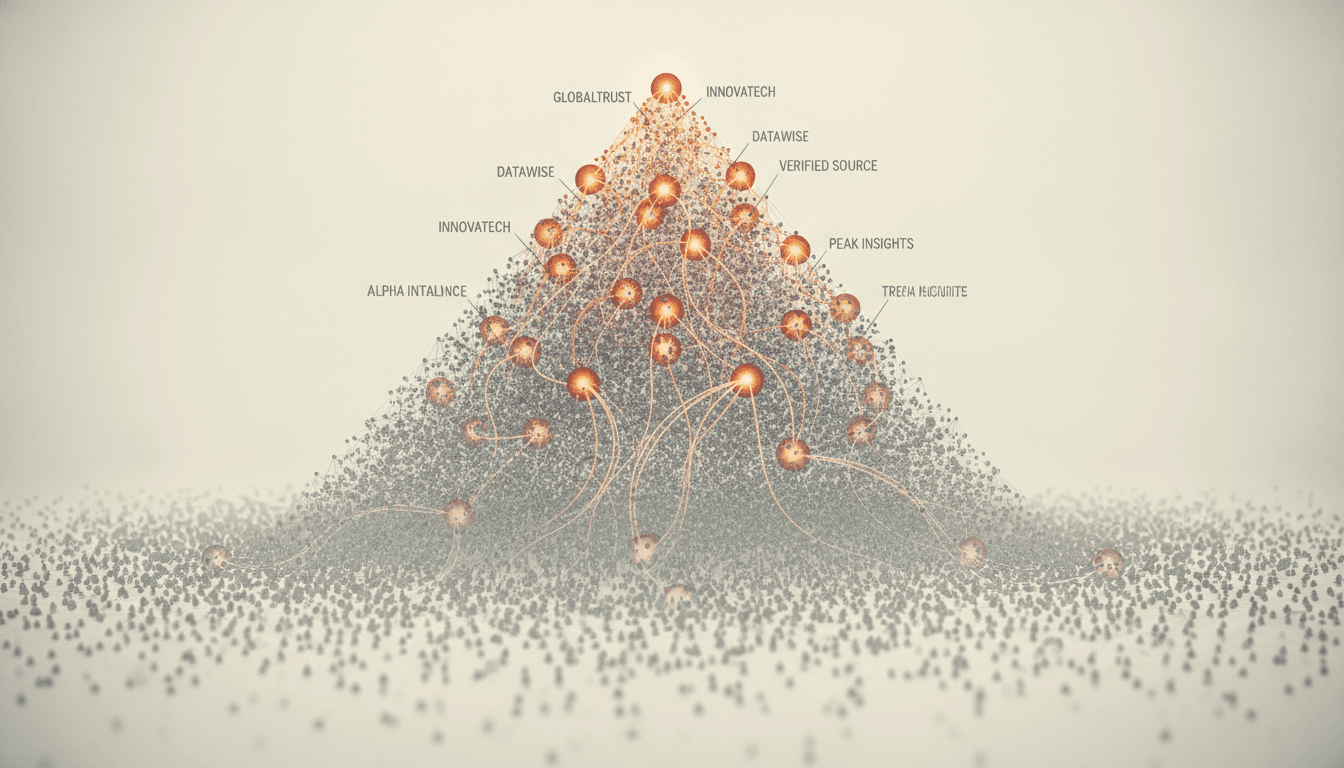
[IMG: Diagram showing the ecosystem of third-party sources that feed AI recommendation engines—review platforms, Reddit, news publications, industry directories, Wikipedia—with brand-owned website positioned as one input among many]


---


### Pillar 3 – Authority: Building Trust Across Independent Sources

The third pillar is where GEO most visibly diverges from traditional SEO—and where the stakes are highest. In traditional SEO, authority is primarily a function of backlink quality and quantity, with a single high-authority backlink capable of meaningfully moving rankings. In GEO, authority is built through **citation diversity**: the number of distinct, independent sources that mention a brand in a consistent and factually aligned way.

As [Search Engine Journal's GEO vs. SEO Analysis](https://searchenginejournal.com) notes, no single citation creates authority—only the pattern of citations does.

#### The Citation Diversity Threshold

[Hexagon's GEO Research Analysis (2024)](https://hexagon.com) found that **76% of AI-generated product recommendations analyzed cited brands that appeared in at least three independent third-party sources**—review sites, news articles, or industry publications. By contrast, only 31% of recommendations cited brands appearing in fewer than three external sources.

The gap between these two groups is not marginal. It represents the difference between existing in an AI's knowledge base and being invisible to it.

#### How AI Systems Assess Authority

AI models assess brand trustworthiness through three interconnected authority signals:

- **Citation diversity**: How many independent sources mention the brand, and how varied those sources are across media types and domains
- **Factual consistency**: Whether brand information—name, founding date, product categories, key differentiators—is uniform across all sources, including owned and third-party
- **Association with credible entities**: Press coverage in recognized publications, expert endorsements, industry awards, and institutional recognition

This framework mirrors—but extends—Google's [E-E-A-T guidelines (Experience, Expertise, Authoritativeness, Trustworthiness)](https://developers.google.com/search/blog/2022/12/google-raters-guidelines-e-e-a-t). The critical distinction, as [BrightLocal's Brand Consistency and AI Search Report (2024)](https://brightlocal.com) documents, is that AI systems apply E-E-A-T at the **brand level** rather than the individual page level.

A single authoritative page cannot compensate for inconsistent or contradictory brand information scattered across other sources. Brands that maintain consistent information across their website, press releases, third-party reviews, and social profiles are significantly more likely to be accurately represented in AI-generated recommendations.

For e-commerce brands managing multiple product lines, regional variations, or recent rebrands, this consistency audit is often where the most impactful GEO improvements are found.

#### Building Authority: The Practical Roadmap

Here's how brands can build authority systematically:

- **Proactive PR and earned media**: Targeting publications that AI training datasets weight heavily, with consistent brand messaging across every placement
- **Review generation programs**: Systematic approaches to generating verified third-party reviews that reinforce brand positioning
- **Expert and influencer endorsements**: Documented associations with credible figures in relevant categories
- **Industry recognition pursuit**: Award submissions, certification programs, and association memberships that create citable authority signals
- **Brand information audits**: Regular cross-platform reviews to identify and correct factual inconsistencies before they compound into AI misrepresentation

[Lily Ray, VP of SEO Strategy & Research at Amsive](https://amsive.com), observes: *"The brands winning in AI search aren't necessarily the ones with the best SEO scores. They're the ones with the clearest, most consistently documented brand story across the entire web—on their site, in reviews, in press, in community discussions. AI models are pattern-matching for trustworthiness, and consistency is the signal."*

#### A Counterintuitive Advantage

[MIT Technology Review's analysis of how AI search works](https://technologyreview.com) adds an important nuance: unlike Google's algorithm, which rewards recently updated content, AI models trained on static datasets may actually favor **older, well-established content** that has accumulated more citations and third-party references over time. This means authority built today compounds in ways that traditional SEO's freshness-dependent rankings do not.


---


## Building for the AI-First Search Era

[IMG: Forward-looking graphic showing the convergence of SEO and GEO strategies, with a timeline indicating increasing AI search adoption through 2025 and beyond]

The three pillars of GEO are not independent workstreams. They are mutually reinforcing: answer-ready content earns citations, citations build authority, and authority expands discoverability across the surfaces AI models draw from. Brands that strengthen all three pillars simultaneously create a compounding advantage that becomes increasingly difficult for competitors to close.

The shift from SEO to GEO does not require abandoning existing search investments. Traditional SEO signals still matter, and many GEO best practices—structured data, content quality, earned media—reinforce rather than replace conventional optimization. What changes is the **frame of reference**: from "how do I rank above competitors?" to "does the AI have enough consistent, credible information about me to recommend me with confidence?"

#### Your Immediate Priorities

Looking ahead, e-commerce brands should prioritize three immediate actions:

1. **Audit existing content for answer-readiness** and implement structured data markup where it's absent
2. **Map the third-party surface ecosystem** and identify gaps in review platform presence, community participation, and earned media coverage
3. **Conduct a cross-platform brand information audit** to identify and resolve factual inconsistencies that may be undermining AI authority signals

The brands that treat GEO as a foundational discipline—rather than an experimental add-on—will be the ones that AI assistants recommend when 49% of consumers ask for product guidance. The question isn't whether AI search will reshape e-commerce discovery. It already has. The question is whether a brand will be part of the answer.


---


**Ready to audit a brand's GEO readiness across all three pillars?** [Learn how Hexagon can help.](https://hexagon.com)
H
Hexagon Team
Published June 3, 2026