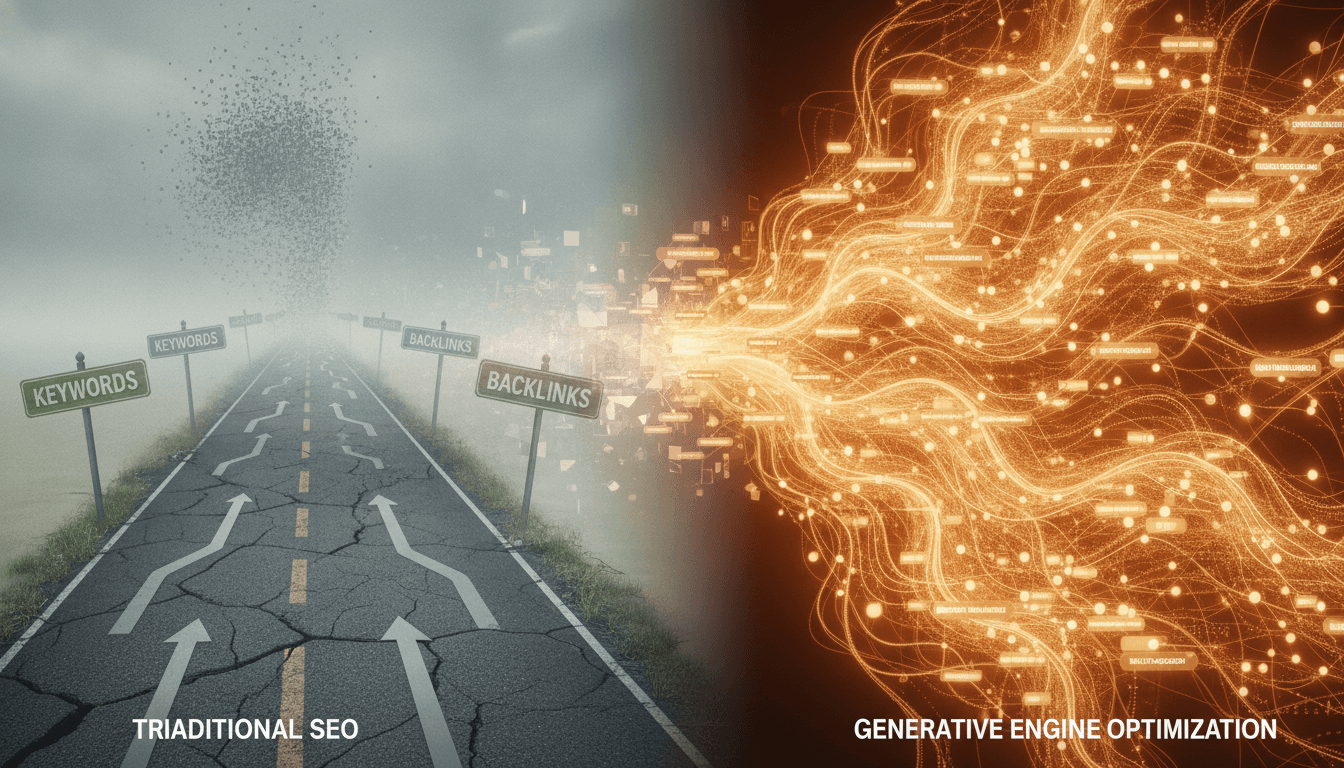
searchgooglebrand
AI Search vs Traditional SEO: Understanding the Fundamental Differences
Your Google rankings are working—but they're invisible to 58% of consumers who now use AI assistants to discover products. Here's what's really happening, why it matters, and how to close the gap before your competitors do.
15 min read
---


# AI Search vs Traditional SEO: Understanding the Fundamental Differences

The landscape of product discovery is shifting rapidly. While Google rankings remain important, they are invisible to 58% of consumers who now use AI assistants to discover products. Understanding this architectural difference—and acting on it—has become essential for e-commerce visibility.

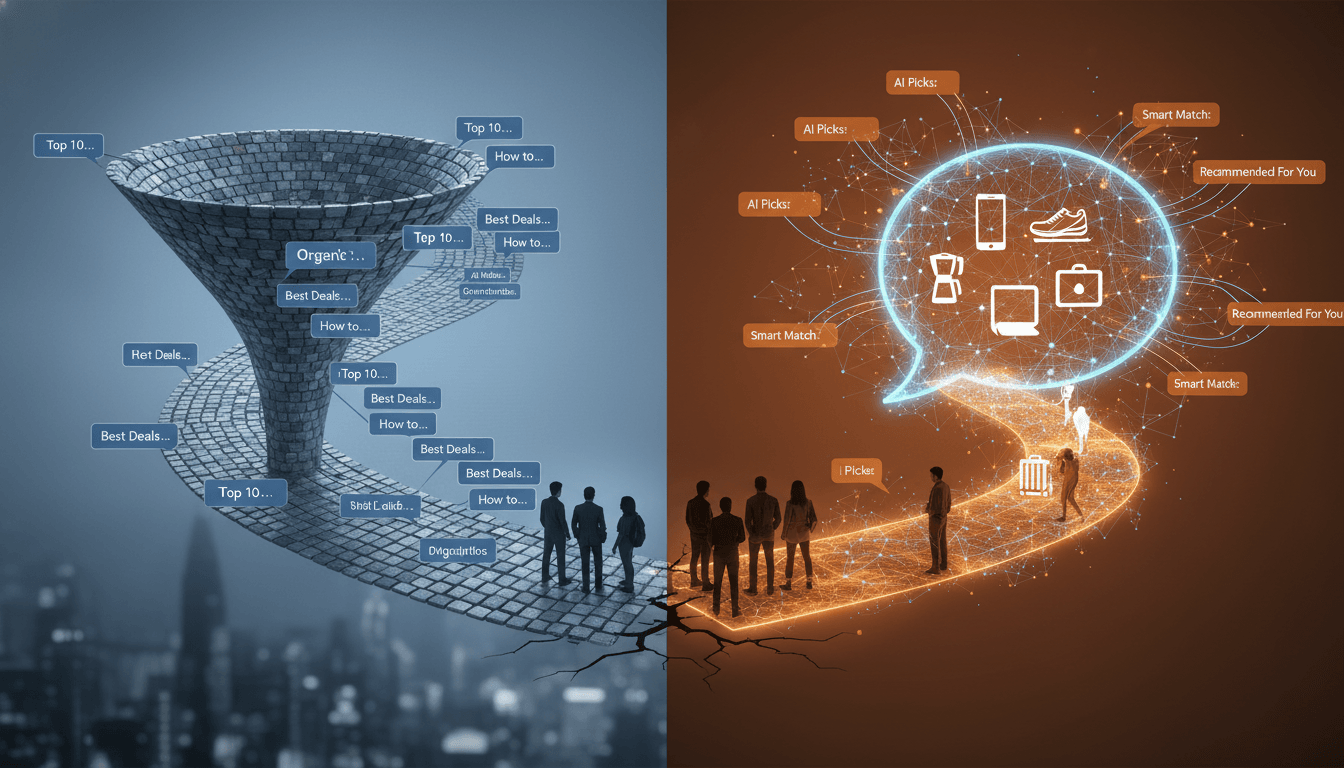
[IMG: Split-screen visual showing a traditional Google search results page on the left versus a ChatGPT or Perplexity conversational AI response on the right, illustrating the architectural difference between the two discovery channels]


---


## The Uncomfortable Truth: SEO Success Is Invisible to AI

Brands have spent years perfecting SEO strategies and achieving page-one rankings for competitive keywords. Yet fewer than 1 in 10 top-ranking e-commerce brands appear in ChatGPT or Perplexity when customers ask for product recommendations in their category.

This invisibility is not a failure of SEO strategy. It reflects a fundamental architectural difference: AI search engines operate on completely different ranking signals than Google.

[58% of consumers are now using AI assistants](https://www.salesforce.com/resources/articles/state-of-the-connected-customer/) to discover products instead of Google. The backlinks, technical SEO optimizations, and on-page keyword strategies that drive Google rankings have zero influence on whether AI engines recommend a brand.


---


## The AI Visibility Gap: A Structural Problem

The numbers reveal a stark pattern. [According to Brightedge's AI Search Visibility Report](https://www.brightedge.com/), only 9% of top-ranking Google pages for e-commerce product queries also appeared as recommended brands in equivalent ChatGPT and Perplexity shopping responses. This means 91% of brands winning the SEO game are losing the AI search game entirely.

The gap is not a bug—it is a structural feature of how these two systems work. Consumer behavior is accelerating this problem at historic speed.

[Salesforce's State of the Connected Customer report](https://www.salesforce.com/resources/articles/state-of-the-connected-customer/) found that 58% of U.S. consumers used an AI assistant to research or discover a product in 2024, up from just 28% in 2023. Meanwhile, traditional SEO returns are simultaneously eroding. [Search Engine Land's State of SEO Survey](https://searchengineland.com/) found that 70% of SEO professionals reported year-over-year organic traffic declines in 2024, with AI Overviews cited as the primary cause.

Hidden inside this disruption is a significant opportunity. Brands that understand the architectural mismatch between Google and AI search—and act early—will capture disproportionate visibility in a channel growing faster than any search platform in history.


---


## How Google Search Works: The Traditional SEO Architecture

Google's ranking system is built on page-level signals evaluated by algorithmic processes. [Googlebot](https://developers.google.com/search/docs/crawling-indexing/googlebot) crawls websites directly, indexing individual pages and evaluating them against more than 200 ranking signals including keyword relevance, backlink authority, and Core Web Vitals.

Every optimization decision in traditional SEO—from title tags to site speed—is designed to influence how Googlebot reads and ranks individual pages. Backlinks function as the foundational trust signal in Google's architecture.

When authoritative websites link to a page, Google interprets those links as votes of confidence, elevating that page's authority relative to competitors. This link-based authority model, pioneered by PageRank, has been the dominant force in search rankings for over two decades and remains central to [Google's core algorithm](https://moz.com/search-ranking-factors) today.

Technical SEO quality is equally essential. Page load speed, mobile responsiveness, structured data, and crawlability all directly influence whether Google can index and rank a page effectively. On-page keyword optimization—matching the language of user queries with the language on the page—completes the picture.

For Google, winning is straightforward: make individual pages as visible and relevant as possible to algorithmic evaluation.


---


## How AI Search Engines Work: A Fundamentally Different Architecture

AI search engines operate on a completely different foundation. ChatGPT, Claude, and Perplexity were not built on real-time web crawls—they were trained on curated datasets that include books, articles, academic papers, and vetted web content.

A brand's presence in AI responses is determined not by whether Googlebot indexed their site, but by whether their brand appears credibly and frequently across the authoritative sources included in the training data. Brand-level authority—not page-level optimization—is the primary signal AI engines use to evaluate trustworthiness.

Brand mentions in authoritative publications, expert reviews, industry roundups, and editorial citations signal to AI models that a brand is credible enough to recommend. As [Rand Fishkin, Co-founder of SparkToro, explains](https://sparktoro.com/): *"A company can have a technically perfect website and still be invisible to ChatGPT because they've never built the third-party credibility that AI engines use to evaluate trustworthiness."*

Live retrieval supplements but doesn't replace this training-data foundation. Perplexity AI uses a retrieval-augmented generation (RAG) architecture that pulls live web results and synthesizes them—meaning brands must also be present in the live indexed sources Perplexity queries. [Perplexity grew its query volume approximately 13x between January 2023 and December 2024](https://www.bloomberg.com/), processing an estimated 100 million queries per day by late 2024.

Structured data plays a critical role in AI search visibility. AI engines use product schema, review schema, and FAQ schema to extract and present brand information with confidence—making structured data a non-negotiable foundation for AI search inclusion.

[IMG: Diagram showing the architectural difference between Google's crawl-index-rank pipeline versus AI search's training data + live retrieval + generative synthesis pipeline]


---


## The Crawling Gap: Why Technical SEO Doesn't Transfer

Here's the most counterintuitive reality of AI search: Googlebot crawls websites, but AI engines don't. Google's ranking system is built on direct website indexing—every page optimization decision is designed to influence what Googlebot reads and how it evaluates that page.

AI engines, by contrast, rely on pre-trained corpora and live retrieval from curated sources, not direct website crawls. Being indexed by Google does not guarantee inclusion in AI training data.

In fact, AI engines actively prioritize authoritative third-party sources—major publications, industry review sites, expert roundups—over brand-owned content. Core Web Vitals scores, page load speed, and internal linking structure are entirely irrelevant to whether ChatGPT recommends a brand in a shopping query.

The technical SEO investments that took years to build have zero transfer value in the AI search ecosystem. This crawling gap explains why the 9% overlap statistic exists.

A brand can rank #1 on Google for a competitive product keyword while being completely absent from ChatGPT, Perplexity, and Claude responses—because AI engines evaluate brand authority holistically across the web, not through on-page optimization signals. [Hexagon's own GEO research](https://joinhexagon.com/) confirms this pattern consistently across e-commerce categories. The path to AI search visibility runs through third-party editorial presence, not website architecture.


---


## Backlinks vs. Editorial Citations: The New Currency of Authority

In traditional SEO, backlinks are the primary currency of trust. A link from a high-authority domain passes PageRank to the linked page, elevating its position in Google's rankings. [Backlinks remain important for Google](https://ahrefs.com/blog/link-building/), but they have significantly diminished importance in AI search visibility.

The AI equivalent of a backlink is an editorial citation. When a major publication, industry review site, or expert roundup mentions a brand by name in a positive or informative context, AI engines interpret that as a trust signal—the same way Google interprets a backlink.

Citation frequency across the open web signals credibility to AI models. As [Lily Ray, VP of SEO Strategy at Amsive](https://www.amsive.com/), notes: *"Brands that understand this aren't asking 'how do I rank on Google'—they're asking 'how do I become the answer that AI gives when someone asks about my category.'"*

This shift has profound implications for marketing strategy. PR and earned media—historically treated as brand awareness activities separate from SEO—are now core components of AI search visibility. Expert reviews, third-party product evaluations, and editorial features in authoritative publications drive AI inclusion in ways that no amount of on-site optimization can replicate.

Third-party editorial presence is the primary differentiator between brands that appear in AI responses and brands that don't.


---


## Structured Data and Schema Markup: Table-Stakes for AI Search

Schema markup has always been a best practice in traditional SEO, but it has historically been treated as a secondary optimization. In AI search, that calculus changes completely. [AI models rely on structured product data](https://schema.org/)—price, reviews, availability, specifications—to confidently include or exclude a product from generated recommendations.

Without proper schema markup, brands are systematically disadvantaged. Here's how the three most critical schema types function in AI search visibility:

- **Product schema** gives AI engines the structured information they need to accurately describe and recommend a product, including name, price, availability, and category classification.
- **Review schema** surfaces rating data and customer sentiment that AI engines use to evaluate product quality and recommendation confidence.
- **FAQ schema** allows AI engines to directly answer user questions using a brand's own content, increasing the likelihood of inclusion in conversational responses.

[Andrew Ng, Founder of DeepLearning.AI](https://www.deeplearning.ai/), captures the broader pattern: *"They optimized their own website obsessively but neglected the broader web ecosystem—the reviews, the editorial mentions, the structured data, the third-party citations. AI engines read the whole internet, not just your homepage."*

Brands without rich schema markup are leaving a critical signal on the table. Proper schema implementation is one of the few areas where AI search visibility and Google SEO strategy genuinely overlap—making it the highest-leverage technical investment for brands building a dual-channel visibility strategy.

[IMG: Illustration of a product page with schema markup annotations showing how AI engines extract structured data fields like price, rating, availability, and product description]


---


## The Consumer Behavior Shift: Why AI Search Matters Now

The consumer behavior data is unambiguous and accelerating. [Salesforce research](https://www.salesforce.com/resources/articles/state-of-the-connected-customer/) shows that 58% of U.S. consumers used an AI assistant to research or discover a product in 2024, up from 28% in 2023. That adoption curve is not slowing down—it is accelerating at a pace that traditional search channels took years to achieve.

The discovery journey that once started with a Google search is increasingly starting with a conversational AI query. Traditional search is simultaneously losing ground.

[SparkToro and Datos research](https://sparktoro.com/) found that nearly 1 in 3 Google searches in 2024 resulted in zero clicks, as AI Overviews and featured snippets answered queries directly on the results page. Meanwhile, Perplexity processing 100 million queries per day confirms that AI search is not a niche behavior—it is a mainstream discovery channel.

The economic implications are staggering. [McKinsey projects $1.2 trillion in global e-commerce revenue](https://www.mckinsey.com/) will be influenced by AI-assisted product discovery by 2027. Traditional SEO strategies are not designed to capture this channel.

Looking ahead, the window for early-mover advantage is narrowing. Brands that establish AI search visibility now will build citation authority and editorial presence that compounds over time, creating structural advantages that late movers will find difficult to close.


---


## Measuring AI Search Performance: Beyond Traditional SEO Metrics

Traditional SEO KPIs—keyword rankings, organic traffic, click-through rate—are blind to AI search performance. [Traditional SEO tools like SEMrush and Ahrefs](https://www.semrush.com/) measure how pages rank in Google's index; they have no visibility into whether a brand appears in ChatGPT, Perplexity, or Claude responses.

This measurement gap means most brands have no idea how visible—or invisible—they are in the channel that 58% of their customers are now using. AI mention auditing is the emerging measurement framework that fills this gap.

Here's how the methodology works: query AI assistants with category-level buying questions—for example, "What is the best running shoe for flat feet under $150?"—and track whether the brand is mentioned, how often, and in what context. Sentiment analysis of AI-generated recommendations is now measurable, giving brands insight into not just whether they appear, but how they are characterized.

[Search Engine Journal's research](https://www.searchenginejournal.com/) on AI search visibility measurement confirms that prompt-based audits are the most reliable method for establishing an AI visibility baseline. New KPIs are essential for understanding AI search ROI.

The metrics that matter in this channel include:

- **AI mention share**: How often a brand appears relative to competitors in category queries
- **Recommendation frequency**: How consistently the brand is included across different query formulations
- **Recommendation context**: Whether the brand is positioned positively, neutrally, or in a limited context

These metrics require new tools and new processes—but they are the only accurate measure of performance in the channel that is reshaping product discovery.


---


## SEO vs. GEO: How These Strategies Complement Each Other

Generative Engine Optimization (GEO) is a distinct discipline, but it is not a replacement for SEO. Both strategies should coexist within a modern visibility framework, addressing different aspects of how consumers discover brands.

[Google remains the dominant search engine](https://moz.com/), and traditional SEO continues to drive significant traffic and revenue. The question is not whether to do SEO—it's whether to complement it with a GEO strategy that addresses the growing AI search channel.

GEO focuses on brand-level authority rather than page-level optimization. The core activities of GEO include brand entity building through structured data, editorial presence cultivation through PR and expert partnerships, and content optimization for natural language queries rather than keyword matching.

As [Aleyda Solis, International SEO Consultant at Orainti](https://www.orainti.com/), explains: *"The brands that will win are those who recognize that the currency of AI search is trustworthiness and citation authority, not keyword density."*

Here's how the two disciplines divide and overlap:

- **SEO** optimizes individual pages for algorithmic ranking signals—backlinks, keywords, technical performance.
- **GEO** cultivates brand-level authority across the open web—editorial citations, structured data, third-party validation.
- **Both** require authoritative content creation, E-E-A-T signal building, and consistent brand presence across the web.

Most traditional SEO agencies have significant blind spots in GEO strategy. The skills required—PR outreach, editorial relationship building, brand entity structuring—are adjacent to but distinct from traditional SEO practice. Brands that recognize this gap and build GEO capabilities alongside their SEO programs will be structurally advantaged in the evolving discovery landscape.


---


## Key Differences at a Glance: AI Search vs. Traditional SEO

Understanding the architectural differences between Google and AI search requires seeing them side by side. Here's a direct comparison across the dimensions that matter most for e-commerce visibility:

| Dimension | Traditional SEO (Google) | AI Search (GEO) |
|---|---|---|
| **Ranking Signals** | Backlinks, keywords, Core Web Vitals | Editorial citations, brand mentions, structured data |
| **Data Sources** | Direct website crawling via Googlebot | Curated training corpora + live retrieval |
| **Trust Signals** | Algorithmic link authority (PageRank) | Editorial mentions in authoritative publications |
| **Content Strategy** | Keyword optimization, long-tail targeting | Natural language query mapping, answer-focused content |
| **Measurement** | Rankings, organic traffic, CTR | AI mention share, recommendation frequency, sentiment |
| **Primary Activities** | Technical SEO, link building, on-page optimization | Brand entity building, PR, schema markup, third-party validation |

[IMG: Clean comparison table graphic showing AI Search vs Traditional SEO across six dimensions: ranking signals, data sources, trust signals, content strategy, measurement, and primary activities]

The table above illustrates why traditional SEO investments don't transfer to AI visibility—the ranking signals, data sources, and trust mechanisms are architecturally different. It also shows where the two strategies overlap: authoritative content creation and E-E-A-T signal building benefit both channels.

Brands that will win are those that run both programs deliberately, not those that assume one strategy covers both channels.


---


## What to Do Now: A Practical Framework for AI Search Visibility

The path to AI search visibility is clear, but it requires deliberate action across several dimensions simultaneously. Here's a practical framework for brands ready to close the AI Visibility Gap:

**1. Conduct an AI visibility audit.**

Systematically query ChatGPT, Perplexity, and Claude with category-level buying questions relevant to products. Document where the brand appears, where competitors appear, and what language AI engines use to describe each brand. This baseline is the foundation of every subsequent decision.

**2. Implement comprehensive schema markup.**

Audit every product page for product schema, review schema, and FAQ schema completeness. Schema markup improves both Google and AI search visibility—making it the highest-leverage technical investment available. Prioritize pages in highest-revenue categories first.

**3. Build third-party editorial presence through PR.**

Identify the authoritative publications, industry review sites, and expert voices that AI engines cite in the category. Develop a systematic outreach program to earn editorial mentions, product reviews, and expert roundup inclusions. Third-party editorial presence is the fastest path to AI search inclusion.

**4. Create answer-focused content optimized for natural language queries.**

Map the natural language questions customers ask AI assistants—for example, "What is the best [product] for [use case]?"—and create content that directly and authoritatively answers those questions. This differs meaningfully from traditional keyword research and requires a new content development process.

**5. Establish a measurement framework for AI search performance.**

Implement regular prompt-based audits to track AI mention share, recommendation frequency, and sentiment over time. Early movers in GEO who establish measurement baselines now will have a compounding advantage as the channel grows.

**6. Don't abandon SEO—complement it with GEO.**

Traditional SEO continues to drive significant revenue and should remain a core investment. The goal is to build GEO capabilities alongside existing SEO programs, not to replace one with the other.

Brands that act now will capture disproportionate market share in a channel projected to influence $1.2 trillion in e-commerce revenue by 2027.


---


## Ready to Build AI Search Visibility Strategy?

Hexagon specializes in Generative Engine Optimization (GEO) for e-commerce brands. The firm conducts comprehensive AI visibility audits, identifies where competitors appear in AI responses, and builds roadmaps to capture this rapidly growing discovery channel.

[Book a 30-minute consultation with Hexagon's GEO specialists](https://calendly.com/ramon-joinhexagon/30min) to learn how to start winning in AI search.
H
Hexagon Team
Published May 24, 2026