brandsbrandauthority
How AI Search Engines Actually Evaluate E-Commerce Brand Authority: The E-E-A-T Framework for Generative Engines
Your brand ranks on page one of Google—but AI search engines are barely mentioning you. This guide breaks down exactly how generative AI engines evaluate brand authority, why traditional SEO metrics don't translate, and what e-commerce brands must do to win citations in the AI era.
14 min read
---


# How AI Search Engines Actually Evaluate E-Commerce Brand Authority: The E-E-A-T Framework for Generative Engines

*E-commerce brands dominating Google's first page often find themselves nearly invisible when customers ask ChatGPT or Perplexity for product recommendations. This guide reveals why traditional SEO metrics no longer predict AI visibility—and exactly what brands must do to win citations in the AI era.*

[IMG: Split-screen visual showing a Google search results page on the left and a ChatGPT/Perplexity AI response on the right, with different brands highlighted in each, illustrating the citation gap]

## The Visibility Paradox: Why Page One Doesn't Guarantee AI Citations

A brand may rank on page one of Google with strong domain authority and hundreds of quality backlinks. Yet when customers search ChatGPT or Perplexity for product recommendations in that category, the brand barely gets mentioned. This isn't a failure of SEO strategy—it's evidence of a fundamental shift in how search authority is evaluated.

While Google rewards domain authority and link equity, generative AI engines operate on an entirely different principle: **citation consensus**, the degree to which independent, unaffiliated sources across the web agree that a brand is credible. The gap is striking: [41% of top-ranking SEO pages don't appear in AI responses](https://searchengineland.com) for the same queries.

With [68% of consumers aged 18-34 now using AI assistants as part of product discovery](https://www.salesforce.com/resources/research-reports/state-of-the-connected-customer/) (up from 31% in 2023), this shift represents a significant commerce channel. Brands that ignore this evolution risk losing an entire generation's purchasing decisions. The question isn't whether to optimize for AI search—it's how to do it strategically.


---


## AI Search and Traditional SEO Are Now Separate Disciplines

AI search and traditional SEO are no longer the same game. They require separate strategies, separate metrics, and separate optimization approaches. This distinction is fundamental to understanding modern search visibility.

The 41% gap between Google rankings and AI citations reflects a fundamental inversion in how credibility is calculated. Google asks: "Does this domain have high authority?" AI engines ask: "Do multiple unaffiliated sources agree this brand is credible?" The difference is subtle but consequential.

This divergence has spawned an entirely new optimization discipline: **GEO (Generative Engine Optimization)**. Brand-owned content that ranks brilliantly in Google doesn't automatically generate AI citations, because AI engines weight distributed credibility over concentrated link equity. There's also a new reputation risk dimension: negative community sentiment can override strong domain authority entirely—something traditional SEO never had to fully account for.

The implication is clear: brands investing exclusively in traditional SEO are capturing only half the search visibility opportunity.


---


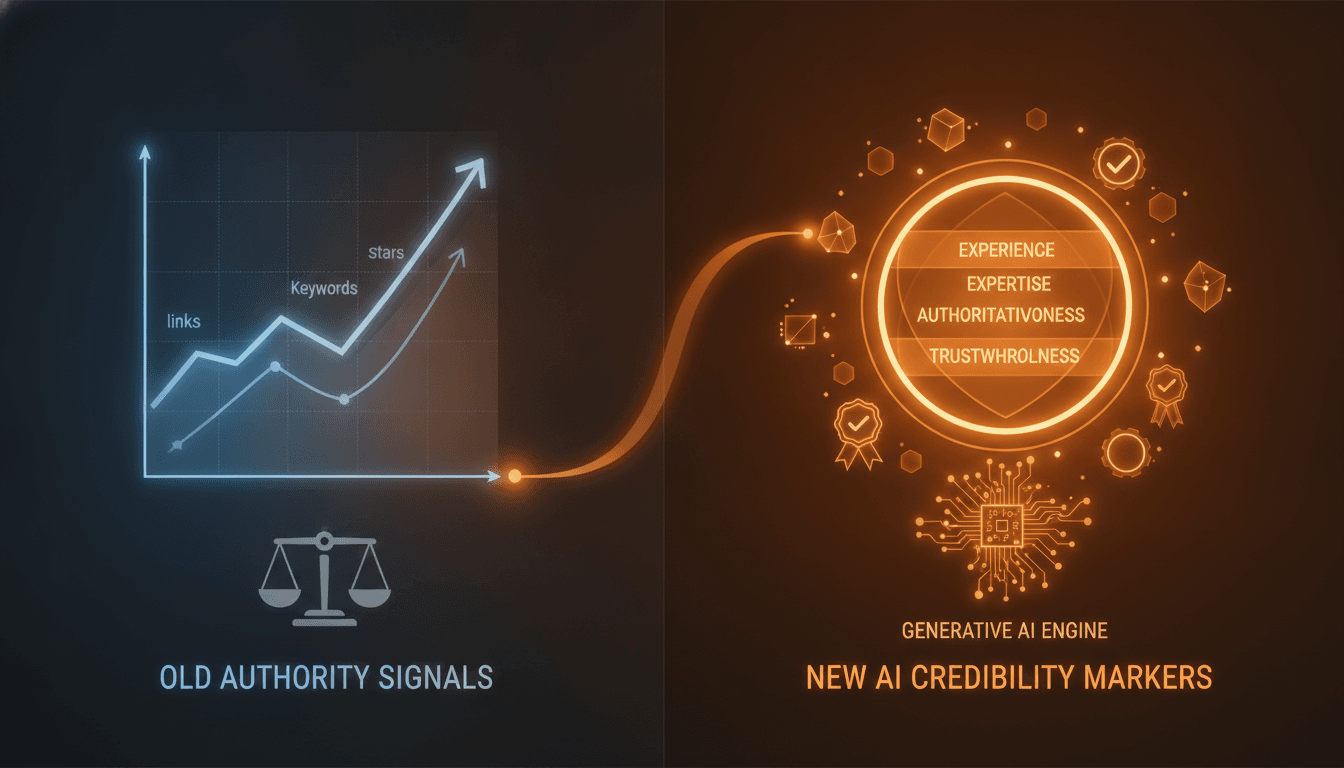
## The Four Pillars of E-E-A-T in Generative Search (And How They Differ from Traditional SEO)

[IMG: Infographic showing the four E-E-A-T pillars (Experience, Expertise, Authority, Trust) with traditional SEO signals on one side and AI/GEO signals on the other, illustrating the differences]

Google introduced the first "E" (Experience) to its E-E-A-T framework in [December 2022](https://developers.google.com/search/blog/2022/12/google-raters-guidelines-e-e-a-t), signaling a shift toward valuing lived, first-hand experience in content. AI engines have adopted this signal even more aggressively, prioritizing user-generated content, verified purchase reviews, and founder stories as proxies for genuine product experience.

The data is compelling: brands with verified third-party certifications and multi-platform editorial coverage are **3.1 times more likely to be cited in AI-generated product recommendations** than brands relying solely on strong traditional SEO metrics. But here's where the divergence becomes critical—each pillar functions differently in generative search:

**Experience:** Validated through user-generated content and verified reviews—not brand-owned testimonials. AI engines treat peer validation as more credible than any marketing message.

**Expertise:** Proven through external expert endorsements and third-party trade publication features. A mention in Allure carries more weight than a 5,000-word guide on a brand's website.

**Authority:** Built via category-specific multi-platform presence, not just domain-level metrics. Brands need distinct credibility ecosystems for each product category they want to dominate.

**Trust:** Anchored in verifiable business data, certifications, and the absence of negative sentiment clusters. Transparency now directly impacts AI visibility.

Consider this finding: [55% of AI product recommendations](https://moz.com/generative-engine-optimization) analyzed across ChatGPT, Perplexity, and Google AI Overviews included at least one trust signal from community platforms—Reddit threads, YouTube reviews, or consumer forums. The pattern is unmistakable.

Category-specific authority is evaluated at the subcategory level, meaning brands must build distinct credibility ecosystems for each product category they want to be recommended in. Rand Fishkin, Co-Founder & CEO of SparkToro, observes: "We're seeing a fundamental inversion in how authority is built for AI versus traditional search. In classic SEO, authority comes from earning links. In GEO, authority comes from earning mentions—in reviews, editorial, and community discussions. The currency has shifted from links to mentions, and from domain authority to distributed credibility."


---


## Experience: The New Currency Is Community Validation

AI engines treat community validation as a primary experience signal—and the data backs this up. [55% of AI product recommendations](https://moz.com/generative-engine-optimization) included trust signals from community platforms, confirming that peer validation is now non-negotiable for AI visibility. Brands without active community presence rarely get cited, regardless of how strong their owned content is.

Reddit threads, YouTube reviews, and consumer forums carry disproportionate weight in citation decisions. Beauty and fashion brands with consistent YouTube creator reviews and Reddit community engagement see **2.5x higher citation rates** than comparable brands without that community presence. Active engagement signals something crucial to AI models—ongoing customer validation, not just historical reputation.

The reputation risk dimension deserves special attention. AI engines treat negative sentiment clusters on platforms like Trustpilot or Reddit as credibility disqualifiers, not just minor detractors. This is fundamentally different from traditional SEO, where negative reviews might never suppress rankings.

Additionally, review authenticity matters significantly. AI engines demonstrate a measurable ability to distinguish between genuine customer feedback and inauthentic reviews, making manufactured social proof both risky and ineffective. Brands building community presence should prioritize authentic engagement over volume.


---


## Expertise: Why Editorial Features Trump Domain Authority

[IMG: Visual showing a brand's editorial coverage map—logos of publications like Allure, Vogue, WWD, Byrdie arranged around a central brand logo, with lines indicating citation pathways to AI engines]

The expertise signal in AI search operates on an entirely different plane than traditional SEO. Rather than analyzing author bylines and credentials on a page, AI engines assess whether a brand's claims are echoed and validated by recognized subject-matter experts in external publications, podcasts, and clinical contexts. Trade publication features function as machine-readable credibility markers that AI models can identify and weight heavily.

The numbers are striking: [79% of AI-cited beauty brands had a minimum of two features in recognized editorial outlets](https://hexagon.marketing)—Allure, Vogue, Byrdie, or equivalent—within the 12 months prior to being recommended. Brands consistently featured in category-relevant publications are **3.1x more likely to be cited** by AI engines.

Founder credibility stories follow a similar pattern. For beauty, fashion, and food brands especially, AI engines consistently recommend brands whose founders have published origin stories and interviews across external platforms. This creates distributed expertise signals across independent sources, which AI engines treat as more credible than brand-owned content.

Category-specific expert partnerships also matter significantly. For example, a skincare brand partnering with dermatologists creates localized authority ecosystems that AI engines can identify and validate. These partnerships signal that real experts, not just marketers, stand behind the brand's claims.

Marie Haynes, CEO of Marie Haynes Consulting, notes: "E-E-A-T was always about the quality of information, but for generative AI, it's become about the verifiability of identity. Can the AI confirm who a brand is, what it stands for, and why real humans trust it? Brands that answer those questions clearly in their digital footprint are the ones getting cited."


---


## Authority: Building Category-Specific Credibility Ecosystems

One of the most commonly overlooked dimensions of AI search visibility is that authority is evaluated at the **category level**, not just the brand level. A skincare brand may be highly authoritative for acne solution queries but completely invisible in anti-aging recommendations if its content, expert endorsements, and review ecosystem don't extend into that subcategory.

This requires brands to think strategically about building distinct credibility ecosystems for each product category. Multi-platform presence—brand website, social media, retail partnerships, editorial features—creates the distributed credibility AI engines actively seek. Absence from category-relevant platforms signals weak authority to AI engines, even when overall domain authority is strong.

Cross-platform consistency in brand messaging reinforces these authority signals and makes corroboration easier for AI models to identify and weight. Here's how category-specific authority building breaks down in practice:

- **Map each product subcategory** and identify the key platforms, publications, and communities where credibility is established
- **Build editorial coverage specifically within each subcategory**, not just at the brand level
- **Develop expert partnerships** relevant to each category's specific credibility ecosystem
- **Ensure review volume and sentiment are strong** across each subcategory independently

This granular approach is what separates brands that get cited from those that don't.


---


## Trust: Structured Data, Certifications, and Reputation Risk

Technical trust infrastructure has become as important as content quality for GEO. [Schema markup](https://schema.org)—particularly Organization, Product, Review, and FAQPage schema—serves as a critical machine-readable trust signal for AI engines. Brands that implement structured data comprehensively are significantly more likely to have their attributes accurately represented in AI-generated responses.

Third-party certifications function as verifiable trust anchors that AI models can cross-reference against authoritative databases. Brands with transparent ingredient sourcing, clinical study references, or certifications like USDA Organic, B Corp, or NSF Certified are disproportionately recommended by AI engines in beauty and food categories.

Verifiable business data—consistent NAP information, clear privacy and return policies, and the absence of deceptive marketing claims—also strengthens trust signals significantly. The reputation risk dimension is where many strong brands get blindsided. A brand with strong domain authority but consistent negative Reddit sentiment will rarely appear in AI recommendations.

This is fundamentally different from traditional SEO, where negative sentiment rarely directly suppresses rankings. Aleyda Solis, International SEO Consultant and Founder of Orainti, notes: "Brands that have been cutting corners on transparency—vague claims, hidden ingredients, unclear return policies—are finding those shortcuts have a real cost in the AI era." The shift toward transparency isn't just ethical; it's now a competitive necessity.


---


## The Citation Consensus Model: How AI Engines Actually Make Authority Decisions

[IMG: Diagram illustrating the citation consensus model—multiple independent source types (Reddit, YouTube, editorial, retail reviews, expert forums) feeding into an AI engine's authority decision, contrasted with the traditional single-source backlink model]

Citation consensus is the core mechanism that differentiates AI authority evaluation from everything brands have built their SEO strategies around. AI engines like Perplexity and ChatGPT with browsing capabilities don't rank pages by PageRank—they synthesize information from multiple corroborating sources. A brand mentioned positively across Reddit, editorial reviews, and expert blogs simultaneously is far more likely to be cited than a brand with a single high-DA backlink.

The practical implication is profound: a brand mentioned in five independent sources—Reddit, YouTube, editorial, retail reviews, and expert forums—appears more credible to AI engines than a brand with 100 backlinks from related domains. The strategic question shifts from "How do I earn more links?" to "How do I get more independent sources talking about my brand consistently?"

Lily Ray, VP of SEO Strategy & Research at Amsive Digital, captures this precisely: "The brands that will win in AI search are not the ones with the most backlinks—they're the ones with the most coherent, corroborated story across the entire web. AI models are essentially asking: 'Does the internet agree that this brand is good at what it claims?' If the answer isn't a clear yes across multiple independent sources, the brand simply won't be recommended."

Owning a brand narrative across the web through distributed credibility-building is the strategic imperative of the GEO era.


---


## The GEO Playbook: How Top Brands Build Authority for AI Search

Across an analysis of 50+ AI-generated product recommendations in beauty, fashion, and food categories, cited brands consistently shared three common trust signals. These brands maintained presence in at least two independent editorial publications, had a minimum of 100 verified reviews averaging 4.2 stars or higher, and articulated a clearly defined founding story or brand mission on their website. The playbook is becoming clear.

Here's how top brands are building authority for AI search:

**Editorial PR:** Securing features in category-relevant trade publications (Allure, WWD, Business of Fashion, Bon Appétit) as table-stakes credibility markers. This isn't optional—it's foundational.

**Founder credibility stories:** Publishing founder interviews and origin stories across external platforms to create personal expertise anchors that AI engines can identify and validate.

**Community engagement:** Actively participating in Reddit communities, supporting YouTube creator reviews, and maintaining presence in consumer forums. This signals ongoing validation rather than one-time credibility.

**Third-party certifications:** Pursuing verifiable certifications that function as machine-readable trust signals. These matter more in AI search than traditional SEO.

**Educational content:** Creating content that answers category-level questions—not just product pitches—to build expertise signals at the subcategory level where AI engines evaluate authority.

The financial stakes are real. The [AI-influenced e-commerce market is projected to reach $6.2 billion by 2026](https://www.grandviewresearch.com), as generative AI engines shift from informational tools to active commerce facilitators. The shift from "ranking for keywords" to "owning a brand narrative across the web" requires editorial PR, community engagement, expert partnerships, and transparent product information working together as a unified strategy.


---


## Measuring GEO Success: Why Traditional SEO Metrics Miss the Mark

The 41% gap between Google rankings and AI citations proves that these two disciplines require entirely separate measurement frameworks. Domain authority and backlink count simply don't predict AI citation visibility. Brands optimizing only for traditional SEO are missing **59% of the AI visibility opportunity**.

GEO requires its own measurement discipline built around metrics that reflect how AI engines actually make authority decisions. Here are the key metrics brands should track:

**Citation frequency:** How often does a brand appear in AI responses for target category queries across ChatGPT, Perplexity, and Google AI Overviews? This is the primary GEO metric.

**Community sentiment clusters:** What is the aggregate sentiment across Reddit, Trustpilot, and YouTube for a brand and its product categories? Negative clusters are credibility killers.

**Editorial coverage count:** How many independent editorial features has a brand earned in category-relevant publications in the past 12 months? This directly correlates with AI citation likelihood.

**Certification visibility:** Are certifications and trust signals accurately represented in AI-generated responses? Visibility here matters more than possession.

**Category-specific authority scores:** How does citation rate differ across each product subcategory? This reveals where brands are strong and where they're vulnerable.

Tracking these metrics alongside traditional SEO metrics gives brands a complete picture of their search visibility. This approach reveals the specific gaps where GEO investment will generate the highest return.


---


## Building Brand Authority for AI Search: A Practical Roadmap

[IMG: Roadmap graphic showing a six-step GEO authority-building process: Audit → Map Gaps → Editorial PR → Community Building → Structured Data → Educational Content]

The urgency is real. With [68% of consumers aged 18-34 using AI assistants for product discovery](https://www.salesforce.com/resources/research-reports/state-of-the-connected-customer/), the audience most brands are targeting is already making purchase decisions through AI-mediated search. Early movers in GEO will capture disproportionate market share as AI-influenced commerce scales.

Looking ahead, the brands that build category-specific authority ecosystems now will be the ones AI engines consistently recommend as the channel matures. The 3.1x citation advantage that comes with multi-platform editorial coverage and certifications compounds over time—the credibility signals brands build today become the citation consensus AI engines rely on tomorrow.

Here's how to start:

**Step 1: Audit AI citation visibility** across ChatGPT, Perplexity, and Google AI Overviews for target category queries. Document where a brand appears and where it's missing.

**Step 2: Map category-specific authority gaps** by comparing citation rate to competitors in each product subcategory. This reveals the most valuable opportunities.

**Step 3: Develop an editorial PR strategy** targeting the publications that AI engines treat as credibility markers in a specific category. Quality over quantity is essential.

**Step 4: Build a community presence strategy** across Reddit, YouTube, and consumer forums relevant to product categories. Authentic engagement beats marketing speak.

**Step 5: Implement structured data and certification verification** to strengthen technical trust infrastructure. Make it easy for AI engines to verify claims.

**Step 6: Create educational content** that answers category-level questions and builds expertise signals beyond product-level information.

Category-specific authority building is the competitive advantage most e-commerce brands are currently overlooking—and the window to move first is still open. The brands that act now will define the citation consensus AI engines rely on for the next five years.

**Ready to understand a brand's AI citation visibility? Schedule a 30-minute GEO strategy session with specialists to identify citation gaps across ChatGPT, Perplexity, and Google AI Overviews. The session will walk through specific category dynamics and show exactly where to invest for maximum AI visibility.**
H
Hexagon Team
Published June 10, 2026