brandcontentsearch
From Keywords to Conversations: How Generative Engine Optimization Differs from Traditional SEO
AI-powered search adoption jumped from 28% to 58% in a single year. Most e-commerce brands are still optimizing for a search paradigm that's rapidly becoming obsolete. Here's what generative engine optimization (GEO) is, why it's a parallel discipline—not an evolution of SEO—and what your brand needs to do differently right now.
15 min read
# From Keywords to Conversations: How Generative Engine Optimization Differs from Traditional SEO

*AI-powered search adoption jumped from 28% to 58% in a single year. Most e-commerce brands are still optimizing for a search paradigm that's rapidly becoming obsolete. Here's how generative engine optimization (GEO) differs fundamentally from traditional SEO, why it represents a parallel discipline rather than an evolution, and what brands need to do differently right now.*

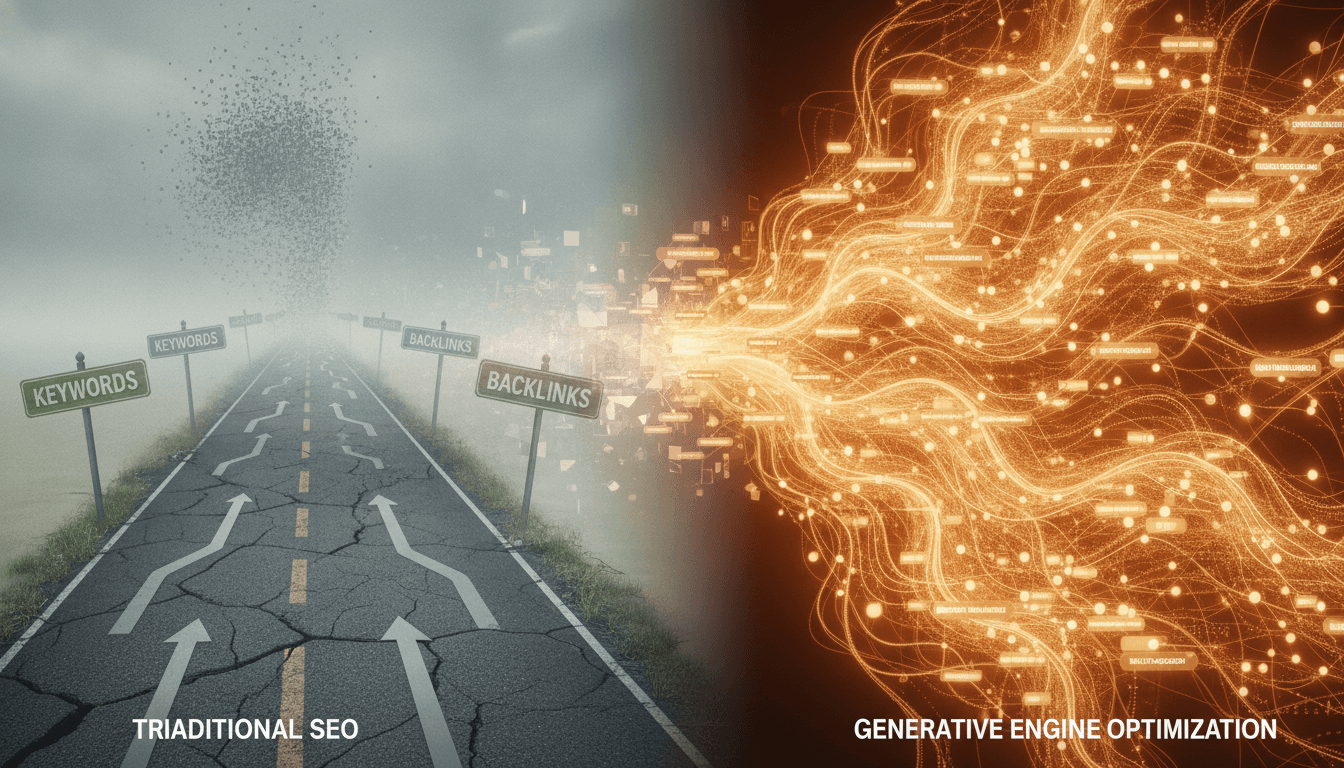
[IMG: Split visual showing a traditional Google search results page on the left versus an AI-generated conversational response on the right, with a visual divide emphasizing the paradigm shift]

## The Shift Is Already Happening

In just one year, AI-powered search adoption among consumers jumped from 28% to 58%. Traditional SEO strategies were not built for this shift—and they cannot be retrofitted to handle it.

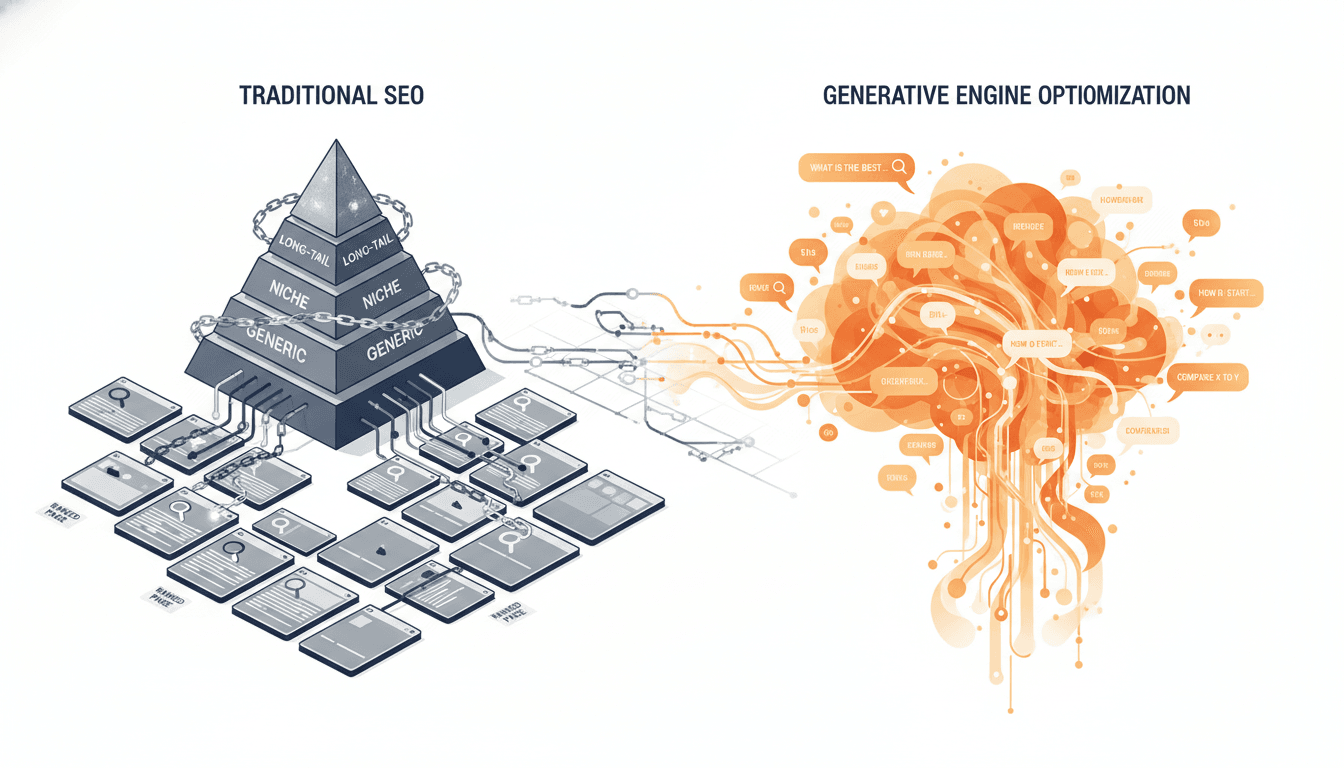
Traditional SEO optimizes for algorithmic page rankings. Generative engine optimization (GEO) optimizes for something fundamentally different: how AI models comprehend, synthesize, and recommend brands in real-time conversations. The distinction is not semantic—it is strategic, and it is reshaping how brands compete for visibility.

E-commerce companies that confuse GEO with SEO evolution are already falling behind competitors who understand these are parallel disciplines with entirely different rules, metrics, and content requirements.

AI search engines like Perplexity and ChatGPT's browsing mode do not rank pages 1–10 as Google does. Instead, they synthesize a single authoritative answer—meaning only brands embedded in that synthesis receive any visibility at all.

The fundamental question has shifted. It is no longer *Can a brand be found?* It is now *Will a brand be recommended?*


---


## The Philosophy Shift: Ranking Pages vs. Comprehending Brands

Traditional SEO is built around a single core goal: get individual pages to rank in the top 10 results for target keywords. Success is measured by position, impressions, and click-through rates—all metrics tied to how well a crawler indexes and scores a specific URL.

GEO operates on an entirely different premise. AI engines do not rank pages. Instead, they construct answers by synthesizing information across multiple sources to form a coherent brand profile. Success in GEO means being accurately and favorably included in AI-generated responses, not appearing in a list of links.

This is not an evolution of SEO. It is a fundamentally different discipline with different inputs, different success metrics, and different content requirements.

According to a [Search Engine Land AI Search Survey](https://searchengineland.com), 84% of SEO professionals believe AI will significantly disrupt traditional organic search within two years—yet fewer than 25% have a dedicated GEO strategy in place. That gap represents both a risk and an opportunity for brands willing to move first.

**The Core Differences:**

| Dimension | SEO | GEO |
|-----------|-----|-----|
| **Primary Goal** | Individual pages compete for ranking positions | Brands compete for AI mention and recommendation |
| **Success Metric** | Visibility in top 10 results | Accurate, favorable inclusion in synthesized answers |
| **Authority Signal** | Backlinks and domain authority | Consistent brand mentions across trusted sources |
| **Optimization Logic** | Crawler-based keyword matching | LLM-based synthesis of brand authority |

[Rand Fishkin, Co-founder of SparkToro](https://sparktoro.com), explains the distinction: "SEO was about getting Google to rank a page. GEO is about getting AI to trust a brand. Those are fundamentally different problems. One is about signals and links; the other is about knowledge, authority, and how clearly a brand communicates what it does and why it is credible."

Most e-commerce brands are still optimizing for yesterday's search paradigm. Brands ready to build a GEO strategy that positions them for AI-powered discovery should begin immediately.


---


## Keyword Density vs. Conversational Intent: How Content Strategy Must Change

Traditional SEO content strategy is built around keyword research, placement density, and meta optimization. Content teams write for crawlers first and readers second—a strategy that earned rankings in a keyword-matching world. In generative search, that approach is now a liability.

AI engines do not match keywords to pages. They extract passages, synthesize information, and generate fluent responses. This fundamental difference means they reward content that mirrors how real people actually ask questions.

According to the landmark [Princeton GEO research paper](https://arxiv.org/abs/2311.09735), content that incorporated statistics, cited authoritative external sources, and used quotable, fluent language achieved up to **40% improvement in AI search visibility** compared to standard keyword-optimized content.

**How This Plays Out in Practice**

Instead of optimizing a page for the keyword phrase "best running shoes for flat feet," GEO-optimized content answers the question as a consumer would actually ask it: *"I have flat feet—what running shoes should I buy?"* That conversational framing, paired with clear answers and embedded evidence, is what AI engines extract and cite in their responses.

The content strategy shift extends across several dimensions:

- **Conversational, Q&A-formatted content** receives [4x more citations](https://joinhexagon.com) in AI-generated responses than keyword-dense content
- **Statistics and authoritative citations** embedded in content signal credibility to AI models in ways traditional SEO tools do not measure
- **Quotable language**—clear, standalone passages that can function independently—is what AI engines actually extract and surface to users
- **Keyword-stuffed copy** written for crawlers performs poorly in GEO environments and can actively undermine visibility

The Princeton research team noted: "The optimization strategies that drive AI citation are meaningfully different from those that drive Google rankings. Fluency, the inclusion of verified statistics, and authoritative sourcing matter enormously to generative engines."


---


## Backlinks vs. Brand Authority Signals: Rethinking Link Strategy

In traditional SEO, backlinks are the primary currency of authority. The more high-quality sites link to pages, the higher the domain authority and ranking potential. This logic has governed search marketing strategy for two decades.

In GEO, authority is assessed through a different lens. AI models cross-reference multiple sources to construct brand profiles and evaluate credibility. A mention in an authoritative industry report, expert review, or news outlet carries significant weight—often more than a backlink alone.

[BrightEdge AI Search Research](https://brightedge.com) confirms that consistent brand mentions across trusted third-party sources are a primary driver of AI recommendation likelihood.

**The Hidden Risk: Knowledge Conflicts**

Inconsistent brand narratives create what GEO practitioners call "knowledge conflicts"—contradictory signals that reduce an AI model's confidence in recommending a brand. If product descriptions differ between a website and Amazon, or if brand messaging varies between social media and an official site, AI models register those conflicts and lower the reliability score assigned to the brand.

Here's what matters for GEO authority:

- **Structured data and schema markup** help AI engines verify and cite brand information accurately—moving from optional SEO enhancement to critical GEO requirement
- **Mentions in authoritative publications**—industry reports, expert reviews, news archives—carry significant weight in AI authority assessment
- **Brand data hygiene** is now a GEO priority: consistent product descriptions, pricing, and messaging across all digital touchpoints
- **PR and content partnership strategy** must shift from link acquisition to authoritative mention building

[Amanda Whalen, VP of Digital Marketing Strategy at BrightEdge](https://brightedge.com), explains: "The brands winning in generative search are not necessarily the ones with the most backlinks or the highest domain authority. They are the ones whose content answers real questions completely, whose brand narrative is consistent across every source an AI might consult."

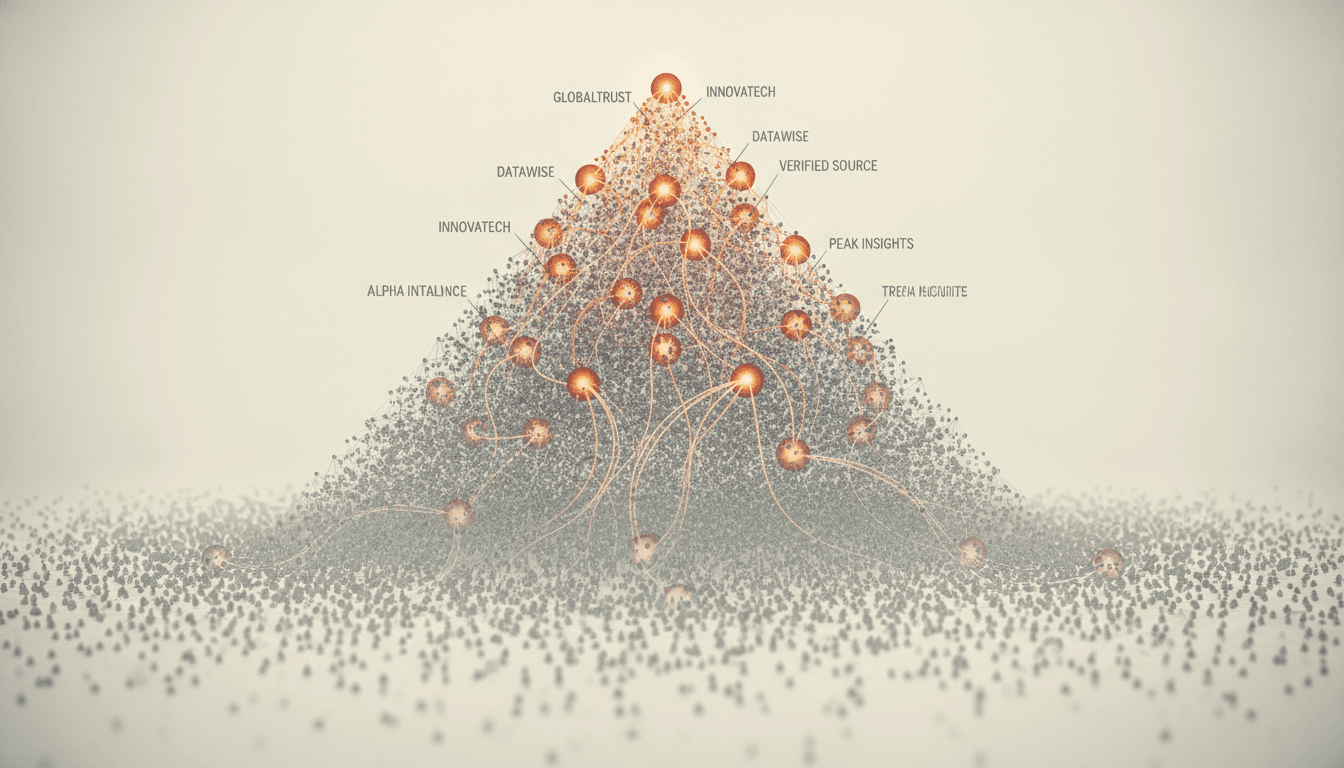
[IMG: Diagram comparing the traditional SEO authority model (backlink pyramid) versus the GEO authority model (web of consistent brand mentions, structured data, and third-party citations across platforms)]


---


## The Zero-Click Reality: Shifting from Traffic to AI Share of Voice

Nearly 60% of Google searches in 2024 ended without a click, according to the [SparkToro & Datos Zero-Click Search Study](https://sparktoro.com). AI Overviews and featured snippets now provide answers directly on the results page—and that number will only grow as generative search matures. The traffic-based success metrics that have defined SEO for years are becoming structurally obsolete.

The new success metric is **AI share of voice**—the percentage of relevant AI-generated responses in which a brand is mentioned or recommended. This requires a fundamental KPI shift for e-commerce marketing teams. Instead of measuring "Rank #1 for running shoes," the GEO equivalent is "Mentioned in AI responses for running shoe queries 40% of the time."

**Why This Matters Commercially**

Consumers are [3x more likely to trust and act on a product recommendation](https://edelman.com) delivered through an AI assistant's conversational response compared to a traditional paid search ad. That trust differential translates directly into revenue—making AI visibility a commercial priority, not just a technical one.

What to track moving forward:

- **AI mention frequency** in responses for core product and category queries
- **Recommendation accuracy**—whether AI describes products and brand correctly
- **Favorable sentiment** in generated responses and comparison frequency with competitors
- **Zero-click acceleration** makes click-through rate an increasingly unreliable measure of search marketing effectiveness
- **Most e-commerce marketing stacks** currently lack tools to measure GEO performance—creating a significant competitive intelligence gap

Early movers that establish GEO baselines now will have measurable advantage as AI search adoption continues to accelerate.


---


## Content Structure for AI Readability: From Crawler Optimization to Model Extraction

GEO-optimized content is not just written differently—it is structured differently. AI models need to extract, verify, and cite specific passages, which means content architecture directly impacts whether an AI engine can understand and recommend information. Clear H2/H3 hierarchies, FAQ sections, embedded statistics with sources, and expert quotes all signal extractability to AI models.

[Schema markup](https://developers.google.com/search/docs/appearance/structured-data/intro-structured-data)—Product, Organization, and Review schemas in particular—helps AI engines construct accurate brand profiles by parsing product attributes, pricing, reviews, and brand identity without ambiguity. What was once considered an optional SEO enhancement is now a foundational GEO requirement.

**Practical Structural Changes**

Content that provides step-by-step comparisons and use-case guidance consistently performs better in AI-generated responses than content optimized solely for keyword position. For example, instead of writing "Our running shoes offer arch support for flat feet," GEO-optimized structure frames it as: *"What arch support do our running shoes provide for flat feet? [Clear answer with specs, materials, and sourced evidence]."* That format gives AI models a complete, citable passage rather than a marketing claim.

The structural priorities for GEO include:

- **High-quotability content**—clear, fluent passages that can stand alone in a generated response—is the primary structural goal
- **FAQ sections** directly mirror the conversational queries AI engines are designed to answer
- **Statistics with sources** embedded in content signal credibility and increase citation likelihood
- **Avoid keyword-stuffed copy** written for crawler indexing—it actively undermines GEO performance


---


## Topical Authority Clusters vs. Isolated Page Optimization

Traditional SEO often optimizes individual product pages in isolation—targeting specific keywords, building page-level authority, and measuring page-level performance. AI engines do not evaluate pages in isolation. They assess whether a brand demonstrates comprehensive expertise across an entire topic ecosystem.

GEO rewards brands that build interconnected content hubs covering categories, use cases, comparisons, and FAQs—what [Semrush's State of Content Marketing Report](https://semrush.com) identifies as "topical authority clusters." For an e-commerce brand selling running shoes, this means building a content hub that includes product category pages, flat feet vs. high arches comparison guides, training use-case content, expert reviews, brand history, and customer stories—all cross-linked to signal depth and credibility.

**Why This Architecture Matters**

AI engines construct brand authority by seeing interconnected, comprehensive coverage of a topic area. A brand with 50 isolated optimized product pages signals "retailer." A brand with a comprehensive, cross-linked content ecosystem covering every dimension of a topic signals "authority." That distinction determines who gets cited in AI responses and who remains invisible.

The structural approach includes:

- **Topic-centric content architecture** replaces product-centric page optimization as the organizing principle
- **Internal cross-linking** should connect related content nodes within the topic cluster to signal coherence to AI models
- **Comprehensive coverage** of a subject—including comparisons, FAQs, use cases, and expert perspectives—demonstrates the depth AI engines reward
- **Brands that apply SEO-only strategies** achieve [3.5x lower AI recommendation rates](https://joinhexagon.com) compared to brands that actively build topical authority for GEO

[IMG: Visual diagram of a topical authority cluster for an e-commerce running shoe brand, showing interconnected content nodes: product categories, comparison guides, use-case articles, expert reviews, FAQs, and brand history pages]


---


## Consistency Across Digital Touchpoints: Building AI-Readable Brand Profiles

AI engines do not rely on a single source to form a brand profile. They cross-reference websites, Amazon listings, social media profiles, review sites, industry directories, and news archives—synthesizing a unified picture of who a brand is and what it offers. Inconsistencies across those sources create knowledge conflicts that reduce AI recommendation confidence.

The practical implications are significant. If product descriptions on a website differ from Amazon listings, if pricing varies across platforms, or if brand mission statements read differently on LinkedIn than on official sites, AI models register those conflicts and lower the reliability score assigned to the brand.

[BrightEdge research](https://brightedge.com) confirms that brands maintaining consistent product descriptions, brand narratives, and factual claims across all digital touchpoints are significantly more likely to be accurately represented in AI-generated responses.

**How to Conduct a Brand Consistency Audit**

The first step is mapping every digital touchpoint where brand information appears. Then systematically check for conflicts in product descriptions, pricing, brand messaging, and key factual claims. Centralized data management—using structured data and API integrations—ensures that updates propagate consistently across platforms rather than creating new conflicts.

Key audit elements:

- **Map all digital touchpoints** where brand information appears (website, Amazon, social, review sites, directories)
- **Check for conflicts** in product descriptions, pricing, brand mission, and key facts across all platforms
- **Third-party verification:** Ensure brand information on review sites, industry directories, and news archives aligns with official sources
- **Structured data and API integrations** provide the infrastructure for maintaining consistency at scale
- **Brand data hygiene** is no longer just a customer experience issue—it is a GEO performance driver


---


## The Measurement Gap: Why GEO Monitoring Matters Now

Most e-commerce marketing stacks have no tools to measure GEO performance. There is currently no standard platform for tracking how often brands appear in ChatGPT, Perplexity, Claude, or Google's AI Overviews—creating a significant blind spot for data-driven organizations. The [projected $6.5 billion market size](https://grandviewresearch.com) for AI search optimization services by 2028 reflects commercial recognition that this gap is real and growing.

The competitive intelligence opportunity is significant for early movers. Brands that begin building GEO measurement frameworks now—even through manual audits—will have established baselines and improvement benchmarks before standardized tools emerge.

[Greg Sterling, Co-founder of Near Media](https://nearmedia.co), observes: "Marketers who internalize this shift early will have an enormous first-mover advantage."

**Starting GEO Measurement Today**

The process begins with manual audits: query AI engines with core product and category terms, then document whether a brand is mentioned, how accurately it is described, and what sentiment surrounds the recommendation. This builds toward automated monitoring as tools mature.

Establish these measurement foundations:

- **Brand mention frequency** in AI responses for core queries
- **Accuracy of information** cited about products and brand
- **Sentiment of recommendations** and comparison frequency with competitors
- **Manual audits** of AI responses for key queries provide an immediate starting point before automated tools are available
- **Competitive benchmarking:** Track how often competitors are mentioned in the same AI responses where a brand appears or is absent

Brands that start now will have a 6–12 month advantage as AI search adoption continues to accelerate.


---


## Traditional SEO Strategy Isn't Enough: Building a Parallel GEO Approach

Traditional SEO remains important—organic search traffic still has value, and Google's crawler-based index is not disappearing overnight. But SEO alone is no longer sufficient for brands that want comprehensive search visibility in an AI-powered discovery environment. GEO requires distinct strategies, different content structures, different authority signals, and different performance metrics running in parallel with existing SEO efforts.

The transition does not require abandoning SEO. It requires adding a new dimension. A practical resource allocation framework suggests dedicating **20–30% of search marketing resources to GEO** while maintaining the SEO baseline that continues to drive traditional search traffic.

**Three-Step Transition Path**

1. **Audit current content** for GEO readiness—structure, quotability, schema markup, and conversational framing
2. **Build topical authority clusters** that demonstrate comprehensive expertise across core categories
3. **Implement AI visibility monitoring**, starting with manual audits and building toward automated systems

Looking ahead, the window for first-mover advantage is open now but will not remain open indefinitely. Voice and conversational search queries are projected to account for over 50% of all search interactions by 2026, according to [Gartner Digital Marketing Predictions](https://gartner.com). Brands that begin GEO optimization today will have a 6–12 month structural advantage as AI search adoption reaches mainstream scale.

Quick diagnostic questions:

- Do current SEO efforts include topical authority clusters?
- Is content structured for conversational queries and AI extraction?
- Are brands monitoring mentions in AI-generated responses?
- Have consistency audits been conducted across all digital touchpoints?

If the answer is no to any of these questions, GEO optimization has not started. **70% of brands** relying solely on traditional SEO tactics [achieve zero measurable visibility](https://joinhexagon.com) in AI-generated search responses.

[IMG: Side-by-side roadmap graphic showing traditional SEO strategy elements on one track and GEO strategy elements running in parallel on a second track, with shared foundations at the base]


---


## The Shift Is Already Underway

The transition from keywords to conversations is already happening. Brands that treat GEO as a parallel discipline—not a future consideration—are the ones that will be recommended when consumers ask AI engines what to buy next.

Most e-commerce brands are still optimizing for yesterday's search paradigm. Brands ready to build a GEO strategy that positions them for AI-powered discovery should begin immediately. A 30-minute strategy session can help audit current AI visibility and map a path forward.

[**Schedule a Free GEO Strategy Session →**](https://calendly.com/ramon-joinhexagon/30min)
H
Hexagon Team
Published May 26, 2026