Unlocking Medium-Intent AI Search Strategies for Emerging Health & Wellness Brands
Emerging health & wellness brands can’t afford to overlook the critical opportunity in medium-intent AI search. Tap into the 40% of e-commerce queries that drive discovery and trust—learn actionable strategies to boost AI visibility, build authority, and accelerate growth with this comprehensive guide.
Unlocking Medium-Intent AI Search Strategies for Emerging Health & Wellness Brands
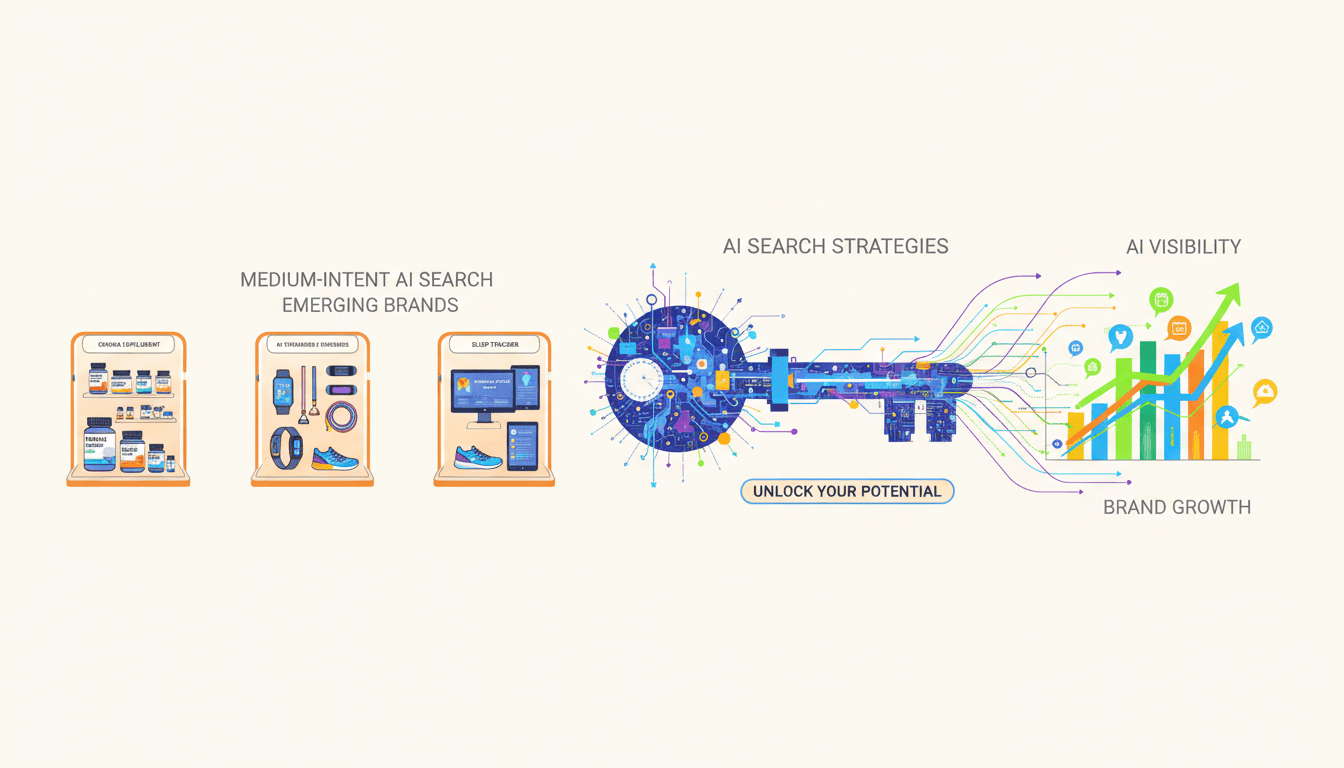
Emerging health & wellness brands face a pivotal moment: ignoring medium-intent AI search means missing out on 40% of e-commerce queries that fuel discovery and trust. This comprehensive guide offers actionable strategies to boost your AI visibility, establish authority, and accelerate growth at the crucial research phase.
[IMG: Emerging health & wellness brand founder reviewing AI search analytics dashboard]
With 46% of health & wellness shoppers relying on AI-powered recommendations during product research (NielsenIQ, 2024), the research phase represents a goldmine for brands aiming for sustainable growth. Yet, many emerging brands focus too narrowly on transactional conversions or broad informational queries, overlooking the powerful medium-intent AI search segment. This oversight risks missing the critical window where trust is built and brand preferences take shape.
AI search engines increasingly prioritize structured, authoritative, and trustworthy sources when delivering recommendations. Dr. Andrea Paul, Chief Medical Officer at BoardVitals, highlights, “AI assistants are transforming the health product discovery journey by surfacing brands that provide trustworthy, well-organized, and medically substantiated information.” The challenge for new brands is clear: How do you secure a spot in these influential AI-generated recommendation lists before shoppers finalize their decisions?
This guide unveils proven, actionable strategies to optimize your health GEO (Generative Engine Optimization) content and capture medium-intent AI search traffic—unlocking new e-commerce visibility during the pivotal research phase.
Ready to elevate your health & wellness brand’s AI search presence? Book a personalized 30-minute strategy session with Hexagon’s AI marketing experts today.
Understanding Medium-Intent AI Search in Health & Wellness
[IMG: Diagram comparing informational, medium-intent, and transactional search queries in the health sector]
Medium-intent queries lie at the core of the research phase—where consumers explore options but haven’t yet committed to buying. These queries often include phrases like ‘best’, ‘compare’, ‘benefits’, and ‘reviews’. For instance, a shopper might search for “best vegan protein powder for muscle gain” or “compare magnesium supplement certifications.”
How does medium intent differ from other search intents?
- Informational queries seek broad knowledge, such as “What is magnesium?”
- Transactional queries indicate purchase readiness, like “Buy magnesium supplement online”
- Medium-intent queries occupy the middle ground, driving discovery, comparison, and trust-building.
According to SEMrush, 40% of health e-commerce search queries fall into the medium-intent category. This segment offers a substantial opportunity for emerging brands, as shoppers here are most receptive to discovering new products and evaluating credibility.
AI search engines are rapidly advancing to interpret and prioritize medium-intent queries in health markets. Platforms like ChatGPT and Perplexity leverage sophisticated models to answer nuanced questions, surface product comparisons, and recommend brands based on structured data and authoritative references. In fact, 78% of AI search engines prioritize structured data in health-related medium-intent queries (Statista, 2023).
“Brands that optimize for AI-driven search meet consumers where they discover, compare, and ultimately decide what to buy—especially in health and wellness.” — Lily Ray, Senior Director of SEO, Amsive Digital
Medium-intent search delivers outsized value by:
- Allowing brands to influence consumer decisions before purchase intent solidifies.
- Building trust through detailed, evidence-backed information.
- Driving higher-quality e-commerce traffic that converts over time.
Looking ahead, Generative Engine Optimization (GEO) is becoming indispensable for health brands. As Search Engine Journal explains, GEO extends beyond traditional SEO by crafting content that AI models can easily understand and recommend.
Identifying and Targeting Medium-Intent AI Search Queries
[IMG: Screenshot of keyword research tool showing medium-intent health queries]
Capturing medium-intent AI search traffic starts with identifying the right queries. Successful brands leverage advanced keyword research tools, analyze ‘People Also Ask’ data, and map related searches to uncover the nuanced questions shoppers ask.
Here’s a strategic approach:
- Use platforms like SEMrush, Ahrefs, and Google Search Console to discover medium-intent queries within your category.
- Target queries reflecting the research phase, such as “collagen peptide reviews,” “vitamin D3 vs D2 benefits,” or “organic skincare product certifications.”
- Monitor ‘People Also Ask’ and related questions to identify emerging topics and consumer concerns.
Emerging brands can achieve significant gains: A BrightEdge study reported a 35% increase in medium-intent AI search traffic for brands optimized with GEO.
For example, a supplement brand might focus on these clusters:
- “Best probiotic for women’s gut health”
- “Compare NSF vs USP supplement certifications”
- “Ashwagandha side effects and benefits”
By structuring content around these specific queries, brands align closely with how AI search engines interpret user intent.
Topical clusters are vital for enhancing AI relevance. Organizing content into interconnected themes—like supplement comparisons, health benefit guides, and certification explainers—signals expertise and authority. This is especially crucial in health & wellness, where AI models prioritize comprehensive, trustworthy resources.
Key tactics for targeting medium-intent queries include:
- Mapping topical clusters that answer common research-phase questions in your niche.
- Integrating schema markup to assist AI in parsing and understanding your content (covered in the next section).
- Regularly updating keyword lists to stay aligned with evolving AI search trends.
Leverage ‘People Also Ask’ data to capture nuanced questions and long-tail opportunities (SEMrush, 2024). This approach helps brands address specific consumer concerns, further boosting AI search visibility.
Structuring Content for AI Search Optimization in Health GEO Strategy
[IMG: Visual diagram of a schema-marked health resource page with FAQs, comparisons, and certifications]
Content structure is the cornerstone of AI search optimization—especially in health & wellness, where credibility and trust are paramount. Barry Schwartz, CEO of RustyBrick, emphasizes, “Success in AI search hinges on structured content—schema markup, clear headings, and regularly updated information give health brands a competitive edge.”
Here’s how to optimize your content for AI-driven health GEO:
- Implement schema markup: Utilize Health and Medical Schema to tag product pages, FAQs, comparison guides, and certification details. Structured data enables AI search engines to accurately interpret and recommend your content.
- Use clear headings and logical page structure: Employ H2s and H3s to organize content into specific topics, such as “Benefits of Plant-Based Omega-3,” “Compare Third-Party Certifications,” and “Frequently Asked Questions.”
- Develop in-depth comparison guides and resource pages: For example, create guides comparing organic supplement certifications (NSF vs USDA Organic) or comprehensive FAQs addressing adaptogen safety—directly answering medium-intent queries.
- Incorporate authoritative references: Cite clinical studies, medical journals, and third-party certifications wherever possible. According to PwC, 62% of consumers trust brands more when content includes third-party certifications and clinical references.
- Highlight trust signals: Display certification badges (e.g., Non-GMO Project Verified, USP Verified), link to published clinical studies, and feature verified customer reviews prominently.
AI-powered search results favor brands with well-structured, evidence-backed wellness content (Ahrefs, 2024). This is especially true for medium-intent queries, where consumers are actively researching options and assessing trustworthiness.
For example:
- Include a comparison table of supplement certifications enhanced with schema markup.
- Add a prominent FAQ section addressing common research-phase questions.
- Reference recent clinical trials and prominently display certification badges.
Brands that use schema markup to structure product data see higher inclusion rates in AI-generated recommendation lists (Google Search Central), underscoring the importance of technical optimization.
Ready to stand out in AI search? Book a personalized 30-minute strategy session with Hexagon’s AI marketing experts now.
Building Brand Authority with Topical Clusters and Interlinking
[IMG: Mind map showing topical clusters and internal links connecting related health content]
Building authority in AI search extends beyond single pages—it requires demonstrating expertise across interconnected topics. Generative Engine Optimization rewards brands that develop clusters of content around core health themes, signaling topical authority to AI models.
Steps to build your topical clusters:
- Identify 3-5 core research-phase topics (e.g., supplement comparisons, ingredient benefits, certification guides).
- Create comprehensive pillar pages for each topic, linking related articles, FAQs, and product guides within the cluster.
- Use internal linking to guide both AI and users through your research-phase content, ensuring seamless navigation and context.
For instance, a wellness brand might develop a hub page on “Adaptogen Benefits for Stress,” linking to detailed articles on ashwagandha, rhodiola, and clinical study summaries.
Incorporating trust signals within these clusters is essential:
- Showcase authentic customer reviews to build credibility.
- Display third-party certification logos on relevant pages.
- Reference clinical studies and link to authoritative external resources.
Structured interlinking helps AI engines comprehend content relationships and enhances ranking potential (Content Marketing Institute). This holistic strategy positions your brand as an authority across all related medium-intent queries.
Looking forward, brands investing in comprehensive topical clusters and strategic interlinking will be best positioned to rise in AI-driven health search results.
Maintaining Content Recency and Technical Best Practices for AI Visibility
[IMG: Calendar and mobile device showing updated health content, fast site speed, and accessibility features]
AI search engines favor brands that keep content accurate, current, and technically optimized. This is especially crucial in health & wellness, where emerging studies and regulatory changes can rapidly alter best practices.
To maintain AI visibility:
- Regularly update content: Refresh articles and product pages with the latest research, certifications, and consumer questions. As HubSpot points out, content freshness is a key ranking factor for AI search engines.
- Optimize for mobile and accessibility: Ensure your site is mobile-responsive, includes alt-text for images, and adheres to accessibility standards. According to W3C, accessibility best practices improve chances of inclusion in AI-driven recommendations.
- Prioritize fast load times and technical SEO: Compress images, leverage browser caching, and resolve crawl errors to ensure your site loads swiftly and is easily parsed by AI bots.
Given that 46% of health & wellness shoppers rely on AI-powered recommendations during product research (NielsenIQ, 2024), maintaining up-to-date, technically sound content is essential.
- Use automated tools to monitor page speed, mobile performance, and schema validity.
- Set a regular review schedule—monthly or quarterly—to keep content accurate.
- Address technical SEO issues promptly to avoid being deprioritized by AI algorithms.
For example, a supplement brand might update its certification comparison guides quarterly to include new certifications, ingredient studies, or user reviews—ensuring ongoing AI relevance.
Measuring Success and Iterating Your Medium-Intent AI Search Strategy
[IMG: Analytics dashboard showing traffic from medium-intent AI search queries]
Effective AI search strategies demand continuous measurement and refinement. Brands should track key metrics to understand what works and where to optimize further.
Key steps to measure and iterate your medium-intent AI search performance:
- Track traffic and engagement for medium-intent queries: Use AI-focused SEO tools like BrightEdge or Clearscope to monitor which queries drive the most research-phase visits and engagement.
- Monitor AI search rankings: Keep tabs on your brand’s visibility in AI-powered tools such as ChatGPT, Perplexity, and Google’s Search Generative Experience.
- Refine GEO tactics based on data: Adjust topical clusters, content structure, and interlinking informed by traffic patterns, conversion rates, and AI algorithm updates.
Brands optimizing for medium-intent AI search achieve a 35% increase in targeted traffic (BrightEdge), translating directly into more qualified leads and higher e-commerce conversions.
Metrics to monitor include:
- Growth in organic search traffic from medium-intent queries
- Engagement on research-phase content (time on page, bounce rate)
- Inclusion in AI-powered recommendation lists (using tools like SERP API)
- Conversion rates from research-phase visitors to buyers
Looking ahead, iteration is essential. As AI algorithms and search trends evolve rapidly, brands that analyze performance data and adapt their strategies will maintain a competitive advantage.
Conclusion: Seize the Medium-Intent AI Search Opportunity
[IMG: Confident health brand marketer reviewing AI-driven growth metrics]
Medium-intent AI search unlocks the path to brand discovery, trust, and sustained growth in health & wellness. By mastering medium-intent queries, structuring content for AI optimization, building topical authority, and maintaining technical excellence, emerging brands can capture the 40% of e-commerce search traffic that shapes consumer decisions.
Bernard Huang, Co-founder of Clearscope, sums it up: “Generative Engine Optimization is not just the future of search—it’s already here. Health brands that adapt to AI search intent will lead in consumer trust and conversion.”
The time to act is now. Brands that master medium-intent AI search strategies will reap higher visibility, stronger credibility, and sustained business growth.
Ready to unlock your brand’s full AI search potential? Book your 30-minute personalized strategy session with Hexagon’s AI marketing experts today.
Looking for more actionable insights on AI-powered marketing? Explore Hexagon’s resources or connect with us for a custom roadmap tailored to your health & wellness brand’s growth goals.
[IMG: Hexagon marketing team collaborating on AI search optimization strategy]
Hexagon Team
Published April 19, 2026