brandstrainingbrand
The AI Search Training Data Crisis: Why Your E-Commerce Brand Might Be Missing from ChatGPT (And How to Fix It)
With more than half of U.S. consumers now using AI assistants to research purchases, the brands that don't exist in AI training data don't exist in the consideration set. Here's what e-commerce leaders need to understand—and do—right now.
13 min readRecently updated
---


# The AI Search Training Data Crisis: Why E-Commerce Brands Might Be Missing from ChatGPT (And How to Fix It)

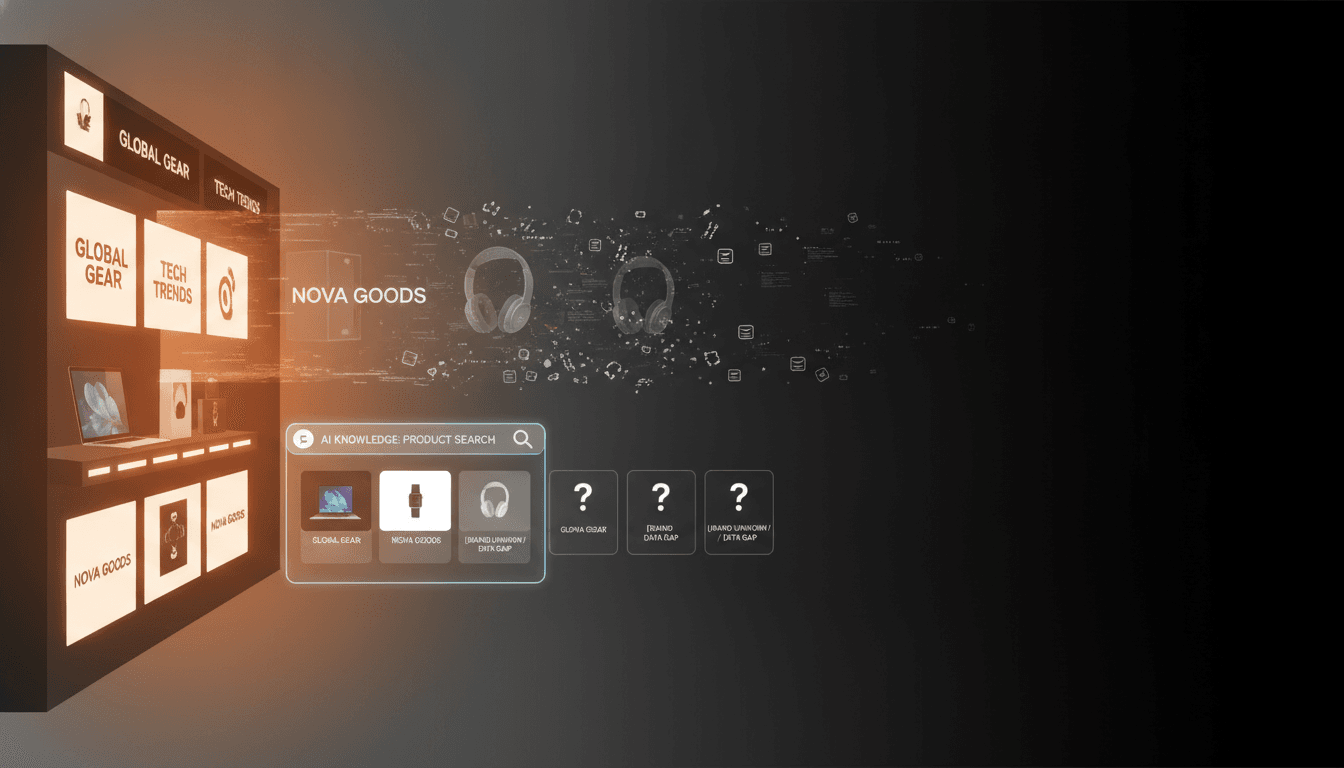
Most e-commerce brands do not exist in ChatGPT's training data. Neither do they exist in Gemini's, or Perplexity's. With over half of U.S. consumers now using AI assistants to research purchases, this invisibility is quietly costing brands sales.

The stakes are high and the window for action is narrow. E-commerce leaders need to understand the mechanics of AI training data inclusion—and act with urgency.

[IMG: A split-screen graphic showing a ChatGPT interface recommending legacy brands on one side, and an invisible/ghosted DTC brand storefront on the other, representing AI training data invisibility]


---


## The Invisible Brand Problem No One Is Talking About

When a potential customer types "best running shoes" or "top-rated skincare serum" into ChatGPT, Gemini, or Perplexity, something quietly consequential happens. The AI does not browse the web the way a search engine does. Instead, it reaches into its parametric knowledge—the compressed understanding of the world baked into its weights during training—and surfaces the brands it learned about months or years ago.

If a brand is not in that training data, it simply does not exist to the model. This invisibility is not accidental—it is structural.

The scale of this shift is staggering. According to the [Salesforce State of the Connected Customer Report (2024)](https://www.salesforce.com/resources/research-reports/state-of-the-connected-customer/), more than 58% of U.S. consumers have used an AI chatbot or assistant to help research a product or service purchase, up from just 20% in 2022. That trajectory makes AI discoverability a mainstream commercial imperative, not a niche technical concern.

The brands that understand this early hold a compounding advantage over those that do not. The competitive window is narrowing rapidly.

The structural root cause lies in how large language models are actually built. Models like GPT-4 are trained on datasets comprising hundreds of billions to trillions of tokens of text, drawn primarily from web crawls, Wikipedia, Reddit, books, and curated high-quality editorial sources. Notably absent: structured product catalogs, brand marketing materials, and DTC storefronts.

According to the [OpenAI GPT-4 Technical Report (2023)](https://openai.com/research/gpt-4), the training pipeline explicitly prioritizes editorial depth and third-party authority over brand-owned content volume. This bias is not a bug—it is a deliberate design choice.

Knowledge cutoff dates compound this problem significantly. GPT-4's training data stops at April 2023, while GPT-4o extends only to October 2023, according to [OpenAI's Model Specification and System Cards (2024)](https://openai.com/index/model-spec). Any brand that launched, rebranded, or meaningfully scaled after those dates is entirely absent from the model's parametric knowledge.

Brands are invisible by default, not by choice. This gap creates a permanent disadvantage for newer market entrants.

Then there is the frequency bias loop. Research from [Stanford HAI's "Auditing AI Recommendation Systems" (2024)](https://hai.stanford.edu/) confirms that AI assistants exhibit strong frequency bias: brands mentioned more often across training sources are recommended more often, regardless of actual product quality. This creates a self-reinforcing visibility loop that compounds advantages for legacy brands while systematically disadvantaging newer DTC challengers.

The playing field is not just uneven. It is structurally tilted in favor of established incumbents.

Scott Galloway, Professor of Marketing at NYU Stern School of Business, frames the strategic shift clearly: "We are entering an era where the question is not 'does my brand rank on Google?' but 'does my brand exist in the minds of AI systems?' These are fundamentally different problems with fundamentally different solutions. Most marketing teams are not equipped for the second question yet."

[IMG: A timeline graphic illustrating LLM training cutoff dates for GPT-4, GPT-4o, Claude 3, and Gemini, with annotations showing which brand "generations" are invisible to each model]

The financial stakes are impossible to ignore. AI-influenced e-commerce sales are projected to reach [$1.2 trillion globally by 2030](https://www.mckinsey.com/capabilities/mckinsey-digital/our-insights/the-next-frontier-of-customer-engagement-ai-enabled-customer-service), according to McKinsey Global Institute. For e-commerce brands, the revenue implications of training data visibility have never been higher—and the window to act has never been shorter.


---


## What the Data Actually Reveals About AI Brand Discoverability

Understanding why brands are missing from AI outputs requires a clear-eyed look at how training datasets are assembled, filtered, and weighted. Which content signals carry the most authority? Which sources do AI developers actually prioritize? The answers reveal a landscape fundamentally different from traditional SEO.

### The Brutal Math of Training Data Inclusion

[Common Crawl](https://commoncrawl.org/), the primary web scraping dataset used by most LLM developers, indexes roughly 3.15 billion web pages per monthly crawl. This appears to offer comprehensive coverage of the web. In reality, the dataset applies aggressive quality filters that systematically exclude thin-content e-commerce product pages, brand microsites, and DTC storefronts.

The exact content types that most online retailers produce in abundance are filtered out. This is a critical structural disadvantage for e-commerce brands.

Research analyzing Common Crawl quality-filtered subsets—including C4 and FineWeb—reveals a sobering reality. According to the [HuggingFace FineWeb Dataset Paper (2024)](https://huggingface.co/datasets/HuggingFaceFW/fineweb), fewer than 0.1% of all crawled URLs survive aggressive deduplication and quality filtering to be meaningfully represented in LLM training data.

The scale of exclusion is staggering. There are more than 26 million e-commerce stores worldwide, according to [Shopify Commerce Trends data](https://www.shopify.com/research/future-of-commerce). The vast majority generate insufficient third-party editorial coverage, press mentions, or forum discussions to cross the quality thresholds used in dataset curation.

The long tail of e-commerce is, for all practical purposes, absent from LLM training data. This is not a temporary problem—it is a permanent structural feature of how training datasets are built.

The [Dolma Dataset Analysis from the Allen Institute for AI (2023)](https://allenai.org/dolma) reinforces this picture with striking clarity. AI training datasets heavily over-represent content from a small number of high-authority domains. Wikipedia, Reddit, news outlets, and academic sources collectively account for a disproportionate share of training tokens.

Brands without meaningful coverage in these sources are effectively invisible to LLMs—regardless of their product quality, customer reviews, or owned-channel following. The editorial layer of the web determines AI visibility.

### The Sources That Actually Move the Needle

Which signals matter most? The data is unambiguous. The [Profound.co AI Brand Visibility Benchmark (2024)](https://www.profound.co/) conducted an independent audit of ChatGPT, Gemini, and Perplexity product recommendations across 15 consumer categories. The findings were stark: 72% of recommended brands had a Wikipedia page, compared to just 8% of brands in the same categories that were never recommended.

Wikipedia presence is not a vanity metric—it is a critical training data signal. For example, brands with Wikipedia entries are nine times more likely to be spontaneously recommended by AI assistants than brands without them.

Major press coverage operates similarly. According to the [Semrush AI Visibility Study (2024)](https://www.semrush.com/), e-commerce brands covered by at least three major online publications—Wired, TechCrunch, NYT Wirecutter, Forbes—are approximately three times more likely to be spontaneously recommended by AI assistants than brands with equivalent product ratings but no major press coverage.

Editorial authority from trusted third parties is the currency of AI discoverability. This is a fundamental shift from traditional SEO, where owned-channel optimization could drive visibility.

Reddit deserves particular attention here. OpenAI entered a [data licensing agreement with Reddit](https://www.reuters.com/technology/reddit-ai-content-licensing-deal-google-2024-02-22/) that makes Reddit one of the most heavily weighted sources in GPT model training. Brands discussed authentically in high-signal subreddits—r/BuyItForLife, r/malefashionadvice, r/SkincareAddiction—have measurably higher AI recommendation rates.

This is not coincidence. It is a direct consequence of training data composition and deliberate weighting decisions by AI developers.

Rand Fishkin, Co-founder of SparkToro and former CEO of Moz, frames the strategic implication clearly: "The brands that win in AI search will not necessarily be the ones with the best products or the biggest ad budgets—they will be the ones that understood, early enough, that AI systems learn from the web's editorial layer, not from brand-owned channels. An Instagram following means nothing to GPT-4. A Wirecutter review means everything."

[IMG: A weighted pyramid diagram showing which content sources carry the most influence in LLM training data—Wikipedia and Reddit at the top, brand-owned content and product pages at the bottom]

### RAG vs. Parametric Knowledge: Why Brands Need a Strategy for Both

Not all AI systems operate on parametric knowledge alone. Retrieval-Augmented Generation (RAG) systems—used by ChatGPT with Browse, Perplexity, and Google's AI Overviews—can surface brands in real-time by querying live search indexes. This distinction matters enormously for brand strategy.

According to [Microsoft Bing AI Documentation (2024)](https://learn.microsoft.com/en-us/bing/search-apis/bing-web-search/overview), RAG-enabled AI assistants can only surface brands that have sufficient structured, crawlable, authoritative content already ranked highly by Bing and Google. A brand with weak SEO authority, thin content, or no structured data will be bypassed by RAG systems just as reliably as it is bypassed by parametric models.

The two problems are related but distinct—and they require parallel solutions. Here's how brands need to think about this: parametric visibility requires building presence in editorial sources, while RAG visibility requires strong traditional SEO foundations.

Google's Search Generative Experience (SGE) and AI Overviews add another layer of complexity. According to [Google Search Central Documentation on AI Overviews Best Practices (2024)](https://developers.google.com/search/docs/appearance/ai-overviews), brands with incomplete or missing Google Knowledge Panels are significantly less likely to appear in AI-generated summaries. Structured entity data—the kind that powers Knowledge Panels—functions as a foundational signal for AI retrieval systems.

Most brands need both strategies working in concert. Parametric visibility and RAG visibility are complementary, not competing, priorities.

### The No-Submission-Portal Problem

Here is where the AI search landscape diverges most sharply from traditional SEO. With Google, brands can submit sitemaps, structured data, and business information directly through Google Search Console. There is a feedback mechanism. There is a submission pathway.

With AI training data, there is none. According to a [2024 review of OpenAI, Anthropic, and Google AI public documentation](https://openai.com/policies), there is currently no official mechanism for brands to submit information directly to these organizations for inclusion in future training runs. No portal. No API. No direct path.

This gap has profound implications for brand strategy. Brands cannot buy their way into training data. Brands cannot submit their way in.

Lily Ray, VP of SEO Strategy & Research at Amsive Digital, observes: "Training data is the new PageRank. Just as early SEO practitioners learned that getting linked to by authoritative sites was the lever that mattered, the new game is getting cited, discussed, and reviewed by the sources that AI developers actually use to train their models. The playbook is different, but the underlying logic—earn authority from trusted third parties—is remarkably similar."

Brands must earn their way in—through editorial coverage, authentic community presence, structured data signals, and the kind of third-party authority that training dataset curators have consistently prioritized. This is the only viable path to AI discoverability.

Nik Sharma, CEO of Sharma Brands and a prominent DTC investor, identifies a dangerous misconception still widespread among founders: "Most DTC founders assume that if they have good SEO, they will show up in AI search. That is a dangerous misconception. AI models have a knowledge cutoff, they are biased toward sources they were trained on, and they have no idea a brand exists unless something in their training data told them about it. This is a genuinely new problem that requires a genuinely new strategy."

The window for proactive action is narrowing rapidly. According to [Andreessen Horowitz AI Market Analysis (2024)](https://a16z.com/ai/) and OpenAI product roadmap disclosures, major LLMs are moving toward more frequent training cycles and deeper real-time retrieval integration. The content ecosystem a brand builds today will directly influence its AI discoverability within 6 to 18 months.

Waiting is not a neutral choice—it is a compounding disadvantage.

[IMG: A side-by-side comparison graphic: "Traditional SEO Playbook" (Google Search Console, sitemaps, backlinks) vs. "AI Discoverability Playbook" (Wikipedia, press coverage, Reddit, structured entity data, RAG optimization), highlighting the strategic differences]


---


## What E-Commerce Brands Should Do Next

The AI training data crisis is real, it is structural, and it is already affecting which brands consumers discover and purchase from. But it is also addressable—for brands that understand the mechanics and act with intention.

The core insight is this: AI systems learn from the web's editorial layer, not from brand-owned channels. A brand's product pages, social media presence, and email list are invisible to the systems that shape AI recommendations.

What matters is third-party editorial coverage, authentic community discussion, structured entity data, and presence in the high-authority sources that training dataset curators have consistently weighted most heavily.

### Priority Actions for E-Commerce Brands

**Pursue Wikipedia presence** through legitimate, verifiable, notability-qualifying editorial coverage. This is not about paid placement or self-promotion. Wikipedia's editorial standards are rigorous, but brands with genuine third-party coverage can build credible entries that function as permanent training data signals.

**Secure major press coverage** in outlets like Wirecutter, Forbes, Wired, and TechCrunch. These publications carry disproportionate weight in both training datasets and RAG retrieval systems. A single feature in Wirecutter often generates more AI discoverability value than months of owned-channel marketing.

**Build authentic Reddit presence** in relevant subreddits. Recognize that Reddit is one of the most heavily weighted sources in GPT model training data. Authentic participation in communities like r/BuyItForLife, r/malefashionadvice, and r/SkincareAddiction creates durable training data signals that persist across model updates.

**Strengthen structured data and Google Knowledge Panel completeness** to improve performance in RAG-based AI systems like SGE and AI Overviews. This foundational work improves both traditional search and AI discoverability simultaneously.

**Develop a RAG content strategy** that ensures high-quality, crawlable, authoritative content is indexed and ranked by Bing and Google. The search indexes that power real-time AI retrieval must contain a brand's best content, properly structured and optimized for both human readers and AI systems.

### The Compounding Advantage

Looking ahead, the brands that treat AI discoverability as a core marketing function—not a technical afterthought—will accumulate a compounding advantage as AI assistants become the primary discovery channel for consumer purchases. The $1.2 trillion in AI-influenced e-commerce sales projected by 2030 will not be distributed evenly.

It will flow disproportionately to the brands that exist in the minds of AI systems. The question is no longer whether AI search matters.

The question is whether a brand's leadership team understands the new rules well enough to compete. The brands that answer yes will capture disproportionate market share. The brands that answer no will find themselves increasingly invisible—not just to consumers, but to the AI systems that shape consumer behavior.

The time to act is now. The window is closing.


---


*Hexagon helps e-commerce brands build AI discoverability strategies that address both parametric training data presence and real-time retrieval optimization. [Learn how Hexagon can help.](#)*
H
Hexagon Team
Published October 16, 2026