commerceclickbrands
Understanding the Zero-Click Commerce Revolution: How AI Is Reshaping E-Commerce Conversion Paths
AI shopping assistants are simultaneously sending higher-quality traffic to e-commerce sites and making most of the shopping journey invisible to traditional analytics. Here's what zero-click commerce means for your brand—and why the window to act is open right now.
11 min read
# Understanding the Zero-Click Commerce Revolution: How AI Is Reshaping E-Commerce Conversion Paths

AI shopping assistants are simultaneously sending higher-quality traffic to e-commerce sites and making most of the shopping journey invisible to traditional analytics. This shift represents a fundamental change in how brands should think about discovery, conversion, and customer data. Here's what zero-click commerce means for e-commerce brands—and why the window to act is open right now.

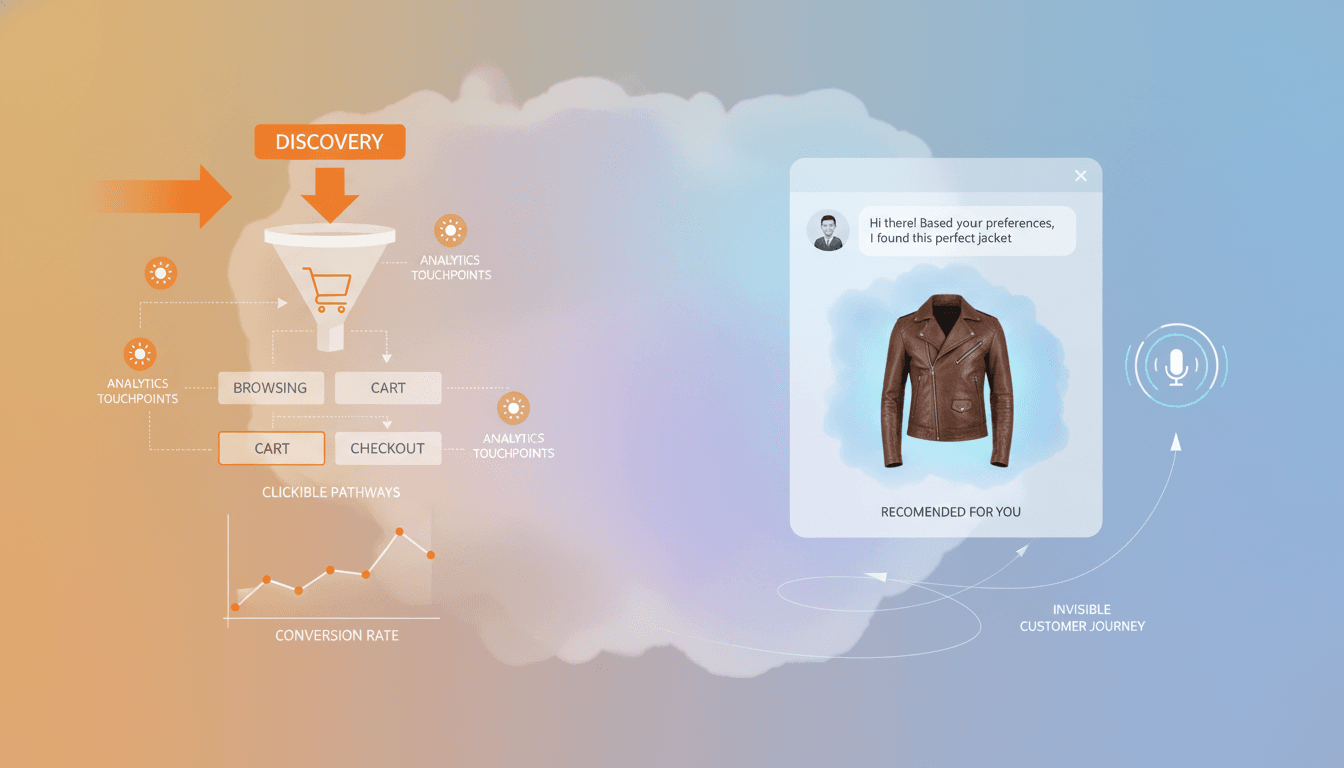
[IMG: Split-screen visualization showing a customer chatting with an AI assistant on one side and a brand's analytics dashboard showing incomplete attribution data on the other]

## The Invisible Sale: When AI Becomes the Salesperson

A customer asks ChatGPT for a sustainable water bottle recommendation. Within seconds, the AI provides a specific product suggestion, price comparison, and purchase rationale—all without the customer visiting a brand website. The customer either buys through an integrated checkout or clicks through to complete the transaction.

The analytics team sees a single session with no attribution data. The revenue team sees a sale. The marketing team has no visibility into what happened. This is zero-click commerce, and it's reshaping how e-commerce brands think about their conversion paths.

The surprising finding is that AI-referred customers convert 3x faster than organic search traffic. The challenge remains that brands cannot optimize what they cannot see. However, brands that understand this dynamic now are positioning themselves to capture a disproportionate share of what Juniper Research projects will be $194 billion in AI-influenced e-commerce transactions by 2026.


---


## What Is Zero-Click Commerce? Defining a New E-Commerce Reality

Zero-click commerce occurs when an AI assistant provides a product recommendation so specific—including name, price, retailer, and rationale—that the consumer's decision is effectively made within the AI interface. Any subsequent click is transactional rather than exploratory.

This differs fundamentally from the zero-click search phenomenon most marketers already understand. Traditional zero-click search results (a Google snippet answering "What is the capital of France?") keep users from visiting informational pages. Zero-click commerce goes further by resolving purchase intent entirely within the AI interface, collapsing discovery, consideration, and decision into a single conversation.

The scale of this shift is already significant. According to the SparkToro & Datos Zero-Click Search Study 2024, 58.5% of all Google searches in 2024 resulted in zero clicks, with commercial queries increasingly resolved by AI without users visiting brand websites. Salesforce's State of the Connected Customer Report 2024 found that 27% of U.S. consumers now use AI assistants to research or discover products—up from under 10% in 2022.

A Similarweb analysis found that 45% of ChatGPT's product recommendation queries resulted in no outbound click to a retailer or brand website at all. This is not a future scenario—it is happening today across every e-commerce vertical.


---


## How AI Shopping Assistants Collapse the Traditional Conversion Funnel

The classic AIDA funnel—Awareness, Interest, Desire, Action—was built on the assumption that customers move through multiple touchpoints across owned and paid digital real estate. Marketers optimized each stage: ad creative for awareness, landing pages for interest, product pages for desire, checkout flows for action.

AI shopping assistants have fundamentally collapsed this model. According to McKinsey & Company, a customer's entire journey from awareness to purchase decision can now happen in two or three chat turns. The AI becomes the de facto conversion environment.

Here's how this reframes competitive advantage: the NRF Retail's Big Show AI Commerce Track panel noted that "the brands that win won't necessarily be the ones with the best landing pages. They'll be the ones that AI systems trust enough to recommend in the first place."

The structural problem this creates is significant: the AI interface is a conversion environment that brands cannot directly control. Traditional conversion rate optimization tactics—A/B testing, CTA placement, page layout, urgency triggers—become irrelevant when the conversion decision is made before users ever reach a brand site. Brands move from owning the conversion environment to competing for visibility within an algorithm-controlled one.

[IMG: Side-by-side funnel diagram comparing traditional multi-touchpoint AIDA funnel vs. compressed AI-mediated single-conversation funnel]


---


## The Attribution Crisis: Why AI-Influenced Revenue Becomes 'Dark Funnel' Revenue

When ChatGPT, Perplexity, or Google AI Overviews recommend a product, zero first-party data passes to the brand. No session IDs, behavioral signals, or UTM parameters transfer to the brand's systems. According to Forrester Research, this fundamentally breaks the data feedback loops that modern e-commerce optimization depends on.

This creates what HubSpot's Marketing Analytics Research describes as a "dark funnel" problem: revenue is generated or influenced by AI recommendations, but standard last-click attribution, Google Analytics, and Shopify's built-in reporting cannot capture these touchpoints. A customer may arrive at a site with zero referral data, making it impossible to correlate their purchase with the AI recommendation that drove it.

Unlike paid search—where every click is tracked—or organic search—where referrer data exists—AI recommendations operate in a data vacuum for the brand. Kiri Masters, Founder of Bobsled Marketing and Forbes Retail Contributor, observed: "Attribution is the central crisis of AI-era marketing. When a consumer asks ChatGPT for the best running shoe under $150 and buys what it recommends, that sale is real—but it's invisible to every attribution model we've built over the last decade."

The attribution gap grows as AI-mediated shopping expands, and brands are losing visibility into an increasingly large portion of their customer acquisition.


---


## The Paradox of Higher-Quality AI-Referred Traffic

Here's the counterintuitive reality: while AI assistants send fewer total clicks to brand sites compared to organic search, the clicks they do send convert at significantly higher rates. Semrush's AI Traffic Quality Report 2024 found that AI-referred visitors convert at 3x the rate of traditional organic search traffic.

The volume loss is real, but the quality gain is substantial. This makes sense when considering what AI has already accomplished before that click arrives—the AI has pre-qualified the customer, matched their stated needs to a specific product, provided a rationale for the recommendation, and addressed likely objections.

By the time a user clicks through to a brand site, they are not browsing—they are buying. This means optimizing for click volume from AI platforms misses the strategic value entirely. Rand Fishkin, Co-founder and CEO of SparkToro, observed: "The search box is being replaced by a conversation. And in that conversation, the brand that gets mentioned wins—whether or not anyone ever visits their website."

Brands should measure AI success by revenue impact and conversion rate, not session counts.


---


## What Makes Products Eligible for AI Recommendations?

Unlike paid search, where placement can be purchased with budget, AI recommendation visibility is currently a purely earned position. According to Search Engine Land's Generative AI Search Ranking Factors Analysis and Digiday, the primary levers for AI visibility are organic authority, product data quality, and brand reputation—not advertising spend.

Here's what specifically drives AI recommendation eligibility:

- **Structured data quality**: Schema markup is foundational. AI systems need clean, standardized product information—name, price, availability, specifications—to reference and recommend with confidence.
- **Third-party review authority**: Reviews on Trustpilot, G2, Amazon, and industry-specific platforms signal credibility to AI systems pattern-matching across trusted sources.
- **Editorial mention frequency**: Brand citations across industry publications, blogs, and news sites influence how frequently AI systems surface a brand in recommendations.
- **Cross-web consistency**: Ensuring product information, pricing, and messaging align across a brand's site, marketplaces, and third-party platforms builds the algorithmic trust that drives recommendation eligibility.
- **Multimodal visibility**: Tools like Google Lens with AI integration and Amazon's Rufus shopping assistant extend zero-click commerce to image-based discovery—making visual brand consistency equally important.

Lily Ray, VP of SEO Strategy & Research at Amsive, noted: "Generative AI is not a new channel. It's a new layer that sits above all channels and decides what gets recommended. If a brand is not in the training data, the product reviews, the editorial coverage that these models learn from—it simply doesn't exist in AI commerce."

This earned-not-bought model creates a structural advantage for brands that establish AI recommendation authority early.

[IMG: Infographic showing the five key signals that drive AI recommendation eligibility: structured data, third-party reviews, editorial mentions, cross-web consistency, and multimodal visibility]


---


## AI-Native Checkout: The Full Realization of Zero-Click Commerce

The endpoint of zero-click commerce is not a referred click—it's a completed purchase that never leaves the AI interface. Perplexity AI's launch of its "Buy with Pro" feature in late 2024 made this concrete: users can now discover, compare, and purchase entirely within the Perplexity environment. Anticipated ChatGPT shopping integrations point in the same direction.

In this scenario, the brand's direct-to-consumer channel becomes fully disintermediated. The brand becomes a fulfillment partner rather than the primary customer touchpoint. Revenue attribution becomes even more complex when the AI platform handles payment, inventory coordination, and customer data.

OpenAI's introduction of persistent shopping memory in ChatGPT deepens this dynamic further: the AI remembers user preferences and makes increasingly personalized recommendations over time, functioning as a trusted shopping advisor rather than a neutral search tool. The $194 billion in projected AI-influenced e-commerce transactions by 2026, according to Juniper Research, encompasses precisely this emerging AI-native checkout reality.


---


## Strategic Framework: How E-Commerce Brands Should Adapt Now

The zero-click commerce landscape requires a distinct strategic response. Here's how leading e-commerce brands are building their AI recommendation authority today:

**Measure AI Share of Voice**

Brands should track how frequently their products appear in AI recommendations relative to competitors in their category. This becomes a leading indicator of AI-influenced revenue, even when direct attribution is unavailable.

**Build Influence Attribution Models**

Correlating AI mention frequency with downstream revenue trends bridges the dark funnel gap until direct attribution infrastructure matures. Gartner's Future of Marketing Attribution 2025 recommends this proxy metric approach.

**Audit and Optimize Structured Data**

Schema markup implementation is the foundation of AI recommendation eligibility and often a quick win for brands starting their AI optimization journey. For example, ensuring product schema includes all relevant attributes increases AI recommendation eligibility.

**Invest in Third-Party Review Authority**

Brands should actively build review volume and quality on Trustpilot, Amazon, G2, and category-specific platforms—these are the signals AI systems weight heavily in their recommendations.

**Develop AI-Specific Content**

Creating content that answers the questions AI systems use to inform recommendations is essential. This includes comparisons, use cases, specifications, sustainability claims, and category-level guides.

**Optimize On-Site Experience for AI-Referred Visitors**

According to Baymard Institute, brands that appear in AI recommendations but fail to convert may be suffering from "recommendation-to-purchase friction"—gaps between AI-described product attributes and the actual on-site experience. If the AI recommended a specific product, that product must be immediately visible and purchasable upon arrival.

**Monitor and Integrate AI-Native Checkout**

Looking ahead, brands should track platform announcements from Perplexity, ChatGPT, and Google and integrate with emerging AI-native checkout features as they become available. This positions brands to capture transactions that occur entirely within AI interfaces.

The overarching shift is from thinking about "driving traffic to a site" to thinking about "building authority in AI recommendation systems." The goal is visibility where customers are making decisions—not necessarily clicks to a domain.


---


## The Competitive Urgency: Why Zero-Click Commerce Maturity Favors Early Movers

The competitive landscape for AI recommendation authority is currently wide open. Algorithms are still in their learning phase, the field is relatively uncrowded compared to paid search or organic SEO, and the signals that drive AI visibility take time to accumulate. Brands that start building now have a compounding advantage over those that wait.

Salesforce's Generative AI Consumer Research 2024 found that 70% of consumers said they would trust an AI agent to make routine purchases on their behalf by 2025. The consumer psychology is already shifting toward AI-mediated commerce at scale. As that mainstream adoption arrives, the brands with established recommendation visibility will capture a disproportionate share of this emerging channel.

The cost of waiting is not linear—it compounds. Every quarter of delay means competitors are accumulating review authority, editorial mentions, and structured data quality that will be progressively harder to overcome. Looking ahead, the brands winning in zero-click commerce will be those that treated it as a strategic priority in 2024 and 2025, not a future consideration for 2027.

The window of relatively open competition is real, but it will not remain open indefinitely.

[IMG: Timeline graphic showing the compounding advantage of early AI recommendation authority investment vs. delayed entry, with key milestones in AI commerce adoption]


---


## Conclusion: Zero-Click Commerce Is the Next Competitive Battleground

Zero-click commerce represents a fundamental shift in where e-commerce conversions happen—from brand-controlled websites to algorithm-controlled AI interfaces. The brands that adapt their strategy to optimize for AI recommendation authority will capture a disproportionate share of the $194 billion in AI-influenced e-commerce transactions projected by 2026.

This is not about abandoning traditional e-commerce optimization—it's about expanding strategy to include the new conversion environment where customers are already making decisions. The next phase of e-commerce competitive advantage belongs to brands that understand AI as a distinct channel requiring distinct optimization approaches.

The signals that drive AI visibility—structured data, third-party reviews, editorial authority, cross-web consistency—are buildable today. The algorithms are still learning, the competitive field is still relatively open, and the time to establish AI recommendation authority is now, before the landscape matures and structural advantages become locked in.
H
Hexagon Team
Published June 2, 2026