commerceclickbrand
Zero-Click Commerce: How AI Search Is Changing the E-Commerce Conversion Funnel
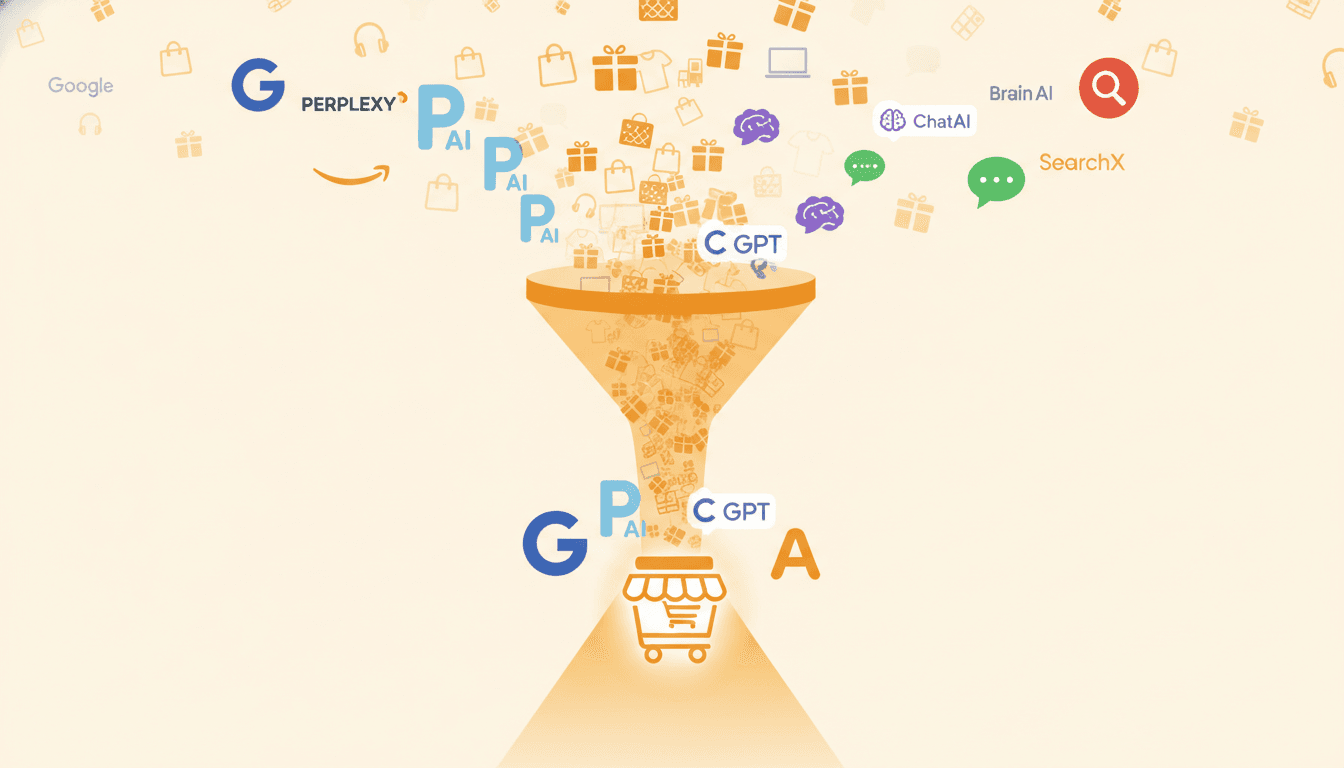
The traditional e-commerce funnel is collapsing. AI assistants are compressing awareness, consideration, and decision into a single interaction—and brands that aren't optimized for AI discovery are already losing revenue they can't see or measure.
14 min read

# Zero-Click Commerce: How AI Search Is Changing the E-Commerce Conversion Funnel

The traditional e-commerce funnel is collapsing. AI assistants are compressing awareness, consideration, and decision into a single interaction. Brands not optimized for AI discovery are already losing revenue they cannot see or measure.

[IMG: Split-screen visual showing traditional multi-step e-commerce funnel on the left versus a single AI chat interface completing a purchase on the right]


---


## What Is Zero-Click Commerce? Redefining the Path to Purchase

The customer journey to purchase has become shorter—and it might bypass a brand's website entirely. When a Gen Z shopper asks an AI assistant "What's the best sustainable sneaker under $120?", the shopper is not scrolling through a Google search results page. The shopper wants a curated recommendation, delivered instantly, with a direct path to checkout.

This is zero-click commerce: the compression of the traditional browse-and-click funnel when AI assistants deliver product recommendations, comparisons, and purchase pathways directly within the chat interface itself. According to [Gartner Digital Commerce Research](https://www.gartner.com), transactions and purchase decisions are increasingly initiated—and often completed—inside an AI assistant without the consumer ever visiting a brand's website. The funnel has not shortened; it has structurally transformed.

The traditional five-to-seven touchpoint journey is being replaced by one or two AI interactions. Instead of clicking through five to ten links, a customer receives a ranked list of products with reviews, prices, and direct purchase links—all in a single chat window. [McKinsey & Company](https://www.mckinsey.com) confirms that AI-assisted shopping can compress the average conversion journey to as few as one to two interactions.

Here's how zero-click differs from traditional commerce: zero-click does not mean no transaction. It means no visit to a brand's website as the discovery and decision point. The sale still happens—it just happens somewhere else, on terms set by the AI.

The numbers signal genuine urgency. [Salesforce's Connected Shoppers Report 2024](https://www.salesforce.com) found that **58% of Gen Z consumers are open to AI-driven product recommendations**, and **34% have already made a purchase directly influenced by an AI chatbot recommendation**. [SparkToro and Datos](https://sparktoro.com) project that **70% of all online searches will result in zero-click outcomes by 2026**. [Juniper Research](https://www.juniperresearch.com) forecasts **$1.2 trillion in global e-commerce sales will be influenced by AI assistants by 2027**, representing 13% of total projected global e-commerce revenue.

Brands that optimize for AI visibility now will capture a disproportionate share of that conversational commerce revenue. Those that wait will be invisible to the fastest-growing shopping behavior of the decade.


---


## How AI Assistants Are Reshaping the Conversion Funnel

[IMG: Animated diagram showing the new AI-mediated funnel: AI Mention → AI Comparison → AI Recommendation → Direct Checkout, with traditional funnel stages fading in the background]

The traditional awareness-to-decision funnel assumed multiple touchpoints across multiple sessions. AI assistants have collapsed that model entirely. Awareness, consideration, and decision now happen simultaneously—inside one interface, in one conversation.

This compression fundamentally shifts who controls the customer's decision environment. AI assistants serve as both discovery engine and decision-making tool, reducing friction and compressing the time between intent and purchase. The new funnel operates in four stages:

- **AI Mention** — The consumer's query surfaces a brand recommendation
- **AI Comparison** — The assistant contextualizes the brand against alternatives
- **AI Recommendation** — A specific product is surfaced with clear rationale
- **Conversion** — A direct link or integrated checkout completes the transaction

One reason this funnel converts effectively is trust. Consumers perceive AI recommendations as more objective than paid search ads, because the conversational context feels advisory rather than promotional. [Boston Consulting Group's AI in Retail Commerce Benchmark 2024](https://www.bcg.com) documented a **2–3x higher purchase intent conversion rate for AI-assisted recommendations compared to standard paid search ads**, attributed directly to this perceived objectivity.

The structural data story matters equally. AI assistants rely on product schema, reviews, and metadata to rank and recommend products. Data quality is no longer just an operational concern—it is a direct conversion lever. Poor schema markup means poor AI visibility, regardless of paid media spend.

The evidence of funnel disruption is already visible in organic search performance. [Ahrefs' Organic CTR Study 2024](https://ahrefs.com) recorded a **27% year-over-year decline in organic click-through rates from Google SERPs**, driven by the expansion of AI Overviews. Product and shopping queries are experiencing some of the steepest drops. The shift from search to AI is not theoretical—it is measurable, and it is accelerating.

As [Rand Fishkin, Co-founder & CEO of SparkToro](https://sparktoro.com), frames it: "The question for every e-commerce brand is no longer just 'do we rank on Google?' It's 'does ChatGPT know who we are, trust what we sell, and recommend us when someone asks?' Those are fundamentally different optimization problems."

Gen Z's outsized adoption signals a generational tipping point. Brands treating AI-mediated commerce as a future consideration are already behind.


---


## The Attribution Crisis: Why Traditional Metrics Fail in Zero-Click Commerce

[IMG: Dashboard visualization showing analytics blind spots—standard metrics (CTR, sessions, page views) showing data, while AI-driven revenue influence shows a question mark]

Here's the problem: if a customer discovers a product through an AI assistant and completes the purchase through a direct link inside that interface, no pixel fires on the brand's website. No UTM parameter is captured. No cookie is set. The conversion happened—but analytics recorded nothing.

This is the attribution crisis at the heart of zero-click commerce. Last-click attribution is structurally incompatible with AI-mediated discovery, as [MMA Global's Attribution in the Age of Generative AI Report 2024](https://www.mmaglobal.com) confirms. The "click" that drove the purchase decision happened inside an AI interface that most analytics platforms cannot track. Multi-touch attribution fares no better—zero-click interactions simply do not generate the digital breadcrumbs those models depend on.

The scale of the blind spot is significant. [Klaviyo and PYMNTS' E-Commerce Intelligence Report 2024](https://www.klaviyo.com) found that **45% of e-commerce marketers report their current analytics stack cannot accurately attribute revenue to AI-driven discovery channels**. As [Avinash Kaushik, Chief Strategy Officer at Croud](https://www.croud.com), puts it: "Last-click attribution was already flawed. Zero-click commerce doesn't just stress-test it—it breaks it entirely. Marketers need influence measurement, not just click measurement, to understand what's actually driving revenue."

The strategic implication is direct: if a brand cannot measure AI-driven influence, that brand cannot optimize for it. Without measurement, brands cannot justify investment in AI optimization to leadership. Emerging alternatives to traditional attribution include:

- **AI share of voice** — percentage of category queries where a brand is recommended
- **Mention frequency** — how often a brand appears across major AI assistants
- **Sentiment-weighted presence** — not just whether a brand is mentioned, but how favorably
- **Recommendation frequency by query intent** — high-intent versus low-intent query performance
- **AI-attributed revenue influence** — tracked through AI commerce platform partnerships

Marketers adopting these new measurement frameworks now will have both the data and organizational credibility to compete as zero-click commerce scales. Those who do not will be flying blind.


---


## What Brands Must Optimize for: The GEO Framework

[IMG: Visual framework diagram showing GEO pillars: Structured Data, Review Ecosystem, Brand Signals, Product Feed, Content Authority—arranged around a central AI recommendation engine icon]

Traditional SEO optimized for Google's crawlers. **Generative Engine Optimization (GEO)** optimizes for AI models—and the signals these models use to evaluate and recommend products are fundamentally different. [Search Engine Land](https://searchengineland.com) identifies GEO as a distinct discipline focused on structuring brand content, product data, and reviews so that AI models are more likely to surface a brand in conversational queries.

As [Azita Martin, VP of AI for Retail & CPG at NVIDIA](https://www.nvidia.com), observes: "Brands are moving from an era where the website was the center of the commerce universe to one where the AI response is the storefront. The brands winning in this environment are the ones investing in being the answer, not just having the best landing page."

The GEO framework translates into five actionable optimization priorities:

**Structured Product Data**

AI assistants parse and rank based on schema markup (Product, Offer, Review, AggregateRating). According to [Semrush's State of Search 2024](https://www.semrush.com), product structured data has become disproportionately important in AI recommendation algorithms. These machine-readable signals help AI models evaluate products without human editorial input. Incomplete or inaccurate schema directly reduces recommendation likelihood.

**Third-Party Review Authority**

AI assistants weight external reviews on platforms like Trustpilot, G2, and industry-specific sites more heavily than first-party testimonials. Building a review ecosystem is now a direct conversion lever, not just a reputation management tactic. Brands should target a 4.5+ star average and actively drive review velocity.

**Consistent Brand Signals Across the Open Web**

AI assistants cross-reference brand mentions, product mentions, and sentiment across multiple sources. Distributed presence across high-authority domains matters more than ever. A brand mentioned positively on industry blogs, news sites, and authority publications carries more weight than mentions on the brand's own website.

**Product Feed Optimization**

AI assistants ingest product feeds from platforms like Google Merchant Center. Accurate, complete, and richly attributed feeds increase recommendation likelihood. Missing attributes, incorrect pricing, or outdated inventory directly reduces AI visibility.

**Sentiment and Context in High-Authority Content**

AI assistants favor brands mentioned positively in authoritative editorial, PR, and thought leadership content. Content marketing directly impacts AI visibility. For example, a well-structured buying guide or comparison article becomes source material for AI recommendations.

[Forrester Research](https://www.forrester.com) draws the analogy plainly: brands not present in AI recommendations face a visibility problem analogous to not ranking on page one of Google in the 2000s. GEO is now a board-level strategic priority for competitive e-commerce brands, not a technical afterthought.


---


## The New Metrics Framework: Measuring Success in Zero-Click Commerce

[IMG: Clean metrics dashboard mockup showing AI share of voice, recommendation frequency by query intent, sentiment score, and review velocity as primary KPIs]

Organic traffic, click-through rate, and page views were built for a web where every interaction generated a trackable click. Zero-click commerce requires a fundamentally different measurement architecture. Leading brands are already tracking AI-specific KPIs alongside—or in place of—traditional digital metrics.

The core metrics framework for zero-click commerce includes:

**AI Share of Voice**

What percentage of recommendations for a given category does a brand receive across major AI assistants? [Gartner's Marketing in the Generative AI Era 2024](https://www.gartner.com) identifies this as a more meaningful KPI than organic search ranking position in AI-mediated environments. Tracking this metric across ChatGPT, Perplexity, Claude, and other assistants reveals competitive positioning.

**Recommendation Frequency by Query Intent**

How often is a brand recommended for high-intent queries (e.g., "best product for X use case") versus informational or low-intent queries? High-intent frequency directly correlates with revenue influence and should be the primary optimization target.

**AI-Attributed Revenue Influence**

This metric is tracked through partnerships with AI commerce platforms and analytics vendors who can connect recommendation events to downstream purchase behavior. This metric directly ties AI optimization to revenue impact.

**Sentiment Scoring Within AI Responses**

Not just whether a brand is mentioned, but how it is described matters significantly. Positive, neutral, and negative context each carry different conversion implications. A mention alongside "overpriced" carries different weight than a mention alongside "best value."

**Review Velocity and Authority**

Growth in third-party review volume and average rating serve as leading indicators of AI recommendation lift. Monitoring these metrics reveals whether review ecosystem investments are translating to increased AI visibility.

**Competitive Benchmarking**

Measuring AI visibility against direct competitors across multiple assistants reveals relative positioning and optimization gaps. This competitive context is essential for prioritizing optimization efforts.

With **45% of marketers currently lacking the measurement tools to track AI-driven discovery**, brands building this measurement infrastructure now will have a compounding advantage. The data accumulated will inform optimization decisions that competitors cannot replicate without the same longitudinal baseline.


---


## Practical Action Plan: Competing in a Zero-Click World

[IMG: Six-step roadmap graphic with icons for each action: audit, optimize, build, create, partner, monitor]

Competing in zero-click commerce is not a single campaign initiative. It is an ongoing optimization discipline spanning data infrastructure, content strategy, and partnership development. Here's how to build that capability systematically.

**Step 1: Audit AI Visibility**

Brands should test product recommendations across ChatGPT, Perplexity, Claude, and other major AI assistants. Ask specific queries related to the brand's category and note whether the brand appears, how frequently, and in what context. This baseline audit is the foundation for all subsequent optimization decisions. Document sentiment, positioning relative to competitors, and any gaps in product information.

**Step 2: Optimize Product Feeds and Schema**

Audit Google Merchant Center feeds, website schema markup, and product data for completeness and accuracy. [BrightEdge's AI Search Impact Report 2024](https://www.brightedge.com) confirms that Google's AI Overviews now appear in over 50% of U.S. search queries—meaning rich, accurate product data directly influences whether a brand appears before any organic link is clicked. Ensure all products have complete schema markup, accurate pricing, availability, and high-quality images.

**Step 3: Build a Review Ecosystem**

Brands should invest in third-party review platforms—Trustpilot, G2, and industry-specific sites. AI assistants weight these signals heavily in recommendation algorithms. Implement post-purchase email campaigns to drive review velocity, target a 4.5+ star average rating, and actively respond to reviews to build sentiment authority.

**Step 4: Create AI-Friendly Content**

Develop product comparison guides, buying guides, and FAQ content optimized for AI extraction and citation. This content becomes source material for AI recommendations. For example, a well-structured "Best Running Shoes for Flat Feet" guide is more likely to be cited by an AI assistant than a standard product page. Focus on answering specific questions that AI assistants are likely to receive.

**Step 5: Partner with AI Commerce Platforms**

Integrate with platforms like Shopify's AI shopping assistant, commerce-enabled AI APIs, or emerging zero-click commerce networks. [Perplexity AI's native "Buy with Pro" shopping feature](https://www.perplexity.ai), launched in 2024, and [Amazon's Rufus AI shopping assistant](https://www.aboutamazon.com) demonstrate that zero-click commerce infrastructure is already operating at scale. Early integration with these platforms increases visibility.

**Step 6: Monitor and Iterate**

Set up dashboards to track AI share of voice, recommendation frequency, and sentiment across assistants. Treat AI optimization as an ongoing discipline, not a one-time audit. As [Bret Taylor, Co-founder of Sierra AI](https://sierra.ai), warns: "Brands that wait for this shift to fully materialize before adapting will find themselves locked out of conversations they never knew were happening." Monthly reviews of these metrics should inform optimization priorities.


---


## Why This Matters: The Competitive Stakes of Zero-Click Commerce

[IMG: Market opportunity visualization showing $1.2 trillion AI-influenced e-commerce revenue by 2027, with early mover advantage highlighted]

The competitive stakes of zero-click commerce are not abstract. They are measured in revenue, market share, and long-term brand discoverability. Brands not optimized for AI recommendations are effectively invisible to a growing segment of consumers who use AI as their primary research tool. [Forrester Research](https://www.forrester.com) compares this new form of "AI search exclusion" directly to failing to rank on page one of Google during the search era's formative years.

The generational signal is unambiguous. With **58% of Gen Z open to AI recommendations** and **34% already making AI-influenced purchases**, this is not niche behavior. It is the leading edge of mainstream e-commerce discovery. As this cohort's purchasing power grows, AI-mediated commerce will become the dominant channel for product discovery across demographics.

The revenue opportunity is equally clear. [Juniper Research](https://www.juniperresearch.com) projects **$1.2 trillion in AI-influenced global e-commerce sales by 2027**—13% of total projected e-commerce revenue. Early movers establishing AI visibility now will build a competitive moat in structured data quality, review authority, and brand sentiment that late entrants will struggle to replicate. Meanwhile, the **27% year-over-year decline in organic CTR** signals that the transition away from traditional search is already eroding the value of conventional SEO investments.

The window for early-mover advantage is open, but it is narrowing. As more brands invest in GEO, the cost of establishing AI visibility will rise and the differentiation available to pioneers will compress. Brands acting now—auditing AI discoverability, optimizing product data, and building review ecosystems—will own the conversational commerce landscape forming around them.

Zero-click commerce is not a future scenario. It is a present competitive reality, and brands treating it as such will be the ones writing the next decade of e-commerce success.


---


*Zero-click commerce is reshaping how consumers discover and purchase products. Brands optimizing for AI visibility now will capture disproportionate market share in this emerging channel. Hexagon's GEO experts help e-commerce brands optimize for AI discovery, build the measurement frameworks zero-click commerce demands, and capture revenue that traditional analytics cannot even see.*
H
Hexagon Team
Published June 27, 2026