searchbrandbrands
The AI Search Revolution: Why Traditional E-Commerce Marketing Strategies Are Becoming Obsolete
In 2024, 58% of online shoppers used an AI assistant to discover or research a product before buying—yet only 9% of marketing teams have a strategy to capitalize on it. Here's why the ground beneath e-commerce marketing is shifting, and what forward-thinking brands must do before the window closes.
11 min read

# The AI Search Revolution: Why Traditional E-Commerce Marketing Strategies Are Becoming Obsolete

In 2024, 58% of online shoppers used an AI assistant to discover or research a product before buying. Yet only 9% of marketing teams have a strategy to capitalize on it. While competitors optimize Google Shopping feeds, the ground beneath e-commerce marketing is shifting—and most brands haven't noticed they're already losing.

[IMG: Split-screen visual contrasting a traditional Google Shopping results page on the left with a clean AI assistant product recommendation interface on the right, emphasizing the visual and structural difference in how results are presented]


---


## The Seismic Shift: How AI Search Fundamentally Differs from Google Shopping

The numbers tell a stark story. [58% of consumers](https://www.salesforce.com/resources/research-reports/state-of-the-connected-customer/) now use AI assistants to research or discover products before purchasing. Yet only 9% of marketing teams have built a strategy around this shift.

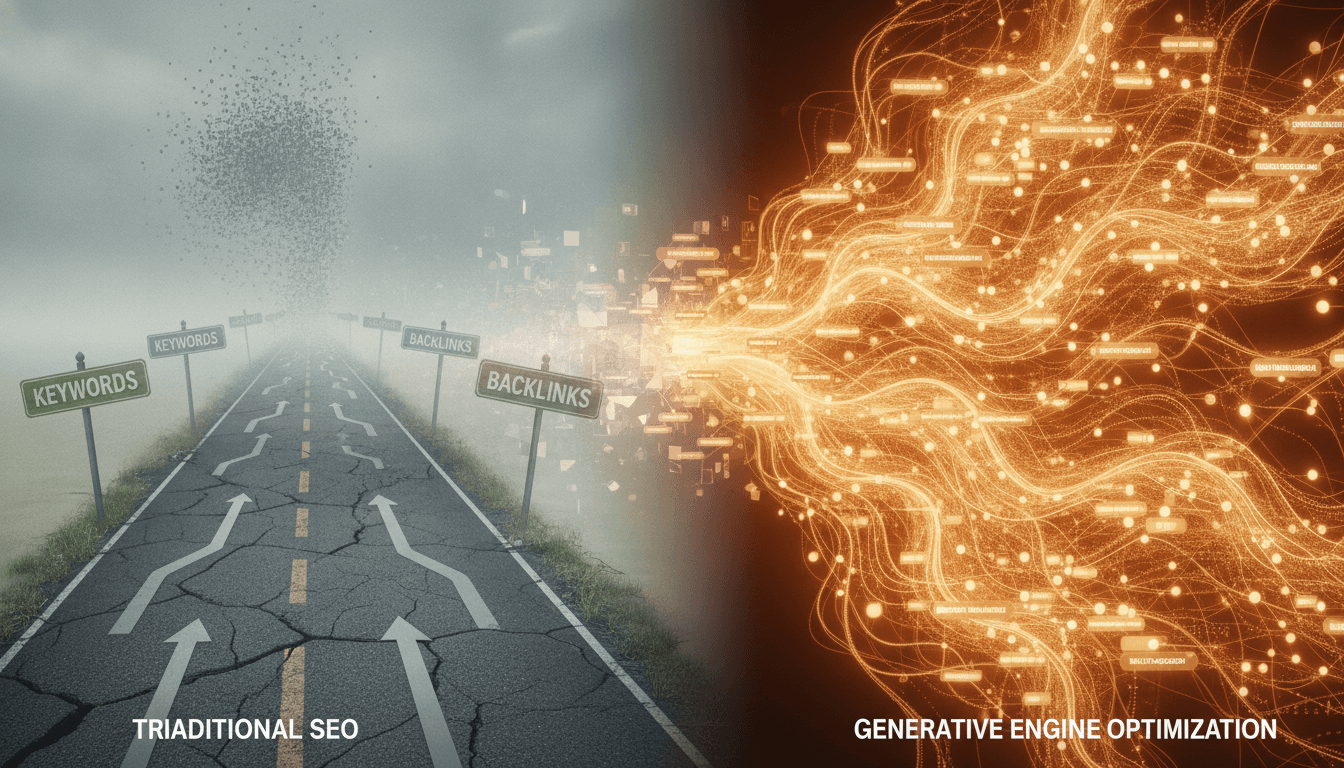
The mechanics of AI search operate by entirely different rules than traditional platforms. Google rewards ad spend, feed optimization, and keyword-rich product pages. AI assistants like ChatGPT and Perplexity work differently—they synthesize recommendations from trusted, independently corroborated sources.

This structural difference has profound consequences for visibility. Google Shopping surfaces 50 or more results per query, distributing visibility across dozens of brands. AI assistants recommend just 2–5 brands per query.

The competitive math is brutal. [Organic click-through rates for top-ranked Google results have fallen 37% since AI Overviews launched in 2024](https://searchengineland.com/), as Google's own AI-generated answer boxes resolve queries directly on the search results page. Even brands holding the coveted #1 organic position are experiencing meaningful traffic loss.

What drives AI recommendation? Not keywords or backlinks. The answer is **corroboration**. Brands mentioned in 10 or more independent editorial sources are [3.7x more likely to be recommended by AI assistants](https://joinhexagon.com/) than brands with fewer than three external mentions.

This single data point reframes the entire marketing investment conversation. AI search doesn't reward who spends the most—it rewards who is trusted the most.

[IMG: Infographic showing the contrast between Google's ranking signals (bid price, keyword density, feed quality) vs. AI recommendation signals (editorial mentions, review sentiment, structured data, third-party authority)]


---


## Why Traditional SEO and PPC Are Losing Their Edge

Keyword optimization and backlink strategies were engineered for a specific purpose: to signal relevance to algorithmic ranking systems. That system is no longer the only one that matters for product discovery.

Generative engines don't crawl for keyword relevance. They synthesize answers from training data, live web citations, and trusted editorial sources. This renders traditional SEO signals largely irrelevant to AI recommendation logic.

PPC faces an even starker reality. [AI-powered search engines do not display traditional paid search ads or Google Shopping product listings](https://www.gartner.com/)—meaning brands cannot buy their way into AI recommendations. Ad spend has zero bearing on whether ChatGPT or Perplexity recommends a brand.

The shift from keyword-based search to AI-mediated discovery is not incremental—it is categorical. Marketers optimizing for blue links and Shopping feeds are solving yesterday's problem. The question is no longer "how do I rank?" but "how do I get recommended?"

The data confirms this shift is already underway. [Gartner forecasts a 25% decline in traditional search engine volume by 2026](https://www.gartner.com/en/newsroom/press-releases/2024-02-19-gartner-predicts-search-engine-volume-will-fall-25-percent-by-2026-due-to-ai-chatbots-and-other-virtual-agents) as AI chatbots handle a growing share of product discovery queries. The 37% drop in organic CTR since AI Overviews launched is the early signal of a much larger structural shift.

Google's own behavior is the most telling proof point. [AI Overviews now appear on an estimated 30–50% of all U.S. search queries](https://www.brightedge.com/), pushing organic results further down the page. The search giant is systematically cannibalizing its own monetization model—which signals just how irreversible this transition is.

**The practical implications are clear:**

- Traditional SEO ranking signals—backlinks, keyword density, meta tags—have minimal direct influence on AI recommendations
- PPC bidding strategies are structurally excluded from AI assistant outputs
- Google Shopping click-through rates have declined 15–25% on high-intent queries where AI answers now appear
- The 25% search volume decline Gartner forecasts is a floor, not a ceiling


---


## The New Currency of E-Commerce Visibility: Third-Party Authority

If ad spend and keyword optimization no longer drive AI visibility, what does? The answer is straightforward: **third-party authority**—the degree to which independent, trusted sources corroborate a brand's expertise, quality, and relevance.

AI assistants are designed to be recommendation-agnostic. They reward the brands that the broader web ecosystem already trusts. The 3.7x recommendation likelihood for brands with 10+ independent editorial mentions is not a soft signal—it is the core mechanic of AI search visibility.

Unlike Google Shopping, which ranks products on bid price and feed quality, AI assistants rank on perceived trustworthiness, editorial mentions, review sentiment, and structured brand information. These are fundamentally different inputs requiring a fundamentally different investment strategy.

Genuine expertise, consistent brand narrative, and a web presence that third parties trust enough to cite are what generative AI rewards. This insight cascades through marketing investment priorities.

For example, brands pursuing AI visibility must shift their investment mix dramatically. PR and editorial partnerships become a core channel, not supplementary—independent "best of" lists, comparison articles, and editorial reviews directly feed AI recommendation logic.

Review management matters more than ever, as AI assistants synthesize review sentiment across platforms to assess brand trustworthiness. Structured data markup (Schema.org) and consistent brand information across authoritative third-party platforms are among the most impactful technical factors for AI visibility.

E-commerce brands frequently cited in independent reviews and editorial content are significantly more likely to be recommended by AI assistants. These engines prioritize corroborated, third-party validated information over brand-owned content.

The shift is from *ranking* to *being recommended*—and the investment mix must reflect that reality. On-page SEO remains relevant for Google but is insufficient on its own for AI-native discovery.


---


## The Winner-Take-Most Reality: Why AI Visibility Stakes Are Higher Than Ever

The competitive math of AI search is unforgiving. Google Shopping gives every brand with a budget a seat at the table—50+ results mean dozens of brands share visibility. AI assistants recommend 2–5 brands per query.

Being outside that narrow set doesn't mean ranking lower. It means being invisible to the fastest-growing discovery channel in e-commerce.

This dynamic is accelerating faster than most marketers realize. The [generative AI in e-commerce market is projected to grow from $1.8 billion in 2023 to over $22.6 billion by 2032, at a CAGR of 32.8%](https://www.precedenceresearch.com/). That trajectory reflects how rapidly AI-native shopping experiences are becoming the default.

The scale is staggering. [ChatGPT surpassed 200 million weekly active users as of 2024](https://openai.com/), while [Perplexity AI was processing over 500 million queries per month as of early 2025](https://www.perplexity.ai/)—with a significant share related to product research. These are not niche platforms.

The 67% awareness / 9% action gap represents a critical window. Most marketing directors understand that AI search matters. Almost none have built a strategy to address it.

Looking ahead, the brands investing in Generative Engine Optimization now will own their categories in AI search before competitors catch up. When GEO becomes table stakes—as Google SEO did in the 2010s and Google Shopping did in the 2020s—the cost of entry will be significantly higher.

**The stakes are measurable:**

- The winner-take-most dynamic means 2–5 brands capture nearly all AI-driven discovery traffic per query
- Amazon's dominance in product search is being challenged as users ask ChatGPT "what is the best [product]" before visiting any marketplace
- First-mover brands building AI visibility now will establish authority signals that are difficult for late entrants to replicate quickly
- The competitive intensity will only increase as the 67% aware-but-inactive segment begins to act


---


## What Is Generative Engine Optimization (GEO)? The Emerging Discipline You Need to Master

[Generative Engine Optimization (GEO) is an emerging discipline distinct from traditional SEO](https://arxiv.org/abs/2311.09735), focused on ensuring a brand's information, positioning, and product data are structured and distributed in ways that AI training pipelines and real-time retrieval systems can accurately synthesize. It is not an SEO update. It is a different optimization problem requiring different skills, different metrics, and a fundamentally different content strategy.

The core question GEO answers is not "how do we rank on Google?" but "how do we become the brand AI assistants confidently recommend?" That reframe touches every layer of marketing—from how a brand positions itself in editorial content to how its product data is structured across third-party platforms.

Traditional SEO consultants who have not studied GEO mechanics may not recognize how fundamentally different the playbook actually is. The next battleground is whether a brand gets cited, recommended, or synthesized by an AI model when a consumer asks a purchase-intent question.

The practical differences are substantial. Here's how each discipline approaches the same challenge:

- **Editorial authority**: GEO prioritizes earning mentions in independent, trusted publications—not just building backlinks for PageRank
- **Review management**: AI systems synthesize review sentiment across platforms; managing this signal is a GEO-specific priority
- **Structured data**: Schema.org markup and consistent brand data across authoritative platforms directly improve AI retrieval accuracy
- **Brand positioning**: How a brand is described by third parties matters more than how it describes itself in owned content
- **PR strategy**: Earned media is no longer a "nice to have"—it is a primary GEO investment channel

Brands attempting to adapt existing SEO playbooks without understanding GEO mechanics will systematically underinvest in what actually drives AI visibility. The discipline is new enough that first movers have a genuine knowledge and execution advantage—one that compounds over time.


---


## The Strategic Reframe: From Ranking to Recommendation

The most important shift marketing teams can make right now is not tactical. It is conceptual. The core question must change from "how do we rank on Google?" to "how do we become the brand AI assistants recommend?"

That reframe is not semantic. It cascades through every layer of marketing investment and strategy. A brand that reframes around recommendation will immediately recognize that its PR budget is an AI visibility investment, that its review management program is a GEO signal, and that its editorial content strategy needs to prioritize third-party corroboration.

The investment mix shifts. The success metrics shift. The agency and tool relationships shift. Brands that delay this reframe face a compounding competitive disadvantage—not just in AI search performance, but in brand authority signals that are slow to build and difficult to replicate quickly.

The 67% awareness / 9% action gap will not persist indefinitely. As GEO becomes as competitive and expensive as Google Shopping is today, the cost of building AI visibility will rise sharply.


---


## What Brands Need to Do Right Now: A GEO-First Action Plan

The strategic case is clear. Here's how to translate it into immediate action. The first step is an honest audit of current AI visibility—specifically, whether the brand is mentioned in 10 or more independent editorial sources, what review sentiment looks like across platforms, and whether structured data is implemented correctly.

Investment priorities must be reordered to reflect the new discovery landscape. For AI-native visibility, PR and editorial partnerships should lead, followed by review management infrastructure, structured data implementation, and then traditional SEO. PPC remains relevant for Google conversion but has no direct bearing on AI recommendation.

Brands should have a defined GEO strategy in place by Q2 2025. The competitive window created by the 67% awareness / 9% action gap is real, but it is narrowing.

A practical GEO action plan includes:

- **Audit editorial footprint**: Determine whether the brand is mentioned in 10+ independent sources; if not, that is the most urgent gap
- **Prioritize PR as a GEO channel**: Target independent "best of" lists, comparison articles, and editorial reviews in the category
- **Implement structured data**: Ensure Schema.org markup is complete and brand information is consistent across authoritative third-party platforms
- **Build a review management system**: Monitor and respond to reviews across all major platforms—AI assistants synthesize this sentiment
- **Measure AI visibility directly**: Track how often and in what context the brand appears in AI assistant responses for key purchase-intent queries
- **Engage GEO-native expertise**: Traditional SEO agencies may not understand GEO mechanics—seek partners who specialize in AI-native visibility

[IMG: Step-by-step action plan graphic showing the GEO audit and implementation roadmap, from editorial footprint assessment through structured data implementation and AI visibility measurement]


---


## The Window Is Open—But Not for Long

The AI search revolution is not a future scenario to prepare for. It is the present reality that 58% of online shoppers are already living. The brands that treat GEO as urgent—not eventual—will own their categories in AI search before competitors recognize what they've lost.

The data is unambiguous: traditional search volume is declining, organic CTR is eroding, PPC cannot buy AI visibility, and the winner-take-most dynamics of AI recommendation make invisibility in this channel a genuine existential risk. The 67% awareness / 9% action gap is the opportunity.

The question is which brands will seize it. [Book a 30-minute strategy session](https://calendly.com/ramon-joinhexagon/30min) to audit current AI visibility and map out a GEO roadmap tailored to the brand's category.
H
Hexagon Team
Published June 14, 2026