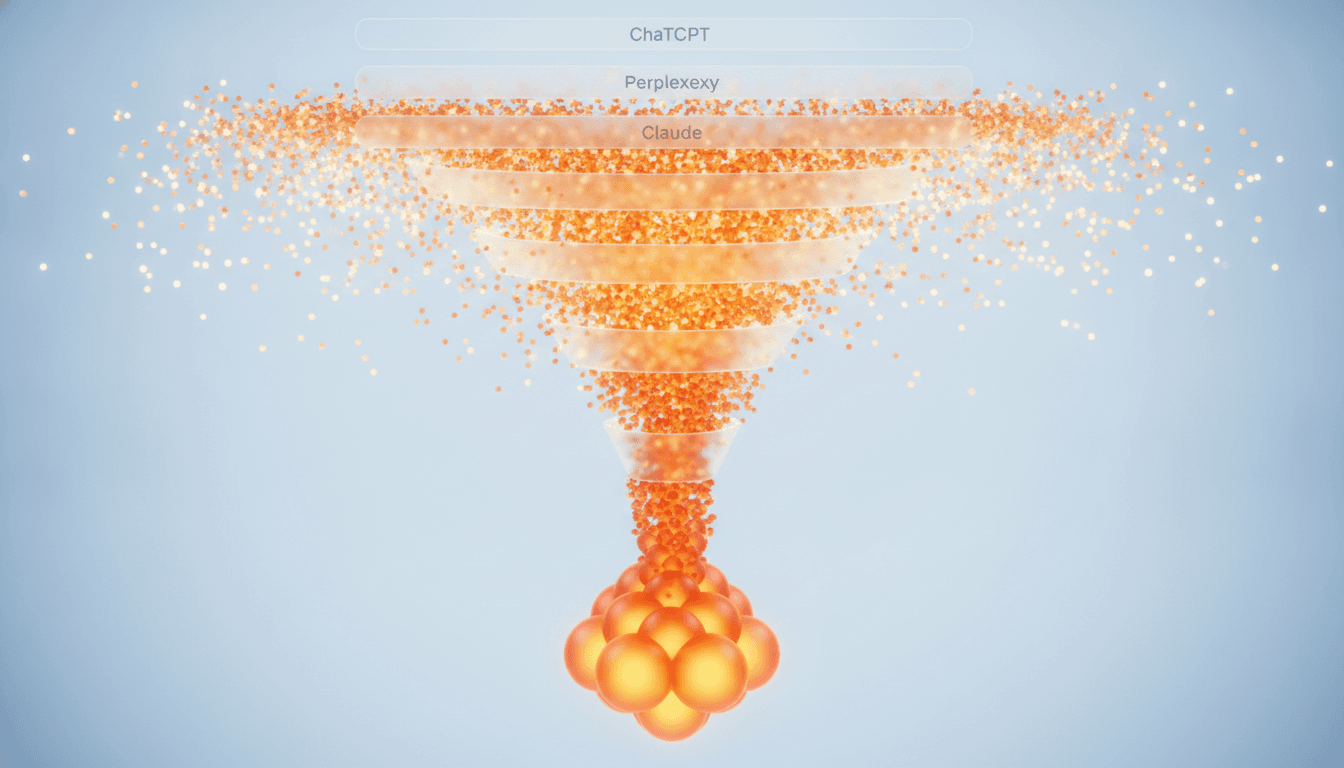
citationbrandsbrand
The AI Search Citation Crisis: How Generative Engines Choose (and Reject) E-Commerce Brands as Trusted Sources
In 2024, AI assistants became the primary product discovery channel for millions of younger consumers—yet most e-commerce brands have no strategy for appearing in those recommendations. Here's why the citation gap is widening, and what CMOs must do now.
15 min read
---


# The AI Search Citation Crisis: How Generative Engines Choose (and Reject) E-Commerce Brands as Trusted Sources

*In 2024, AI assistants became the primary product discovery channel for millions of younger consumers—yet most e-commerce brands have no strategy for appearing in those recommendations. Here's why the citation gap is widening, and what CMOs must do now.*

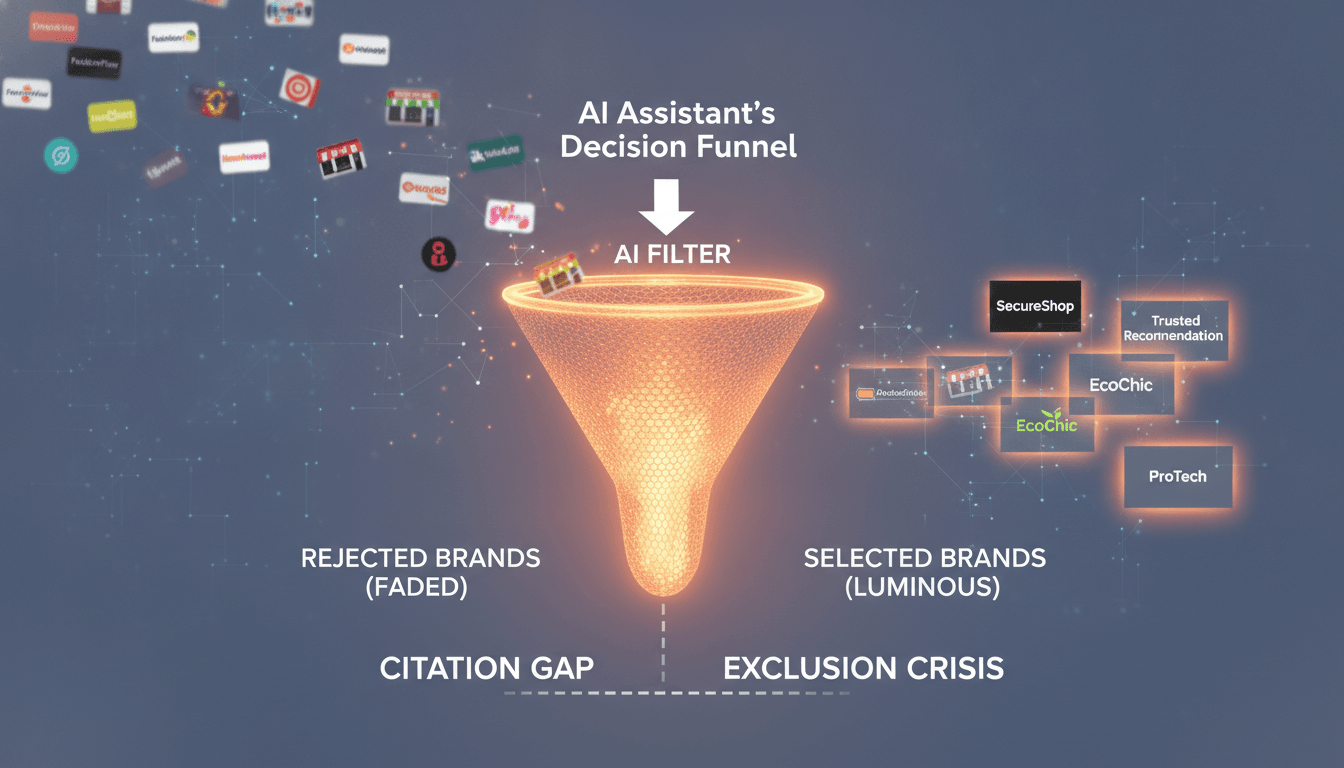
[IMG: Split-screen visualization showing a consumer asking an AI assistant for product recommendations on one side, and a brand's website analytics showing declining organic discovery traffic on the other]


---


## The Silent Threat Most E-Commerce Brands Haven't Noticed Yet

Most e-commerce brands remain invisible to the AI assistants their customers are already using. [58% of consumers aged 18-34 have used an AI assistant to help make a purchase decision](https://www.salesforce.com/resources/research-reports/state-of-the-connected-customer/) in the past 12 months.

For brands founded after 2018, there is only a 12% chance they will appear in AI-generated product recommendations—regardless of market position or customer satisfaction scores. The purchase discovery funnel has shifted to AI, but the citation hierarchy has not.

This is not a ranking problem. It is a trust signal problem, and it is costing DTC brands millions in invisible revenue that flows to competitors who understand how generative engines evaluate brand credibility.


---


## The Citation Crisis: Why AI Invisibility Is Structurally Different from SEO Invisibility

AI citation invisibility operates on entirely different mechanics than traditional search engine invisibility. When a Gen Z consumer asks ChatGPT or Perplexity to recommend the best skincare brand for sensitive skin, the brands appearing in that response capture awareness before any other marketing channel engages.

Citation gaps in generative AI are determined by training data density, third-party corroboration, and entity recognition. A brand can rank on page one of Google and remain completely absent from AI-generated recommendations. Page speed, keyword optimization, and backlink profiles have almost no impact on AI citation rates.

The problem compounds over time. [Perplexity AI's shopping-related queries grew 340% year-over-year in 2024](https://www.theinformation.com/), with product recommendation queries now representing the platform's fastest-growing category. As AI-assisted discovery moves from minority behavior to majority behavior, citation gaps translate directly to revenue loss.


---


## How Generative Engines Actually Evaluate Brand Authority

Generative engines do not evaluate brands the way search algorithms evaluate web pages. Before any real-time retrieval occurs, base LLM training data has already established a de facto authority ranking for every brand entity in the model's knowledge.

Here's how the process works: Brands that accumulated dense editorial coverage before a model's training cutoff enter every recommendation query with a structural head start. Entity recognition systems categorize brands into implicit trust tiers based on historical presence across large-scale web datasets like Common Crawl.

A brand with years of editorial mentions, Wikipedia entries, and consistent third-party corroboration is recognized as a high-confidence entity. A brand without that footprint may not be recognized as a distinct entity at all—regardless of current market position.

Real-time retrieval systems like Perplexity and ChatGPT with browsing enabled layer fresh signals on top of base knowledge, creating a potential equalizer for newer brands. Kevin Indig, Growth Advisor and former VP of SEO at Shopify, explains: "Citation in generative AI follows a discernible logic that rewards entities with strong knowledge graph presence, high-authority inbound links, and consistent factual representation across multiple independent sources. Brands that understand this logic can engineer their way into AI recommendations. Brands that don't will cede that ground to competitors who do."

The hierarchy is invisible to most brands, but its outcomes are entirely deterministic.

**If an organization is ready to understand how its brand ranks in the AI citation hierarchy and what specific signals are holding it back, [book a free 30-minute GEO strategy session with our team](https://calendly.com/ramon-joinhexagon/30min).**


---


## The Legacy Brand Advantage: Training Data Density Creates Structural Barriers

[IMG: Bar chart comparing legacy brand AI citation rates (73%) vs. their market revenue share (41%) against DTC brand citation rates vs. their market revenue share]

Legacy brands founded before 2015 capture approximately **73% of all brand-specific citations** in AI product recommendation queries—despite representing only 41% of actual market revenue in categories like apparel, home goods, and consumer electronics. The citation advantage is wildly disproportionate to commercial reality.

The mechanism is straightforward: older brands have spent years accumulating the exact signals that AI training datasets weight most heavily. Decades of editorial coverage, Wikipedia entries, industry database listings, and third-party product reviews create a mention density that newer brands cannot replicate quickly.

A DTC brand with superior products and higher customer satisfaction scores will still lose the citation competition to a legacy brand with inferior products but deeper editorial history. This is not a quality problem—it is a time-and-coverage problem.

Wikipedia presence is particularly consequential. Brands with verified Wikipedia entries are cited by ChatGPT in product recommendation queries at a rate **6.3x higher** than brands without Wikipedia presence, according to Hexagon's analysis of 25,000+ citations. The time-to-authority gap—the period required for a new DTC brand to accumulate equivalent mention density to a pre-2015 legacy brand—can span five to seven years without deliberate intervention.

That is the structural barrier most DTC CMOs do not yet understand they are facing.


---


## E-E-A-T for AI: How Google's Framework Translates to Generative Engine Credibility

Google's E-E-A-T framework—Experience, Expertise, Authoritativeness, and Trustworthiness—was designed to help human quality raters evaluate content. Lily Ray, VP of SEO Strategy and Research at Amsive, observes: "E-E-A-T was always about more than Google—it was about how any intelligent system evaluates trustworthiness. The signals that make a source credible to a human editor are largely the same signals that make it credible to a large language model: original expertise, verifiable credentials, and consistent third-party corroboration."

The key distinction between Google Search and AI engines lies in how they weight third-party corroboration. Traditional Google Search rewards well-structured on-page signals and high-authority inbound links. AI engines go further—they systematically discount self-reported expertise in favor of independently verifiable claims.

A brand's "About Us" page carries almost no weight in AI citation decisions. A profile in a major trade publication carries significant weight.

Trustworthiness in the AI citation context means three specific things:

- **Verifiable identity**: consistent brand information across all platforms
- **Consistent brand presence**: the same brand entity recognized across Wikipedia, review sites, news coverage, and social platforms
- **Third-party endorsement**: editorial sources confirming the brand's existence and claims without commercial incentive

Brands that treated E-E-A-T as a Google-specific compliance exercise are caught flat-footed by AI search. The signals matter more than ever—they are just being evaluated by different systems.


---


## The Third-Party Corroboration Imperative: Why AI Engines Distrust Owned Content

[IMG: Diagram showing the "citation web" of an established brand—Wikipedia, editorial reviews, Reddit mentions, Amazon listings, and news coverage—all feeding into AI recommendation outputs]

AI engines do not distrust owned content because it is inaccurate—they distrust it because it is incentivized. Claude (Anthropic) applies Constitutional AI principles that make it more likely to cite sources perceived as balanced and low in commercial bias. Overtly promotional brand content is systematically deprioritized in favor of editorial and review-based mentions.

Here's how the third-party corroboration hierarchy works in practice:

**Editorial publications** (Wirecutter, CNET, Good Housekeeping, Consumer Reports) function as citation amplifiers. A single positive mention can increase a brand's AI citation rate by an estimated 3-6x.

**Review aggregators** (Trustpilot, G2, Yelp) serve as citation intermediaries that validate brand existence and quality signals.

**UGC platforms** (Reddit, Quora, niche product forums) carry outsized weight because they are perceived as authentic peer signals. Brands actively discussed in these communities gain citation advantages that no amount of owned content can replicate.

**Amazon listings** appear in AI-generated product recommendations **2.8x more frequently** than brand-owned e-commerce pages for identical products—a direct result of platform authority stacking.

**Wikipedia entries** represent the single highest-leverage third-party signal available, with the 6.3x citation advantage noted above.

The citation multiplier effect is real and measurable. Hexagon's analysis found that brands mentioned in 50 or more unique third-party editorial sources are cited by generative AI engines at a rate approximately **4.7x higher** than brands with fewer than 10 third-party mentions—regardless of actual market share.


---


## Training Data Recency Bias: The Knowledge Cutoff Trap and the Real-Time Retrieval Escape Hatch

ChatGPT's base models were trained on data with a defined knowledge cutoff. Brands that lacked substantial editorial coverage before that cutoff are effectively invisible to the model's baseline recommendations—regardless of current market position.

For post-2023 brands, this creates an immediate structural disadvantage in every base model recommendation query. A DTC brand that launched in 2022 and grew to $50M in revenue by 2024 may have almost no presence in ChatGPT's base model outputs.

This is the knowledge cutoff trap: strong current performance provides no protection against training data recency bias.

But there is an escape hatch. Real-time retrieval systems like Perplexity index fresh content continuously, creating a more accessible entry point for newer brands. This changes the timeline equation entirely:

- **6 months to measurable improvement** in real-time retrieval systems vs. 12-18 months for base model influence
- [Structured data markup (Schema.org product, review, and organization schemas)](https://schema.org/) significantly increases the probability of content being parsed and cited by retrieval-augmented AI engines
- Brands publishing original research and proprietary data studies are cited at significantly higher rates because these assets are treated as primary sources
- The window of opportunity is open—but it requires deliberate investment in content architecture and structured data, not just content volume


---


## The Platform Authority Trap: How Amazon and Major Retailers Capture AI Recommendations

Amazon, major retailers, and high-domain-authority platforms have become de facto citation intermediaries in the AI recommendation ecosystem. The mechanism is straightforward: Amazon's domain authority, combined with its review density and product data completeness, creates a citation default that AI engines consistently favor over brand-owned pages.

The 2.8x frequency advantage of Amazon listings over brand-owned e-commerce pages is not a coincidence—it is the predictable output of platform authority stacking.

This creates a paradox for DTC brands. Investment in owned-channel development—direct-to-consumer websites, brand storytelling, first-party data collection—often results in AI engines systematically defaulting to platform-hosted product information. A brand that exists only on its own website is, from an AI citation perspective, a brand that barely exists at all.

The long-term risk is significant. Brands that rely exclusively on Amazon or major retailer listings for AI citation visibility are building on infrastructure they do not own. Platform algorithm changes, listing suppression, or policy shifts can eliminate that citation presence overnight.

The sustainable strategy requires building owned-channel authority in parallel with platform presence—not instead of it.


---


## The GEO Action Framework: 7-Step Roadmap for E-Commerce CMOs to Improve AI Citation Rates

[IMG: Visual roadmap showing the 7-step GEO framework as a progressive timeline, with estimated impact timelines for each step]

Brands that actively engage in GEO practices see an average **47% improvement in AI mention frequency within 6 months**. Here is how to structure that effort:

**Step 1: Establish Knowledge Graph Presence**

Organizations should implement structured data, schema markup, and entity recognition optimization across all owned properties. This is the prerequisite for AI engines to recognize a brand as a distinct, credible entity rather than an ambiguous string of text.

**Step 2: Build Wikipedia Authority**

Creating and maintaining a verified brand Wikipedia entry represents the single highest-leverage foundational trust signal available. Wikipedia's heavy weighting in Common Crawl and other training datasets makes this investment disproportionately valuable relative to its cost.

**Step 3: Implement Comprehensive Structured Data**

Deploying Product schema, Organization schema, and Review schema across all owned properties reduces ambiguity in entity recognition. This significantly increases the probability of content being parsed by retrieval-augmented AI engines.

**Step 4: Launch an Authoritative Content Program**

Developing third-party bylines, expert positioning content, and category education assets demonstrates genuine expertise. Publishing original research and proprietary data studies—these are treated as primary sources by AI engines and generate disproportionate citation authority.

**Step 5: Execute a Third-Party Citation Campaign**

Pursuing editorial placements in authoritative review publications (Wirecutter, CNET, Consumer Reports), securing listings in relevant industry databases, and building presence on review aggregators drives measurable results. A single placement in a high-authority review publication can increase AI mention frequency by 3-6x.

**Step 6: Optimize for Real-Time Retrieval Systems**

Structuring content for answer-engine optimization—clear factual claims, structured formatting, and fresh data feeds—allows Perplexity and browsing-enabled ChatGPT to index and cite the content. This track is prioritized for brands seeking citation improvements within 6 months.

**Step 7: Establish a Measurement Framework**

Tracking AI mention frequency across major platforms, attributing citation sources, and connecting AI citation rates to discovery traffic and revenue impact creates accountability. GEO without measurement is brand awareness spend without attribution—measurement infrastructure should be built from day one.

Rand Fishkin, Co-founder and CEO of SparkToro, frames the opportunity this way: "The brands that will win in AI search are not necessarily the ones with the best products—they're the ones with the deepest, most corroborated information footprint."

**Brands that move fastest on GEO will establish citation advantages that compound as AI adoption accelerates. [Let's audit current AI citation performance and build a prioritized action plan.](https://calendly.com/ramon-joinhexagon/30min)**


---


## The Compounding Cost of AI Invisibility: Long-Term Revenue Impact and the Business Case for GEO Investment

[IMG: Line graph showing projected growth of AI-assisted purchase discovery from 30-40% of Gen Z behavior today to 70%+ within 2-3 years, with annotation showing the citation gap widening over time]

The revenue math on AI invisibility is straightforward—and it gets worse every quarter. With 58% of Gen Z already using AI for purchase decisions, and that percentage projected to move from 30-40% of total discovery behavior to 70%+ within two to three years, citation gaps translate directly to revenue loss. Every unanswered AI recommendation query is a first-touch opportunity that went to a competitor.

The compounding effect is the most dangerous aspect. As AI training data accumulates, brands not cited in current outputs become less likely to appear in future outputs. Their absence from recommendation history reinforces the model's existing citation hierarchy.

Early citation gaps create feedback loops that deepen over time. [Gartner's digital commerce research](https://www.gartner.com/en/digital-markets) describes this as the "AI citation gap"—a widening divide between established and emerging DTC brands that becomes structurally harder to close the longer intervention is delayed.

The business case for GEO investment is no longer speculative. With [340% YoY growth in Perplexity shopping queries](https://www.theinformation.com/), a 47% improvement in AI mention frequency for active GEO practitioners within six months, and a discovery channel growing faster than any other in e-commerce, GEO is a core marketing channel with measurable ROI.

Andrew Lipsman, Independent Analyst in Media, Advertising and Commerce, frames the shift this way: "The question isn't just 'can customers find us on Google?' anymore—it's 'when an AI assistant is asked for a recommendation in our category, does it even know we exist?' For most DTC brands, the honest answer right now is no."


---


## What Brands Are Already Winning at GEO: Early-Adopter Patterns and Advantages

Brands seeing the fastest citation growth share a consistent pattern: **Wikipedia presence combined with structured data implementation and an active third-party citation campaign**. No single element produces the full effect—it is the combination of foundational trust signals, machine-readable entity data, and independent corroboration that triggers AI citation at scale.

Legacy brands that added deliberate GEO practices to their existing authority base outperformed pure DTC brands without third-party corroboration. This confirms that authority accumulation is a prerequisite, not just an accelerant.

For emerging DTC brands, the most actionable finding is that aggressive third-party placement strategies can compress the authority-building timeline from years to months. Brands that secured placements in three or more authoritative review publications within a six-month window saw citation rates increase at rates consistent with the 6.3x Wikipedia advantage—suggesting that citation multiplier effects are stackable.

The pattern that consistently predicts GEO success is measurement orientation. Brands that established AI mention tracking from the beginning of their GEO programs iterated faster and identified which citation sources drove the most downstream impact. This analytical advantage compounds over time and is difficult for pure-execution competitors to replicate.


---


## Conclusion: The Window Is Open—But Not for Long

The AI citation hierarchy is forming right now, in real time, with every product recommendation query that ChatGPT, Perplexity, and Claude answer. Brands appearing in those outputs are building compounding discovery advantages. Brands that do not are accumulating compounding invisibility.

The good news is that the hierarchy is not yet fixed. Real-time retrieval systems offer accessible entry points for brands willing to invest in structured content, third-party corroboration, and entity recognition optimization. The 47% improvement in AI mention frequency that active GEO practitioners achieve within six months is evidence that the citation gap is closeable—but only for brands that move with urgency.

The cost of waiting is not linear. It compounds.

**Organizations should not let their brands become invisible to the AI engines their customers are already using. [Schedule a free 30-minute GEO strategy session](https://calendly.com/ramon-joinhexagon/30min) to map a path to AI citation authority—audit current citation performance, identify the specific signals holding the brand back, and build a prioritized action plan before competitors do.**


---


*Sources: [Salesforce State of the Connected Customer Report 2024](https://www.salesforce.com/resources/research-reports/state-of-the-connected-customer/) | [Hexagon AI Citation Analysis, 2024](https://joinhexagon.com/) | [BrightEdge AI Search Visibility Benchmark Report 2024](https://www.brightedge.com/) | [Perplexity AI Usage Data via The Information, 2024](https://www.theinformation.com/) | [Search Engine Land GEO Case Study Compilation, 2024](https://searchengineland.com/) | [Gartner Digital Commerce Research, 2024](https://www.gartner.com/) | [Anthropic Constitutional AI Research](https://www.anthropic.com/research/constitutional-ai-harmlessness-from-ai-feedback) | [Schema.org Documentation](https://schema.org/)*
H
Hexagon Team
Published July 1, 2026