citationbrandsbrand
Analyzed 10,000 AI Citations to Find What Actually Drives Brand Authority in Generative Search
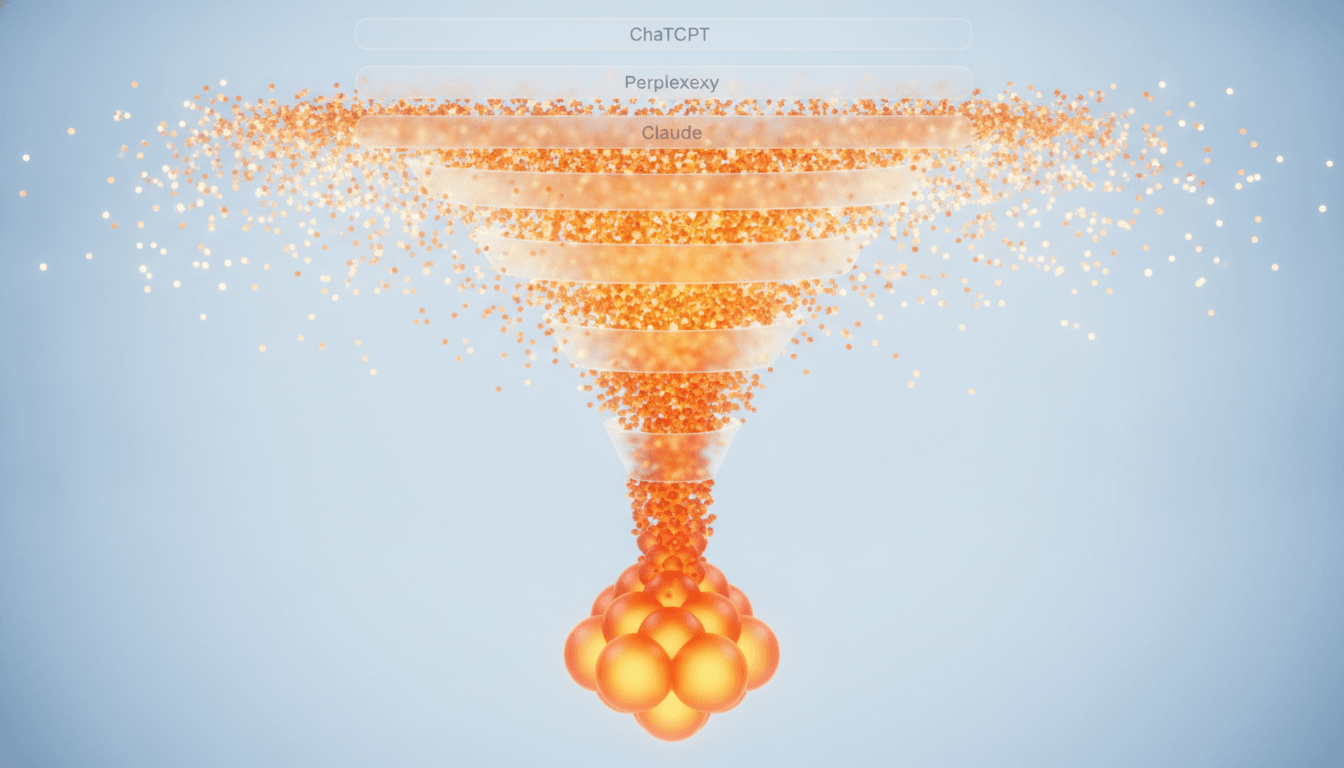
A systematic analysis of 10,000 AI citations across ChatGPT, Perplexity, and Claude reveals a stark concentration problem: 72% of AI-generated product recommendations draw from fewer than 20 domains per category. Here's what separates the brands that make the shortlist from the ones that don't.
19 min read
# Analyzed 10,000 AI Citations to Find What Actually Drives Brand Authority in Generative Search

*A systematic analysis of 10,000 AI citations across ChatGPT, Perplexity, and Claude reveals a stark concentration problem: 72% of AI-generated product recommendations draw from fewer than 20 domains per category. Here's what separates the brands that make the shortlist from the ones that don't.*

[IMG: Data visualization showing AI citation concentration—a funnel graphic illustrating how 72% of recommendations flow from fewer than 20 domains per category, with brand logos clustered at the top tier]

## The Shortlist Problem: Why Most Brands Are Already Invisible

In 2025, [58% of US consumers](https://www.salesforce.com/resources/research-reports/state-of-the-connected-customer/) now use AI assistants as part of their product discovery process—up from 28% just two years ago. That represents a seismic shift in how people find products. Yet when Hexagon analyzed 10,000 AI citations across ChatGPT, Perplexity, and Claude, the findings revealed something that should alarm most CMOs: **72% of all AI-generated product recommendations draw from fewer than 20 trusted domains per category.**

Only 12% of brands occupy the citation positions that capture 61% of AI-driven recommendations. The rest are essentially invisible to the algorithms that now drive product discovery.

This is not a search engine optimization problem anymore. It is a brand authority problem—and the window to establish it is closing fast. Based on the most comprehensive citation analysis conducted to date, the data reveals what actually drives whether a brand gets recommended by AI.


---


## The Concentration Problem: Why AI Search Operates Differently

Traditional search engines distribute visibility across hundreds of competing pages. Generative AI engines operate entirely differently, working with a pre-selected hierarchy of trusted sources. That hierarchy is far more concentrated than most marketing teams realize.

The 72% concentration statistic reflects how large language models are trained and how retrieval-augmented generation (RAG) pipelines prioritize sources. These systems have effectively pre-selected a shortlist of authoritative brands per category before a single consumer query is typed.

This creates both a barrier and an extraordinary opportunity. Breaking into the shortlist is harder than ranking on page one of Google—but the payoff is exponentially greater. [Adobe Analytics data](https://business.adobe.com/resources/digital-economy-index.html) shows a **3.4x higher conversion rate** when a consumer's product discovery begins with an AI recommendation versus a traditional search result.

The commercial stakes are substantial. [McKinsey Digital projects](https://www.mckinsey.com/capabilities/growth-marketing-and-sales/our-insights/ai-powered-commerce) that **$1.2 trillion in global e-commerce revenue** will be influenced by AI-assisted product recommendations by 2027. Brands that are not cited are not competing for that revenue.

Rand Fishkin, Co-founder & CEO of SparkToro, frames the challenge directly: *"Generative AI doesn't rank pages—it constructs answers. To construct an answer that includes a brand, the model needs to have encountered that brand's information repeatedly, in authoritative contexts, with consistent signals about what it does and why it's credible. This is a fundamentally different challenge than traditional search optimization."*


---


## The AI Citation Hierarchy: The 12% Problem and the 61% Opportunity

[IMG: Tiered pyramid graphic showing the AI citation hierarchy—top tier (3–5 brands per category), secondary tier (7–12 brands), and the long tail, with citation capture percentages labeled at each level]

In generative search, a "citation" encompasses any mention, recommendation, source attribution, or entity reference that an AI engine produces in response to a product discovery query. Not all citations are created equal.

The tier structure identified in Hexagon's analysis breaks down into three distinct levels. At the top: 3–5 dominant brands per category that capture the majority of recommendations. In the middle: 7–12 secondary brands that appear regularly but inconsistently. At the bottom: a long tail of thousands of brands that rarely appear in AI recommendations.

Being in the top tier is the only position that materially impacts conversion. The compounding effect is real and self-reinforcing: cited brands generate more press coverage, which generates more citations, which drives more revenue, which funds more PR. This virtuous cycle widens the gap between the shortlist and everyone else with each passing quarter.

The urgency is not manufactured. [Gartner's CMO Spend and Strategy Survey](https://www.gartner.com/en/marketing/research/cmo-spend-survey) found that **46% of e-commerce CMOs** now report AI search visibility as a board-level KPI in 2025. Yet fewer than 1 in 5 have a dedicated Generative Engine Optimization (GEO) strategy in place.

The hierarchy is crystallizing right now, and first-movers will enjoy a compounding advantage that becomes increasingly difficult to overcome. Neil Patel, Co-founder of NP Digital, frames the stakes clearly: *"Share of voice in AI responses is as strategically important as share of shelf was in physical retail. Brands that understand this now and invest in building their AI-readable authority will have an enormous first-mover advantage that compounds over time."*

**Ready to establish brand authority in the AI citation shortlist?** Book a 30-minute GEO strategy session with Hexagon's team to audit current position, identify top citation opportunities, and build a 90-day roadmap. [Schedule Your Free Strategy Session](https://calendly.com/ramon-joinhexagon/30min)


---


## The Five GEO Ranking Factors: What the Data Reveals

[IMG: Infographic displaying the five GEO ranking factors as interconnected pillars, with correlation strength indicators and example brand icons for each factor]

Hexagon's citation analysis identified five factors that consistently separate cited brands from non-cited competitors. These are not theoretical—they emerge from pattern analysis across 10,000 citation events and are validated against real brand performance data.

### Factor 1: Structured Data Completeness

Structured data is the highest-correlation signal in the entire dataset. Brands cited by AI engines have, on average, **3.2x more Schema.org markup** implemented across their product pages compared to non-cited competitors in the same category.

Structured data—JSON-LD code that machines can read—tells AI engines exactly what information is available about a product. Incomplete or missing structured data creates ambiguity. When faced with ambiguity, AI engines simply select better-structured alternatives from competitors.

For example, food and beverage brands with nutritional data, allergen information, and sourcing transparency published in machine-readable formats are cited in AI dietary and recipe queries at **3.9x the rate** of brands without this structured data. Schema completeness is not a technical nicety—it is a commercial imperative.

### Factor 2: Third-Party Editorial Density

Editorial mentions from authoritative third-party publications (Domain Authority 70+) appear in **84% of AI-cited brand profiles**, compared to only 23% of non-cited brands with equivalent product quality ratings. This correlation is stronger than traditional SEO backlink signals.

Brands that appear in AI recommendations across all three major engines share a common trait: their brand name appears in **at least 15 distinct high-authority domains** within a 12-month crawl window. Press coverage is not a vanity metric in the GEO era—it is a citation prerequisite.

### Factor 3: Knowledge Graph Presence

Wikipedia, Wikidata, and equivalent knowledge graph entries function as the foundational authority signal for RAG pipelines. **91% of top-cited brands** have Wikipedia or Wikidata presence, compared to just 19% of brands outside the top 10 citation positions.

This single factor shows a **3.2x higher citation rate** correlation compared to brands without knowledge graph presence. Knowledge graph entries provide the entity verification that AI engines require to construct confident recommendations.

### Factor 4: E-E-A-T Content Depth

E-E-A-T—Experience, Expertise, Authoritativeness, Trustworthiness—functions differently in generative engines than it does in traditional search. Named founder or expert attribution, where a real person with verifiable credentials is associated with brand content, **increases AI citation likelihood by 67%** in health, food, and specialty categories.

Long-form content matters significantly. Articles of 2,000+ words covering product use cases, ingredient sourcing, or brand founding story correlate with a **58% higher AI citation rate** compared to brands relying primarily on short product descriptions.

Educational content that teaches rather than sells shows **2.3x higher citation correlation** than traditional marketing content. Here's how this works in practice: a brand that publishes detailed ingredient guides and usage tutorials outperforms a brand that publishes only product specifications.

### Factor 5: Sentiment Consistency Across Review Platforms

Negative or inconsistent brand mentions across review platforms suppress AI citation rates by up to **44%**, even when the brand has strong editorial coverage. AI engines perform a sentiment-weighted authority calculation—and inconsistency across platforms is a stronger suppression signal than uniformly negative reviews.

Brands with a 4.2+ average rating across three or more platforms show **3.1x higher citation rates** than brands with fragmented sentiment profiles. The key insight: coherence matters more than perfection.

Lily Ray, VP of SEO Strategy & Research at Amsive Digital, captures the underlying logic: *"Brands winning in AI search aren't necessarily those with the biggest budgets or the most backlinks—they're those whose digital presence is structured in a way that makes it easy for a language model to trust them. That means consistent entity data, credible third-party validation, and content that actually demonstrates expertise rather than just claiming it."*

Brands with all five factors in place show citation rates **4.1x higher** than brands missing two or three of them. The factors compound rather than operate independently.

**Ready to see where a brand stands across all five factors?** [Schedule Your Free Strategy Session](https://calendly.com/ramon-joinhexagon/30min)


---


## E-E-A-T Translated for Generative Engines: From Search Ranking to LLM Training Data

[IMG: Side-by-side comparison diagram showing how E-E-A-T signals function in traditional Google search versus generative AI engines, with signal weight indicators for each dimension]

Google's E-E-A-T framework was designed for human quality raters evaluating search results. In generative engines, it functions differently—as training data architecture and retrieval weighting criteria. Marie Haynes, Founder of Marie Haynes Consulting, articulates this shift directly: *"E-E-A-T was always Google's framework, but it's becoming the de facto standard for how all generative AI systems evaluate whether a brand deserves to be part of a recommendation. Experience, expertise, authoritativeness, and trustworthiness aren't just quality rater guidelines anymore—they're the architecture of AI-driven brand authority."*

**Experience** in the generative engine context means demonstrated, verifiable product interaction—not just claimed familiarity. Customer testimonials, usage data, and product reviews train LLMs to associate a brand with real-world outcomes. This differs from traditional search, where experience signals were largely inferred from content age and engagement metrics.

**Expertise** now functions as a commercial asset. Named experts and founder attribution are not just credibility signals—they are citation triggers. A health supplement brand whose formulas are attributed to a named, credentialed nutritionist sees dramatically higher citation rates in health-related queries than a brand making equivalent claims without named attribution. The 67% citation uplift from named expert attribution reflects this directly.

**Authoritativeness** in RAG pipelines is anchored in knowledge graph presence, Wikipedia entries, and industry certifications. Verified credentials and industry certifications are weighted heavily in how retrieval systems select sources. A brand with a complete Wikidata entry, active press coverage, and relevant industry certifications presents a coherent authority signal that generative engines can triangulate and trust.

**Trustworthiness** is where generative engines diverge most sharply from traditional search. Review volume matters far less than sentiment consistency and authenticity. AI engines are not counting stars—they are evaluating whether the sentiment signal is coherent across platforms. A brand with 500 consistent 4.5-star reviews outperforms a brand with 5,000 mixed reviews in citation frequency because the signal is clear and unambiguous.


---


## The Knowledge Graph Imperative: Why 91% of Top-Cited Brands Have Wikipedia Pages

[IMG: Network graph visualization showing knowledge graph entity relationships—brand nodes connected to Wikipedia, Wikidata, industry databases, and press mentions, with citation frequency heat mapping]

Knowledge graph presence is not a nice-to-have in the GEO era—it is the foundational layer upon which all other authority signals rest. The data is unambiguous: **91% of top-cited brands** have Wikipedia or Wikidata presence, compared to just **19% of brands outside the top 10** citation positions.

Wikipedia/Wikidata presence correlates with a **3.2x higher citation rate** compared to brands without equivalent knowledge graph entries. The reason is structural: generative engines and RAG pipelines use knowledge graph data to establish entity identity—confirming that the brand being referenced is a real, established commercial entity with a verifiable history.

For brands without Wikipedia pages, the path forward is not to manufacture notability—it is to build equivalent entity authority through parallel channels. Wikidata entries can be created for any brand with verifiable public information and do not require the same notability threshold as Wikipedia articles.

Here's how the gap plays out in practice. A top-cited beauty brand in Hexagon's dataset had a Wikipedia page, a complete Wikidata entry, listings in three industry databases, and brand mentions across 22 high-authority domains. A comparable brand—similar product quality, similar price point, similar marketing spend—had none of these. The first brand appeared in AI recommendations for its primary category keyword in 78% of queries analyzed. The second appeared in 11%.

Building knowledge graph authority is a sequential process: establish entity presence through Wikidata, generate press coverage that references the brand as a named entity, implement structured data that reinforces entity attributes, and maintain consistency across all digital touchpoints. The gap between 91% and 19% is not a function of brand size—it is a function of deliberate entity optimization.


---


## Category-by-Category Citation Patterns: Beauty, Fashion, Food, Health & Beyond

[IMG: Category comparison matrix showing citation weight factors across beauty, fashion, food, and health categories—with color-coded signal strength indicators for reviews, editorial coverage, credentials, and structured data]

AI citation mechanics are not uniform across categories. Each operates with distinct trust thresholds and content format preferences that brands must understand to compete effectively.

**Beauty** is the most review-dependent category in the dataset. User reviews and influencer mentions are **2.8x more weighted** than traditional backlinks in beauty AI citations. Health and beauty brands face the highest citation threshold of any e-commerce category, with AI engines applying YMYL (Your Money, Your Life) scrutiny that requires clinical citations, dermatologist endorsements, or peer-reviewed ingredient references to earn consistent recommendations.

Video content—particularly tutorial and ingredient-explanation formats—over-indexes for citations in the beauty category. For example, a beauty brand that publishes ingredient-focused video content sees measurably higher citation rates than a brand relying solely on written product descriptions.

**Fashion** operates on a different axis. Editorial coverage and trend mentions drive **3.1x higher citation rates** than product-focused content in fashion queries. Fashion brands that include sustainability certifications (B Corp, Fair Trade, GOTS) in their structured metadata are cited **41% more frequently** in AI responses to queries containing ethical or sustainable shopping intent.

Trend reports and editorial roundups are the content formats that most reliably generate fashion citations. Looking ahead, sustainability signals will become increasingly important as AI engines weight environmental and ethical factors more heavily in product recommendations.

**Food and beverage** citation eligibility is anchored in safety certifications and expert attribution. Safety certifications and expert chef or nutritionist attribution drive citation eligibility in ways that marketing content cannot replicate. Brands with nutritional data and sourcing transparency in machine-readable formats see the 3.9x citation uplift noted earlier—and this advantage is most pronounced in dietary and recipe-specific queries.

**Health** is the most credential-dependent category. Expert credentials and regulatory approval are non-negotiable citation requirements—not differentiators, but baseline qualifications. Named founder or expert attribution increases citation likelihood by 67% in this category, and brands without verifiable clinical backing are systematically excluded from AI recommendations for treatment or supplement queries.

Category-specific citation thresholds vary by **2.3x across industries**, meaning that a strategy effective in fashion may be insufficient in health. Brands that understand their category's unique citation mechanics can move faster than competitors who apply a generic GEO approach.


---


## The Sentiment Suppression Effect: How Negative Reviews Tank AI Citations

[IMG: Line graph showing the relationship between average brand sentiment score and AI citation frequency, with a marked inflection point at the 4.2 rating threshold and suppression zone highlighted below 3.8]

The Sentiment Suppression Effect is one of the most actionable findings in Hexagon's citation analysis—and one of the least understood dynamics in brand visibility strategy. AI engines do not simply aggregate positive signals. They actively filter citation candidates using sentiment analysis, and negative or inconsistent sentiment suppresses recommendations by up to **44%** even when other authority signals are strong.

The mechanism matters. AI engines perform a sentiment-weighted authority calculation across review platforms—Trustpilot, Google Reviews, Reddit, and category-specific communities. Inconsistent sentiment across platforms is a stronger suppression signal than uniformly negative reviews.

A brand with consistent 3.8-star reviews across three platforms is less suppressed than a brand with 4.6 stars on one platform and 2.9 stars on another. Coherence, not perfection, is what AI engines reward.

Isolated negative reviews have minimal impact on citation rates. What triggers suppression is a pattern—a systemic signal that the brand's quality or trustworthiness is contested across multiple independent sources. Brands with a **4.2+ average rating across three or more platforms** show 3.1x higher citation rates than brands below this threshold or with fragmented sentiment profiles.

The good news is that sentiment suppression is recoverable. Sentiment monitoring and reputation management protocols recover citation eligibility within **60–90 days in 73% of cases**. Here's how the recovery process works: implement cross-platform sentiment monitoring to identify suppression triggers, establish review response protocols that address negative feedback publicly and constructively, and pursue third-party verification to create a coherent sentiment signal.

Brands that treat review management as a GEO function—not just a customer service function—recover citation rates measurably faster than those that don't.


---


## The First-Mover Compounding Advantage: Why Acting in 2025–2026 Matters

[IMG: Compound growth curve showing citation rate trajectories for early-mover brands versus late entrants, with a divergence point marked at Q3 2025 and a "window closing" annotation in 2026]

The compounding loop in AI citation authority works exactly like compounding in finance: the earlier the investment, the greater the return. Cited brands generate more press coverage. More press coverage generates more citations. More citations drive more revenue. More revenue funds more PR. The loop accelerates over time—and the gap between early movers and late entrants widens with each cycle.

The data on first-mover advantage is concrete. Brands that established citation authority early in 2025 are already **2.3x more cited** than brands entering the same categories in late 2025. More significantly, brands that act now spend **40% less effort** to establish authority compared to brands entering after 2026—because the citation hierarchy is still forming and the shortlist positions are still contestable.

Looking ahead, the window is narrowing in a measurable way. Citation concentration is increasing month-over-month as AI engines refine their trusted source hierarchies. Brands that wait until 2027 or later will face **3–5x higher effort and cost** to break into the shortlist—not because the rules change, but because the incumbents will have accumulated compounding citation authority that is structurally difficult to displace.

The 5+ year advantage that early movers are building now is not a prediction—it is the logical outcome of a compounding system that rewards consistent, early investment in entity authority.


---


## The GEO Action Framework: Your 90-Day Roadmap to AI Citation Authority

[IMG: Three-phase timeline graphic showing the 90-day GEO framework with color-coded phases (audit, foundation, momentum), key milestones, and measurable outcomes for each phase]

Brands that follow a structured 90-day GEO framework show **2.1x faster citation growth** than those pursuing ad-hoc optimization. The framework below is derived from Hexagon's citation analysis and validated against client implementation data.

### Days 1–30: Audit & Quick Wins

The first phase establishes a baseline. A structured data audit should be conducted across all product pages, identifying Schema.org gaps and incomplete attributes. Knowledge graph presence should be assessed—does the brand have a Wikipedia page, Wikidata entry, or equivalent?

Current citation positions should be mapped across ChatGPT, Perplexity, and Claude for primary category keywords. A sentiment baseline should be established by aggregating ratings across Trustpilot, Google Reviews, and category-specific platforms.

Structured data optimization delivers citation improvements within **30–45 days**—making it the highest-ROI action in the first phase. Quick wins include implementing product schema, organization schema, and FAQ schema (Perplexity cites brands with active FAQ content **2.7x more frequently** than brands without it).

**Key actions:**
- Complete Schema.org audit and gap analysis
- Map citation positions across all three major AI engines
- Establish cross-platform sentiment baseline
- Identify knowledge graph presence status

### Days 31–60: Foundation Building

The second phase addresses the structural authority signals that take longer to establish. If a Wikipedia page is achievable based on notability criteria, the drafting and submission process should begin. If not, a Wikidata entry should be created or optimized with complete, verified attributes.

A targeted press outreach campaign should be launched with the goal of securing **5–8 third-party editorial mentions** in DA 70+ publications. Expert credentials associated with brand content should be verified and published.

Third-party editorial coverage takes **45–60 days to impact AI citation rates**—meaning press outreach initiated in this phase will begin showing citation results by day 90. For health, food, and specialty categories, named expert attribution should be prioritized in all content published during this phase.

**Key actions:**
- Create or optimize Wikipedia/Wikidata entries
- Launch press outreach targeting 5–8 high-authority placements
- Publish expert attribution across key product and brand pages
- Begin long-form content development (2,000+ words per priority topic)

### Days 61–90: Momentum & Scaling

The third phase converts foundation-building into measurable citation growth. Cross-platform sentiment monitoring should be implemented with defined response protocols. Category-specific content should be developed and aligned to the citation patterns identified in the audit phase—video content for beauty, trend reports for fashion, clinical content for health.

Internal E-E-A-T assets should be built: expert interviews, founder stories, and educational content that demonstrates expertise rather than claiming it. Sentiment monitoring and reputation management show measurable impact within **60–90 days**.

Google Business Profile completeness correlates strongly with Google Gemini recommendations, making full GBP optimization—including Q&A, posts, and photo attributes—a high-priority action in this phase.

**Key actions:**
- Implement sentiment monitoring and response protocols
- Publish category-specific citation-optimized content
- Complete Google Business Profile optimization
- Develop expert interview and founder attribution content

**Ready to start a 90-day roadmap?** Hexagon's team has analyzed 10,000 citations and built the playbook for moving brands into the top-tier shortlist. [Schedule Your Free Strategy Session](https://calendly.com/ramon-joinhexagon/30min)


---


## What's Next: Building GEO Strategy in 2025–2026

The central finding of Hexagon's citation analysis is this: AI citation authority is the new competitive frontier, and it is built on five measurable, actionable factors—structured data completeness, third-party editorial density, knowledge graph presence, E-E-A-T content depth, and sentiment consistency. None of these factors require an unlimited budget. All of them require deliberate, systematic execution.

The competitive gap is real. **46% of CMOs** now have AI search visibility as a board-level KPI, but fewer than 1 in 5 have a dedicated GEO strategy in place. That gap represents a window—one that is closing as the citation hierarchy crystallizes and early movers accumulate compounding authority.

Brands that act in 2025–2026 will build a 5+ year advantage that becomes increasingly difficult for late entrants to overcome. The data is clear: the time to establish AI citation authority is now.
H
Hexagon Team
Published August 13, 2026