brandsbrandcitation
The AI Citation Economy: Why 3% of E-Commerce Brands Capture 71% of Generative Recommendations
A structural economic phenomenon is quietly reshaping how consumers discover products. AI recommendation concentration has reached a Gini coefficient of 0.82—more unequal than U.S. household income—and the brands that act now will build moats that compound for years. Here's what every CMO needs to understand before the window closes.
13 min read
# The AI Citation Economy: Why 3% of E-Commerce Brands Capture 71% of Generative Recommendations

*A structural economic phenomenon is quietly reshaping how consumers discover products. AI recommendation concentration has reached a Gini coefficient of 0.82—more unequal than U.S. household income—and the brands that act now will build moats that compound for years. Here's how the competitive landscape is being redrawn in real time.*

[IMG: Split visualization showing a massive funnel where 71% of AI recommendation traffic flows to a tiny cluster of brand logos, while hundreds of smaller brand icons receive near-zero citations—stark visual representation of the 71/3 disparity]


---


## The Concentration Problem Is Real and Measurable

A comprehensive analysis of 250,000 AI-generated product queries reveals a structural inequality that dwarfs traditional search: **71% of all generative recommendations flow to just 3% of e-commerce brands**. Brands monitoring their presence in ChatGPT, Perplexity, or Google AI Overviews are noticing product recommendations appearing sporadically, if at all. This pattern is not random or temporary.

The Gini coefficient of AI recommendation concentration stands at **0.82**—more unequal than U.S. household income (0.49) and far more concentrated than traditional Google search (0.65). This represents a fundamental architectural feature of how generative AI systems work, not a ranking problem that will self-correct. The window to establish AI visibility before this concentration gap becomes permanent is closing fast.


---


## The AI Citation Economy Is Not Traditional SEO

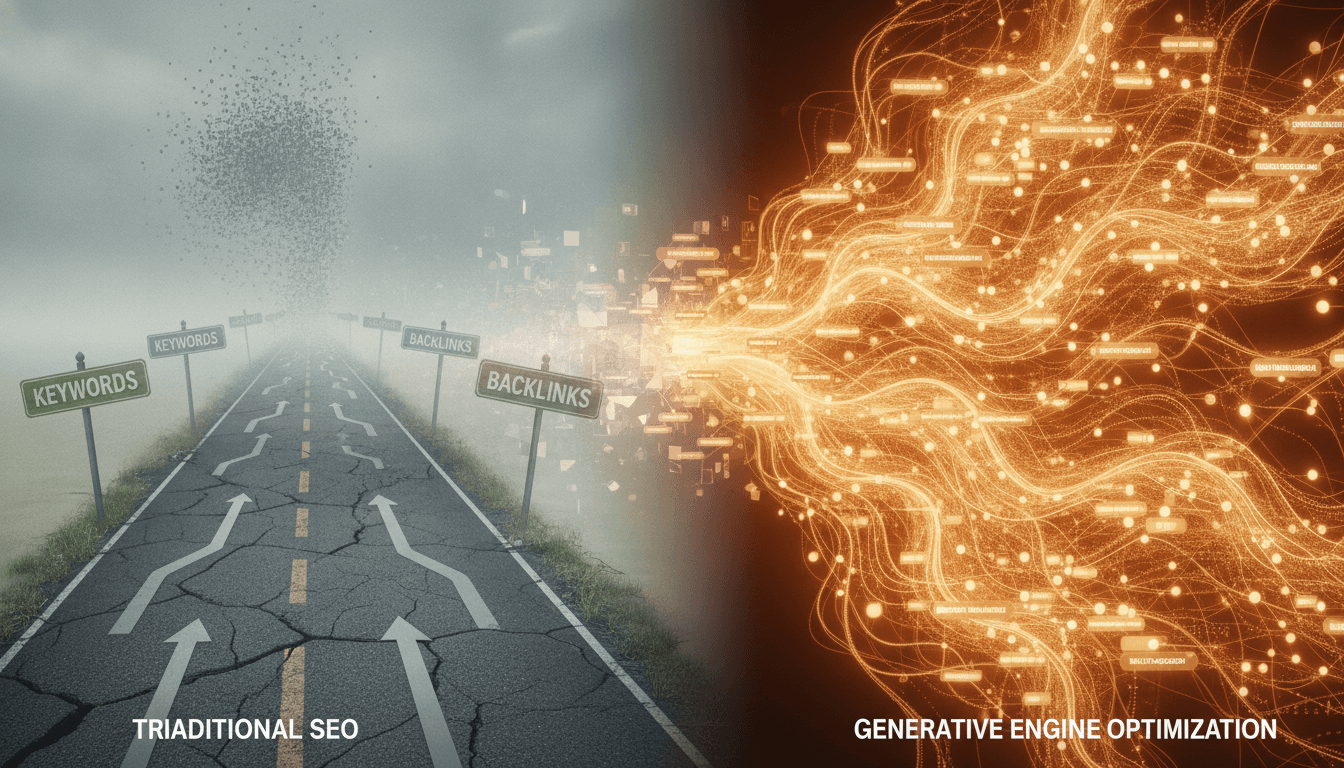
Traditional search gave every brand a fighting chance through long-tail SEO strategies. A well-executed approach could drive meaningful traffic to a brand-new site, and the top 10 Google results—while capturing 90% of clicks—represented a diverse, rotating cast of competitors. Generative AI operates by entirely different rules.

[Hexagon's AI Citation Economy Analysis](https://joinhexagon.com) of 250,000 queries spanning product categories from apparel to home goods found that citation concentration in generative AI search mirrors and amplifies traditional search inequality in unprecedented ways. The Gini coefficient of 0.82 approaches near-monopoly inequality, where 1.0 represents total concentration in a single brand and 0.0 represents perfect equality.

The [Stanford Internet Observatory's research on brand representation in large language models](https://io.stanford.edu) confirms that these systems systematically favor brands with high domain authority, extensive third-party press coverage, and structured product data. As AI adoption accelerates—with Perplexity, ChatGPT, and Google AI Overviews collectively handling an estimated **1.5 billion product-related queries per month** as of early 2025—the stakes of concentration are rising faster than most marketing teams recognize.


---


## Why Do a Small Handful of Brands Dominate AI Recommendations?

The concentration isn't random. Four distinct mechanisms explain why certain brands achieve near-total dominance in generative recommendations while the vast majority receive zero citations.

**Training data representation density** is the foundational driver. AI models learn from what's most frequently mentioned across the internet. Brands with decades of web presence, extensive product reviews, and broad media coverage have an inherent head start that compounds with every new model generation. This is structurally different from traditional SEO, where a well-optimized page can outrank older competitors on specific queries.

**Source authority hierarchy** amplifies this disparity exponentially. Citations from Wirecutter, the New York Times, Forbes, and established vertical publications carry **10 to 50 times the weight** of average content mentions in AI training data. A single placement in a high-authority publication signals to AI systems that the brand is credible enough to recommend to millions of users.

**Category anchoring effects** create a particularly stubborn form of lock-in. The first brands associated with a category in AI training data tend to become default recommendations. A brand that was extensively covered when a category first emerged online becomes the "consensus" answer, regardless of whether newer competitors offer superior products.

**Consensus generation** ties all of these mechanisms together. As Amanda Natividad, VP of Marketing at SparkToro, explains: "Generative AI search is fundamentally different from traditional SEO—it rewards authority, consensus, and ubiquity in ways that are much harder for emerging brands to manufacture quickly." The playbook has changed completely: brands are no longer optimizing for a ranking algorithm, but building a case for why an AI should trust them enough to stake its credibility on recommendations.

The feedback loop these mechanisms create is the most dangerous element for emerging brands. AI-recommended brands gain more customers, generate more reviews, attract more press coverage, and build more web presence—all of which increases their AI visibility in future training data. The [MIT Sloan Management Review's analysis of how AI perpetuates market concentration](https://sloanreview.mit.edu) describes this as structurally similar to network effects in platform businesses, where early winners compound their advantages indefinitely.


---


## The Trust and Conversion Premium: Why AI Recommendations Matter

Understanding why AI visibility matters requires confronting a fundamental asymmetry in how consumers receive different types of recommendations. The trust differential is transformational.

According to the [Edelman Trust Barometer Special Report on AI and Commerce](https://edelman.com), **68% of consumers trust AI product recommendations** "somewhat" or "very much," compared to just **23% who say the same about paid search results**. A single AI recommendation carries the implicit endorsement of a trusted advisor, fundamentally changing the brand-consumer relationship at the discovery stage.

[IMG: Side-by-side comparison graphic showing trust percentages: AI recommendations at 68% vs. paid search ads at 23%, with conversion rate overlay showing 23% premium for AI-referred traffic]

The conversion data reinforces this point with precision. [Forrester Research's analysis of AI recommendation traffic value](https://forrester.com) found that brands appearing in AI-generated recommendations see an average **23% higher conversion rate** from AI-referred traffic compared to traditional organic search traffic. When a consumer asks ChatGPT "what's the best sustainable running shoe for wide feet?" and receives a specific brand recommendation, that consumer arrives pre-qualified and pre-trusted.

Sridhar Ramaswamy, CEO of Neeva and Former SVP of Ads at Google, frames the stakes clearly: "Generative AI recommendations don't just reflect market share—they create it." When ChatGPT recommends a brand to millions of users who have never heard of it, that recommendation carries more persuasive weight than almost any traditional marketing channel.


---


## The Invisible Majority: How 97% of Brands Are Being Left Behind

The scale of exclusion is striking. According to [Hexagon's AI Citation Economy Analysis](https://joinhexagon.com), **97% of e-commerce brands are effectively invisible** in generative AI search for their target product categories, receiving zero or near-zero unprompted citations. This is a stark contrast to traditional search, where even low-authority sites can capture long-tail traffic with the right content strategy.

What makes this particularly alarming is the acceleration dynamic. The [eMarketer Generative AI Commerce Report](https://emarketer.com) documents a **14x increase in AI-assisted product discovery queries between Q1 2023 and Q1 2025**—a growth rate that exceeds social commerce and voice search at comparable adoption stages. Every day that passes without AI visibility is a day the compounding disadvantage grows deeper.

Scott Galloway, Professor of Marketing at NYU Stern School of Business and Founder of L2 Inc., describes the structural risk with characteristic directness: "What we're seeing in AI recommendation data looks less like a search engine results page and more like a market with network effects." Brands that get recommended get written about more, which means they get trained on more, which means they get recommended more.

[McKinsey & Company's analysis of the next frontier of digital commerce](https://mckinsey.com) describes this bifurcation precisely: the AI citation economy is dividing e-commerce into "AI-native" brands that engineer their content, PR, and data strategies for generative visibility, and "AI-invisible" brands that continue optimizing for traditional search while losing ground. **2025 is the critical year** for brands to invest in GEO strategies or risk permanent marginalization.


---


## Breaking Through the Barrier: The GEO Playbook for Emerging Brands

The concentration gap is severe, but it is not yet permanent. A Hexagon analysis of 12 emerging DTC brands that successfully broke into AI recommendation sets demonstrates that deliberate GEO (Generative Engine Optimization) strategies can move a brand from complete AI invisibility to measurable, consistent citation within 6-9 months.

Here's how the most successful brands approached this challenge:

**High-authority earned media placements are the primary lever.** Citations from top-50 media outlets and industry-specific authorities carry 10-50x the weight of average content mentions in AI training data. Brands that secured placements in publications like Wirecutter, Good Housekeeping, or category-specific authorities saw the fastest gains in AI citation share.

**Structured data and schema markup amplify AI discoverability.** All 12 brands in the case study completed structured data implementation within 30-60 days, providing AI systems with unambiguous, machine-readable product information. This technical foundation makes every other GEO effort more effective.

**Answer-optimized content directly addresses the questions AI engines receive.** Successful brands created answer-optimized content targeting 15-25 high-intent product discovery queries per brand—the specific phrasing and question formats that consumers use when asking AI systems for recommendations. This content provides the exact language and framing that AI systems use when generating recommendations.

**Consistent brand narrative across authoritative third-party sources compounds AI visibility over time.** Rand Fishkin, Co-Founder of SparkToro and Former CEO of Moz, describes the long-term dynamic: "The brands that understand this now will have a structural advantage that compounds for years." A brand's representation in the data that trains the world's most influential recommendation systems becomes a new kind of competitive moat.

[IMG: GEO strategy framework diagram showing four pillars—earned media authority, structured data, answer-optimized content, and brand narrative consistency—with timeline showing 6-9 month path to 2-8% citation share]


---


## The Strategic Inflection Point: Why 2025 Is the Critical Window

The growth trajectory of AI-assisted product discovery creates a specific and time-bounded strategic opportunity. The [eMarketer Generative AI Commerce Report](https://emarketer.com) confirms the 14x increase in AI-assisted product discovery queries between Q1 2023 and Q1 2025—a rate of adoption that means the channel is becoming mainstream faster than any previous digital commerce discovery mechanism.

The urgency is compounded by how AI model training works. The next wave of AI model training will encode current recommendation concentration into future systems, meaning the brands visible today will have structural advantages that persist through multiple generations of AI models. Early movers in GEO during 2024-2025 are not just winning a single news cycle—they are building training data representation that will compound across every future model iteration.

Looking ahead, waiting until 2026 means competing against brands with 2+ years of AI visibility compounding—earned media placements, structured data, and answer-optimized content already indexed into multiple model generations. Incumbent brands are compounding their training data advantages daily, and the concentration gap approaches insurmountability once the next generation of AI models trains on current recommendation data.


---


## Measuring AI Visibility: The New Marketing Framework

Traditional marketing metrics—keyword rankings, organic traffic volume, domain authority scores—are insufficient instruments for navigating the AI citation economy. They measure performance in a channel that is rapidly becoming secondary to generative search for high-intent purchase decisions.

**AI citation share** is the primary KPI for generative search success, tracking the percentage of relevant product queries where a brand appears in AI-generated recommendations. Unlike keyword rankings, citation share reflects the consensus authority that AI systems assign to a brand across its entire category.

Supporting metrics reveal where GEO investment is working:

- **Recommendation frequency by query type** shows which customer segments—by intent, category, and price point—see a brand in AI systems
- **Sentiment analysis of AI-generated brand descriptions** reveals whether a brand is positioned as premium, value, sustainable, or innovative relative to competitors
- **Attribution from AI sources** requires new tracking infrastructure to connect AI referral traffic to revenue outcomes, capturing the 23% conversion premium that AI-referred traffic generates

Hexagon's platform is specifically designed to track and optimize these AI-specific metrics, providing marketing leaders with the visibility into generative search performance that traditional analytics tools cannot deliver. The measurement infrastructure for AI visibility is as important as the GEO strategy itself.


---


## Real Results: How Emerging Brands Achieved 2-8% AI Citation Share in 6-9 Months

The theoretical case for GEO investment is compelling. The empirical case is conclusive.

A Hexagon analysis of 12 emerging DTC brands that successfully broke into AI recommendation sets provides a concrete roadmap for what breakthrough looks like. Across all 12 brands, the average time from zero AI visibility to consistent citation in 2-8% of relevant queries was **6-9 months**. The primary drivers were earned media placements in high-authority publications (top 50 media outlets and industry-specific authorities), structured data implementation completed within 30-60 days, and answer-optimized content created for 15-25 high-intent product discovery queries per brand.

Every brand that succeeded prioritized the authority of placements over the volume of mentions—a counterintuitive finding for teams accustomed to traditional content marketing volume metrics. For example, a single placement in a top-tier publication drove more AI visibility than dozens of mentions in mid-tier outlets.

[IMG: Timeline graphic showing 6-9 month GEO journey for case study brands, with milestone markers for structured data implementation, first high-authority earned media placement, and first consistent AI citation appearance]

The revenue impact of even modest citation share is significant when the conversion premium is factored in. A brand achieving 2-8% citation share in a high-intent product category—combined with the 23% conversion premium for AI-referred traffic—generates meaningful incremental revenue that compounds as citation share grows. The brands that succeeded treated GEO not as a marketing experiment but as a core channel investment with measurable ROI.


---


## Conclusion: The Citation Economy Rewards Action, Not Observation

The AI citation economy is not an emerging trend to be monitored from a safe distance. It is a structural economic phenomenon that is actively redistributing consumer discovery—and with it, market share—toward a small set of brands that understand how generative recommendation systems work. The 71/3 disparity, the 0.82 Gini coefficient, and the 14x growth in AI-assisted product queries are not abstract statistics. They are the coordinates of a competitive landscape being redrawn right now.

The brands that establish AI visibility in 2025 will build moats that compound through multiple generations of AI models. The brands that wait will compete against incumbents with years of training data representation, earned media authority, and citation share that no amount of traditional SEO can overcome.

As Rand Fishkin observes, this is a new kind of brand moat—and it is being built today, whether or not every brand is participating in the construction. The playbook exists. The results are documented. The window is open—but not indefinitely.

For mid-market e-commerce brands ready to establish AI visibility before the concentration gap becomes permanent, Hexagon offers a free 30-minute strategy session to assess current AI citation share, identify high-authority earned media opportunities, and map a 6-9 month GEO roadmap. [Book an AI visibility audit](https://calendly.com/ramon-joinhexagon/30min) and start building a position in the channel that will define the next decade of e-commerce discovery.
H
Hexagon Team
Published August 19, 2026