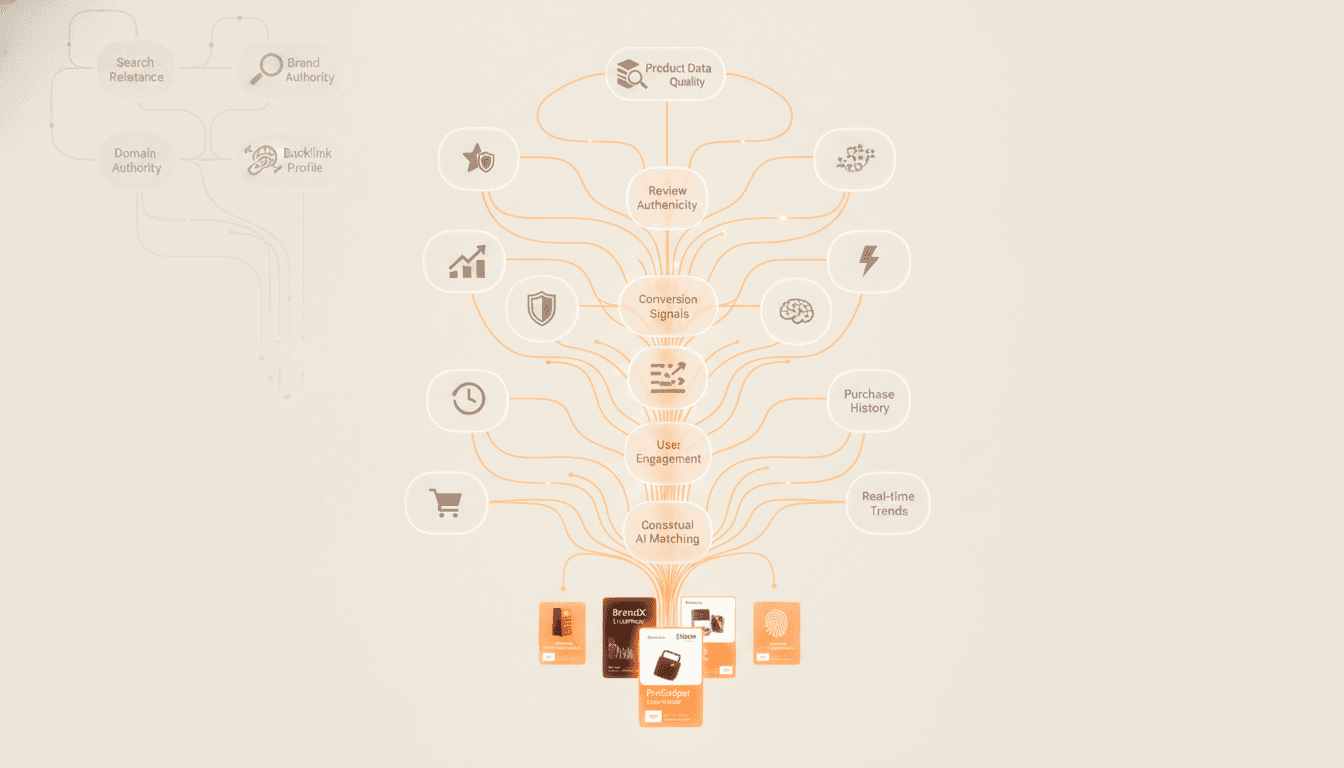
searchgenerativebrand
From Traditional SEO to Generative Engine Optimization: Why Your Current Strategy Won't Work for AI Search (And What Will)
What if the SEO strategy that took years to build is now invisible to the channel where your next customer is already searching? For a growing number of e-commerce brands, that isn't a hypothetical—it's the reality of AI-powered search in 2025.
11 min read
---


# From Traditional SEO to Generative Engine Optimization: Why Current Strategies Won't Work for AI Search (And What Will)

The SEO strategy that took years to perfect—the one that finally achieved page-one rankings—is becoming invisible to the channel where the next customer is already searching. For a growing number of e-commerce brands, this scenario is not hypothetical. It is happening in 2025, as AI-powered search fundamentally reshapes how consumers discover products.

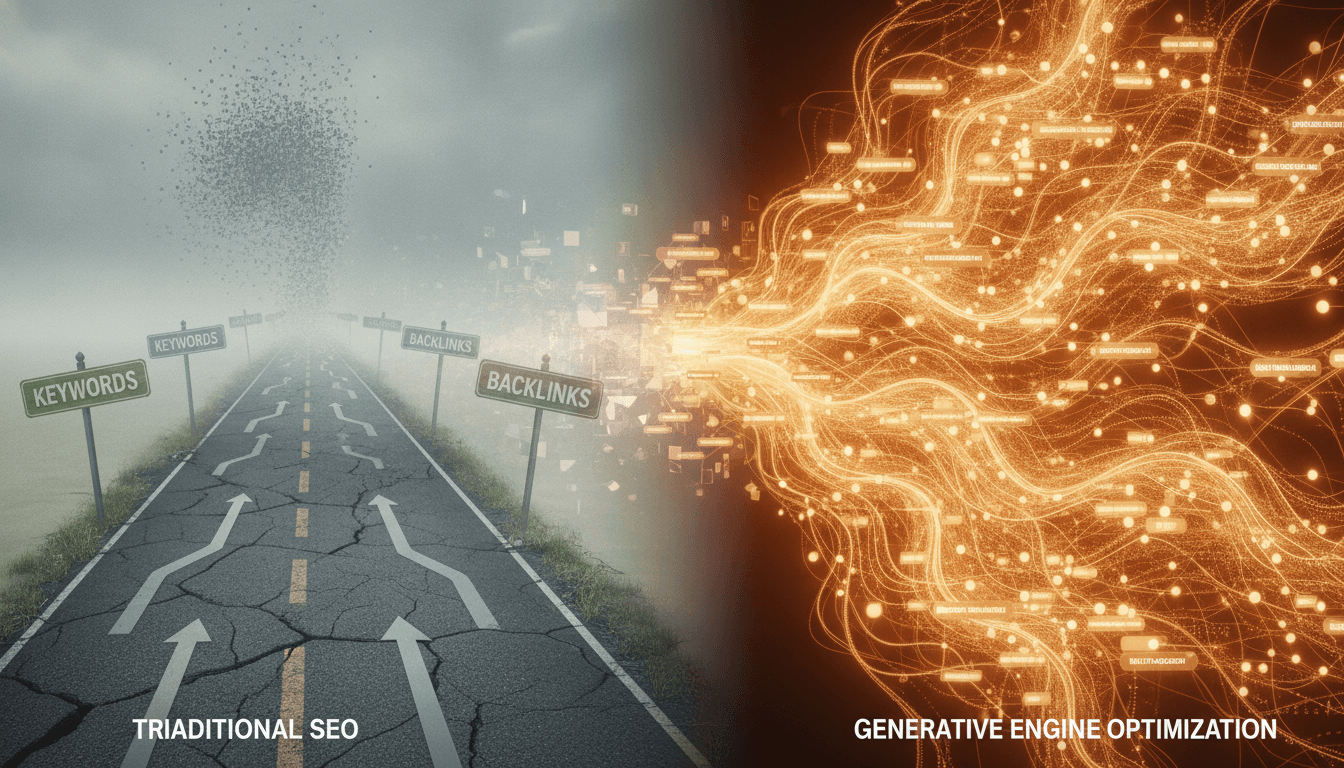
[IMG: Split-screen visual contrasting a traditional Google search results page on the left with an AI assistant conversational response on the right, illustrating the divergence between two discovery paradigms]


---


## The Great Decoupling: Why Google Rankings No Longer Guarantee Discovery

The rules of search have changed—not gradually, but fundamentally. A brand can hold the number-one organic ranking on Google for its most competitive keyword and simultaneously receive zero mentions when a consumer asks an AI assistant the same question. This is not a temporary glitch or a bug that will be fixed. It is the defining structural reality of search in 2025, and most marketing organizations have not begun measuring it.

[Hexagon's AI Visibility Audit Study](https://hexagon.com) analyzed more than 500 e-commerce brands across 12 product categories and uncovered a startling finding: approximately **60% of brands holding top-5 Google organic rankings for their primary category keywords had zero measurable presence in AI assistant responses** to equivalent shopping queries. The data confirms what many CMOs are beginning to sense intuitively: traditional SEO rank and AI search visibility operate as largely independent variables. These two systems use entirely different signals to determine what is relevant and authoritative.

The urgency intensifies when considering the scope of the shift. [Google AI Overviews now appear on approximately 47% of all U.S. Google searches](https://sparktoro.com) as of Q1 2025. Nearly half of all search queries now return an AI-synthesized answer before any organic blue-link results appear. For brands relying solely on traditional rankings, this means dramatically fewer click-through opportunities.

### Four Paradigm Shifts That Define Generative Engine Optimization

Understanding **Generative Engine Optimization (GEO)** requires recognizing a fundamental truth: it is not SEO with an AI layer added on top. Instead, it demands replacing four foundational optimization principles entirely:

**Keyword Targeting → Intent Architecture.** GEO requires understanding the full conversational context of buyer questions, not matching exact-match phrases to individual pages.

**Backlink Equity → Contextual Authority.** Earning mentions in editorially independent, trusted third-party sources matters far more than accumulating inbound links from any source.

**Content Volume → Semantic Depth.** AI models reward comprehensive, factually precise content they can confidently cite—not content produced at scale for keyword coverage.

**Domain Authority Score → Brand Mention Density.** Building a wide, consistent, and positive presence across the third-party web determines AI visibility in ways that any single domain metric cannot capture.

Scott Galloway, Professor of Marketing at NYU Stern School of Business, captures the magnitude of this shift precisely: "The transition from traditional search to generative AI search is not an evolution—it is a platform shift on the order of the transition from print to digital. Brands that treat GEO as 'SEO with some AI sprinkled in' will make the same mistake that print advertisers made when they simply moved their newspaper ads to banner ads. The medium has changed. The strategy must change completely."

### The AI Visibility Audit Gap: The Blind Spot in Analytics

Most e-commerce organizations are operating with a critical blind spot in their discovery analytics. They measure rankings, traffic, and conversions with precision—but have no visibility into the fastest-growing top-of-funnel channel in digital marketing. AI visibility is probabilistic and context-dependent: the same brand might be cited in 70% of queries about "best sustainable running shoes" and 0% of queries about "affordable running shoes."

This requires an entirely new measurement framework that most analytics stacks do not yet support. The investment gap reflects this blind spot directly. The average enterprise e-commerce brand currently allocates [less than 4% of its SEO budget](https://forrester.com) to any form of AI search optimization, despite AI assistants accounting for a rapidly growing share of top-of-funnel discovery.

Meanwhile, global enterprise spending on AI search optimization, generative content strategies, and AI-readiness audits is projected to [reach $3.7 billion annually by 2026](https://idc.com)—a compound annual growth rate of over 180% from the estimated $680 million spent in 2024. The organizations moving first are not waiting for the market to mature.

[IMG: Bar chart showing the AI visibility audit gap—percentage of top-ranking SEO brands with zero AI search presence, broken down by product category]


---


## Key Insights: What Actually Drives Visibility in Generative Search

[IMG: Diagram illustrating the four GEO optimization principles (Intent Architecture, Contextual Authority, Semantic Depth, Brand Mention Density) contrasted with their traditional SEO counterparts]

### Why Technical SEO Alone Fails in Generative Engines

The mechanics of generative AI search are fundamentally different from the crawl-and-rank model that traditional SEO was built to influence. Generative models are not real-time crawlers rewarding on-page signals. Instead, they are probabilistic systems trained on the aggregate written record of the web.

This means a brand's discoverability is determined long before a consumer types a question into an AI assistant. [Research from Stanford HAI](https://hai.stanford.edu) confirms this architectural reality: generative AI engines rely on training data, retrieval-augmented generation (RAG) pipelines, and indexed knowledge bases rather than live page crawls.

The strategic implication is direct and consequential. Optimizing individual pages for on-page signals is insufficient if the broader information ecosystem does not reflect the brand accurately and favorably. Winning in this environment requires a brand to be consistently, accurately, and positively represented across the entire information ecosystem—not just on its own optimized pages.

Aleyda Solis, International SEO Consultant and Founder of Orainti, frames the distinction with clarity: "Large language models do not read meta descriptions. They do not count keywords. They build a probabilistic understanding of a brand based on everything written about it across the entire web. If the independent, authoritative sources in a category do not mention a brand favorably and frequently, it simply does not exist in the AI's world—regardless of how well-optimized the website is."

### The Signals That Generative Models Actually Use

Research from the [Princeton NLP Group](https://nlp.cs.princeton.edu) establishes that keyword density and exact-match optimization—cornerstones of traditional SEO—have no measurable correlation with AI citation frequency. Generative models select sources based on semantic relevance, factual consistency, and cross-source corroboration rather than on-page keyword signals.

Similarly, [Moz's State of SEO Report 2024](https://moz.com) confirms that backlink profiles, which remain the dominant ranking factor in Google's PageRank algorithm, carry no direct weight in generative engine outputs. The signals that actually matter in GEO break down into four distinct categories:

**Cross-source corroboration.** AI models weight claims that appear consistently across multiple independent sources. A single well-optimized product page carries far less authority than the same claim appearing in three independent review publications.

**Third-party editorial coverage.** Brands that invest in category-specific product reviews, expert endorsements, and independent comparison guides see measurably higher AI citation rates. [Ahrefs research](https://ahrefs.com) confirms that generative models weight corroborated claims over self-published brand content.

**Factual precision and consistency.** Inconsistent product specifications, pricing discrepancies, or conflicting brand claims across sources actively reduce AI citation probability. Accuracy across the information ecosystem is a prerequisite, not a differentiator.

**Review ecosystem depth.** Ratings and reviews on third-party platforms contribute to the aggregate brand signal that generative models use to assess trustworthiness and relevance.

Rand Fishkin, Co-founder and CEO of SparkToro, captures the strategic implication directly: "The brands that will win in AI search are not the ones with the most backlinks or the highest domain authority scores. They are the ones that have built genuine topical authority—brands that are talked about, cited, and recommended by credible third parties across the web. The currency of generative search is trust and corroboration, not technical optimization."

### The Structured Data Bridge: The Highest-Carryover Investment from Traditional SEO

While most traditional SEO signals do not transfer to GEO, one critical exception exists: **structured data markup**. Schema.org implementation remains highly relevant in the generative search environment because it helps AI systems accurately parse product attributes, pricing, reviews, and specifications.

[Research published by Search Engine Journal](https://searchenginejournal.com) found that pages with comprehensive structured data markup are cited in AI-generated responses at rates approximately **3 times higher** than semantically similar pages without structured markup. This makes schema implementation—particularly product schema, review schema, and FAQ schema—the single highest-carryover investment from conventional SEO practice into a GEO strategy.

For example, a product page with complete Schema.org markup that includes pricing, availability, aggregate review scores, and detailed specifications gives an AI model everything it needs to extract and cite that product accurately. A page with identical content but no structured markup requires the model to interpret and infer—introducing ambiguity that reduces citation probability significantly.

### The Budget Reallocation Imperative

The commercial stakes of AI search visibility extend far beyond vanity metrics. [Salesforce's State of the Connected Customer Report](https://salesforce.com) found that **72% of consumers who receive a product recommendation from an AI assistant report high or very high purchase intent** for the recommended brand, compared to 48% for consumers who find a brand through a traditional organic search result. AI-driven discovery reaches more conversion-ready consumers.

The scale of this shift is staggering. [Gartner's Future of Search and E-Commerce Discovery Forecast](https://gartner.com) projects that AI-powered search and discovery tools will account for **15–25% of all e-commerce product discovery sessions by 2027**, up from an estimated 8–10% in 2024. AI search assistants already influence an estimated 19% of all online purchase research sessions in the United States, rising to 31% among consumers aged 18–34.

[Perplexity AI](https://perplexity.ai) surpassed 100 million queries per day in early 2025, with shopping and product research representing one of its top three query categories. Here's how marketing leaders should begin rebalancing investment to capture first-mover advantage while the window remains open:

**Structured data infrastructure.** Audit and implement comprehensive Schema.org markup across all product, category, and content pages as the foundational technical investment.

**Third-party editorial programs.** Build systematic relationships with category-specific publications, independent review platforms, and expert communities to generate the corroborated mentions that generative models prioritize.

**Review ecosystem management.** Develop proactive strategies for generating, monitoring, and responding to third-party reviews—not as a reputation management function, but as a core AI visibility input.

**AI-specific content architecture.** Restructure content around conversational intent and semantic depth rather than keyword targeting, ensuring that brand content can serve as a reliable, citable source for AI models.

**AI visibility measurement.** Implement instrumentation to track brand citation rates across major AI platforms (ChatGPT, Perplexity, Claude, Google AI Overviews) as a primary discovery metric alongside traditional rank tracking.

Sundar Pichai, CEO of Alphabet and Google, has observed: "Organizations are at an inflection point where the 20-year playbook for search engine optimization becomes insufficient almost overnight. The question every CMO should be asking is not 'how do we rank higher on Google' but 'how does an AI model learn to trust and recommend our brand?' Those are fundamentally different questions with fundamentally different answers."

[IMG: Investment reallocation chart showing the recommended shift in SEO/GEO budget allocation across structured data, third-party editorial, review management, and AI content architecture]


---


## Conclusion: The Window for First-Mover Advantage Is Open—But Not Indefinitely

The evidence is clear and consistent across independent research sources. Traditional SEO rank does not translate to generative engine visibility. The signals that determine AI citation—contextual authority, cross-source corroboration, semantic depth, and structured data clarity—are fundamentally different from the signals that determine Google organic rankings.

Organizations that treat GEO as an extension of existing SEO practice will systematically underinvest in the capabilities that matter. They will continue measuring a channel that no longer captures the full picture of how consumers discover brands. The competitive landscape of AI search will consolidate quickly as more brands recognize the visibility gap and begin investing in GEO infrastructure.

Looking ahead, the cost of entry will rise and the differentiation available to early movers will compress. The brands building contextual authority, third-party editorial presence, and structured data depth today are establishing the training data and retrieval signals that will determine AI visibility for years to come. The measurement frameworks, editorial relationships, and content architectures built now will compound in ways that late entrants cannot easily replicate.

The path forward for marketing leaders is straightforward: conduct an AI visibility audit to understand the current gap, identify the highest-leverage GEO investments for the specific category and competitive context, and begin rebalancing budget allocation before the first-mover window closes. The question is no longer whether AI search will reshape e-commerce discovery—it already has. The only question that matters now is whether a brand will be visible when it does.


---


**Ready to understand brand AI search visibility and build a GEO strategy that closes the gap?** [Learn how Hexagon can help.](https://hexagon.com)
H
Hexagon Team
Published August 7, 2026