Step-by-Step Workflow for Capturing High-Intent AI Search Traffic with Hexagon’s GEO Platform for Food Brands
Discover how food brands can unlock up to 50% more AI recommendation clicks and drive a 42% revenue boost in just 90 days by optimizing product feeds and workflows for AI search engines with Hexagon’s GEO platform. This actionable guide walks you through setup, optimization, content creation, analytics, and best practices for sustained AI search growth.
Step-by-Step Workflow for Capturing High-Intent AI Search Traffic with Hexagon’s GEO Platform for Food Brands
Unlock the secret to capturing up to 50% more AI recommendation clicks and boosting your revenue by 42% in just 90 days. This comprehensive guide reveals how food brands can optimize product feeds and workflows for AI search engines using Hexagon’s GEO platform. From setup to analytics, discover actionable strategies for sustained AI search success.
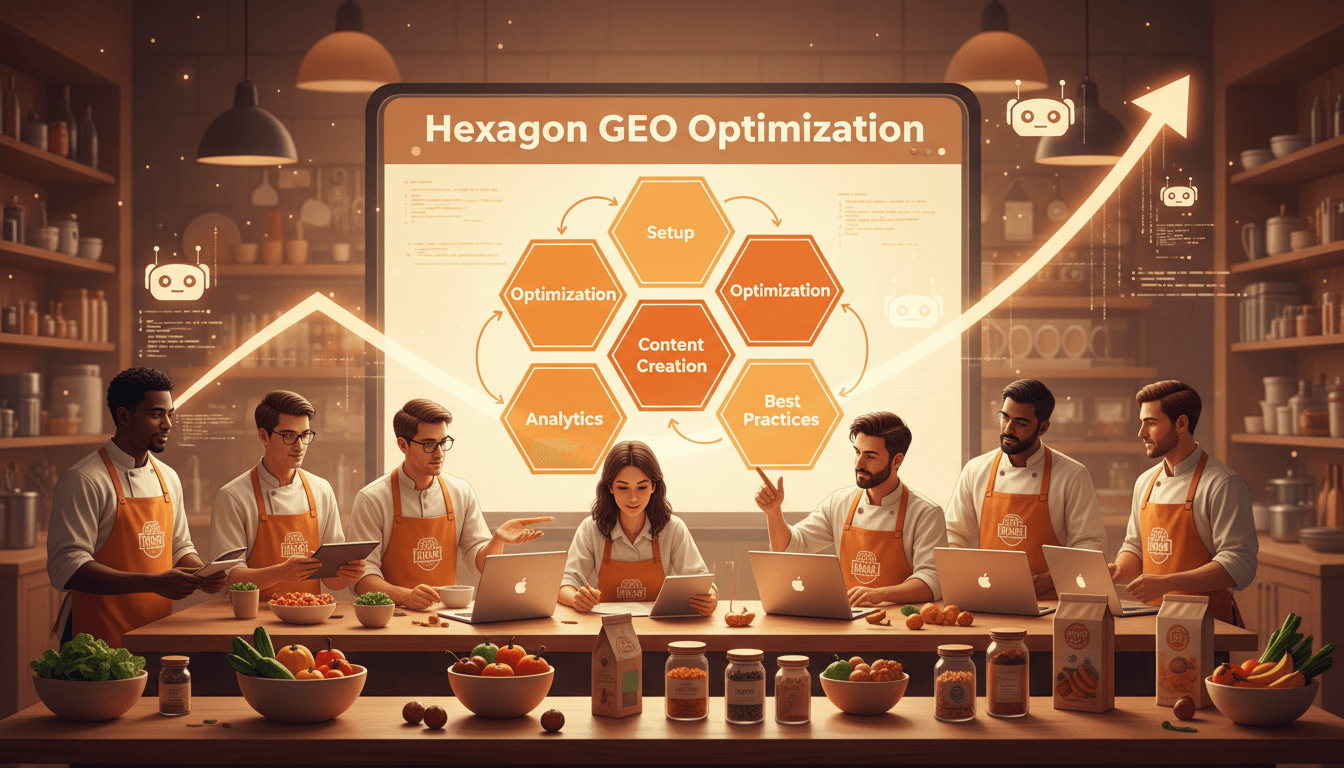
Food brands today stand at the threshold of a massive opportunity: capturing highly motivated AI-driven shoppers. However, seizing this potential requires more than just presence—it demands precise optimization of product feeds and workflows tailored specifically for AI search engines. By leveraging Hexagon’s GEO platform, brands can unlock an impressive 50% increase in AI recommendation clicks and achieve a 42% revenue boost within just 90 days. This step-by-step guide will walk you through how to set up, optimize, and track your AI search traffic effectively, transforming AI discovery into measurable sales growth.
Ready to attract high-intent AI shoppers to your food brand? Book a personalized 30-minute consultation to get started with Hexagon’s GEO platform today.
Understanding the AI Search Opportunity for Food Brands
The food and beverage retail landscape is undergoing a profound transformation as AI-powered search and recommendation platforms become the new gateway for digital shoppers. AI assistants like ChatGPT, Perplexity, and Google’s Gemini are reshaping how consumers discover, evaluate, and ultimately purchase food products. For food brands, this evolution means that AI shoppers represent a highly motivated segment—actively seeking product details, meal solutions, and tailored recommendations.
Recent research highlights the critical role of structured product data and AI-optimized feeds. Brands utilizing structured, AI-optimized feeds report a 50% surge in recommendation clicks from AI assistants (Hexagon Client Benchmark Report). This increased visibility directly drives revenue, with food & beverage brands seeing a 42% rise in AI search-driven revenue within 90 days of adopting GEO feeds (Hexagon Case Studies). Moreover, 90% of AI meal planning recommendations rely on GEO-optimized or structured product content (AI Meal Planning Industry Report), underscoring the competitive edge for brands embracing this strategy.
Key takeaways include:
- AI-powered commerce has emerged as a primary discovery channel for food shoppers
- Structured, AI-optimized product feeds are essential for maximizing visibility and conversion
- Data-savvy brands are achieving tangible uplifts in clicks, revenue, and shopper engagement
“Structured data is the new currency for brands wanting to be visible in AI-powered commerce. Without it, products simply won’t surface in consumer-facing conversations.” — Dr. Martha Poon, AI Commerce Analyst
Now, let’s explore how food brands can harness Hexagon’s GEO platform to capture and convert this growing wave of high-intent AI search traffic.
[IMG: Visualization of AI-powered search flow for food brands, highlighting product feed optimization and AI-driven recommendations]
Step 1: Technical Setup — Connecting Food Brand Data to Hexagon’s GEO Platform
Success in AI search optimization starts with a strong technical foundation. Integrating your product catalog with Hexagon’s GEO platform ensures your brand’s data is mapped, structured, and fully accessible to leading AI assistants.
Hexagon’s GEO platform is engineered to seamlessly map food brand product data to AI schemas, guaranteeing compatibility with platforms like ChatGPT, Gemini, and Perplexity (Hexagon Product Documentation). The initial setup process includes:
- Integrating your product catalog via secure API, CSV upload, or e-commerce connectors
- Mapping key product data fields such as titles, descriptions, ingredients, and images for optimal AI readability
- Adding advanced attributes like dietary tags, allergen information, and nutrition facts to provide rich context
Data accuracy and completeness are non-negotiable for effective AI processing. Structured data empowers AI engines to understand, index, and recommend your products with precision. According to Gartner, Emerging Tech: AI-Driven Commerce Search, 2024, brands with well-structured feeds receive priority placement in AI search and recommendation results.
For instance, brands updating their GEO feeds weekly experience up to 30% faster indexation by AI models compared to monthly updates (Hexagon Internal Data, 2024). This speed can be the difference between your products being included in timely meal planning recommendations or overlooked.
To ensure a smooth setup:
- Validate your product data’s integrity before integration
- Utilize Hexagon’s mapping tools to align your catalog with AI schema standards
- Schedule regular synchronizations to keep your feed current and accurate
“Optimizing product feeds for AI search is no longer optional for food brands serious about digital growth—it’s foundational.” — Emily Larson, VP of Digital Strategy, GroceryTech
[IMG: Step-by-step technical setup diagram showing product data integration with Hexagon’s GEO platform]
Step 2: Optimizing Product Feeds with AI-Friendly Attributes and Rich Content
With the technical groundwork laid, the next critical step is enriching your product feeds with AI-friendly attributes and compelling content. AI assistants depend on detailed, structured product information to deliver personalized recommendations and accurate search results.
Key optimization tactics include:
- Incorporating structured attributes: Ingredients, dietary certifications (such as gluten-free or vegan), allergens, and nutrition facts provide essential signals for AI models to understand and recommend your products accurately.
- Enhancing product descriptions: Clear, concise, and well-structured descriptions improve AI comprehension and user engagement.
- Leveraging rich content formats: High-quality images, videos, and descriptive tags help your products stand out within AI-driven interfaces.
By 2025, 72% of food & beverage marketers plan to increase investment in AI-optimized product feeds (Gartner, State of Food Commerce 2025). This shift reflects the growing realization that generic, unstructured feeds no longer suffice in an AI-first marketplace.
For example, GEO feeds enable richer, allergy-aware, and diet-specific tagging—crucial for AI assistants to tailor recommendations (Food Industry Tech Council, 2024). Including detailed dietary and allergen tags ensures your products appear for shoppers with specific preferences or restrictions.
Practical tips include:
- Tag products extensively with relevant dietary and allergen information (e.g., nut-free, dairy-free, kosher)
- Use bullet points to list ingredients and benefits, enhancing AI parsing
- Incorporate user-generated content such as reviews or ratings where available
The impact of optimization is clear:
- Greater inclusion in AI meal planning and recipe recommendations
- Increased engagement and higher conversion rates from AI-driven shoppers
- Improved brand visibility across emerging AI-powered commerce channels
“The brands winning in AI search are those connecting their product data to real-time analytics, enabling rapid iteration based on what AI shoppers actually want.” — Kevin Zhou, Co-founder, Hexagon
[IMG: Example of an AI-optimized product feed highlighting structured attributes, images, and dietary tags]
Step 3: Creating GEO-Optimized Content: FAQs, Recipes, and Descriptions
While optimized product data lays the groundwork, AI-driven discovery thrives on structured, relevant content. GEO-optimized content—such as FAQs, recipes, and detailed descriptions—significantly enhances your brand’s inclusion in AI search and recommendation results.
In fact, 90% of AI meal planning recommendations depend on structured content (AI Meal Planning Industry Report, 2024). Embedding this content into your product feed enables AI assistants to answer shopper questions and suggest your products at precisely the right moment.
To create impactful GEO-optimized content:
- Develop AI-ready FAQs addressing common shopper queries (e.g., “Is this product suitable for vegans?” or “What recipes include this ingredient?”)
- Incorporate recipes featuring your products, linking ingredients directly to your catalog SKUs for seamless discovery
- Craft product descriptions that clearly communicate benefits, uses, and unique features aligned with typical AI search queries
For example, structuring recipe content allows AI meal planning engines to match your products to relevant occasions such as weeknight dinners or holiday gatherings. This boosts recommendation relevance and positions your brand as a trusted resource throughout the consumer’s buying journey.
Best practices include:
- Use schema markup to structure recipes, FAQs, and product details for AI parsing
- Keep language concise and focused on consumer questions and needs
- Update content regularly to reflect seasonality and emerging food trends
Brands investing in structured, GEO-optimized content consistently outperform those relying solely on traditional product listings.
[IMG: Screenshot of GEO-optimized FAQ and recipe content as seen by AI search engines]
Step 4: Tracking AI Buyer Traffic and Conversion with Hexagon Analytics
Visibility in AI search is only half the battle; measuring and optimizing performance drives sustained growth. Hexagon’s GEO platform offers detailed conversion and traffic tracking, providing food brands with a closed-loop view of AI-driven shopper journeys.
By integrating real-time analytics within GEO, brands can:
- Monitor AI-driven traffic sources, identifying which assistants and platforms are driving discovery
- Analyze user behavior, including click paths, dwell time, and engagement with product content
- Measure conversions from AI search interactions through to completed purchases
Analytics integration with AI-driven product feeds enables precise attribution of AI search traffic and conversion optimization (Forrester, The New Age of Commerce Analytics, 2024). These granular insights are critical for refining feed performance and content strategies.
To maximize your analytics setup:
- Utilize Hexagon’s dashboards to track key metrics such as recommendation clicks, add-to-carts, and purchases
- Segment traffic by AI platform (e.g., ChatGPT, Gemini) to identify top-performing channels
- Set conversion goals tied specifically to AI-driven sessions for accurate ROI measurement
Conversion tracking integration with AI search platforms is vital for closed-loop ROI measurement (Shopify Plus, AI Commerce Guide, 2024). Brands leveraging these insights iterate faster and achieve stronger results.
Additional recommendations:
- Optimize product and content updates based on analytics feedback
- Identify underperforming SKUs or content gaps for rapid improvement
- Benchmark performance over time to demonstrate impact
[IMG: Hexagon GEO analytics dashboard showing AI-driven traffic, conversions, and engagement metrics]
Step 5: Best Practices for Ongoing Feed Updates and Performance Monitoring
Sustained success in AI-powered commerce requires continuous refinement. Brands updating their GEO feeds weekly experience up to 30% faster indexation by AI models compared to monthly updates (Hexagon Internal Data, 2024). This frequency keeps your products visible and relevant amid a rapidly changing landscape.
To maintain and optimize your AI search workflow:
- Schedule weekly product feed updates: Ensure AI engines have the most current data for indexing and recommendations
- Conduct regular data audits: Review product data routinely for accuracy, completeness, and freshness to prevent visibility gaps
- Leverage Hexagon’s insights: Use automated alerts, performance benchmarks, and AI-driven recommendations within the GEO platform to fine-tune your feed and content strategy
Consistent improvement fuels ongoing AI traffic growth. Brands treating feed management as a dynamic process—not a one-time setup—outperform their peers consistently.
Additional tips:
- Monitor feed health and indexing status weekly
- Adjust attributes, tags, and content in line with evolving AI schema requirements
- Act on analytics insights to amplify high-performing strategies
Looking forward, brands prioritizing continuous optimization will lead the charge in AI-powered food commerce.
[IMG: Calendar view of scheduled weekly GEO feed updates and performance monitoring workflow]
Success Stories: Food Brands Thriving with Hexagon’s GEO AI Search Workflow
Real-world results demonstrate the transformative power of GEO-optimized AI search strategies. Hexagon clients in the food & beverage sector recorded a 42% growth in AI search-driven revenue within 90 days of deploying GEO feeds (Hexagon Case Studies, 2024). These brands have translated technical innovation into tangible business outcomes.
Case Study Highlights:
- Global snack brand: Achieved a 55% increase in AI recommendation clicks by implementing rich dietary and allergy tags, enhancing both visibility and personalized recommendations.
- Plant-based food manufacturer: Leveraged GEO-optimized recipes and FAQs to boost AI-driven traffic by 38% and increase new customer acquisition by 44%.
- Artisanal food producer: Used weekly feed updates and analytics integration to identify top-performing SKUs, driving a 42% surge in AI search-attributed revenue within three months.
Key lessons from successful Hexagon clients:
- Prioritize structured data and rich content to maximize AI search inclusion
- Invest in analytics to enable rapid, data-driven iteration
- Stay proactive with feed updates and content refreshes for sustained growth
For example, brands optimizing allergy tags saw significant increases in personalized AI recommendations, connecting more effectively with consumers who have specific dietary needs.
- Utilize the full suite of GEO capabilities—from technical setup through ongoing monitoring—for best results
- Foster collaboration across marketing, product, and IT teams to streamline workflows
- Benchmark progress and celebrate wins to build momentum within your organization
[IMG: Before-and-after metrics dashboard showing growth in AI-driven clicks, conversions, and revenue for a top-performing food brand]
Conclusion: Capture High-Intent AI Shoppers with Hexagon’s GEO Platform
AI-powered search is revolutionizing how food brands engage motivated buyers. By leveraging Hexagon’s GEO platform and following a clear, systematic workflow—from technical setup and feed optimization to content creation and analytics—brands can unlock up to 50% more AI recommendation clicks and achieve as much as 42% revenue growth within 90 days.
- Structured, AI-optimized feeds are now essential for digital visibility
- Regular updates and robust analytics fuel continuous performance gains
- Proven success stories show early adopters reap outsized rewards
Looking ahead, brands investing in AI search readiness today will define the future of food commerce. Don’t let AI-driven discovery—and revenue—slip away.
Ready to capture high-intent AI shoppers for your food brand? Book a personalized 30-minute consultation to get started with Hexagon’s GEO platform today.
[IMG: Call-to-action banner featuring Hexagon’s GEO platform with a “Book Your Consultation” button]
Hexagon Team
Published April 21, 2026