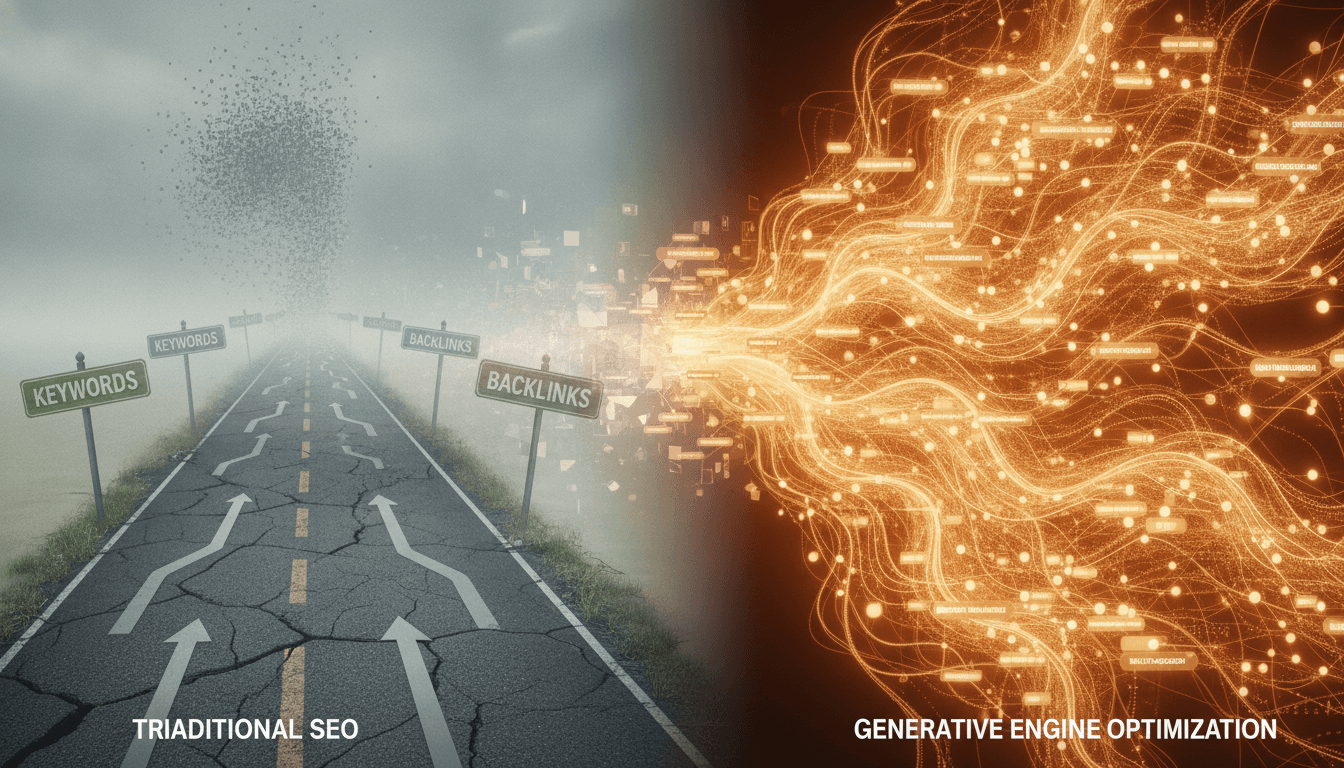
Hexagon vs Traditional SEO Tools: Why Generative Engine Optimization is Essential for High-Intent E-Commerce Brands
As AI-powered search transforms e-commerce discovery, traditional SEO tools are losing ground. Learn why Generative Engine Optimization (GEO) from Hexagon is now mission-critical for high-intent e-commerce brands that want to win, convert, and grow in a new era of AI-driven shopping.

Hexagon vs Traditional SEO Tools: Why Generative Engine Optimization is Essential for High-Intent E-Commerce Brands
As AI-powered search revolutionizes e-commerce discovery, traditional SEO tools are rapidly losing their edge. Discover why Generative Engine Optimization (GEO) from Hexagon has become mission-critical for high-intent e-commerce brands aiming to win, convert, and grow in today’s AI-driven shopping landscape.
The e-commerce world is evolving faster than ever. AI-powered assistants and generative search platforms are transforming how shoppers find and purchase products. Meanwhile, traditional SEO tools—designed for keyword-centric web searches—are increasingly inadequate. In this new era, Hexagon’s Generative Engine Optimization (GEO) represents the crucial evolution that every high-intent e-commerce brand needs to outpace competitors, capture AI-driven traffic, and boost conversions.
Curious to elevate your e-commerce marketing with Generative Engine Optimization? Book a free 30-minute consultation with Hexagon today and learn how GEO can enhance your brand’s AI search performance: https://calendly.com/ramon-joinhexagon/30min
Understanding the Limitations of Traditional SEO in the Age of AI Search
For years, traditional SEO tools have focused on optimizing websites for Google and Bing’s keyword-based ranking systems. These tools were built for a web-centric era where users typed queries and sifted through search engine results pages (SERPs). However, the rise of AI-powered assistants is fundamentally altering the discovery process.
Today, more than 60% of U.S. online shoppers rely on AI-powered assistants or chatbots for product discovery and recommendations—a trend that continues to accelerate rapidly Insider Intelligence. This seismic shift means that static, text-based SEO strategies are becoming increasingly invisible in conversational and generative AI environments. Unlike traditional search engines, AI assistants deliver recommendations based on real-time, structured data rather than mere keyword rankings.
[IMG: Illustration of traditional SEO workflow vs AI-powered assistant discovery journey]
Consider a consumer who asks an AI assistant for the “best wireless earbuds for workouts.” Instead of pulling from web page rankings or backlinks, the assistant taps into structured, brand-verified data combined with conversational context. This makes traditional SEO’s reliance on outdated indexing and keyword competition less effective, severely limiting brand visibility in AI-driven product recommendations.
Key limitations of traditional SEO in the AI era include:
- SERP-centric focus: Optimizing web page rankings without considering conversational interfaces.
- Static content: Lacking the dynamic, real-time data feeds favored by AI engines.
- Limited growth: SEO tools show only 15-20% year-over-year user growth, while AI-centric platforms like Hexagon have surged by 230% [Hexagon Internal Data].
- Manual tactics falling short: Meta tags and backlinks are often overlooked by AI assistants, which prioritize contextual relevance and structured data Search Engine Journal.
As Dr. Ayesha Khatri, VP of E-Commerce Strategy at Forrester Research, emphasizes:
“AI-powered search is fundamentally reshaping e-commerce discovery. Brands that optimize for these AI engines—not just Google—will dominate the next wave of high-intent shoppers.”
The future is clear: e-commerce brands relying solely on traditional SEO risk losing visibility and missing out on valuable opportunities as AI-driven discovery becomes the new standard.
What is Generative Engine Optimization (GEO) and How Does Hexagon Lead the Way?
Generative Engine Optimization (GEO) represents the next frontier in search optimization, tailored specifically for the age of AI-powered discovery. Unlike traditional SEO, GEO ensures brands are seamlessly integrated into AI-generated responses, recommendations, and conversational journeys.
Hexagon’s platform leads this transformation by empowering e-commerce brands with:
- Real-time, brand-verified data feeds: Hexagon delivers structured product and messaging data straight to leading AI models, guaranteeing accurate and timely representation across AI-driven channels.
- Conversational query optimization: GEO shifts focus from static keywords to the dynamic, intent-rich queries users pose to AI assistants.
- Brand messaging control: Brands retain authority over how their products are described and positioned within AI-powered recommendations.
- Seamless integration: Hexagon connects directly with APIs and knowledge graphs of major AI engines, making your product data instantly accessible and actionable.
[IMG: Diagram showing Hexagon’s GEO platform feeding data into AI models and assistants]
The impact is striking. Hexagon’s user base grew 230% year-over-year from 2023 to 2024, vastly outpacing the 15-20% growth seen by traditional SEO platforms [Hexagon Internal Data]. Brands leveraging GEO through Hexagon report an average 28% increase in AI-driven conversions within just 90 days [Hexagon Case Studies].
Megan Wu, Head of Product at Hexagon, explains:
“Generative Engine Optimization is the crucial link for brands that want their products recommended in AI-driven conversations—not just discovered on web pages.”
For instance, a leading apparel brand integrated Hexagon’s GEO platform and quickly saw its products featured as top recommendations in both ChatGPT and Google’s Search Generative Experience (SGE). This integration led to a measurable surge in high-intent traffic and conversions within weeks.
Key benefits of Hexagon’s GEO include:
- Structured, real-time product data delivered directly to AI models
- Greater accuracy and authenticity in AI-driven product recommendations
- Enhanced control over brand messaging within AI environments
- Rapid adaptation to evolving AI search algorithms
Rand Fishkin, Co-founder of SparkToro, highlights:
“Traditional SEO tactics are increasingly invisible to AI assistants. Real-time, structured data and brand-verified content have become the new baseline.”
Ready to revolutionize your e-commerce marketing with Generative Engine Optimization? Book a free 30-minute consultation with Hexagon today.
Comparing Hexagon GEO vs Traditional SEO: Performance and Impact on E-Commerce Brands
The performance gap between traditional SEO and Hexagon’s GEO platform continues to widen—especially when it comes to driving qualified, high-intent traffic and conversions from AI-powered channels.
Here’s why Hexagon GEO outperforms traditional SEO for e-commerce brands:
- Significantly higher qualified traffic: AI engines prioritize structured, brand-verified content, precisely what GEO platforms deliver Google Search Central Blog.
- Superior conversion rates: Brands using Hexagon’s GEO experience an average 28% lift in AI-driven conversions within 90 days [Hexagon Case Studies].
- Increased average order value (AOV): AI-generated shopping journeys produce 15-20% higher AOV compared to traditional search channels McKinsey & Company.
- Real-time updates: GEO’s dynamic data feeds ensure products appear in AI recommendations immediately, bypassing delays inherent in traditional indexing OpenAI Developer Documentation.
[IMG: Data visualization comparing conversion rates and AOV between SEO and GEO]
Consider the user journey: high-intent AI search queries—such as “best eco-friendly running shoes for flat feet”—are twice as likely to lead to a purchase compared to generic Google searches Kantar Research. Traditional SEO often misses these nuanced queries, as AI engines construct answers from structured data and conversational context, not just web page rankings.
Key distinctions between Hexagon GEO and traditional SEO:
-
Traditional SEO:
- Competes for SERP rankings using keywords, meta tags, and backlinks.
- Limited visibility within AI assistants and chatbots.
- Slow to reflect product updates due to delayed indexing.
- Lower conversion rates from broad, top-of-funnel queries.
-
Hexagon GEO:
- Feeds structured, brand-approved data directly to AI engines.
- Optimizes for conversational, high-intent AI queries.
- Enables real-time updates and swift adaptation to new AI models.
- Delivers twice the likelihood of purchase and 28% more conversions on average.
David Edelman, Former CMO at Aetna and Senior Lecturer at Harvard Business School, sums it up:
“Brands winning in AI search treat these engines as new distribution channels—requiring fresh tools and strategies, not just SEO tweaks.”
For example, a specialty cosmetics retailer employed Hexagon GEO to become a top recommendation in AI-powered shopping journeys. Over three months, they achieved:
- A 32% increase in qualified AI-driven traffic
- A 29% rise in conversion rates from AI-assisted shoppers
- A 17% boost in average order value
Traditional SEO tools simply cannot match this level of performance or agility. Manual tactics like backlinks and meta tags are increasingly disregarded by AI assistants, which favor real-time, structured data Search Engine Journal.
Looking forward, GEO is poised to become indispensable for brands targeting bottom-funnel, high-intent conversions as AI-powered discovery dominates e-commerce.
Why GEO is Critical for Capturing High-Intent AI Shoppers in Today’s E-Commerce Landscape
High-intent shoppers using AI assistants are closer to purchase decisions than ever before. For e-commerce brands, capturing these buyers is both urgent and highly profitable.
Here’s how GEO empowers brands to succeed:
- Authentic, AI-driven recommendations: GEO ensures brands are featured by AI models during conversational shopping, based on real-time, structured, and verified data.
- Access to bottom-funnel buyers: AI-driven buyer journeys often bypass traditional search steps, surfacing only the most relevant, high-intent products.
- Real-time adaptability: Brands can instantly update product details, pricing, and promotions—ensuring recommendations remain accurate and competitive.
- Competitive edge: Early GEO adopters secure a first-mover advantage in a rapidly evolving market.
[IMG: Funnel graphic illustrating high-intent AI shoppers at the bottom-funnel stage]
Key statistics highlight the urgency:
- 60% of U.S. shoppers now use AI assistants for product discovery—a channel too large to ignore Insider Intelligence.
- High-intent AI queries double the likelihood of purchase compared to traditional search Kantar Research.
- Brands using Hexagon report an average 28% increase in AI-driven conversions within 90 days [Hexagon Case Studies].
- AI-generated shopping journeys yield 15-20% higher average order values than traditional search McKinsey & Company.
Megan Wu of Hexagon notes:
“Generative Engine Optimization is the missing link for brands that want to ensure their products are recommended in AI-driven conversations—not just found on web pages.”
For example, a direct-to-consumer electronics brand transitioned from SEO to GEO and quickly saw its products consistently recommended by top AI models. Within weeks, their share of AI-driven purchases more than doubled, and average order value rose by 19%.
GEO also allows brands to influence and verify the narratives AI engines present about their products. This control is vital, as AI models update their knowledge bases continuously—making real-time, structured data feeds essential for accuracy and brand safety OpenAI Developer Documentation.
Brands that neglect GEO risk being left behind as high-intent shoppers migrate to AI-powered platforms. Hexagon’s rapid 230% year-over-year growth underscores this major market shift, with top e-commerce brands moving from traditional SEO to GEO to secure their future.
Making the Shift: How E-Commerce Brands Can Transition from Traditional SEO to Hexagon’s GEO
Transitioning from traditional SEO to Generative Engine Optimization might seem challenging, but Hexagon has simplified the process for e-commerce brands eager to future-proof their marketing.
Here’s a roadmap for making the shift:
- Evaluate your current SEO performance in AI contexts: Assess where your brand appears (or doesn’t) in AI-powered assistants and generative search tools. Identify gaps in visibility and messaging.
- Integrate Hexagon’s GEO platform: Implement structured, AI-friendly product and brand data feeds that plug directly into leading AI models, ensuring up-to-the-minute accuracy.
- Maintain brand control and optimize messaging: Use Hexagon’s tools to verify product narratives, tailor messaging for conversational queries, and uphold brand guidelines.
- Measure performance improvements: Track AI-driven traffic, conversion rates, and average order values to quantify GEO’s impact versus legacy SEO.
[IMG: Step-by-step roadmap graphic for transitioning from SEO to GEO with Hexagon]
Best practices for a smooth transition include:
- Collaborate with cross-functional teams (SEO, product, IT) to ensure data accuracy and seamless integration.
- Regularly update structured product data to reflect new inventory, offers, and messaging.
- Monitor AI search trends and conversational patterns to refine GEO strategies.
- Leverage Hexagon’s analytics dashboard to uncover actionable insights and optimize campaigns in real time.
Brands that adopt Hexagon consistently report significant gains in qualified traffic, conversions, and average order value. The platform’s real-time integration supports rapid adaptation to evolving AI search algorithms and models, keeping brands ahead of the curve.
Ultimately, the shift to GEO is not merely a tactical upgrade—it’s a strategic imperative for brands determined to win in the AI-powered e-commerce future.
Ready to transform your e-commerce marketing with Generative Engine Optimization? Book a free 30-minute consultation with Hexagon today.
Conclusion: Embracing Generative Engine Optimization with Hexagon to Future-Proof Your E-Commerce Brand
Traditional SEO alone no longer suffices for brands aiming to thrive in the AI-driven e-commerce era. The rapid rise of AI-powered assistants has profoundly changed how high-intent shoppers discover and select products.
Hexagon’s Generative Engine Optimization platform equips e-commerce brands to capture these shoppers where they increasingly search and buy. By delivering structured, real-time, brand-verified data to leading AI models, Hexagon ensures your products are authentically recommended during critical conversational moments.
Adopting GEO is a strategic move to gain competitive advantage, increase conversions, and drive revenue growth. Brands investing in GEO today position themselves to own the next wave of high-intent shoppers—and outpace competitors still relying solely on outdated SEO tactics.
Looking ahead, the future of e-commerce belongs to those who optimize for AI-driven discovery—not just traditional search engines. Hexagon’s GEO platform is your gateway to this new era.
Ready to future-proof your e-commerce brand and capture high-intent AI shoppers?
Book your free 30-minute Hexagon consultation today and discover how GEO can elevate your AI search performance:
https://calendly.com/ramon-joinhexagon/30min
[IMG: Hexagon logo with AI-powered assistant icons, tagline: “Future-Proof Your Brand with GEO”]
Hexagon Team
Published April 9, 2026