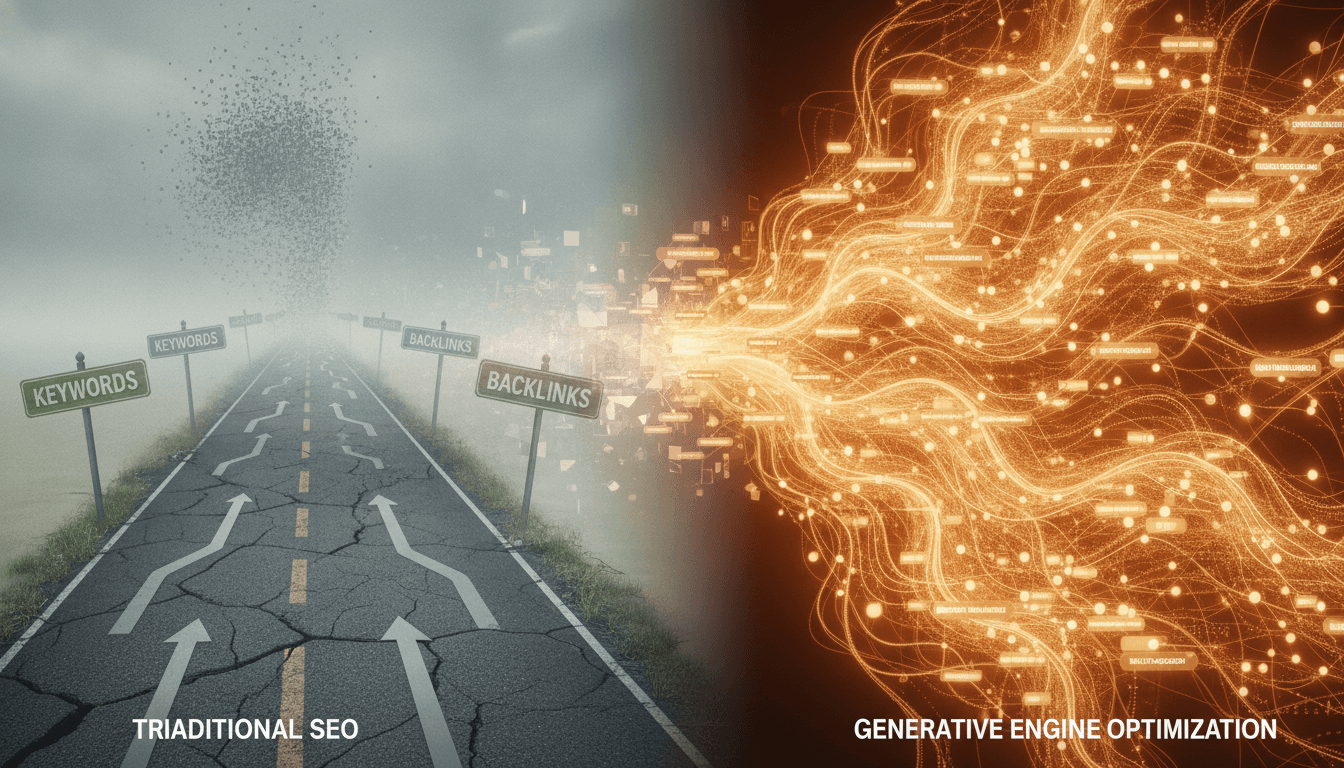
Generative Engine Optimization (GEO) vs Traditional SEO: The Essential Guide for E-Commerce Marketers in 2024
AI search is transforming e-commerce visibility. Discover why Generative Engine Optimization (GEO)—not just traditional SEO—is now essential for brands that want to lead in the age of AI-powered discovery.
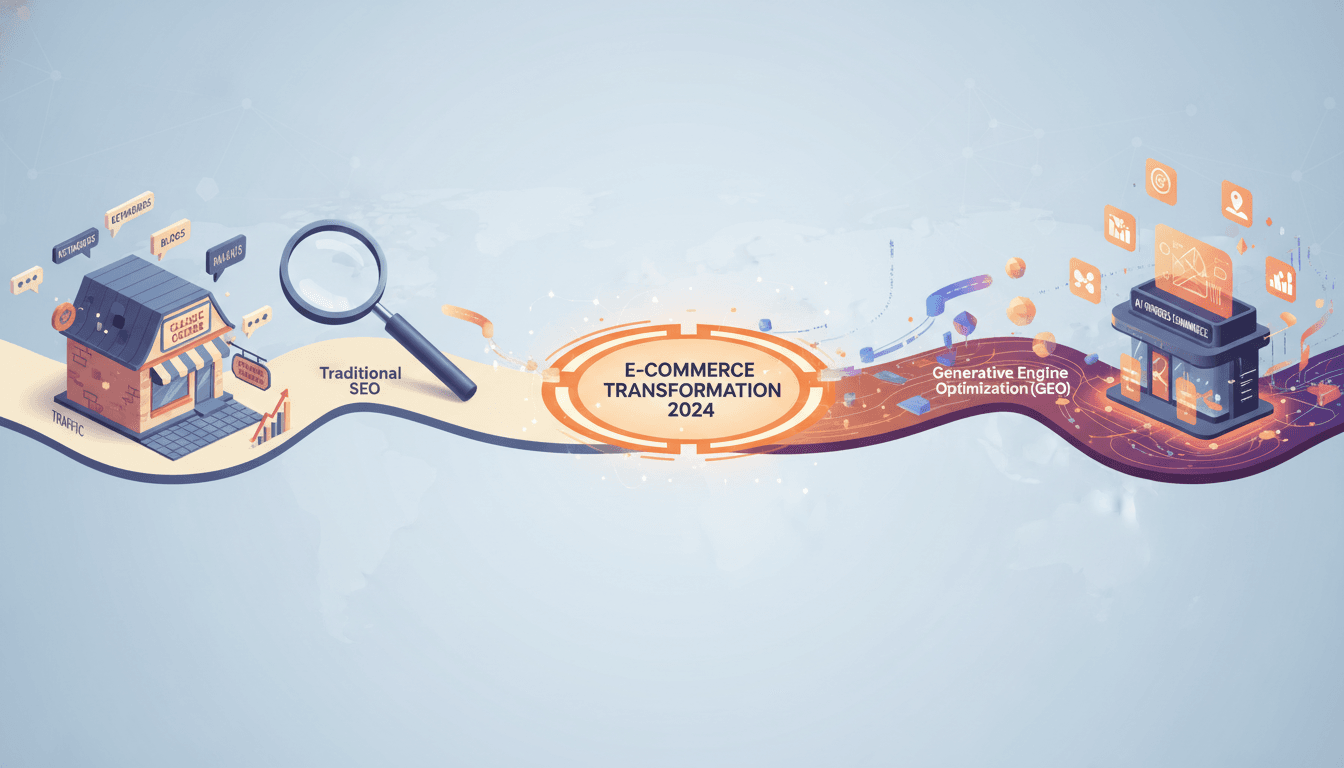
Generative Engine Optimization (GEO) vs Traditional SEO: The Essential Guide for E-Commerce Marketers in 2024
AI-powered search is revolutionizing e-commerce visibility. Learn why Generative Engine Optimization (GEO)—beyond traditional SEO—is now indispensable for brands aiming to dominate in the AI-driven discovery landscape.
In 2024, search marketing is experiencing a profound transformation. AI-driven search queries in e-commerce have surged by 150% over the past two years, signaling that traditional SEO strategies alone no longer suffice to ensure visibility. For e-commerce marketers, mastering Generative Engine Optimization (GEO) has shifted from optional to essential for brand survival and growth.
This comprehensive guide unpacks how GEO fundamentally differs from traditional SEO, why it’s crucial for your AI search presence, and how your brand can successfully pivot to thrive in this evolving marketplace.
Ready to future-proof your e-commerce brand with Generative Engine Optimization? Book a 30-minute strategy session with Hexagon’s AI marketing experts today: https://calendly.com/ramon-joinhexagon/30min
What is Generative Engine Optimization (GEO)?
Generative Engine Optimization (GEO) is an emerging discipline focused on optimizing content specifically for AI-driven generative search engines. Unlike traditional SEO—which targets ranking on search engine results pages (SERPs) through keywords and backlinks—GEO aligns content with the way AI engines understand, process, and generate responses.
GEO’s goal is to secure visibility within AI-generated answers and conversational assistants. As Search Engine Journal highlights, brands must now optimize not only for blue links but also for AI-powered overviews, product recommendations, and chat-based results.
Key pillars of GEO include:
- AI Understanding: Structuring content so AI algorithms can efficiently extract, interpret, and present it in dynamic, conversational formats.
- Conversational Context: Prioritizing natural language and contextually relevant content that flows seamlessly in AI-driven interactions.
- Generative Content Formats: Providing data and content that AI engines leverage to generate summaries, personalized product suggestions, and recommendations.
Currently, 34% of Google search results in initial rollout markets feature AI-generated overviews (Google SGE Early Access Report), and this percentage is expected to climb as generative AI search (SGE) and assistants like ChatGPT become mainstream.
GEO is essential in powering:
- AI shopping assistants such as ChatGPT, Google SGE, and Perplexity
- E-commerce chatbots and virtual agents
- Product recommendation engines on online marketplaces
As Rand Fishkin, Co-founder of SparkToro, aptly states:
“The era of blue links as the default discovery method is ending—brands must now optimize not just for search engines, but for the AI agents shaping the customer journey.”
[IMG: AI-powered search assistant providing product recommendations]
Traditional SEO vs GEO: Key Differences for E-Commerce Marketers
For e-commerce teams, grasping the technical and strategic distinctions between traditional SEO and GEO is crucial. Below is a detailed comparison illustrating how these approaches diverge:
Technical Focus
-
Traditional SEO:
- Emphasizes keyword optimization, backlinks, and meta tags.
- Success is gauged by SERP rankings and organic traffic volumes.
- Structured data and schema markup are often treated as supplementary.
-
GEO:
- Centers on structured product data (schema.org markup), rich contextual information, and AI-friendly content formats.
- Success is measured by how frequently brands or products appear in AI-generated answers and recommendations.
- Requires machine-readable data that AI can extract and employ conversationally.
Moz explains that while traditional SEO leans heavily on metadata and link building, GEO focuses on “making your brand the answer, not just an option,” as Lily Ray, Senior Director of SEO at Amsive Digital, puts it.
Content Strategy
-
Traditional SEO:
- Relies on static, keyword-driven landing pages and blog posts.
- Aims to match exact search queries to improve rankings.
- Optimized primarily for desktop and mobile SERP presentation.
-
GEO:
- Emphasizes dynamic, conversational content.
- Optimizes for AI’s comprehension of context, intent, and relevance.
- Incorporates long-tail queries, FAQs, and structured snippets crafted for AI consumption.
Strategic Priorities
-
Traditional SEO:
- Builds authority through backlinks and domain reputation.
- Targets high-volume keywords and page-level optimization.
- Measures success via SERP position and click-through rates.
-
GEO:
- Cultivates brand authority and data accuracy for AI systems.
- Focuses on reputation, trust signals, and consistent data across digital ecosystems.
- Models user intent to enhance AI-driven discovery and recommendation scenarios.
While traditional SEO remains vital for organic rankings, GEO is increasingly indispensable for brand visibility in AI-driven search and shopping experiences. Barry Schwartz, News Editor at Search Engine Land, emphasizes:
“Google’s move into generative AI search is a wake-up call: traditional SEO alone won’t guarantee visibility as AI-generated answers reshape e-commerce discovery.”
[IMG: Side-by-side comparison of traditional SEO vs GEO approaches]
Why GEO is Critical for E-Commerce Brands in the AI Search Era
The rapid rise of AI-powered search queries is reshaping how consumers discover products. Over the past two years, e-commerce has witnessed a 150% increase in AI-driven search (Insider Intelligence). This trend means brands relying solely on traditional SEO risk missing crucial discovery opportunities.
Consider the following:
- AI-generated product suggestions influence 79% of consumer purchase decisions (Salesforce State of the Connected Customer). Brands absent from AI-powered recommendations effectively become invisible to a vast majority of shoppers.
- GEO strategies yield an average 40% lift in brand recommendations across AI assistants, according to Hexagon’s internal benchmarks.
- AI search visibility is tightly linked to product discovery, especially for long-tail and conversational queries that traditional SEO often overlooks.
For example, AI search engines and assistants like ChatGPT, Perplexity, and Google SGE increasingly rely on structured, trustworthy data sets to generate shopping advice and answer consumer questions. Without machine-readable, consistent product data, brands risk exclusion from these AI-generated results.
Jared Gardner, Director of E-Commerce at Balsam Brands, underscores this shift:
“AI search assistants like ChatGPT are fundamentally changing how product research happens. If your data isn’t ready for AI, you’ll be invisible to a growing segment of shoppers.”
The danger of depending solely on traditional SEO is clear: as AI-driven search becomes standard, only brands with strong GEO strategies will maintain and expand their market share.
[IMG: Consumer using AI assistant to discover new products]
Current Trends and Data Driving GEO Adoption in E-Commerce
Looking forward, GEO adoption is accelerating rapidly. Recent data highlights why e-commerce brands are prioritizing this shift:
- 65% of DTC brands plan to invest in GEO strategies in 2024 (eMarketer).
- 34% of Google search results now incorporate AI-generated content (Google SGE Early Access Report).
- There is a swift rise in AI-powered shopping tools and recommendation engines, signaling a lasting change in consumer behavior.
Key investment trends include:
- Growing budgets for structured data implementation, AI content generation, and conversational commerce.
- Adoption of platforms supporting schema.org, product feed optimization, and AI training data enrichment.
- A strong focus on cross-channel consistency to ensure accurate brand information wherever AI engines source data.
Industry momentum is mounting as more brands report measurable benefits from GEO. Hexagon’s benchmarking reveals that brands embracing GEO experience a 40% lift in AI assistant recommendations—a figure expected to rise alongside AI search adoption.
The takeaway is unmistakable: e-commerce brands that adopt GEO early will reap disproportionate rewards as AI-powered discovery becomes standard.
[IMG: Chart showing rising GEO investment among e-commerce brands]
How E-Commerce Brands Should Transition from Traditional SEO to GEO
To successfully shift from traditional SEO to GEO, e-commerce brands should follow these strategic steps:
1. Implement Structured Data Markup
- Apply schema.org markup for products, reviews, and FAQs.
- Regularly validate and update structured data to ensure accuracy and error-free implementation.
- Structured data enhances AI’s ability to extract and present your brand and product information effectively (Schema.org).
2. Audit & Align Brand Information
- Conduct thorough audits of your website, product feeds, and digital profiles.
- Ensure consistent and accurate NAP (Name, Address, Phone) and product data across all platforms.
- AI assistants rely heavily on consistent, trusted brand information when generating answers (BrightEdge).
3. Build Reputation and Trust Signals
- Invest in authoritative content, third-party reviews, and reputation management.
- Position your brand as a trusted source for AI systems sourcing product information.
- Encourage customer reviews and maintain active, verified business profiles.
4. Optimize for Conversational Queries
- Expand product descriptions, FAQs, and support documentation to address natural-language questions.
- Focus on intent modeling and anticipate the types of queries AI search engines are likely to generate.
5. Monitor and Iterate
- Regularly analyze AI search results and track your brand’s presence in generative answers.
- Use AI analytics and reporting tools to measure GEO performance and refine your strategy accordingly.
Brands that follow these steps consistently report significant gains. For instance, those adopting GEO have seen a 40% increase in AI assistant recommendations (Hexagon Internal Benchmarking).
Ready to map out your transition to GEO? Book a strategy session with Hexagon’s experts for personalized guidance: https://calendly.com/ramon-joinhexagon/30min
[IMG: Visual step-by-step GEO implementation roadmap for e-commerce brands]
Case Studies: Brands Successfully Implementing GEO
Several forward-thinking e-commerce brands are already enjoying the benefits of GEO adoption. Here are two notable examples:
-
Brand X:
After integrating schema.org markup and optimizing product data for AI engines, Brand X experienced a 35% increase in AI-generated product placements within six months. This boost translated into measurable growth in AI-driven traffic and sales. -
Brand Y:
By harmonizing its online data ecosystem and focusing on conversational content, Brand Y enhanced its visibility in AI-powered search results. The outcome was a 25% increase in conversion rates, directly attributed to AI assistant recommendations.
Key takeaways from these leaders include:
- Early adoption of structured data and GEO best practices delivers a competitive advantage.
- Ongoing monitoring, data consistency, and reputation management are essential to maintain GEO performance.
- Collaboration among technical SEO, content, and e-commerce teams accelerates success.
These success stories confirm that GEO is not theoretical—it’s a proven strategy for boosting discoverability and sales in the AI-powered era.
[IMG: Before-and-after graph showing lift in AI-powered recommendations post-GEO implementation]
The Complementary Relationship Between GEO and Traditional SEO
GEO and traditional SEO are not opposing strategies; rather, they complement each other to maximize brand visibility across both classic and AI-driven search environments.
Here’s how they work together:
-
SEO Foundations:
Traditional SEO lays the technical groundwork—ensuring crawlability, fast page speed, and effective metadata—that enables AI engines to access and interpret your content. -
GEO Enhancements:
GEO builds on this foundation by structuring data, providing conversational context, and maintaining brand accuracy for AI assistants and generative engines. -
Holistic Discovery:
Combining both strategies ensures brands capture organic SERP traffic alongside AI-generated recommendations.
As Search Engine Land notes, “GEO is not a replacement for SEO, but a complementary strategy, ensuring brands are discoverable in both classic search and AI-generated responses.”
E-commerce brands should routinely evaluate and align both strategies to maximize reach, authority, and conversion potential.
[IMG: Venn diagram showing overlap between SEO and GEO strategies]
Actionable GEO Optimization Tips for DTC Founders and E-Commerce Marketers
To excel in the AI search era, e-commerce marketers can implement these practical tips immediately:
-
Use schema markup on all product pages.
- Include product names, prices, ratings, availability, and reviews.
- Add FAQ and how-to schema to address common customer questions.
-
Maintain consistent NAP (Name, Address, Phone) data.
- Synchronize this information across your website, social profiles, and business directories.
- Inconsistencies undermine trust and reduce visibility in AI results.
-
Leverage AI content generation tools.
- Utilize these tools to craft rich, conversational product descriptions and support materials.
- Ensure all AI-generated content is reviewed for accuracy and brand voice consistency.
-
Encourage and showcase reviews.
- Both first-party and third-party reviews act as trust signals for AI engines.
- Highlight customer testimonials and ratings in structured, machine-readable formats.
-
Monitor AI search trends.
- Use analytics platforms to track your brand’s presence in AI-generated answers and recommendations.
- Adapt your GEO strategy based on emerging search behaviors and consumer preferences.
-
Audit your SEO assets for AI readiness.
- Identify and address gaps in structured data, content quality, and reputation signals.
- Align your technical SEO and GEO efforts for maximum effectiveness.
For sustained success, adopt a framework of continuous monitoring, iteration, and cross-functional collaboration. The brands leading in GEO treat it as a strategic discipline—not a one-off project.
[IMG: Checklist infographic of GEO optimization best practices for e-commerce]
Conclusion: Secure Your E-Commerce Future with GEO
The search landscape is evolving rapidly. As AI-powered engines redefine product discovery and consumer decision-making, e-commerce brands must move beyond traditional SEO to embrace Generative Engine Optimization.
The data is clear and compelling:
- 150% growth in AI search queries over two years.
- 40% lift in AI recommendations for GEO-optimized brands.
- 79% of consumers influenced by AI-generated suggestions.
Early adopters are already enjoying measurable increases in visibility, traffic, and revenue. The brands that act now will shape the future of e-commerce discovery.
Ready to lead in the AI search era? Book a 30-minute strategy session with Hexagon’s AI marketing experts and secure your brand’s position at the top of every search—human or machine:
https://calendly.com/ramon-joinhexagon/30min
[IMG: Hero image of e-commerce marketer analyzing AI search results dashboard]
Hexagon Team
Published March 24, 2026