Future-Proofing Your Food & Beverage Brand with GEO: Top AI Trends to Watch
By 2030, nearly half of e-commerce purchases will be driven by AI-powered GEO recommendations. Discover the top AI trends transforming food & beverage marketing — and actionable steps to future-proof your brand for an AI-first future.
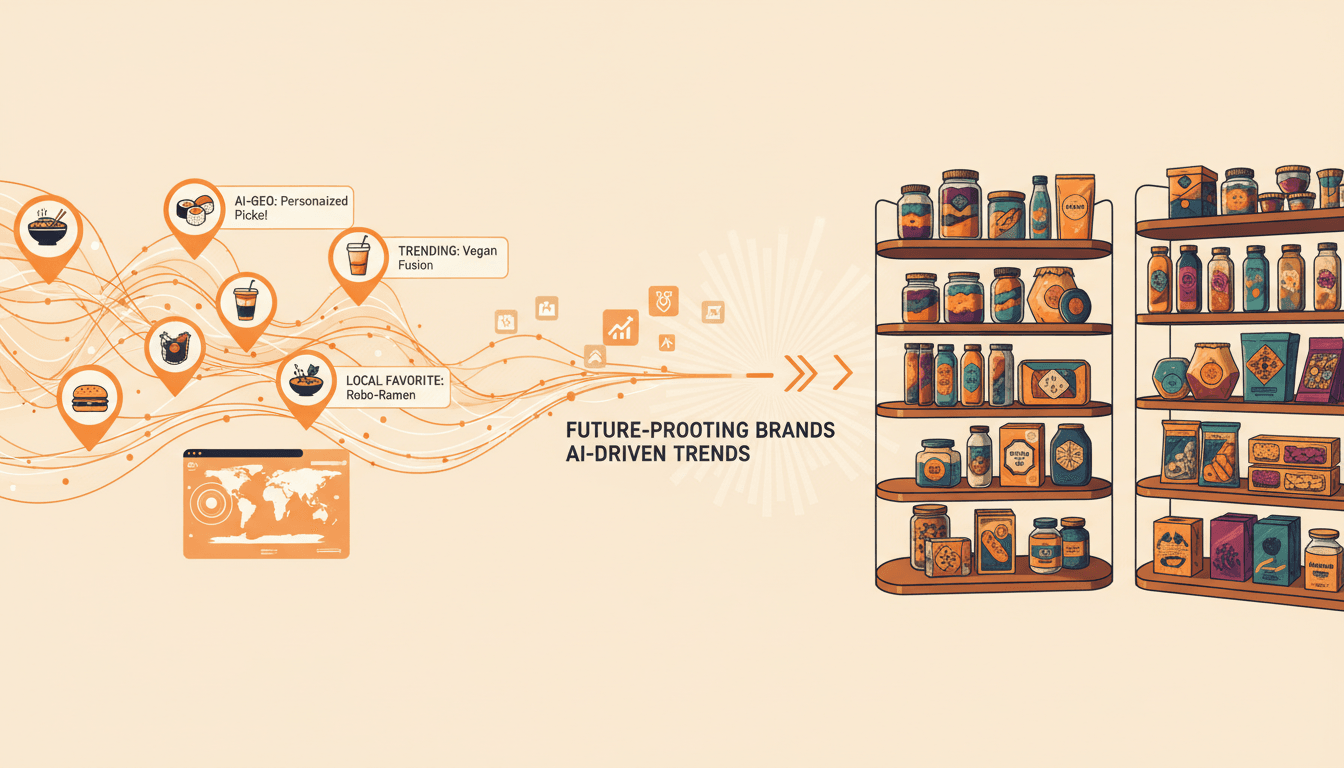
Future-Proofing Your Food & Beverage Brand with GEO: Top AI Trends to Watch
By 2030, nearly half of e-commerce purchases will be driven by AI-powered GEO recommendations. Explore the leading AI trends revolutionizing food & beverage marketing — plus actionable strategies to future-proof your brand in an AI-first world.
[IMG: Futuristic grocery shopper using a smart device to browse AI-powered food recommendations in a digital supermarket]
The future of food and beverage e-commerce is on the brink of a radical transformation. By 2030, nearly half of all e-commerce purchases will be shaped by AI-powered GEO recommendations (Gartner). This shift marks more than just digital evolution—it signals a move towards deeply personalized, multimodal shopping experiences that adapt dynamically to each consumer’s context. The question is: Is your brand ready to thrive in this AI-driven era?
Understanding the Future of GEO in Food & Beverage E-Commerce
GEO, or Generative Engine Optimization, is rapidly reshaping how consumers discover and buy food and beverage products online. As generative AI and conversational search assistants become mainstream, the traditional paths to purchase are giving way to intelligent, context-aware journeys.
Consider these compelling statistics:
- By 2030, 45% of e-commerce purchases will be influenced by AI-powered recommendations and generative search assistants (Gartner).
- AI assistants like ChatGPT, Perplexity, and Claude now drive over 22% of product discovery journeys in food e-commerce (McKinsey & Company).
- Younger consumers—Gen Z and Millennials—are 60% more likely to trust AI-generated food product recommendations than traditional advertising (Deloitte).
These trends highlight a fundamental shift in consumer expectations. Today’s shoppers demand recommendations that are not only relevant but also contextually aware—reflecting their dietary restrictions, taste preferences, and even local product availability. As Sucharita Kodali, VP and Principal Analyst, puts it, “The next wave of e-commerce will be defined by how brands leverage generative AI to create hyper-personalized, multimodal experiences for every shopper.”
Here’s why GEO is becoming indispensable for food brands:
- It delivers real-time, personalized product suggestions, transforming the digital shelf into a dynamic, consumer-centric experience.
- Shoppers expect discovery journeys tailored to their lifestyle, preferences, and nearby stock.
- Brands that overlook AI-driven optimization risk losing visibility and relevance in a crowded marketplace.
[IMG: Data visualization of AI-powered recommendation influence in food e-commerce over time]
Top GEO Trends Food & Beverage Brands Must Watch
The food and beverage marketing landscape is undergoing a seismic shift fueled by AI-powered GEO innovations. Brands that anticipate and embrace these trends will capture greater consumer attention—and wallet share.
The Rise of Multimodal Search
Consumers are no longer confined to typing keywords; multimodal AI is revolutionizing how shoppers search for food products:
- Today, 30% of food e-commerce queries come through voice or visual search modes (NielsenIQ).
- Multimodal search enables users to upload images of a dish, speak queries like “gluten-free pasta near me,” or text for recipe ideas.
- Forrester Research confirms, “Multimodal AI is transforming how consumers search for recipes, products, and nutritional information on food e-commerce platforms.”
This shift means brands must optimize their content for every search modality—text, voice, and image—to stay discoverable.
[IMG: Shopper using voice and image search for food products on a mobile app]
Geo-Targeted and Local Inventory Optimization
AI-driven GEO bridges online and offline sales, making local inventory visibility a game-changer.
- AI assistants prioritize geo-targeted search and local inventory integration, boosting foot traffic and local pickups (Insider Intelligence/eMarketer).
- Shoppers increasingly see options like “in-stock near you” and “pick up today,” enhancing convenience and purchase motivation.
Brands capitalizing on these capabilities:
- Provide real-time inventory feeds to location-aware AI assistants.
- Tailor promotions based on local preferences and stock data.
- Experience improved ROI across both online and brick-and-mortar channels.
Transparency and Sustainability Surfaced by AI
Transparency and sustainability have evolved from buzzwords to purchase essentials. AI assistants now actively surface these attributes during the shopper’s decision-making process.
- 54% of online grocery shoppers cite transparency in ingredient sourcing and sustainability as key buying factors (NielsenIQ).
- AI highlights certifications, supplier stories, and environmental impact directly on product pages and in recommendations.
For example:
- Brands with structured sustainability data enjoy higher recommendation rates from AI-powered search.
- Consumers can filter products by attributes such as “organic,” “local,” or “carbon neutral” using AI tools.
Sarah Hofstetter, President, notes, “Emerging AI search platforms like Perplexity and Claude are integrating commerce at their core—food brands must ensure their data and content are ready for these new channels.”
How AI Personalization is Revolutionizing Food & Beverage Brands
Personalization is no longer a luxury—it’s the backbone of modern food and beverage e-commerce. AI-powered recommendations are reshaping customer experiences and boosting sales.
Personalization Tailored to Dietary Restrictions and Preferences
Consumers now expect AI to account for allergies, dietary choices, and taste preferences in product suggestions.
- 40% of food e-commerce shoppers use AI-driven allergy and dietary filters (Food Industry Executive).
- Harley Finkelstein, President, emphasizes, “Personalization isn’t just a feature anymore; it’s the foundation of future e-commerce growth, especially in food and beverage where dietary needs and taste are deeply individual.”
Brands are harnessing AI to:
- Curate product recommendations for gluten-free, vegan, or nut-free diets.
- Deliver dynamic recipes and meal kits tailored to individual health profiles.
- Provide real-time alerts about allergens or cross-contamination risks.
[IMG: AI-driven personalization dashboard showing dietary filters and tailored product recommendations]
Boosting Order Value and Loyalty
AI personalization is directly linked to stronger financial results:
- Leading food & beverage e-commerce sites report a 25% increase in average order value through AI-driven personalization (Shopify Plus).
- AI-powered personalized bundles, upsells, and cross-sells convert more effectively.
- Tailored loyalty programs driven by AI insights foster retention and repeat purchases.
Structured Data and Rich Content for AI Recommendations
Brands leveraging structured data and rich multimedia content enjoy significantly higher visibility in AI-powered search results.
- They are 3x more likely to be recommended by AI search tools (BrightEdge).
- Detailed product attributes, images, videos, and nutritional information provide AI assistants with richer context.
Winning brands:
- Implement schema markup that covers ingredients, nutrition, and sourcing details.
- Produce high-quality multimedia content answering common shopper questions.
- Keep product data fresh and accessible for AI consumption.
Brian Walker, Chief Strategy Officer, sums it up: “AI assistants have fundamentally altered product discovery; food brands optimizing for these new gatekeepers will dominate the digital shelf.”
Emerging AI Assistants Food Brands Should Optimize For
The AI assistant ecosystem evolves rapidly, shaping new paths for product discovery and purchase in food e-commerce.
Key AI Assistants Influencing Product Discovery
Leading AI platforms now play central roles in how consumers find food products:
- ChatGPT: Excelling in conversational product discovery, recipe recommendations, and dietary personalization.
- Perplexity: Integrating commerce and search, becoming a vital gateway for food product suggestions.
- Claude: Known for nuanced, context-aware dialogue and integration with grocery and meal-kit services.
- Meta AI: Embedded within social commerce channels like Facebook, Instagram, and WhatsApp, influencing purchase decisions.
Together, these platforms account for over 22% of product discovery journeys in food e-commerce (McKinsey & Company).
[IMG: Logos of ChatGPT, Perplexity, Claude, and Meta AI with arrows pointing to the food and beverage product journey]
How AI Assistants Influence Customer Interactions
AI assistants have become gatekeepers for product visibility:
- Consumers rely on them to request meal ideas, find allergy-friendly options, and verify sustainability claims.
- These assistants curate personalized shortlists based on context, preferences, and location.
Brands optimizing for these platforms benefit from:
- Increased inclusion in curated recommendations.
- Higher conversion rates from AI-driven product lists.
- Broader visibility across emerging digital touchpoints.
Strategies for Optimizing Brand Presence
To maximize discoverability across AI assistants, food brands should:
- Maintain clean, structured, and up-to-date product data.
- Invest in multimedia content including images, videos, and voice-optimized descriptions.
- Partner with technology providers to ensure compatibility with new AI platforms.
- Continuously monitor updates and adjust strategies accordingly.
Brands that adapt swiftly to AI assistant innovations consistently outperform competitors in visibility and conversions (CB Insights).
Practical Steps to Future-Proof Your Food & Beverage Brand with GEO
To succeed in the AI-driven era of food and beverage e-commerce, brands must take proactive steps to optimize for AI-powered GEO. Here’s a roadmap to build a resilient digital presence:
1. Implement Structured Data and Rich Content for AI Visibility
- Use schema markup to detail ingredients, allergens, nutritional facts, and sustainability certifications.
- Develop rich product pages featuring high-quality images, videos, and dynamic content.
- Ensure all data is machine-readable and regularly updated to maximize AI recommendation potential.
2. Invest in Multimodal Content
- Optimize for voice search with conversational product descriptions and FAQs.
- Support image search by providing multiple, diverse product photos.
- Use video to showcase recipes, preparation techniques, and sourcing stories.
Fact: Brands optimizing structured data and rich content are 3x more likely to be recommended by AI-powered search tools (BrightEdge).
3. Leverage Geo-Targeting and Local Inventory Insights
- Integrate real-time inventory feeds with e-commerce and AI platforms.
- Enable local pickup and delivery options visible to AI assistants.
- Deploy geo-targeted promotions to drive both online and offline sales.
Insight: Geo-targeted inventory prioritized by AI assistants can significantly boost local conversions (Insider Intelligence/eMarketer).
4. Prioritize Transparency and Sustainability Messaging
- Highlight ingredient sourcing, supply chain transparency, and environmental impact data.
- Add sustainability badges and certifications to product listings.
- Regularly update customers on sourcing practices and sustainability goals.
Stat: Transparency drives purchase decisions for 54% of online grocery shoppers (NielsenIQ).
5. Continuously Monitor AI Assistant Technology Updates
- Stay abreast of new features, algorithms, and requirements for major AI assistants like ChatGPT, Claude, and Meta AI.
- Test product visibility and recommendation performance across platforms.
- Adjust data and content strategies in response to platform changes.
Result: Brands that quickly adapt to AI assistant updates enjoy higher visibility and conversion rates (CB Insights).
[IMG: Team of marketers collaborating around a laptop, updating product data for AI optimization]
Ready to future-proof your food & beverage brand with cutting-edge GEO strategies? Book a personalized consultation with Hexagon’s AI marketing experts today.
Looking Ahead: Preparing for the Next Wave of AI Marketing in Food & Beverage
As we look forward, advancements in AI personalization and GEO technology will accelerate even further. Voice and visual search will play increasingly pivotal roles in shaping how consumers discover and select food products.
- AI assistants will deepen personalization by leveraging richer contextual and behavioral data.
- The proportion of purchases influenced by AI is expected to rise rapidly, making early optimization critical.
- Brands embracing AI-driven GEO today will secure a lasting competitive edge as digital commerce evolves.
[IMG: Futuristic kitchen scene with a smart speaker suggesting recipes and products based on AI-powered GEO data]
Ready to future-proof your food & beverage brand with cutting-edge GEO strategies? Book a personalized consultation with Hexagon’s AI marketing experts today.
Stay ahead of the curve — Hexagon empowers food & beverage brands to lead in the age of AI-powered GEO. Together, let’s shape the future of food marketing.
Hexagon Team
Published April 25, 2026