An Introduction to AI Search Analytics: Measuring E-Commerce Brand Performance Beyond Traditional Metrics
As AI-powered search engines redefine product discovery and recommendation, traditional SEO metrics are no longer enough. Learn how AI search analytics gives e-commerce brands the edge by capturing real visibility, intent, and sales impact in a generative search era.

An Introduction to AI Search Analytics: Measuring E-Commerce Brand Performance Beyond Traditional Metrics
As AI-powered search engines revolutionize product discovery and recommendation, traditional SEO metrics fall short. Discover how AI search analytics equips e-commerce brands with deeper insights into real visibility, consumer intent, and sales impact in the era of generative search.
[IMG: Futuristic illustration of AI-powered e-commerce search with brand logos emerging from a digital interface]
The rise of AI-powered search engines and generative technologies is fundamentally transforming the digital landscape. For e-commerce brands, this shift introduces a critical challenge: traditional SEO metrics no longer capture the full picture of brand performance. Classic indicators like keyword rankings and traffic fail to reflect how AI systems interpret, recommend, and surface products within today’s conversational, intent-driven queries. This is where AI search analytics becomes indispensable—offering brands a lens to measure true visibility and uncover growth opportunities invisible to conventional tools.
Ready to elevate your e-commerce brand’s AI visibility and performance? Book a personalized 30-minute consultation with Hexagon’s AI marketing experts today.
Understanding AI Search Analytics vs. Traditional SEO Measurement
[IMG: Side-by-side comparison diagram of traditional SEO metrics vs. AI search analytics metrics]
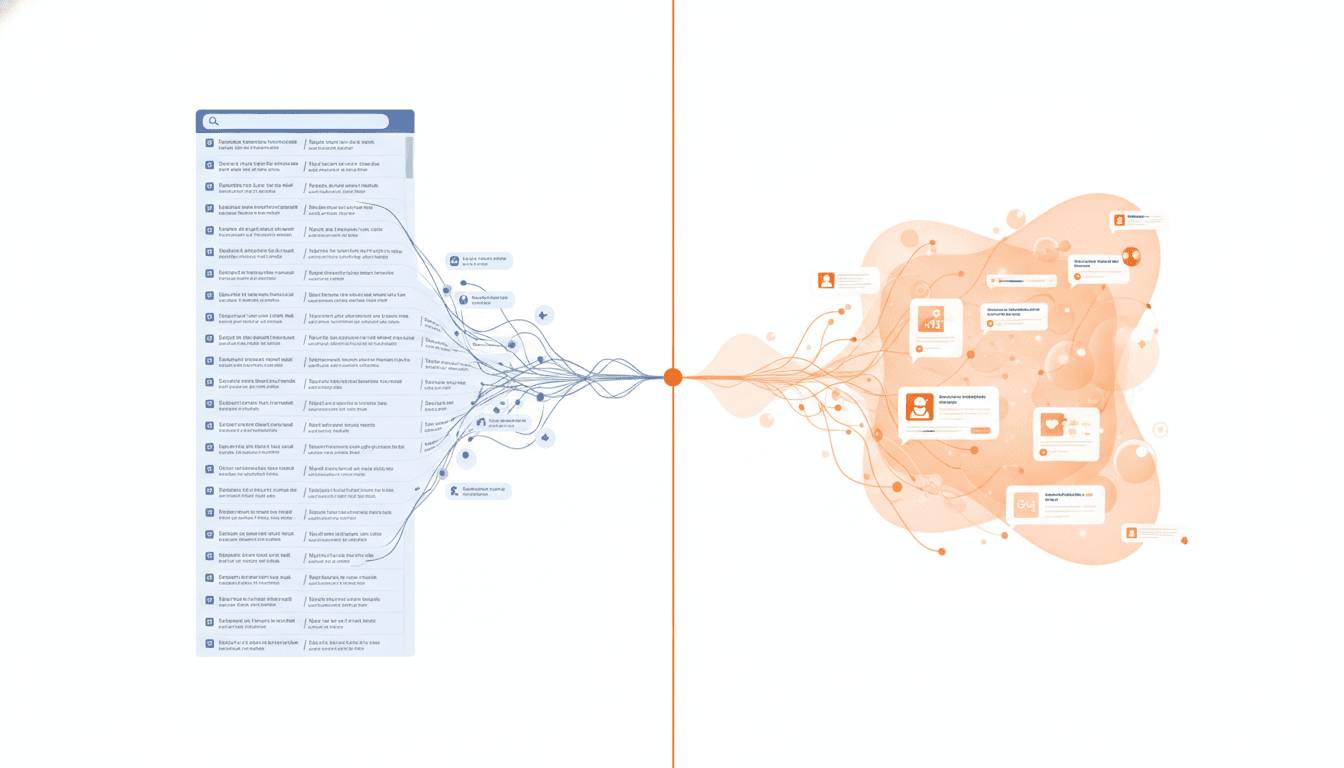
AI search analytics is an emerging discipline dedicated to measuring brand performance within AI-powered search environments. Unlike traditional SEO, which focuses on keyword rankings, backlinks, and organic traffic, AI search analytics captures how brands are mentioned, recommended, and cited in AI-generated responses.
-
Traditional SEO tools monitor:
- Keyword positions in search engine results pages (SERPs)
- Backlink profiles and domain authority
- Organic website traffic and click-through rates
-
AI search analytics tracks:
- Brand mentions and recommendations within AI assistant outputs
- Context and prominence of citations in generative responses
- Frequency and accuracy of product references by AI systems
This distinction is critical. According to the BrightEdge Generative Search Survey, 57% of AI-powered shopping queries yield product recommendations that differ from traditional SEO-driven top results. Consequently, brands that once dominated SERPs may become invisible—or alternatively, suddenly prominent—when consumers rely on AI assistants for shopping.
“AI search analytics are essential for brands aiming to understand how AI assistants interpret, recommend, and surface their products to consumers,” explains Dr. Mia Chen, Chief Data Scientist at Hexagon. Traditional SEO metrics cannot fully capture the way AI systems synthesize, summarize, and reorder brand information based on user intent.
Supporting this shift, the recent AI Marketing Technology Report reveals that 78% of e-commerce marketers now consider tracking AI brand visibility as important as monitoring organic search rankings. AI search analytics bridges the visibility gap left by classic tools by:
- Capturing brand exposure in conversational and generative query environments
- Measuring recommendation share and prominence within AI-generated lists
- Identifying opportunities and threats overlooked by legacy SEO tracking
For e-commerce leaders, this marks the dawn of a new measurement era—where AI-driven interactions shape the path to purchase.
Key Metrics That Matter in AI Search Analytics
[IMG: Dashboard mockup showing brand mention share, AI recommendation frequency, and citation accuracy metrics]
Success in the AI-powered search ecosystem depends on tracking metrics that go beyond traditional SEO. AI search analytics introduces new, actionable KPIs that illuminate brand performance within generative engines and virtual assistants.
Key metrics include:
- Brand mention share: The percentage of AI-generated responses referencing or recommending your brand
- Recommendation frequency: How often your products appear in top AI recommendations or buying guides
- Prominence within responses: The position or emphasis of your brand in AI outputs (e.g., first-mentioned, highlighted, or cited as “best”)
- Citation accuracy: The correctness and clarity of brand references within complex conversational answers
Tracking these AI-specific KPIs is more than curiosity—it’s a proven growth driver. According to Hexagon Case Studies, brands that monitor and optimize AI search analytics have achieved a 42% increase in AI-driven sales.
Additional AI-specific metrics include:
- Share of voice in AI-generated shopping lists and recommendations
- Entity recognition accuracy (ensuring products are correctly identified and described)
- Contextual sentiment of AI responses mentioning your brand
“With generative engines reshaping product discovery, measuring brand visibility in AI outputs is no longer optional—it’s essential,” emphasizes Jordan Kahn, VP of Product at BrightEdge.
These metrics translate into tangible benefits:
- Enhanced brand recall: Keeping your brand top-of-mind during AI-powered shopping journeys
- Higher conversion rates: Increased relevance in AI recommendations drives more qualified traffic and purchases
- Greater resilience to algorithmic shifts: Visibility in AI outputs tends to be more stable than traditional SEO rankings
By monitoring these KPIs, e-commerce brands align their marketing strategies with how consumers actually search, discover, and buy in today’s AI-driven environment.
The Rise of Generative Engine Optimization (GEO) for E-Commerce
[IMG: Flowchart illustrating GEO process from content optimization to AI response monitoring]
Generative Engine Optimization (GEO) represents the next frontier for e-commerce brands striving to capture visibility within AI-powered search results. GEO focuses on optimizing brand assets for AI assistants and generative engines—ensuring product data, reviews, and content are structured for maximum relevance in conversational and intent-driven queries.
Unlike classic SEO, which prioritizes keyword targeting and link building, GEO emphasizes:
- Conversational relevance: How well your brand answers nuanced, voice-driven prompts
- Recommendation share: The likelihood your products appear in AI-generated lists or summaries
- Entity accuracy: Ensuring AI models correctly identify and describe your products
“Traditional SEO metrics don’t capture the full influence AI systems have on product discovery. AI search analytics fills that gap,” states Alex Monroe, Director of AI Strategy at Forrester.
GEO requires monitoring metrics such as:
- AI answer share (frequency of your brand’s inclusion in AI responses)
- Citation presence (inclusion and prominence of your brand)
- Product entity accuracy (correctness of descriptions and attributes)
The impact of GEO is measurable: the Forrester AI Commerce Report found that brands leveraging AI search analytics identify new product search trends three times faster than those relying solely on traditional SEO.
GEO complements and extends classic search optimization by:
- Adapting to conversational and multi-modal search behaviors
- Capturing long-tail queries and intent signals overlooked by keyword-based tools
- Future-proofing e-commerce brands as generative engines reshape the digital buying journey
Looking forward, GEO will become a core pillar of competitive e-commerce strategy.
Top Tools for Measuring E-Commerce AI Visibility and Performance
[IMG: Comparative table of Hexagon, BrightEdge Copilot, and MarketMuse AI analytics features]
As AI search analytics takes center stage in e-commerce, specialized platforms have emerged to help brands measure, optimize, and act on these new KPIs. Leading the field is Hexagon, whose AI-powered analytics suite is purpose-built to track brand visibility, recommendation share, and citation accuracy across generative engines.
Hexagon’s platform offers:
- Real-time monitoring of brand mentions in AI assistant responses
- Dashboard visualizations of recommendation frequency and prominence
- Entity accuracy tracking to ensure correct product representation
- Competitive benchmarking across AI-powered shopping environments
Other notable tools include:
- BrightEdge Copilot: Integrates generative search analytics with traditional SEO dashboards; highlights AI brand visibility and response share
- MarketMuse: Focuses on content optimization for AI and generative engines; tracks how content is summarized and cited by AI systems
Comparison highlights:
- Hexagon: Deep vertical focus on e-commerce, real-time AI response tracking, advanced intent analytics
- BrightEdge Copilot: Broad SEO plus AI visibility suite with cross-channel reporting
- MarketMuse: Content-centric, strong for AI-driven content optimization
According to the Gartner Digital Commerce Hype Cycle, 63% of e-commerce brands plan to adopt AI search analytics platforms by 2025.
These tools empower marketers to:
- Track unique AI-driven metrics such as brand mention share, recommendation prominence, and citation accuracy
- Detect emerging product and shopping trends in real time
- Benchmark performance against competitors in evolving AI-powered environments
Ready to put these insights to work? Book your personalized Hexagon demo today.
Leveraging AI Search Analytics to Monitor Consumer Intent and Emerging Trends
[IMG: Timeline chart showing trend emergence detected by AI search analytics vs. traditional SEO]
AI search analytics revolutionizes how e-commerce brands monitor and respond to consumer intent. By analyzing nuanced prompts, conversational queries, and generative AI responses, brands access real-time intent data far richer than traditional SEO allows.
AI analytics enables next-level intent tracking by:
- Capturing precise questions, pain points, and preferences from user-AI interactions
- Surfacing emerging product trends and demand signals as they appear in generative search outputs
- Identifying shifts in sentiment and purchase drivers across customer segments
For instance, AI search analytics platforms have allowed brands to identify new product trends three times faster than traditional SEO methods, according to the Forrester AI Commerce Report.
Key advantages include:
- Real-time detection: Quickly see which products, features, or use cases are trending in AI-powered shopping journeys
- Intent mapping: Align product development and marketing with the actual language and interests of your audience
- Proactive strategy: Respond to emerging trends before competitors adjust their campaigns
“AI search analytics provide unique intent data by capturing the nuanced queries and conversational prompts users present to AI assistants,” highlights the AI Marketing Technology Report.
Brands leveraging AI-powered trend detection will outpace those relying on slower, traditional SEO insights—turning real-time consumer intent into a decisive first-mover advantage.
Uncovering New Opportunities and Competitive Threats with AI Analytics
[IMG: Heatmap visualizing competitive brand share in AI assistant recommendations]
AI search analytics is not only about visibility—it’s a powerful tool for uncovering growth opportunities and detecting competitive threats. By continuously monitoring how brands are referenced, ranked, and recommended by AI systems, marketers can spot shifts in consumer preferences and competitor positioning early.
AI analytics reveals what traditional tools miss by:
- Detecting rising competitors gaining share in AI-generated shopping lists before they impact SERPs
- Identifying product categories or features newly emphasized in AI assistant responses
- Surfacing negative sentiment or citation errors that could damage brand reputation
For example, a brand might discover a competitor frequently recommended for “eco-friendly running shoes” in AI responses, despite similar sustainability credentials. Traditional SEO tools would miss this dynamic, but AI analytics makes these shifts visible in real time.
Proactive strategies include:
- Adapting messaging and product positioning to emerging consumer preferences
- Launching targeted campaigns to reclaim or grow recommendation share in AI outputs
- Collaborating cross-functionally to correct citation errors and improve entity accuracy
Monitoring AI-driven search performance enables e-commerce brands to stay ahead of threats and seize opportunities—delivering agile, data-driven marketing in a rapidly evolving landscape.
Integrating AI Search Analytics with Broader E-Commerce Performance Tracking
[IMG: Unified dashboard showing AI analytics, sales, customer behavior, and inventory metrics]
To fully unlock AI search analytics’ potential, integration with broader performance data is essential. Leading e-commerce brands combine AI visibility metrics with sales, customer behavior, and inventory insights to build holistic dashboards that fuel actionable decisions.
A unified measurement framework involves:
- Combining AI brand visibility and recommendation data with sales conversion rates to identify which AI-driven exposures translate into revenue
- Overlaying intent and trend analytics with customer journey mapping to pinpoint high-value audiences and optimize touchpoints
- Integrating inventory and supply chain data to respond swiftly when AI analytics reveal surging demand for specific products
This comprehensive approach enables brands to:
- Quickly assess AI-driven recommendations’ impact on sales velocity and inventory turnover
- Align marketing and merchandising strategies with real-world demand captured via AI assistants
- Set and track AI-specific KPIs supporting broader business objectives
Looking ahead, merging AI search analytics with traditional performance tracking will be key to maximizing ROI and sustaining competitive advantage in an AI-first world.
Case Studies: Impact of AI-Specific KPI Monitoring on Sales Performance
[IMG: Before-and-after bar chart illustrating sales growth following AI KPI adoption]
The shift to AI search analytics is not theoretical—it delivers measurable results for leading e-commerce brands. Companies adopting AI-specific KPI monitoring report significant gains in visibility and sales.
Case Study 1: Apparel Brand
- Challenge: Strong traditional SEO rankings but underrepresentation in AI assistant shopping lists
- Solution: Implemented Hexagon’s AI search analytics, focusing on brand mention share and recommendation prominence KPIs
- Result: Achieved a 42% increase in AI-driven sales within six months as brand exposure surged in generative shopping responses
Case Study 2: Consumer Electronics Retailer
- Challenge: Missed early signals of shifting product demand via traditional SEO tools
- Solution: Used AI search analytics to track emerging intent data and real-time trend shifts
- Result: Launched targeted campaigns aligned with new AI-driven queries, boosting engagement and securing first-mover advantage
Key lessons and best practices:
- Monitoring AI-specific KPIs enables faster, more informed marketing pivots
- Aligning content with conversational, intent-driven queries improves both AI and human search performance
- Regular benchmarking against competitors in AI outputs uncovers hidden threats and opportunities
Brands tracking these advanced KPIs aren’t just keeping pace—they’re setting the standard for success in the AI-driven e-commerce era.
Conclusion: The Future of E-Commerce Measurement is AI-Driven
Generative engines and AI assistants are transforming how consumers discover and purchase products, changing the rules of e-commerce measurement. While traditional SEO metrics remain valuable, they cannot capture the full spectrum of brand visibility and influence in AI-powered environments.
AI search analytics empowers brands to:
- Monitor real-time brand presence, recommendation share, and citation accuracy in generative responses
- Detect emerging trends, shifts in consumer intent, and competitive threats faster than ever before
- Integrate AI insights with sales and customer data for holistic, actionable performance tracking
“The shift to AI search means e-commerce brands must move beyond keyword rankings and focus on conversational relevance and recommendation share,” advises Priya Patel, Senior Analyst at Gartner.
Looking forward, brands embracing AI search analytics will unlock new growth opportunities, drive higher sales, and cultivate lasting customer loyalty in the age of generative commerce.
Ready to future-proof your e-commerce performance? Schedule a consultation with Hexagon’s AI marketing experts and discover how to lead in the AI-driven era.
[IMG: Hexagon logo with tagline “AI-Powered Marketing for E-Commerce Excellence”]
Hexagon Team
Published March 12, 2026