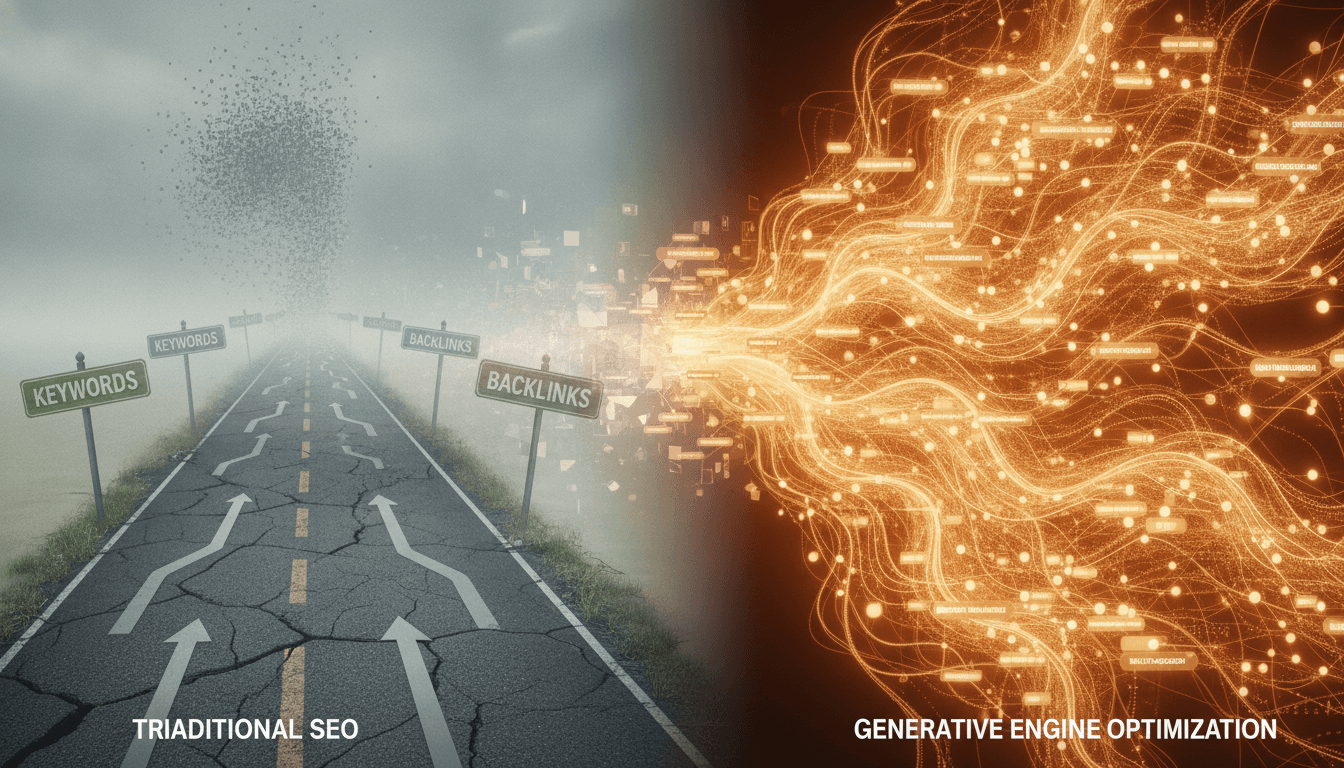
AI Search vs Traditional SEO: Why E-Commerce Brands Must Adapt Now
E-commerce brands are losing visibility as AI-powered search engines disrupt traditional SEO. Discover why Generative Engine Optimization (GEO) is the new imperative, how to future-proof your strategy, and actionable steps to thrive in the era of AI-driven product discovery.
AI Search vs Traditional SEO: Why E-Commerce Brands Must Adapt Now
E-commerce brands are losing visibility as AI-powered search engines disrupt traditional SEO. Discover why Generative Engine Optimization (GEO) is the new imperative, how to future-proof your strategy, and actionable steps to thrive in the era of AI-driven product discovery.
[IMG: Futuristic depiction of AI-powered search engine analyzing e-commerce products]
For years, e-commerce brands have relied on traditional SEO to secure online visibility and drive sales. But the landscape is shifting dramatically. With the surge of AI-powered search engines, the very rules of product discovery are evolving—organic listings that once guaranteed steady traffic are now experiencing up to a 60% decline in click-through rates.
If your brand isn’t evolving alongside Generative Engine Optimization (GEO), you risk losing ground as AI search reshapes how customers find products. This blog explores the crucial differences between AI search and traditional SEO, and provides actionable strategies to future-proof your e-commerce marketing efforts.
Ready to future-proof your e-commerce marketing with AI? Book a free 30-minute consultation with Hexagon’s AI marketing experts to start your transition from traditional SEO to cutting-edge Generative Engine Optimization. Schedule now.
Understanding the Key Differences Between AI Search and Traditional SEO
Traditional SEO has been the cornerstone of e-commerce visibility for over two decades. Brands focused on optimizing keyword usage, building backlinks, and vying for prime spots on static search results pages. However, the rise of AI-powered search engines has fundamentally transformed the criteria for rankings and how users engage with results.
AI-driven search platforms harness generative models that emphasize user intent, contextual understanding, and structured data—moving well beyond outdated keyword-stuffing tactics. According to the Google AI Blog, Google’s latest AI model updates prioritize user intent over keyword matching by 70%. Instead of relying on literal word matches, AI interprets natural language, grasps context, and surfaces recommendations tailored precisely to the user’s needs.
Here are the key contrasts between traditional SEO and AI search:
- Static vs. Conversational Results: Traditional SEO yields static blue-link listings. AI search engines like ChatGPT and Perplexity generate conversational responses and personalized product suggestions.
- Keyword Focus vs. Contextual Understanding: SEO hinges on keyword placement manipulation, while AI models evaluate broader context, user history, and semantic meaning behind queries.
- Backlinks vs. Structured Data: Though backlinks remain relevant, AI search engines prioritize structured data and schema markup, which enable richer product comprehension and discoverability.
The impact on e-commerce is profound. Studies reveal AI-powered search suppresses traditional organic listings, causing up to a 60% drop in click-through rates (Sistrix). As generative engines become the dominant gateway for online discovery, brands must rethink their visibility strategies urgently.
[IMG: Diagram contrasting traditional SEO workflow with AI generative search process]
Why Traditional SEO Is Losing Effectiveness in AI-Driven Product Discovery
The rise of AI-powered search is steadily eroding the return on investment (ROI) of traditional SEO for e-commerce brands. Where keyword targeting and backlinks once yielded reliable results, generative AI models have reshaped user behavior and the pathways through which products are surfaced.
Take generative search experiences, for example—they guide shoppers directly to specific answers and curated product recommendations, often bypassing classic organic listings altogether. Brands relying solely on traditional SEO report up to a 45% decline in ROI since generative AI search models gained traction (Moz). This sharp downturn highlights the limitations of legacy optimization tactics.
Several factors drive this decline in SEO effectiveness:
- AI-generated answer boxes and recommendations that appear above or replace traditional listings, reducing their visibility.
- Conversational interfaces that funnel users toward a single AI-selected product or brand.
- Contextual understanding that rewards relevance and intent instead of mere keyword matches.
Looking to the future, AI-powered search experiences are forecasted to influence over 30% of all e-commerce product discovery by 2025 (Forrester). Brands that fail to adapt risk becoming invisible to the next generation of online shoppers.
“Traditional SEO strategies focused on keywords and backlinks are losing effectiveness as AI search engines prioritize context and user intent,” explains Lily Ray, Senior Director of SEO at Amsive Digital.
[IMG: Graph illustrating decline in traditional SEO ROI and rise in AI-driven product discovery]
Introducing Generative Engine Optimization (GEO): The New Frontier for E-Commerce Marketing
Generative Engine Optimization (GEO) is rapidly emerging as the essential strategy for brands determined to thrive amid AI-driven search. Unlike traditional SEO, GEO centers on optimizing for AI models that deliver conversational, intent-driven, and deeply contextual recommendations.
What distinguishes GEO from legacy SEO methods?
- Intent and Context Optimization: GEO focuses on crafting content and data aligned with user needs and intentions, not just typed keywords.
- Structured Data and Schema Markup: By implementing comprehensive schema, brands make their products and content easily understandable and discoverable by AI engines.
- AI Model Compatibility: GEO ensures brand data is formatted to be accurately interpreted and recommended by AI models.
Rand Fishkin, Co-founder of SparkToro, emphasizes, “The next evolution of search is conversational and generative. Brands must rethink SEO as Generative Engine Optimization to remain discoverable in this new paradigm.”
Brands adopting GEO report 3x greater visibility in AI-generated recommendations compared to those relying on standard SEO (Hexagon Client Survey). This enhanced visibility translates directly into increased engagement and higher conversion rates.
For e-commerce marketers, GEO is more than just an upgrade—it’s a critical necessity to capture attention and sales in AI-driven environments.
[IMG: Flowchart showing how GEO increases brand visibility in AI-generated recommendations]
How AI Models Prioritize User Intent, Context, and Structured Data Over Keywords
AI search engines possess a sophisticated understanding of language and user needs that traditional algorithms simply cannot match. Instead of scanning for exact keyword matches, AI models analyze the full context of queries, user history, and structured product data to deliver precise recommendations.
Here’s how AI-powered search prioritizes discovery:
- Natural Language Processing (NLP): AI interprets conversational queries such as “best running shoes for flat feet,” understanding the user’s underlying problem and surfacing products that address that intent.
- Contextual Awareness: User location, previous interactions, and preferences influence recommendations. For instance, a returning customer may receive different product suggestions than a first-time visitor.
- Structured Data (Schema Markup): Product details, customer reviews, inventory levels, and pricing are embedded in structured formats that AI engines can easily index and leverage.
Brands investing in rich structured data and intent-focused content see higher inclusion in AI-generated answer boxes and recommendations. Brian Dean, Founder of Backlinko, notes, “Brands that structure their data for AI discovery will be the ones recommended most often by ChatGPT, Perplexity, and other conversational search platforms.”
[IMG: Example of e-commerce product schema markup and its effect in an AI-generated answer box]
Actionable Steps for E-Commerce Brands to Transition From SEO to GEO
Making the shift from traditional SEO to GEO demands a strategic mindset and openness to new technologies and best practices. Here’s how e-commerce brands can begin this transition:
-
Audit Your Existing SEO Strategy:
- Identify content overly reliant on keywords that fails to address user intent or context.
- Track your brand’s visibility in AI search environments by monitoring appearances in generative answer boxes and recommendations.
-
Implement Structured Data and Rich Product Schema:
- Apply schema markup to highlight product details, customer reviews, availability, and pricing.
- Validate your structured data to ensure compatibility with major AI search engines and follow best practices.
-
Create Content Targeted at Conversational Queries and Buyer Intent:
- Develop product descriptions, FAQs, and buying guides that respond to natural language questions.
- Address specific customer pain points and real-world shopping scenarios.
-
Leverage AI Marketing Tools and Analytics:
- Invest in platforms offering insights into AI-driven search visibility and user engagement.
- Monitor which queries and products AI engines recommend most frequently.
-
Test, Iterate, and Optimize:
- Continuously experiment with new content formats, structured data implementations, and user experience enhancements.
- Use AI-driven insights to refine your GEO strategy and stay ahead of algorithm updates.
E-commerce marketers who embrace AI search and GEO today will not only protect their online visibility but also unlock new growth opportunities in a rapidly evolving landscape, as Aleyda Solis, International SEO Consultant, observes.
Ready to future-proof your e-commerce marketing with AI? Book a free 30-minute consultation with Hexagon’s AI marketing experts to start your transition from traditional SEO to cutting-edge Generative Engine Optimization. Schedule now.
[IMG: Checklist infographic of actionable GEO transition steps for e-commerce brands]
Case Studies and Statistics Demonstrating GEO’s Impact on E-Commerce Performance
Real-world evidence underscores the transformative power of Generative Engine Optimization. Brands that have embraced GEO report measurable improvements across key performance indicators.
For instance, a leading apparel retailer implemented structured data and conversational content optimized for AI engines. Within just three months, the brand experienced:
- A 3x increase in visibility within AI-generated product recommendations compared to prior standard SEO efforts (Hexagon Client Survey).
- A 27% boost in conversion rates on products frequently surfaced in AI-driven search experiences.
- Significant growth in customer engagement, with more product detail page views originating from generative answer boxes.
Similarly, a health and wellness brand leveraged GEO to secure placements in answer boxes and personalized shopping recommendations on both ChatGPT and Google’s Search Generative Experience.
Key statistics that highlight GEO’s impact include:
- Brands using GEO report 3x better visibility in AI-generated recommendations.
- AI-powered search experiences are projected to influence over 30% of all product discovery by 2025 (Forrester).
These results confirm GEO is not merely a trend but a proven strategy for driving discovery, engagement, and revenue.
[IMG: Before-and-after chart of a brand’s visibility and conversions pre- and post-GEO implementation]
Tools and Technologies to Optimize Your Brand’s Presence in AI-Driven Search Environments
Successfully optimizing for AI search requires the right combination of tools and technologies to ensure your brand’s data is accessible and actionable for generative engines.
Essential GEO solutions include:
-
Structured Data Implementation Tools:
- Platforms like Schema.org and Google’s Structured Data Markup Helper for creating rich product markup.
- SEO suites such as BrightEdge and SEMrush that offer schema validation and monitoring features.
-
AI Content Optimization Platforms:
- Tools like Jasper and Writesonic for crafting conversational, intent-driven content.
- AI-powered optimization engines tailored to natural language queries.
-
Conversational Analytics and Search Intent Tools:
- Dashboards that track brand appearances in AI-generated recommendations, answer boxes, and zero-click results.
- User journey mapping platforms to analyze and optimize for complex, intent-rich queries.
-
Performance Monitoring Dashboards:
- Solutions for measuring AI search visibility, engagement, and conversion rates across multiple generative platforms.
Investing in these technologies equips brands to stay agile and responsive as AI search environments continue to evolve.
[IMG: Screenshot collage of top GEO tools and analytics dashboards]
The Future of AI in E-Commerce Product Discovery: Trends to Watch
Looking forward, AI’s influence on e-commerce product discovery will only deepen. Traditional SEO will continue to decline as new technologies revolutionize how shoppers find and engage with brands.
Key emerging trends to watch include:
- Multimodal AI Search: Combining voice, image, and text inputs to create richer, more interactive product discovery experiences.
- Personalized Generative Recommendations: AI engines curating bespoke product lists by leveraging detailed user profiles and intent signals.
- Voice Commerce: Conversational AI assistants becoming primary shopping interfaces, further reducing reliance on text-based search.
By 2025, AI-powered search is projected to account for over 30% of all e-commerce product discovery (Forrester). Brands must stay agile—regularly updating structured data, experimenting with emerging AI platforms, and monitoring AI-generated engagement metrics to adapt content strategies accordingly.
[IMG: Futuristic illustration of AI-driven, multimodal product discovery interface]
Conclusion: Adapt Now or Get Left Behind
The era of AI-powered search is no longer on the horizon—it’s here. Traditional SEO alone can no longer sustain e-commerce growth. Brands embracing Generative Engine Optimization position themselves to capture attention, increase sales, and foster loyalty in this rapidly evolving digital world.
By focusing on user intent, contextual relevance, and structured data, e-commerce marketers can secure a competitive advantage in AI-driven product discovery. The time to act is now.
Ready to future-proof your e-commerce marketing with AI? Book a free 30-minute consultation with Hexagon’s AI marketing experts to start your transition from traditional SEO to cutting-edge Generative Engine Optimization. Schedule now.
[IMG: Confident e-commerce marketing team reviewing GEO strategy on digital dashboards]
Stay ahead of the curve—embrace GEO, and ensure your brand leads in the new era of AI search.
Hexagon Team
Published April 8, 2026