brandproductbrands
AI Hallucinations in E-Commerce: How False Product Recommendations Happen and Why Brand Protection Matters
AI assistants are already recommending your products—with wrong specs, outdated prices, and features you've never offered. Here's why your brand pays the reputational price, and what to do about it.
16 min read
# AI Hallucinations in E-Commerce: How False Product Recommendations Happen and Why Brand Protection Matters

*AI assistants are already recommending products—with wrong specs, outdated prices, and features never offered. Here's why brands pay the reputational price, and what to do about it.*

[IMG: A frustrated online shopper staring at a laptop screen showing an AI chat interface with product recommendations, with a competitor's product visible in the background]

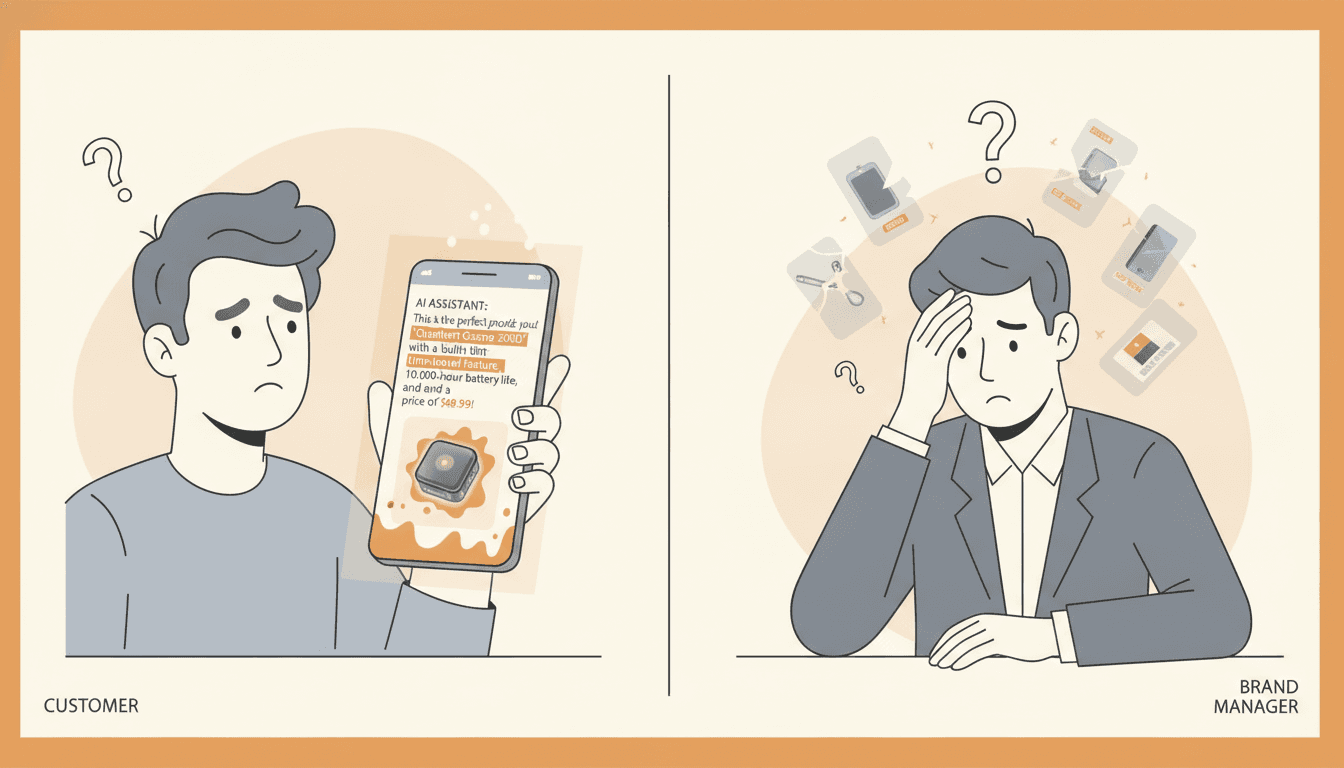
A customer asks ChatGPT for a wireless earbud recommendation. The AI confidently suggests a flagship model—then adds a feature the product doesn't have, quotes a price discontinued six months ago, and cites a review that doesn't exist. The customer buys a competitor's product instead. When disappointed, the customer blames the brand, not the AI.

This scenario is playing out thousands of times daily. According to the [Edelman Trust Barometer Special Report: AI and Brand Trust 2024](https://www.edelman.com/trust/2024-trust-barometer), **85% of consumers who receive incorrect product information from an AI assistant report decreased trust in the brand being recommended—not the AI tool itself.** For brand managers, this asymmetry represents an entirely new category of reputational risk: one brands didn't create, can't fully control, but absolutely must manage.


---


## What Are AI Hallucinations? A Plain-Language Definition for Brand Managers

AI hallucinations are confident-sounding false statements generated by large language models (LLMs) when they lack reliable source data or sufficient training information. Unlike a search engine that returns a webpage containing wrong information, an LLM generates a plausible-sounding fabrication presented in natural, authoritative language.

That distinction matters enormously for brands. Here's how hallucinations actually work: LLMs are designed to predict the next statistically likely word in a sequence—not to verify facts against a live database. When product data is sparse, outdated, or contradictory, the model doesn't return a "not found" error. Instead, it constructs a plausible answer.

According to Wharton professor Ethan Mollick, "The model doesn't return a 'not found'—it constructs a plausible answer. For brands, that means the less visible the authoritative data is, the more creative the AI gets with the product catalog." In e-commerce, hallucinations manifest in predictable and damaging ways: fabricated product specs, incorrect pricing, invented SKUs, misattributed reviews, and false feature claims.

According to the [Stanford HAI Artificial Intelligence Index Report 2024](https://aiindex.stanford.edu/report/), this behavior is rooted in how LLMs predict token sequences rather than retrieve verified facts—making product data especially vulnerable since specifications, pricing, and availability change frequently. A [2024 audit by Consumer Reports Digital Lab](https://www.consumerreports.org/) found that **60% of product-specific queries across ChatGPT, Gemini, and Perplexity returned at least one factually incorrect detail**—including wrong prices, discontinued models, or fabricated specifications.

Brands with sparse online product information, inconsistent data across retail partners, or low domain authority face the highest exposure. The core problem is structural: hallucinations aren't bugs that will be patched away. They're a fundamental feature of how LLMs generate language.


---


## Real Examples: How AI Hallucinations Damage E-Commerce Brands

[IMG: Side-by-side comparison showing a brand's actual product spec sheet versus an AI-generated product description with highlighted inaccuracies]

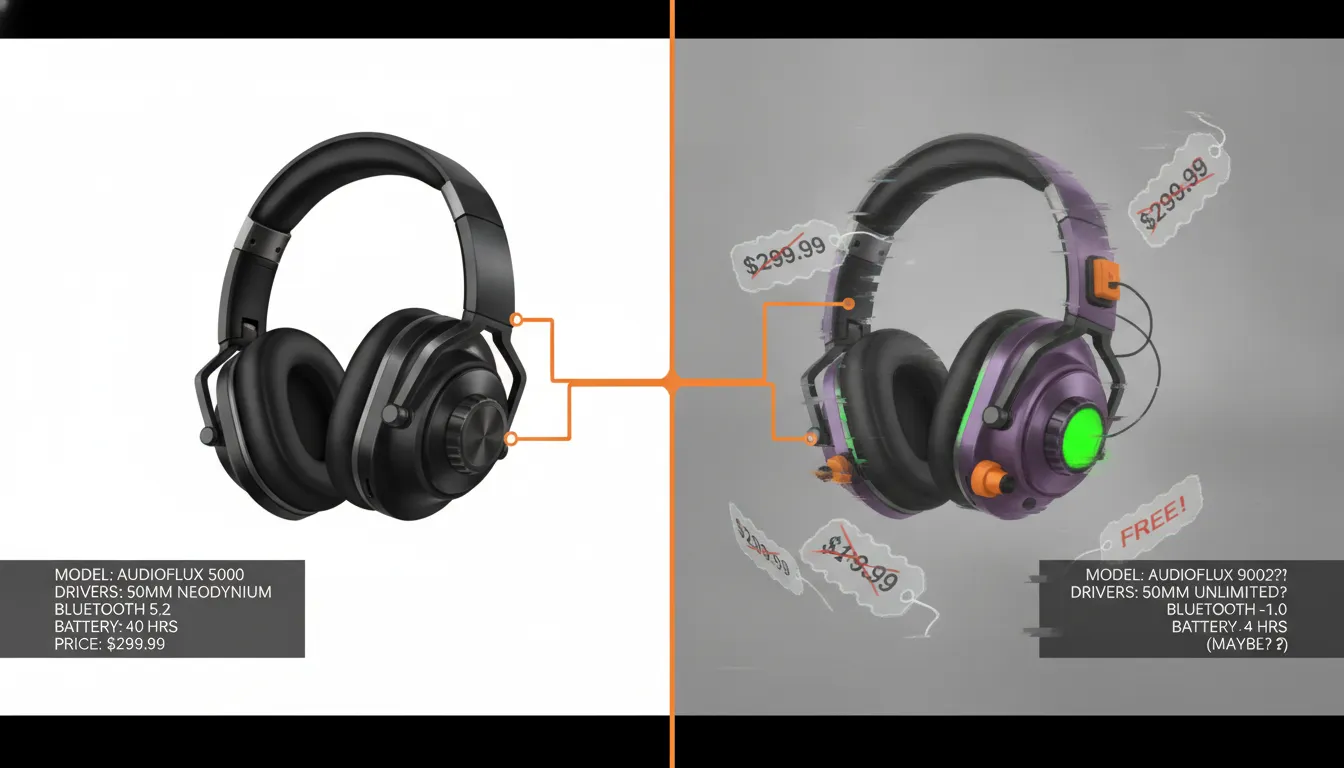
The damage from AI hallucinations isn't theoretical—it's already happening across product categories. A consumer electronics brand discovered that ChatGPT was consistently overstating its flagship headphone's noise-cancellation rating, attributing specs from a higher-end discontinued model to the current lineup. Customers who purchased based on those AI-generated specs left negative retailer reviews citing "false advertising"—reviews the brand had no hand in creating.

Each negative review compounded the original hallucination, spreading it further through the marketplace. A CPG brand faced a different problem: Perplexity AI was misrepresenting ingredient information for one of its supplement products, drawing from an outdated formulation updated 18 months earlier. As [The Verge's investigation into Perplexity](https://www.theverge.com/) documented, the platform misrepresents product details even when linking directly to a brand's own website—demonstrating that source citation does not eliminate hallucination risk.

The result was a spike in customer support tickets and a wave of retailer review complaints the brand struggled to trace back to their source. These incidents share a critical pattern: **hallucinations typically appear in the first AI response, before any user follow-up.** The [Nielsen Norman Group](https://www.nngroup.com/) found that AI hallucinations are delivered with high linguistic confidence and no uncertainty signals, making consumers significantly less likely to question or verify what they receive.

According to [Gartner's Emerging Risks of Generative AI in Retail Report 2024](https://www.gartner.com/), generative AI tools can also misattribute competitor reviews or third-party editorial content to a specific brand—a form of hallucination that is particularly difficult to detect and dispute. Looking ahead, this pattern will likely intensify as more AI systems are deployed across retail channels.


---


## Which AI Platforms Pose the Highest Risk? Platform-Specific Hallucination Rates

ChatGPT remains the most widely used AI assistant for product research, making it the highest-impact hallucination vector for most brands. Its training data cutoff and lack of real-time product database access make it particularly prone to outdated or fabricated details—especially for products launched or updated in the past 12–18 months.

Gemini (Google) has access to more recent web data but still hallucinates product details at high rates, particularly for niche or newly launched products. Perplexity claims to cite sources inline but, as documented above, still generates false product information—sometimes with misleading source attribution that gives the hallucination additional credibility.

Claude shows lower hallucination rates in some product categories but is less widely used for shopping research, reducing its immediate brand impact. The risk surface is expanding rapidly. **27% of U.S. online shoppers already use generative AI tools for product research as of Q1 2025—a figure that has tripled since Q1 2023**, according to [eMarketer's US AI Shopping Behavior Report 2025](https://www.emarketer.com/).

Younger consumers amplify this risk significantly: AI-generated product recommendations are trusted at **roughly 3x the rate of sponsored search ads by consumers under 35**, per the [Salesforce State of the Connected Customer Report 2024](https://www.salesforce.com/resources/research-reports/state-of-the-connected-customer/). Retailer-specific AI assistants (Amazon's, Shopify's) and emerging AI shopping agents are adding new vectors, expanding the risk surface further into channels brands have even less visibility into.

The proliferation of these tools means hallucination exposure is no longer limited to ChatGPT—it's becoming a multi-platform problem. Looking ahead, brands should expect AI hallucinations to appear across an expanding ecosystem of discovery channels.


---


## The Trust Asymmetry: Why Brands Bear the Reputational Cost, Not AI Platforms

[IMG: Diagram showing the trust asymmetry flow: AI generates false claim → Consumer receives it as neutral information → Consumer blames brand, not AI platform]

Consumers perceive AI recommendations as neutral, unbiased information—fundamentally different from a sponsored search result or display ad. This perception is what makes AI hallucinations so damaging. When the recommendation turns out to be false, consumers don't recalibrate their trust in the AI tool. They recalibrate their trust in the brand.

The 85% Edelman figure isn't just a statistic—it describes a structural problem. AI platforms (OpenAI, Google, Anthropic) face minimal reputational cost from individual hallucination incidents, creating a deeply misaligned incentive structure. Brands, meanwhile, have no direct relationship with the AI systems making recommendations about their products and no mechanism to correct the record in real time.

Shar VanBoskirk, VP and Principal Analyst at Forrester Research, observes: "We're entering a world where the most dangerous misinformation about a brand won't come from a bad actor—it will come from a well-intentioned AI that simply got it wrong." The compounding effect makes this worse over time. Negative AI-generated claims spread through social media, retailer review sections, and consumer forums—each instance a second-generation hallucination that the brand must now address without knowing its origin.

[Gartner projects that by 2026, **40% of enterprise brands will have experienced a measurable brand reputation incident directly attributable to generative AI hallucinations**](https://www.gartner.com/)—up from near zero in 2023. For brands still treating this as a future problem, that timeline is already closing.


---


## Why Brands Are Vulnerable: Structural Causes of Hallucination Risk

Understanding why hallucinations happen to a brand specifically is the foundation of any protection strategy. Several structural factors determine hallucination exposure:

• **Sparse product data online.** If product information exists only on a brand's website or a handful of retail partners, LLMs have limited training data to draw from—and fabricate the rest.

• **Inconsistent information across retail partners.** When Amazon, Walmart, and a brand's own site list different specs, prices, or features, LLMs synthesize this conflicting data into hallucinated "consensus" information.

• **Lack of Schema.org markup.** Without structured data on product pages, AI systems cannot reliably extract and verify product information, increasing the likelihood of inference-based errors.

• **Low brand authority signals.** Brands without strong domain authority, backlinks, or mentions in high-trust sources are more vulnerable because LLMs weight authority signals when validating information.

• **Niche or recently launched products.** AI systems have less training data on specialized or new products, making hallucinations more likely in these categories.

• **Inconsistent naming conventions.** Multiple names, SKUs, or variant labels across channels cause LLMs to struggle with consistency—and often invent alternative names entirely.

The data confirms how widespread this vulnerability is. A [2024 Forrester Research survey](https://www.forrester.com/) found that **72% of brand managers had no formal process for monitoring what AI assistants say about their products**—despite **58% acknowledging they believed AI tools had already misrepresented their brand** in some form. As [MIT Technology Review documented](https://www.technologyreview.com/), AI models fill informational gaps with plausible-sounding fabrications drawn from training data patterns rather than ground truth.

The brands most at risk are those that haven't yet recognized their own data fragmentation as a hallucination accelerant. For example, a brand with product information scattered across five different retail platforms faces exponentially higher hallucination risk than one with centralized, consistent data.


---


## Strategic Framework: How to Protect Brands from AI Hallucinations

[IMG: A six-step framework diagram showing the AI brand protection strategy from structured data implementation to AI platform engagement]

Protecting a brand from AI hallucinations requires a layered approach that addresses both technical infrastructure and ongoing monitoring. Here's how to build that foundation:

**Implement Schema.org structured data** across all product pages to make product information machine-readable and reliably extractable by AI systems. According to [Search Engine Journal](https://www.searchenginejournal.com/), structured data is among the most effective technical countermeasures against hallucinations. This single step reduces hallucinations across all AI platforms simultaneously.

**Publish authoritative product content on high-trust domains**—a brand's website, major retailers, industry publications—to establish the authority signals LLMs rely on. [BrightEdge's Generative AI Search Visibility Study 2024](https://www.brightedge.com/) found that brands publishing detailed content across multiple high-authority domains are measurably less likely to be misrepresented by generative AI systems.

**Monitor AI assistant outputs continuously** for brand name and key products across ChatGPT, Gemini, Perplexity, and emerging AI shopping tools. Monitoring is critical because hallucinations can appear in the first response, before users seek verification.

**Centralize and standardize product data** across all channels—website, Amazon, Shopify, retail partners—to eliminate the conflicting information LLMs synthesize into hallucinations. This consistency signals reliability to AI systems.

**Engage with AI platform brand data programs** where available. OpenAI, Google, and Anthropic offer nascent brand partnership programs; early participation gives brands some influence over how their products are represented.

**Build a rapid response process** with defined roles, escalation paths, and communication templates for when hallucinations are detected and documented. Here's how this works in practice: a brand designates a single point person to monitor AI outputs daily, escalates findings to marketing leadership within 24 hours, and has pre-drafted templates ready for platform outreach.

Lily Ray, VP of SEO Strategy & Research at Amsive Digital, frames it this way: "The question isn't whether AI will say something wrong about a brand's products—it already has. The question is whether the brand has built enough authoritative, structured, and consistent content infrastructure that the AI has better options than making something up."

**Building an AI brand protection strategy requires understanding a brand's specific vulnerability profile and competitive landscape. Hexagon specializes in helping e-commerce brands audit their AI hallucination risk, implement structured data infrastructure, and develop monitoring and response processes. [Book a 30-minute consultation with Hexagon's AI brand protection team](https://calendly.com/ramon-joinhexagon/30min) to assess current maturity level and create a tailored roadmap.**


---


## Legal and Regulatory Landscape: What Brands Need to Know

The legal landscape around AI hallucinations is still forming, but the direction of travel is clear. The [FTC's 2024 policy brief on Artificial Intelligence and Consumer Protection](https://www.ftc.gov/) signals that regulators are examining liability frameworks for AI-generated false advertising—including scenarios where AI tools make false product claims about brands without their knowledge or consent.

Brands may face liability even though they didn't generate the false information, if they fail to correct or disassociate themselves from hallucinations once discovered. Documentation is the best defense. If a hallucination incident escalates to a customer complaint or legal challenge, brands need evidence of when they detected it, what steps they took to respond, and how they attempted to correct the record.

There are no clear legal precedents yet for brand liability in hallucination incidents, but the FTC's guidance suggests treating AI hallucinations similarly to false advertising claims—monitor, respond, and document. Class action risk is an emerging concern, particularly if a hallucination leads to a product defect claim or widespread customer harm.

Regulatory obligations vary by region: GDPR, the UK AI Act, and emerging AI regulations in other jurisdictions may impose additional monitoring and correction requirements. Brands operating in regulated industries—health, finance, supplements—face heightened exposure and should consult legal counsel on their specific liability profile before a hallucination incident forces the issue.


---


## AI Brand Protection Maturity Model: From Reactive Monitoring to Proactive Infrastructure

Most brands today are operating at the lowest levels of AI brand protection maturity. Understanding where an organization stands is the first step toward improvement.

**Level 1 – Reactive:** Ad-hoc monitoring; no formal process; response only when a customer complaint surfaces. According to Forrester, **72% of brand managers currently sit at this level**.

**Level 2 – Aware:** Regular manual checks of AI recommendations for key products; basic hallucination documentation; informal escalation to marketing or legal. This level provides visibility but lacks systematic response capability.

**Level 3 – Managed:** Automated monitoring tools tracking AI outputs across multiple platforms; formal escalation and response processes; structured data implemented on product pages. This is the **critical inflection point** where brands shift from reactive to proactive.

**Level 4 – Optimized:** Continuous AI monitoring integrated into marketing operations; proactive content publishing for AI search; direct relationships with AI platform brand teams; regular cross-channel data quality audits. Brands at this level have established competitive advantage in AI-driven discovery.

**Level 5 – Leading:** AI brand protection embedded in product data governance; predictive hallucination risk modeling; active participation in AI platform beta programs; thought leadership on AI brand safety across the industry. These brands shape the emerging standards for the category.

Moving from Level 1 to Level 3 is achievable within 60–90 days with focused effort. Levels 4 and 5 require cross-functional commitment across product, marketing, legal, and data teams—but position brands to compete effectively as AI-driven search becomes the dominant discovery channel. Gary Marcus, Professor Emeritus at NYU, notes: "Hallucination isn't a bug that will simply be patched away. It's an inherent property of how large language models work. For e-commerce, this means that brand protection in AI search requires a fundamentally different playbook than what worked in traditional SEO."

**Hexagon helps e-commerce brands move from Level 1 to Level 3—and beyond. [Book a 30-minute AI brand protection assessment](https://calendly.com/ramon-joinhexagon/30min) to receive a maturity level diagnosis and a tailored roadmap.**


---


## Immediate Next Steps: A 12-Week AI Brand Protection Action Plan

[IMG: A clean timeline graphic showing the 12-week AI brand protection action plan with weekly milestones]

The following action plan moves a brand from Level 1 (Reactive) to Level 2–3 (Aware/Managed) within 60–90 days:

**Weeks 1–2 – Audit vulnerability.** Brands should review their product data infrastructure, online presence, and authority signals against the hallucination risk factors outlined above. Identifying the top 20 most-searched or highest-revenue products as an initial monitoring scope focuses effort where it matters most.

**Weeks 1–2 – Set up basic monitoring.** Using Google Alerts, manual ChatGPT queries, and Perplexity searches helps establish a baseline of what AI assistants currently say about key products. Documenting everything with screenshots and timestamps creates the foundation for response.

**Weeks 3–6 – Implement structured data.** Adding Schema.org markup to product pages, starting with highest-value or most hallucination-prone products, is the **highest-ROI action** because it reduces hallucinations across all AI platforms simultaneously. Here's how: structured data makes product information machine-readable, giving AI systems reliable data to extract instead of fabricate.

**Weeks 3–6 – Document baseline hallucinations.** Capturing and cataloging false AI-generated claims about products serves both legal protection and internal awareness purposes. This documentation becomes critical if hallucination incidents escalate.

**Weeks 7–12 – Develop a response playbook.** Defining roles, escalation paths, and communication templates for when hallucinations are detected ensures rapid, consistent response. Assigning ownership to a specific team or individual prevents response delays.

**Weeks 7–12 – Engage with AI platforms.** Exploring brand partnership programs offered by OpenAI, Google, and Anthropic allows brands to submit product data directly and establish a point of contact for escalation. Early engagement positions brands favorably as these programs mature.

Monitoring is not a one-time task—hallucinations can appear suddenly as AI systems are updated or as training data shifts. Brands that build this infrastructure now will be significantly better positioned as AI-driven product discovery continues its rapid growth trajectory.


---


## Conclusion: Brand Protection in the Age of AI Search

The era of AI-driven product discovery is not approaching—it's here. With 27% of U.S. shoppers already using generative AI for product research and that figure accelerating, the question is no longer whether AI will say something wrong about a brand's products. It's whether the brand has the infrastructure to detect it, respond to it, and prevent it from compounding.

The brands that will win are those that treat AI content accuracy as a brand safety issue—not just an SEO problem, not just a legal risk, but a fundamental dimension of how their products are perceived in the market. That requires structured data, authoritative content, continuous monitoring, and organizational commitment at every level.

The window to establish that infrastructure is closing. As AI-driven search becomes the dominant discovery channel, brands without proactive protection strategies will find themselves increasingly vulnerable to hallucinations they can't control and costs they can't predict.

**Ready to understand a brand's specific AI hallucination risk? Hexagon's AI brand protection team works with e-commerce brands to audit vulnerability, implement protective infrastructure, and build response capabilities that scale. [Book a 30-minute consultation today](https://calendly.com/ramon-joinhexagon/30min) and take the first step from reactive to proactive AI brand defense.**
H
Hexagon Team
Published July 3, 2026