brandproducthallucinations
AI Hallucinations Explained: How False Product Recommendations Happen and Why Brand Protection Matters
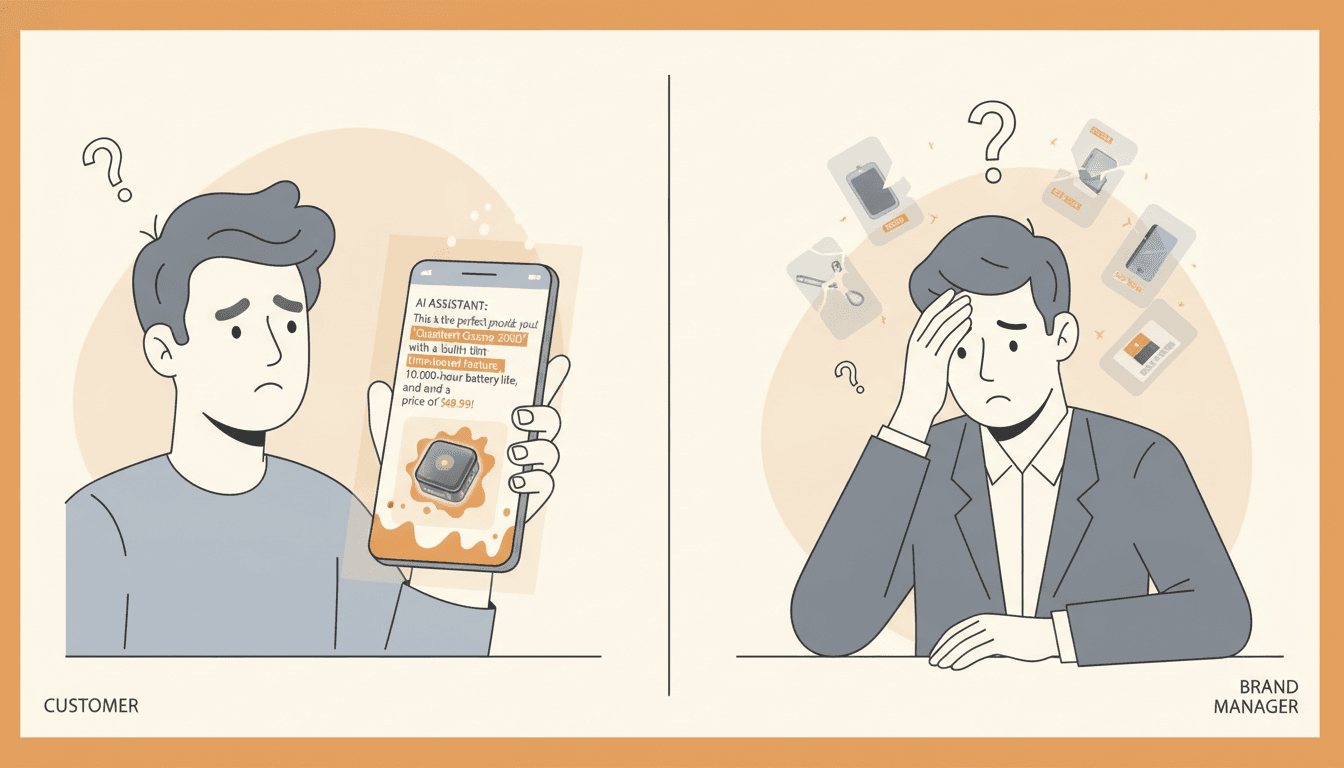
A customer asks an AI assistant about your best-selling product. The AI confidently recommends a variant that doesn't exist, at a price you've never charged. The customer blames your brand. Here's what every brand leader needs to know—and do—right now.
15 min read
# AI Hallucinations Explained: How False Product Recommendations Happen and Why Brand Protection Matters

A customer asks an AI assistant about a brand's best-selling product. The AI confidently recommends a variant that doesn't exist, at a price the brand has never charged. The customer blames the brand—not the AI. Here's what every brand leader needs to know—and do—right now.

[IMG: A frustrated consumer looking at a smartphone screen showing an AI chat interface with product recommendations, with a blurred e-commerce storefront in the background]

## The Real Cost of AI Getting Products Wrong

A customer searches ChatGPT for a best-selling product. The AI recommends a variant that doesn't exist, with pricing completely disconnected from reality. The customer feels misled and leaves a negative review.

The problem is clear: the customer blames the brand, not the AI. According to [Salesforce research](https://www.salesforce.com/resources/research-reports/state-of-the-connected-customer/), **46% of consumers would lose trust in a brand** over this mistake—even though the brand had nothing to do with creating it.

This isn't a hypothetical scenario anymore. It's happening right now, across every major AI platform, to brands in every industry. As AI influences an estimated **$3.1 trillion in global e-commerce transactions by 2030**, the stakes have become impossible to ignore.


---


## What Are AI Hallucinations? A Plain-Language Definition

AI hallucinations are false or fabricated pieces of information that AI language models generate with complete confidence. They are presented in the same polished, authoritative tone as accurate information. This phenomenon of **"confident wrongness"** makes it especially difficult for consumers to distinguish a hallucinated recommendation from a legitimate one, according to [Harvard Business Review](https://hbr.org/2024/01/managing-ai-misinformation-risk).

Large language models (LLMs) don't work like databases. They don't retrieve facts. Instead, they predict the statistically most likely next word, or "token," based on patterns in their training data.

Arvind Narayanan, Professor of Computer Science at Princeton University and co-author of *AI Snake Oil*, explains the mechanism: *"These models are pattern-completion engines. When asked about a specific product, they will generate a fluent, confident answer by interpolating from everything they have seen—whether or not any of those specific details are true. For brands, that is a fundamentally new kind of reputational risk."*

Product recommendations are especially vulnerable to this dynamic. SKU-level data—exact model numbers, pricing, color variants, availability windows—is highly specific, constantly changing, and often sparse in AI training data. When the model encounters a gap in its knowledge, it fills it with a plausible-sounding answer.

According to a [2024 evaluation by Vectara](https://vectara.com/), approximately **60% of responses from leading AI assistants contained at least one factual inaccuracy** in product-related queries. The model isn't lying—it's doing exactly what it was designed to do: generate fluent text. The problem is that fluent text and accurate text are not the same thing.


---


## The Four Hallucination Patterns That Hurt E-Commerce Brands

[IMG: A four-quadrant graphic illustrating the four hallucination patterns: Phantom Products, Specification Drift, Provenance Confusion, and Temporal Staleness, with simple icons for each]

Not all AI hallucinations look the same. [MIT Technology Review](https://www.technologyreview.com/) identifies at least four distinct patterns that cause measurable harm to e-commerce brands. Understanding each pattern is the first step toward defending against it.

**Phantom Products** occur when the AI invents SKUs, model numbers, or product variants that never existed. This often happens when the model blends attributes from multiple similar products or extrapolates from partial training data. [BrightEdge research](https://www.brightedge.com/) found that **27% of AI-generated product recommendations** referenced SKUs or bundles that couldn't be verified as purchasable through any major retail channel.

A customer follows the recommendation, finds nothing, and assumes the brand is disorganized or deceptive. The damage to brand reputation is immediate and measurable.

**Specification Drift** is subtler but equally damaging. The product exists, but the AI gets the details wrong—incorrect color, wrong size range, outdated pricing, or fabricated feature sets. Specification drift is especially common for pricing and availability, which change frequently and are harder for AI systems to track accurately.

A customer sees a recommended price that's 40% lower than what the brand actually charges. The customer gets excited, then feels cheated when reaching the brand's site. The trust is broken before any transaction occurs.

**Provenance Confusion** happens when the AI attributes a brand's product to a competitor, or credits a competitor's product to the brand. According to [Search Engine Land](https://searchengineland.com/), this pattern has been documented redirecting purchase intent to rival brands without either company's knowledge.

The misrepresented brand loses a sale. The competitor gets credit for another brand's product. Both brands suffer reputational damage.

**Temporal Staleness** occurs when discontinued products appear as currently available, or outdated pricing is presented as current. Here's how this plays out: an AI recommends a "limited edition" product variant that was discontinued 18 months ago, complete with a price point the brand no longer offers.

The customer can't find it anywhere, assumes it's out of stock, and moves on to a competitor. For consumers, the journey ends in a dead link, a confused support call, or a negative review—all directed at the brand, not the AI platform.


---


## Why AI Hallucinations Happen: The Technical Roots (Explained Simply)

Understanding the mechanics behind hallucinations doesn't require a computer science degree. The core issue is straightforward: **LLMs generate what sounds right, not what is right.** Every response is a statistical prediction, not a fact retrieval.

The [Stanford HAI AI Index Report 2024](https://aiindex.stanford.edu/) confirms that this is a structural byproduct of how language models are built, not a flaw that can be patched with a simple update.

Training data cutoffs compound the problem significantly. AI models are trained on data collected up to a specific date. Products launched, discontinued, or repriced after that cutoff are invisible to the model—or worse, partially visible in ways that create hybrid, inaccurate representations.

According to [OpenAI's GPT-4 Technical Report](https://openai.com/research/gpt-4), this "hallucination by staleness" is a persistent structural issue distinct from pure confabulation. The model simply doesn't know what it doesn't know.

Thin or fragmented brand content creates an additional vulnerability. Brands with inconsistent, sparse, or poorly structured digital footprints give AI models less authoritative signal to work with. The model then fills information gaps with statistically probable inferences.

[Gartner research](https://www.gartner.com/) found that **brands with fragmented digital footprints experience hallucination rates approximately 3x higher** than those with comprehensive, structured product data. The investment in data quality pays immediate dividends.

Even Retrieval-Augmented Generation (RAG)—the architecture used by Perplexity and Bing Copilot to ground answers in live web data—reduces but does not eliminate hallucinations. [Anthropic's research](https://www.anthropic.com/research) demonstrates that RAG is a mitigation strategy, not a cure.


---


## The Business Impact: Lost Revenue, Brand Damage, and Compliance Risk

The business consequences of AI hallucinations extend well beyond a single frustrated customer. Shar VanBoskirk, VP and Principal Analyst at [Forrester Research](https://www.forrester.com/), frames the stakes clearly: *"The AI layer between a consumer and a brand becomes the most influential touchpoint in the purchase journey. If that layer gets the product wrong—wrong price, wrong feature, wrong availability—the sale is lost and potentially the customer, and it may never be known it happened."*

The consumer trust data makes this concrete. **46% of consumers would lose trust in a brand** after receiving incorrect AI recommendations about that brand's products—even when the brand had no role in generating that content. With **58% of U.S. consumers aged 18–44 now using AI assistants to research products** (up from 31% in 2023, per [Edelman's AI Consumer Behavior Survey](https://www.edelman.com/)), the audience exposed to potential hallucinations is massive and growing rapidly.

This isn't a future concern. It's happening to target demographics right now.

Legal and compliance exposure adds another layer of urgency. The [FTC's updated guidelines](https://www.ftc.gov/legal-library/browse/rules/guides-concerning-use-endorsements-testimonials-advertising) on AI-generated endorsements and the EU AI Act both create potential liability for brands whose products are materially misrepresented by AI systems—even when the brand didn't create the content.

Kristin Cohen, Former Chief Privacy Officer at the FTC Bureau of Consumer Protection, states it plainly: *"Hallucination in commercial contexts isn't just a technical curiosity—it's a liability event waiting to happen. If an AI tells a consumer that a supplement has an ingredient it doesn't have, or that a device is compatible with a system it isn't, there's potential FTC exposure and consumer harm claims regardless of who generated the content."*

The liability is real. The reputational damage is immediate. The window to act is closing.


---


## Real-World Examples: Where AI Hallucinations Are Happening Now

[IMG: Side-by-side screenshots (illustrated/mockup) showing AI assistant responses with highlighted inaccuracies in product descriptions, pricing, and availability]

AI hallucinations in product recommendations are not rare edge cases. They are occurring across every major AI platform—ChatGPT, Perplexity, Google AI Overviews, and Bing Copilot—and across every major retail category. The [2024 Vectara evaluation](https://vectara.com/) of five leading AI assistants found that **approximately 60% of responses contained at least one factual inaccuracy**, spanning incorrect pricing, unavailable variants, wrong specifications, and non-existent SKUs.

In practice, this looks like:

- AI assistants recommending discontinued camera models as "best current options"
- Inventing color variants of popular shoe lines that brands have never manufactured
- Attributing competitor products to major brand names
- Listing prices that are 30–50% off from actual current pricing
- Recommending products with features that don't exist

These aren't isolated incidents—they represent systematic patterns that emerge when training data is sparse, outdated, or contradictory. Hallucinations are measurably more frequent in niche or specialized product categories where training data is thinner.

The [Baymard Institute's AI Commerce UX Research](https://baymard.com/) confirms the downstream impact: when a consumer follows an AI recommendation to a non-existent product, the resulting journey ends in a dead link, a confused support interaction, or a negative review—all attributed to the brand, not the AI platform.

Unlike traditional SEO errors, hallucinated AI recommendations exist within model weights or dynamically generated responses. [The Verge notes](https://www.theverge.com/) that brands have **no direct mechanism to "correct" a false recommendation** once a model is deployed. The model keeps generating the same hallucination, for every customer, indefinitely—until the model is retrained.


---


## The Brand Protection Framework: Four Steps to Reduce Hallucinations

Brands are not powerless. Here's how to systematically reduce hallucination rates and protect brand integrity across AI platforms.

**Step 1: Implement Structured Data**

Deploy [Schema.org](https://schema.org/) Product schema (JSON-LD markup) across all owned digital channels. Structured data gives AI systems direct access to authoritative product information—correct pricing, availability, specifications, and reviews. [Google Search Central](https://developers.google.com/search/docs/appearance/structured-data/intro-structured-data) identifies this as one of the most effective technical countermeasures available to brands.

When a website speaks in a language AI systems understand, hallucination likelihood drops dramatically. The investment in markup pays immediate dividends across multiple channels.

**Step 2: Audit Content Consistency**

Ensure product information is synchronized across the brand's website, e-commerce platforms, marketplace listings, and retail partner data feeds. Inconsistencies between channels create conflicting signals that AI models blend into inaccurate composites.

Jim Yu, Founder and Executive Chairman of [BrightEdge](https://www.brightedge.com/), puts it plainly: *"The signal sent to these models today determines the recommendations consumers receive tomorrow."* A single source of truth is no longer just good practice—it's a competitive necessity.

**Step 3: Monitor AI Mentions Actively**

Set up ongoing monitoring for how AI assistants describe a brand and its products. This is not a passive exercise—brands must actively query AI platforms for their top products, document hallucinations, and track patterns over time.

AI mention monitoring should be integrated into brand management workflows, not treated as a one-time audit. Assign ownership. Create alerts. Make it someone's job to know what AI is saying about the brand's products.

**Step 4: Engage with Platforms**

Use the feedback mechanisms available on ChatGPT, Perplexity, Google, and Bing to report documented inaccuracies and submit corrected product data. Most major AI platforms now offer these mechanisms, and proactive engagement increases the likelihood that corrections will be incorporated into future model updates.

It's not guaranteed—but silence guarantees nothing will change. Persistence and documentation matter.


---


## The "It's Not My Fault" Misconception: Why Brands Still Bear the Risk

Many brand leaders assume that because they didn't create the hallucinated content, they bear no responsibility for it. This assumption is both legally and reputationally incorrect.

**46% of consumers blame the brand—not the AI platform—when they receive false product recommendations.** Reputational damage occurs regardless of who generated the false information. The consumer doesn't care that OpenAI wrote the text.

The legal landscape reinforces this reality. The FTC's guidance on AI and endorsements extends to AI-generated product recommendations. The EU AI Act holds both deployers and providers of AI systems jointly accountable for accuracy and transparency.

Brands that fail to correct documented hallucinations may face increased regulatory scrutiny. Emerging lawsuits from consumers harmed by AI-driven product misrepresentation are beginning to test these frameworks in court.

Passive monitoring is insufficient. Insurance policies may not cover reputational damage from AI hallucinations if brands failed to implement reasonable safeguards. This creates both financial and strategic exposure for organizations that treat this as someone else's problem.

Unlike traditional media misrepresentation, there is no clear third party to hold accountable when an AI platform generates false product information. The brand absorbs the consequence. The sooner this reality is accepted, the sooner action can begin.


---


## The Strategic Imperative: Why AI Accuracy Is Now a Core Brand Function

[IMG: A forward-looking visual showing a brand's digital data flowing into AI platforms, with structured, authoritative signals creating accurate consumer recommendations—contrasted with fragmented data creating hallucinations]

The scale of what's at stake demands a strategic response, not a tactical one. Generative AI is projected to influence **$3.1 trillion in global e-commerce transactions by 2030**—representing more than 10% of global e-commerce, per [McKinsey & Company](https://www.mckinsey.com/capabilities/quantumblack/our-insights/the-state-of-ai).

With **58% of consumers aged 18–44 already using AI assistants for product research**, the audience affected by hallucinations is not a niche segment—it is the core buying demographic. Managing AI accuracy is transitioning from a "nice-to-have" to a core function of brand management.

Early-adopting brands that establish structured data frameworks, content consistency protocols, and active AI monitoring will set the competitive standard. Those that wait for regulation to finalize will face higher remediation costs and greater reputational exposure than those acting now.

Regulatory frameworks from the FTC and the EU AI Act are still evolving, but the direction is unambiguous: brands will be held accountable for AI misrepresentation of their products. The brands that move first won't just protect themselves—they'll establish the baseline that becomes industry standard.

Looking ahead, this is a strategic investment with compounding returns. The structured data, content consistency, and AI engagement practices that reduce hallucinations today also strengthen organic search performance, improve retail partner data quality, and build the information architecture that future AI systems will depend on.

The brands that treat AI accuracy as a competitive moat—not an IT housekeeping task—will be the ones that win in AI-driven commerce.


---


## Getting Started: Your AI Hallucination Audit Checklist

This audit can be completed in **2–4 weeks** depending on portfolio size. Most hallucinations are discoverable through straightforward manual testing. Here's where to begin:

**Audit Current AI Representation**

Search for the top 20 products in ChatGPT, Perplexity, Google AI Overviews, and Bing Copilot. Record exactly what each platform says. Screenshot everything. A baseline is essential for tracking progress.

**Document Hallucinations**

Note any false pricing, unavailable variants, wrong specifications, or phantom products. Categorize by hallucination type (phantom, drift, provenance, staleness). Look for patterns—do certain product categories hallucinate more frequently? Do certain platforms perform worse?

**Assess Structured Data**

Verify whether the website uses Schema.org Product markup with accurate, current pricing and availability signals. Run the site through [Google's Rich Results Test](https://search.google.com/test/rich-results). Are products being properly marked up?

**Review Content Consistency**

Compare product information across the website, marketplace listings, retail partner pages, and data feeds. Identify and resolve conflicts. This is tedious work—but it's foundational.

**Set Up Ongoing Monitoring**

Create alerts for AI mentions of the brand and key products. Assign ownership within the brand or marketing team. Make it a recurring task, not a one-time project.

**Engage with Platforms**

Report documented hallucinations through each platform's feedback mechanism. Keep records of submissions and any corrections observed. Follow up. Be persistent.

**Develop a Response Protocol**

Build a repeatable process for identifying, documenting, escalating, and resolving AI hallucinations. Structured data implementation typically takes **4–12 weeks** depending on technical complexity, so starting now is critical.

Ongoing monitoring is not a one-time project. It is a permanent addition to the brand management function—as essential as monitoring reviews, social mentions, or earned media.


---


## The Path Forward

AI hallucinations are not a technical problem that will solve itself. They're a business problem that requires strategic attention, ongoing investment, and cross-functional coordination. The brands that act now—that implement structured data, audit their digital consistency, and monitor their AI representation—will emerge as the leaders in AI-driven commerce.

Those that wait will pay the price in lost sales, damaged trust, and regulatory exposure. The choice is clear. The time to act is now.


---


*Hexagon helps brands establish authoritative AI representation through structured data strategy, content consistency audits, and proactive AI platform engagement. [Book a free 30-minute AI hallucination assessment today.](https://calendly.com/ramon-joinhexagon/30min)*
H
Hexagon Team
Published July 18, 2026