brandbrandsproduct
Understanding AI Hallucinations in E-Commerce: How False Recommendations Happen and Brand Protection Strategies
AI assistants are now shaping purchase decisions for millions of shoppers—but when they get your brand wrong, you pay the price. Here's what every e-commerce brand manager needs to know about AI hallucinations, why they happen, and the proven framework to protect your brand's reputation.
17 min read
---


# Understanding AI Hallucinations in E-Commerce: How False Recommendations Happen and Brand Protection Strategies

*AI assistants are now shaping purchase decisions for millions of shoppers—but when they get a brand wrong, the cost is significant. This guide explains what AI hallucinations are, why they happen, and the proven framework to protect brand reputation in the AI search era.*

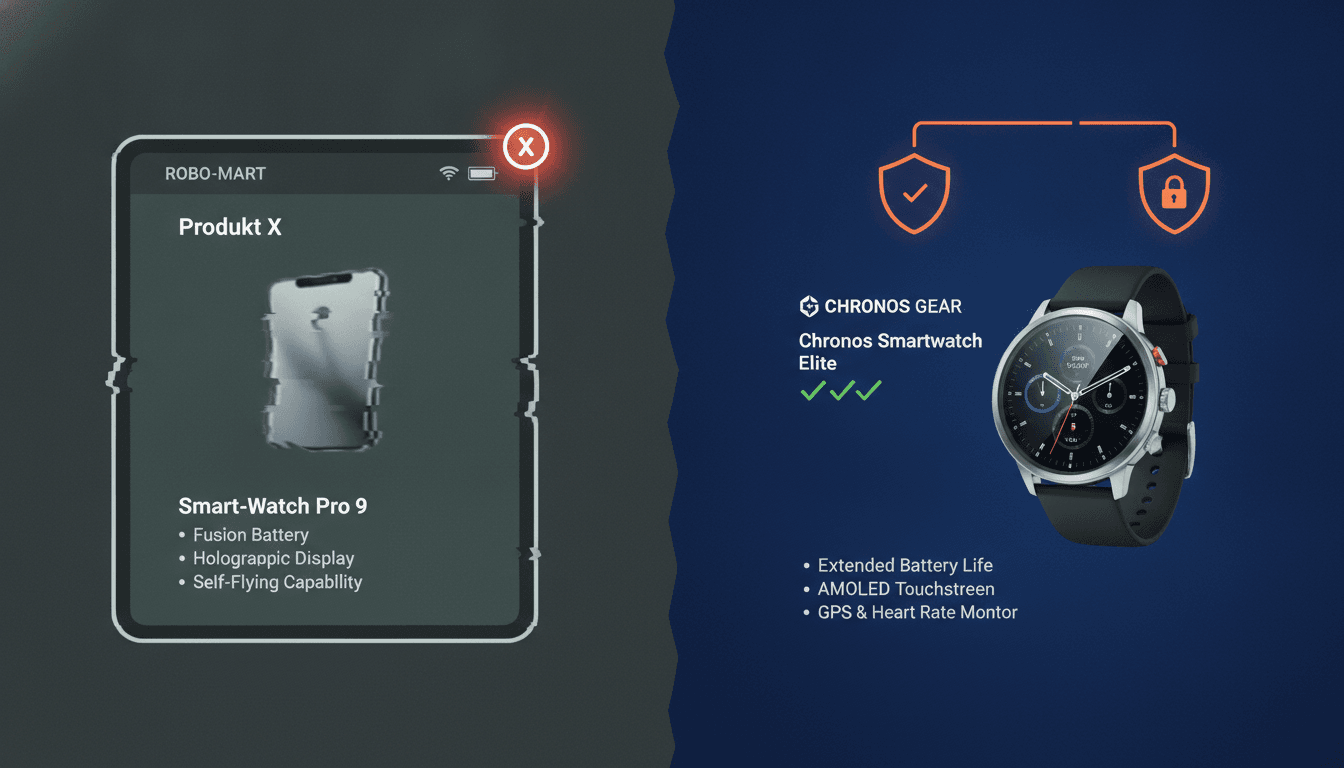
[IMG: A split-screen illustration showing a customer reading an AI chatbot recommendation on one side and a confused brand manager reviewing inaccurate product descriptions on the other, with a visual representation of data gaps and misinformation]


---


## The Real Cost of AI Getting Your Brand Wrong

A customer asks ChatGPT for wireless headphone recommendations and receives a detailed response about a brand's "noise-canceling technology with military-grade encryption." The problem is that the product has neither feature. The customer buys a competitor's product instead—and leaves a one-star review blaming the brand for misleading information.

This scenario is no longer hypothetical. It's happening right now, at scale.

An estimated [35% of U.S. online shoppers](https://www.emarketer.com) now use AI assistants to inform at least some of their purchasing decisions, meaning false AI recommendations have become a critical brand risk reaching millions of potential customers simultaneously. Most brands have no visibility into—or control over—what AI systems are saying about their products.

The asymmetry is brutal: when an AI assistant confidently recommends a product with fabricated features, the customer blames the *brand*, not the AI. The AI gets a pass. The brand takes the hit.

This guide reveals what AI hallucinations actually are, why they're happening to brands specifically, and the practical framework to protect reputation before the damage compounds.


---


## What Are AI Hallucinations and Why Should E-Commerce Brands Care?

AI hallucinations occur when large language models generate plausible-sounding but factually incorrect information. According to the [Stanford HAI AI Index Report 2024](https://aiindex.stanford.edu), this happens because models fill gaps in their training data with statistically likely—but wrong—outputs. The result is confident, fluent fabrications that are indistinguishable from accurate information to the average customer.

Here's how the problem manifests: hallucinations are not a temporary bug waiting to be patched. Andrej Karpathy, Former Director of AI at Tesla and Co-founder of OpenAI, frames it directly: "Hallucination is not a bug that will simply be patched away—it is a fundamental characteristic of how large language models generate text. The models are optimized to produce fluent, plausible responses, not necessarily true ones." For brands, this means the risk is structural and ongoing.

E-commerce is uniquely vulnerable to this problem. Product data is fragmented across dozens of platforms, constantly changing with new SKUs and pricing updates, and often not fully indexed by AI training datasets. This creates a perfect storm: AI systems encounter incomplete information about products and fill the gaps with invented details—with complete confidence.

The scale is significant and measurable:

- **18%** of AI-generated shopping recommendations contain inaccuracies, including incorrect product specifications, outdated pricing, or misattributed brand features ([Hexagon AI Commerce Accuracy Study](https://joinhexagon.com))
- **35%** of U.S. online shoppers now use AI assistants for purchasing decisions ([eMarketer AI Commerce Adoption Report](https://www.emarketer.com))
- **74%** of consumers say they would stop using an AI shopping tool after receiving a single significantly inaccurate product recommendation ([PwC Consumer Intelligence Series](https://www.pwc.com))

For brand managers, these numbers represent a brand safety crisis—not a technical curiosity. The question is no longer whether AI will misrepresent products, but how prepared brands are when it does.


---


## Seven Types of AI Hallucinations That Damage E-Commerce Brands

[IMG: An infographic listing seven AI hallucination types with icons for each, showing example scenarios for a fictional consumer electronics brand]

Not all hallucinations are created equal. Understanding the specific patterns that affect e-commerce brands is essential for building targeted protection. According to [Baymard Institute's AI Product Discovery Research](https://baymard.com), common e-commerce hallucination patterns fall into seven distinct categories, each creating its own brand damage scenario.

**1. False Product Specifications**

AI systems invent features, incorrect dimensions, or wrong materials when training data is sparse. For example, a customer buys based on a fabricated spec, receives a product that doesn't match, and returns it—blaming the brand for the discrepancy.

**2. Invented Product Variants**

AI assistants confidently recommend colors, sizes, or SKUs that don't exist. Customers who attempt to purchase these phantom variants experience immediate friction and frustration, attributing the problem to poor inventory management or misleading product information.

**3. Fabricated Certifications**

AI systems generate false sustainability claims, safety certifications, or compliance badges. As [Harvard Business Review's AI Risk Management research](https://hbr.org) notes, invented certifications expose brands to significant regulatory and legal risk—not to mention customer backlash when the claims prove false.

**4. Outdated Pricing**

Large language models are trained on static datasets with knowledge cutoff dates, making pricing data especially vulnerable to staleness. When customers encounter different prices at checkout, they blame the brand for the discrepancy rather than understanding the AI's training limitations.

**5. Incorrect Availability**

AI tools tell customers a product is in stock when it has been discontinued or is temporarily unavailable. This creates immediate conversion failure, customer service escalation, and negative reviews about product availability.

**6. Misattributed Sustainability Claims**

False environmental benefits are particularly dangerous. Sustainability hallucinations expose brands to greenwashing accusations and regulatory scrutiny, even when the brand itself made no such claim. The reputational damage compounds quickly.

**7. False Competitive Comparisons**

Incorrect claims about how a product compares to competitors can trigger disputes, damage partner relationships, and mislead customers into decisions they later regret—and publicly criticize.

Each hallucination type creates distinct downstream consequences—from customer service costs to legal exposure to lost sales. Brands that understand this taxonomy are better positioned to monitor for and respond to each category systematically.


---


## The Business Impact: Why AI Hallucinations Are a Critical Risk

The reputational math on AI hallucinations is straightforward and sobering. According to the [Hexagon AI Commerce Accuracy Study](https://joinhexagon.com), AI hallucinations result in measurable brand reputation damage in roughly **12% of cases** where false recommendations are surfaced. That may sound modest until considering the scale: if 35% of shoppers use AI assistants, and 18% of those recommendations contain inaccuracies, the volume of false claims about brands is enormous.

Scott Galloway, Professor of Marketing at NYU Stern School of Business, captures the asymmetry precisely: "The challenge with AI hallucinations in commerce is asymmetric: the AI presents false information with the same confidence as true information, but the consumer's negative experience is entirely attributed to the brand. The AI gets a pass; the brand takes the hit."

This attribution problem is compounded by consumer trust fragility. While [67% of shoppers trust AI shopping assistants](https://www.pwc.com), 74% say they would stop using a retailer's AI tool after a single significantly inaccurate recommendation. One hallucination incident can eliminate a customer's future purchase consideration entirely.

The downstream effects are concrete and measurable:

- Negative reviews citing product features that don't exist
- Social media complaints about prices that don't match AI recommendations
- Customer service escalations from customers expecting discontinued variants
- Competitive disadvantage for brands with sparse data visibility
- Lost sales to competitors with cleaner, more visible product information

With 35% of online shoppers now using AI for purchasing decisions, hallucinations are not isolated incidents—they are a scalable brand risk reaching millions of potential customers simultaneously. Brands with sparse or inconsistent structured data are disproportionately exposed, creating a competitive disadvantage that compounds over time.


---


**Ready to find out what AI assistants are saying about a brand right now?** Hexagon specializes in GEO (Generative Engine Optimization) and brand protection in AI search. [Book a free 30-minute consultation](https://calendly.com/ramon-joinhexagon/30min) to assess current AI visibility and create a custom brand safety roadmap.


---


## Why Some Brands Are More Hallucination-Prone Than Others

Not all brands face equal hallucination risk. The data is clear: brands that implement structured verification signals experience approximately **40% fewer hallucination-related customer complaints** compared to brands with sparse or inconsistent structured data ([Hexagon Brand Safety Benchmark Report](https://joinhexagon.com)). The gap between prepared and unprepared brands is significant and growing.

Several factors increase hallucination vulnerability. Understanding them helps identify where brands are exposed.

**Sparse or inconsistent structured data** makes brands invisible to RAG systems (more on this below) and forces AI to generate responses from incomplete training data. When AI systems don't have reliable data to reference, they invent details to fill the gaps.

**Inconsistent brand naming across platforms**—Amazon, company websites, social media, retail partners—confuses AI entity resolution and increases fabrication likelihood. AI systems struggle to understand that "Brand Name," "Brand-Name," and "BrandName" refer to the same entity, leading to fragmented and inaccurate information synthesis.

**Lack of authoritative third-party citations** such as reviews, press coverage, and Wikipedia mentions removes the verification signals AI systems rely on. When an AI system can't find independent confirmation of product information, it's more likely to generate plausible-sounding alternatives.

**Rapidly changing product catalogs** create data staleness problems, particularly for pricing, availability, and new SKUs. If product information updates faster than AI training data, hallucinations become inevitable.

**Niche or technical products** with limited web presence provide AI systems with minimal reliable reference points. The less information available about a product category, the more room AI has to fabricate details.

As [Search Engine Journal's research on entity authority and AI search](https://searchenginejournal.com) confirms, brands with a strong, consistent presence across authoritative third-party sources are significantly less likely to be hallucinated about. Small and mid-market brands are disproportionately affected—their lower data visibility creates the exact conditions where AI systems fill gaps with invented details. The competitive disadvantage is real and measurable.


---


## How RAG Architecture Changes the Hallucination Game

[IMG: A technical diagram showing the difference between standard LLM generation and RAG-augmented generation, with arrows indicating how verified data sources feed into the RAG pipeline before a response is generated]

Retrieval-Augmented Generation (RAG) represents the most significant technical development in reducing AI hallucinations for e-commerce applications. Rather than relying solely on patterns learned during training, RAG systems ground AI responses in verified, real-time data sources before generating a response.

Here's how it works: when a customer asks an AI assistant about a product, a RAG system first retrieves relevant information from verified data sources (like product feeds or Wikipedia), then generates a response based on that information. This is fundamentally different from standard LLMs, which generate responses based entirely on training data patterns.

According to [Meta AI Research on RAG for Knowledge-Intensive NLP Tasks](https://ai.meta.com), RAG systems can reduce hallucination rates by up to **60% compared to standard LLM generation**. Major AI platforms including Perplexity and Claude with web search are increasingly deploying RAG architectures for shopping-related queries. For brands, this changes the strategic calculus significantly.

Here's what this means for brand visibility in AI search:

- RAG systems prioritize indexed, structured data sources when generating responses
- Brands not indexed by RAG-enabled tools are effectively invisible to the most accurate AI assistants
- Brands with structured data feeds are automatically more RAG-friendly and benefit from higher recommendation accuracy
- Being indexed by RAG-enabled tools is becoming as strategically important as Google indexing

Rand Fishkin, Co-founder of SparkToro, frames the strategic implication clearly: "The brands that will win in the AI search era are those that treat their product information as a living, structured asset—not a static catalog. When data is clean, consistent, and machine-readable across every authoritative touchpoint, AI systems have less room to invent things about a brand."

RAG indexing is not a passive outcome—it requires deliberate investment in structured data infrastructure. Brands that make this investment now are building a durable competitive advantage as AI becomes the primary product discovery channel.


---


## The Brand Protection Framework: 5-Step Strategy to Reduce Hallucinations

Protecting brand representation in AI systems requires a systematic, ongoing strategy. The following five-step framework reflects the approach that has delivered measurable results for brands prioritizing AI accuracy as a core brand management function.

**Step 1: Audit Current AI Representation**

Start with a baseline by querying ChatGPT, Perplexity, Claude, and other major AI assistants with product-specific questions about a brand. Document inaccuracies, fabricated features, outdated information, and missing details. This audit reveals the current hallucination landscape and identifies priority areas for remediation.

**Step 2: Implement and Maintain Structured Product Data**

Schema markup is the foundation of RAG-friendly data. Implement JSON-LD schema for products, brands, and organizational information on websites. Maintain consistent product data feeds through Google Merchant Center and manufacturer feeds to reduce data staleness and improve AI indexing.

**Step 3: Build Authoritative Third-Party Presence**

Third-party authority signals act as hallucination brakes. Invest in press coverage, industry publication mentions, review platform presence, and Wikipedia documentation for established brands. AI systems weight these signals heavily when generating responses about a brand, reducing the likelihood of fabrication.

**Step 4: Establish Ongoing AI Monitoring**

Set up monitoring processes to track how AI assistants describe products over time. Regular monitoring reveals hallucination patterns before they cause major customer-facing damage and enables proactive remediation rather than reactive crisis management.

**Step 5: Create a Rapid-Response Protocol**

When hallucinations surface, speed matters. Establish a clear process for reporting inaccuracies to AI platforms—many increasingly accept hallucination reports from brands. Rapid response prevents false information from spreading through word-of-mouth and secondary AI training cycles.

Brands that implement this framework with structured verification signals see approximately **40% fewer hallucination-related customer complaints**. The investment in structured data and third-party authority delivers measurable, compounding returns.


---


**Ready to audit a brand's AI representation and build a hallucination defense strategy?** Hexagon specializes in GEO (Generative Engine Optimization) and brand protection in AI search. [Book a free 30-minute consultation](https://calendly.com/ramon-joinhexagon/30min) to assess current AI visibility and create a custom brand safety roadmap—and learn how brands reduced hallucination-related complaints by 40% with structured data and verification signal strategies.


---


## Implementing Your Brand Protection Strategy: Practical Steps

[IMG: A step-by-step visual checklist showing the practical implementation workflow for brand protection, including schema markup, feed setup, and monitoring tool icons]

Translating the five-step framework into operational reality requires specific technical and content actions. Here's how to begin executing each component systematically.

**Structured Data Foundation**

Start with a full audit to identify gaps in schema markup, product feed consistency, and brand entity documentation. Then implement JSON-LD schema markup for all product pages, brand pages, and organizational data. Create and maintain a consistent product information feed through Google Merchant Center and manufacturer data channels.

Update product feeds regularly—data staleness is a primary hallucination driver. For example, pricing changes, new SKUs, and availability updates should be reflected in feeds within 24-48 hours of changes. This consistency directly reduces AI fabrication likelihood.

**Brand Entity Standardization**

Standardize brand naming, product naming conventions, and category taxonomy across all platforms: websites, Amazon, social media, retail partners, and review sites. Document brand entity information in a format that AI systems can reliably reference and index. Consistency across platforms dramatically reduces AI confusion and hallucination likelihood.

**Third-Party Authority Building**

Distribute press releases through authoritative channels and pursue coverage in industry publications relevant to product categories. Actively manage presence on major review platforms and ensure product information is accurate and current. For established brands, maintain and update Wikipedia entries with accurate, sourced product information.

These third-party signals act as verification checkpoints that AI systems rely on. For example, a brand mentioned in three independent industry publications is significantly less likely to be hallucinated about than a brand with no third-party coverage.

**Monitoring and Response Infrastructure**

Deploy monitoring tools to track AI assistant responses about brand products on a regular cadence—monthly at minimum, weekly for high-risk categories. Establish a clear internal workflow for logging, escalating, and reporting hallucination incidents. Document what was said, where it appeared, and what the correct information should be.

AI platforms increasingly accept hallucination reports from brands, making direct reporting a viable remediation channel. For example, OpenAI and Perplexity both provide feedback mechanisms for brands to report inaccuracies.

As [MIT Technology Review's research on how LLMs handle dynamic data](https://technologyreview.mit.edu) confirms, product information that changes frequently is especially vulnerable to hallucination. Consistent, regularly updated feeds directly reduce data staleness and the hallucination likelihood that follows.


---


## The Strategic Imperative: Why AI Accuracy Is Now Core to Brand Management

Shelly Palmer, CEO of The Palmer Group and Technology Advisor at Syracuse University, frames the strategic reality directly: "We are entering an era where the most dangerous misinformation about a brand may not come from a bad actor or a disgruntled customer—it may come from a well-meaning AI assistant that simply doesn't have accurate, up-to-date information about products. Brand protection strategies must now include AI accuracy monitoring as a core function."

AI search is becoming as important as Google Search for product discovery. With 35% of online shoppers already using AI assistants for purchasing decisions, the channel is too large and too fast-growing to treat as secondary. Brands ignoring AI hallucinations are not just accepting reputational risk—they are actively ceding market share to competitors who invest in AI accuracy infrastructure.

Looking ahead, the opportunity is equally significant. Brands with strong AI representation see measurable conversion benefits as AI assistants confidently and accurately recommend their products. Investment in structured data and verification signals delivers a **40% reduction in hallucination complaints** while simultaneously improving AI recommendation accuracy and frequency.

As AI becomes the dominant product discovery layer, this infrastructure advantage will only compound. Brands that build it now will establish durable competitive advantages in the AI search era.


---


## Common Misconceptions About AI Hallucinations in E-Commerce

Several persistent misconceptions prevent brands from taking appropriate action. Addressing them directly accelerates the path to effective brand protection.

**Myth: Hallucinations are temporary bugs that will be fixed soon.**

Reality: As Karpathy has noted, hallucinations are structurally inherent to current LLM architecture. They will persist as long as LLMs exist without robust external data grounding. The solution is brand-side infrastructure, not waiting for AI platforms to solve the problem.

**Myth: Small brands are too small to worry about AI hallucinations.**

Reality: Small and niche brands are *more* hallucination-prone, not less. Sparse training data means AI systems have fewer reliable reference points and are more likely to fabricate details. Smaller brands face disproportionate risk with fewer resources to absorb the reputational damage.

**Myth: AI platforms are responsible for hallucination accuracy.**

Reality: Brands bear the reputational cost of hallucinations, not the AI platforms that generate them. Ownership of data quality and visibility is a brand responsibility, not a platform responsibility. The sooner brands accept this, the sooner they can build effective defenses.

**Myth: Being on Google is enough for AI visibility.**

Reality: AI systems use fundamentally different indexing and ranking mechanisms than Google. RAG systems prioritize structured data and third-party authority signals that require specific investment to build and maintain. Google visibility and AI visibility are complementary but distinct.


---


## Conclusion: Building Brand Safety for the AI Era

AI hallucinations in e-commerce are not an emerging risk—they are a present-day brand management challenge affecting brands across every category and size. With 18% of AI-generated shopping recommendations containing inaccuracies and 74% of consumers abandoning AI tools after a single bad experience, the cost of inaction is measurable and growing.

The brands that protect and grow market share in the AI era will be those that treat structured product data, third-party authority signals, and AI monitoring as core brand infrastructure—not optional technical projects. The 40% reduction in hallucination complaints achieved through structured verification signals represents both a defensive floor and a competitive advantage.

The framework exists. The tools are available. The only variable is whether brands act before hallucinations compound into lasting reputational damage.

**Hexagon helps e-commerce brands audit their AI representation, implement hallucination-resistant data infrastructure, and monitor brand accuracy across all major AI platforms.** [Book a free 30-minute consultation](https://calendly.com/ramon-joinhexagon/30min) to get a brand's AI safety assessment and a custom roadmap for the AI search era.


---


*Sources: [Hexagon AI Commerce Accuracy Study](https://joinhexagon.com) | [eMarketer AI Commerce Adoption Report](https://www.emarketer.com) | [PwC Consumer Intelligence Series](https://www.pwc.com) | [Meta AI Research – RAG](https://ai.meta.com) | [Stanford HAI AI Index Report](https://aiindex.stanford.edu) | [Hexagon Brand Safety Benchmark Report](https://joinhexagon.com)*
H
Hexagon Team
Published June 30, 2026