brandsbrandvisibility
Why Your E-Commerce Brand Is Invisible to ChatGPT: Understanding AI Training Data Gaps
Most e-commerce brands—including those with strong Google rankings—receive zero unprompted mentions from AI assistants. Here's why structural gaps in AI training data are creating a new visibility crisis, and what DTC founders need to understand to fix it.
13 min read
---


# Why E-Commerce Brands Are Invisible to ChatGPT: Understanding AI Training Data Gaps

Most e-commerce brands—including those with strong Google rankings—receive zero unprompted mentions from AI assistants. Structural gaps in AI training data are creating a new visibility crisis. DTC founders need to understand these gaps to address them effectively.

[IMG: A DTC founder sitting at a laptop, visibly frustrated, with a ChatGPT interface on screen showing competitor brand recommendations instead of their own brand]


---


## The AI Visibility Crisis: Why 73% of E-Commerce Brands Are Invisible

A best-in-class e-commerce brand with superior products and strong customer reviews may still fail to appear when ChatGPT recommends products in its category. Instead, the AI suggests competitors—some with worse customer service and declining market share. This invisibility represents a fundamental shift in how consumers discover products.

The frustration is widespread and measurable. According to the [Hexagon AI Visibility Index (2024)](https://joinhexagon.com), only **27% of e-commerce brands are cited by major AI search engines** when users ask for product category recommendations. The overwhelming majority of online stores—including many with strong Google SEO rankings—receive zero unprompted mentions from ChatGPT, Claude, or Perplexity.

The scale of this challenge is significant. [Salesforce's State of the Connected Customer Report (2024)](https://www.salesforce.com/resources/research-reports/state-of-the-connected-customer/) found that **72% of consumers now use AI assistants at least monthly for product discovery and purchase research**. This behavior is mainstream, not niche. AI-recommended brands see a [34% higher click-through rate](https://www.brightedge.com/resources/research-reports) than traditional search placements, and brands in the top three AI recommendations capture over **60% of AI-referred purchase intent traffic**.

This invisibility is not a marketing failure. It represents a structural gap in how AI systems are trained—one that requires a fundamentally different strategy to address.

**Ready to audit AI visibility and build a GEO strategy that positions a brand in ChatGPT, Perplexity, and Claude recommendations?** [Book Your AI Visibility Audit](https://calendly.com/ramon-joinhexagon/30min)


---


## Understanding AI Training Data: The Foundation of Invisibility

The most important distinction for DTC founders to understand is this: **AI assistants do not search the web in real time**. They rely on static training data compiled months or even years before a user types a query. This foundational difference explains why brand visibility in AI differs so dramatically from visibility in Google.

AI training pipelines prioritize specific types of content. According to [Common Crawl Foundation and EleutherAI Research](https://commoncrawl.org/), large language models are trained primarily on text scraped from the open web, academic papers, books, and curated datasets. **Editorial publications, Wikipedia, Reddit, and established review platforms** carry enormous weight in training data. Owned brand content, paid social posts, and Instagram captions carry almost none.

Most DTC brands have never strategically invested in these channels. As the [Forrester Research DTC Digital Marketing Mix Report (2023)](https://www.forrester.com/) documents, most DTC brands invest heavily in paid social and owned media—Instagram, email, TikTok. Yet they generate little to no content on the **third-party, text-rich platforms** that AI training pipelines prioritize. The result is structural invisibility.

Ethan Mollick, Associate Professor at the Wharton School of Business, frames the problem clearly: *"Language models are essentially compression algorithms for human knowledge. If a brand hasn't generated enough human-written, publicly accessible knowledge, it simply doesn't exist in the model's world—and no amount of prompt engineering by a consumer will conjure it into existence."*

Current Google rankings and paid social performance do not transfer to AI knowledge. A new strategic layer is required.

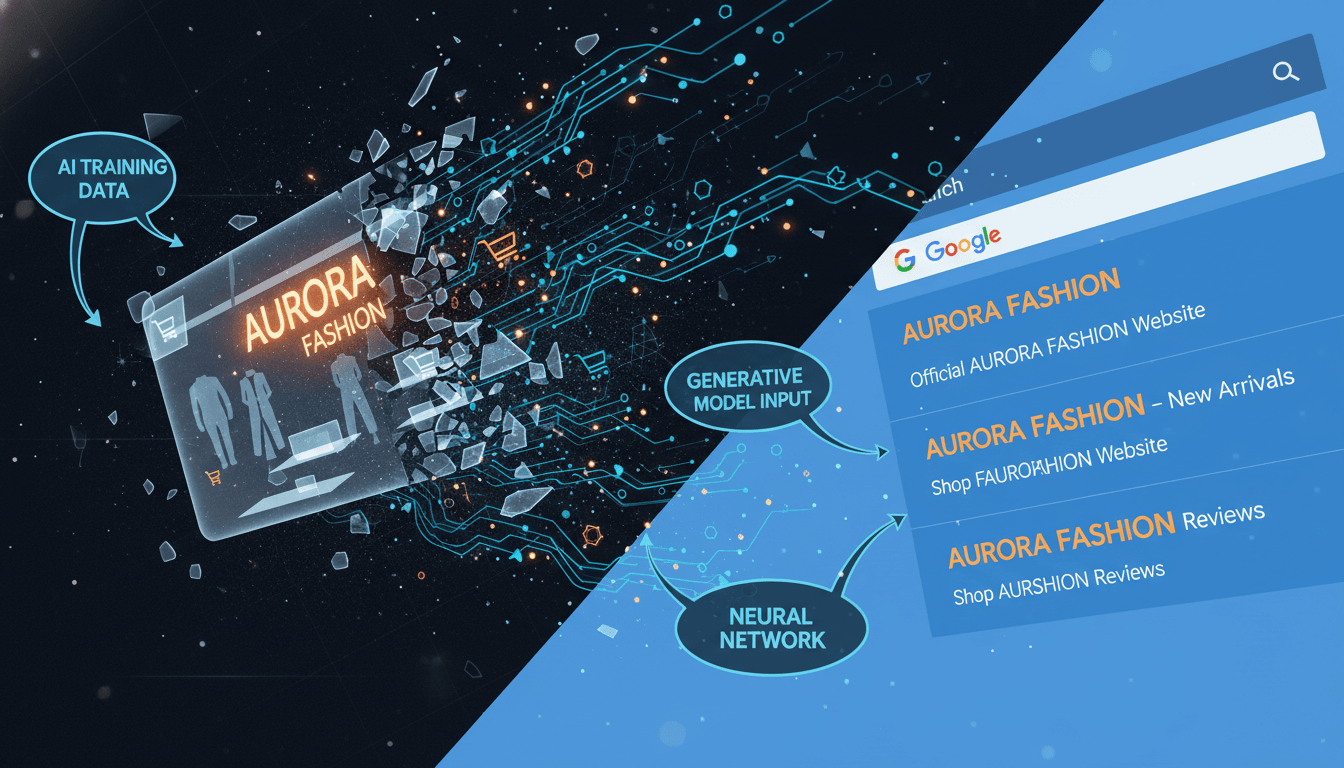
[IMG: A side-by-side diagram comparing how Google indexes web content via crawling and backlinks versus how AI training pipelines prioritize editorial publications, Wikipedia, Reddit, and review platforms]


---


## Knowledge Cutoffs: Why Recent Launches and Rebrands Disappear

The temporal dimension of AI invisibility compounds the structural problem significantly. [OpenAI, Anthropic, and Google's own model documentation](https://platform.openai.com/docs/) confirms that most leading LLMs—including GPT-4, Claude 2, and Gemini 1.0—have **knowledge cutoffs ranging from 12 to 18 months behind the current date**. ChatGPT's base training data has a knowledge cutoff of April 2023.

This creates a **"temporal invisibility" problem**. A brand that launched, rebranded, or gained significant press coverage within the past year may be entirely absent from an AI's foundational knowledge. Press coverage, product innovations, and market share shifts within the cutoff window simply do not exist in the model's world.

The problem extends beyond new brands. Even established brands that underwent significant rebranding—new name, new positioning, new product line—within the past 18 months may be invisible to base AI models. Traditional marketing strategies do not address this gap because they operate around real-time channels. The AI knowledge gap is, by design, always operating with outdated information.


---


## How AI Decides Which Brands to Recommend: Mention Density vs. Backlinks

Understanding *how* AI recommendation logic works is essential for building a strategy to influence it. The mechanism differs fundamentally from Google's PageRank. As [MIT Technology Review's analysis of LLM behavior](https://www.technologyreview.com/) explains, AI recommendation logic is closer to **"citation rank"**—a brand's authority is determined by how often credible human voices have written about it in credible contexts.

Three dynamics shape this ranking system:

- **Mention frequency matters more than link equity.** AI assistants generate recommendations by predicting statistically likely responses based on training data patterns. Brands mentioned frequently across high-authority sources are orders of magnitude more likely to be surfaced than brands with sparse coverage.
- **Source authority is decisive.** The frequency with which a brand is mentioned across independent, authoritative third-party sources—review sites, editorial publications, Reddit threads, and industry blogs—is one of the strongest predictors of AI recommendation, according to [Moz and BrightEdge GEO Research Briefs (2024)](https://moz.com/blog).
- **Traditional SEO signals do not translate.** AI models do not "search" the internet the way Google does—they recall patterns embedded during training. Keyword stuffing and backlink farming have little to no direct impact on AI recommendation frequency, per [Google DeepMind and Anthropic research on LLM behavior](https://www.anthropic.com/research).

Rand Fishkin, Co-founder and CEO of SparkToro, frames it plainly: *"The brands that win in AI search are not necessarily the biggest or the best—they're the most legible to machines. If the training data doesn't contain clear, consistent, authoritative signals about a brand, the model has no basis to recommend it, regardless of how good the product actually is."*

A brand can have strong Google rankings but zero AI recommendations if it lacks third-party written authority. That gap is the core challenge GEO strategy exists to solve.


---


## The Compounding Invisibility Problem: Why Early Intervention Is Critical

The visibility gap does not stay static—it compounds in both directions. Brands absent from AI recommendations miss traffic. Less traffic means fewer customer reviews, fewer community mentions, and less earned media. Fewer mentions reduce future AI citation probability, creating a downward spiral that becomes increasingly difficult to escape.

The inverse is equally true. According to a joint study by [Ahrefs and SparkToro (2024)](https://ahrefs.com/blog/), pages cited by AI assistants in retrieval-augmented generation systems receive an average of **3.2x more organic referral traffic** than non-cited pages in the same domain. AI citation drives human traffic, which generates more signals, which increases future AI citation probability.

The competitive implications are stark. Brands in the top three AI recommendations capture **60% of AI-referred purchase intent traffic**—a concentration effect similar to Google's "position zero" phenomenon. Being fourth or fifth is nearly as invisible as not appearing at all. The brands investing in AI visibility now will establish a compounding moat before competitors recognize the channel's importance.

Early GEO strategy intervention creates structural advantage that becomes harder to displace over time. This window will not remain open indefinitely.

[IMG: A compounding growth chart showing how early GEO investment creates an accelerating visibility advantage over time, compared to a flat line for brands that delay]


---


## RAG Systems and Real-Time Correction: Why Crawlability Still Matters

Retrieval-augmented generation (RAG) systems represent an important nuance in the AI visibility landscape. Platforms like Perplexity AI and ChatGPT with Browse use real-time web retrieval to supplement training data—meaning they can surface more current information than base models alone. For brands invisible due to knowledge cutoffs, this appears to offer a solution.

The reality is more nuanced. RAG does not eliminate the need for AI training data presence—it supplements it. As [Perplexity AI's technical documentation](https://docs.perplexity.ai/) and OpenAI's Help Center confirm, brands must still appear on pages that AI crawlers index and deem authoritative enough to cite. A brand mentioned only on its own website or low-authority pages will not be surfaced by RAG systems any more than by base models.

Here's what matters for RAG-based visibility:

- RAG systems prioritize the same high-trust domains that training pipelines favor: Wikipedia, major editorial publications, established review platforms, and active Reddit communities.
- Crawlable authority on high-trust domains is essential for **both** base model and RAG-based AI visibility.
- Structured data markup, FAQ schema, and clearly formatted product descriptions improve AI crawler parsability—yet fewer than 20% of DTC Shopify stores implement advanced schema markup, per [Shopify Partner Ecosystem and Schema.org Adoption Data (2023)](https://www.shopify.com/partners).

GEO strategy must therefore address both layers: building historical training data presence through earned media and third-party authority, and maintaining ongoing crawlable presence on high-trust domains that RAG systems will retrieve.


---


## Building AI Visibility: A Strategy Fundamentally Different from SEO and Paid Social

Generative Engine Optimization (GEO) requires a fundamentally different approach than any prior digital marketing channel. The shift is not incremental—it is structural. As Lily Ray, VP of SEO Strategy and Research at Amsive Digital, observes: *"The world is entering a phase where a brand's Wikipedia page, Reddit reputation, and Wirecutter review matter more than Google Ad spend. AI does not see retargeting campaigns—it sees what the internet has written about a brand."*

The strategic differences are profound:

- **Earned media over owned content.** GEO requires generating third-party written content, not optimizing owned blog posts. Editorial placements, product reviews in major publications, and community discussions carry weight that blog posts and social captions cannot.
- **Community presence over keyword targeting.** AI assistants trained on Reddit data—which [OpenAI licensed in 2024](https://openai.com/blog/)—disproportionately surface brands discussed positively in communities like r/BuyItForLife, r/skincareaddiction, and r/malefashionadvice. Most DTC brands have never strategically engaged these communities.
- **Mention density over backlink volume.** The primary metric shifts from domain authority and link equity to the frequency and authority of brand-specific mentions across independent third-party sources.
- **Brand narrative consistency across authoritative platforms.** Structured data, consistent brand descriptions, and clear category positioning across Wikipedia, review platforms, and editorial sites directly influence AI recommendation probability.

DTC brands that build AI-readable authority now stand to capture disproportionate AI recommendation share before the channel becomes as competitive as Google. Success metrics also change: AI citation frequency and mention density replace CTR and ROAS as the primary indicators of channel performance.

**Ready to build a GEO strategy that positions a brand in front of the 72% of consumers using AI for product discovery?** [Book Your AI Visibility Audit](https://calendly.com/ramon-joinhexagon/30min)


---


## The Window of Opportunity: Why DTC Brands Should Move Now

The competitive window for AI visibility is open—but it will not stay open indefinitely. AI-assisted shopping discovery has grown faster than social commerce or any previous digital channel shift, with 72% of consumers now using AI assistants monthly for product research. Yet most brands have no GEO strategy whatsoever, creating a first-mover advantage that will not last.

Andrew Lipsman, Independent Analyst and Former Principal Analyst at eMarketer, frames the urgency clearly: *"The shift from keyword search to conversational AI discovery is the biggest channel disruption since mobile. Brands that do not build AI-readable authority in the next 18 months will find themselves locked out of a discovery channel that could represent 30-40% of e-commerce traffic by 2027."*

The numbers reinforce the urgency. Brands mentioned in AI recommendations see **34% higher click-through rates** than traditional search placements. Brands in the top three AI recommendation slots capture over 60% of AI-referred purchase intent traffic. The brands investing in AI visibility today will own the channel before it becomes as competitive—and as expensive—as Google.

The competitive landscape is still nascent. The advantage belongs to early movers.

[IMG: A timeline graphic showing the adoption curve of AI-assisted shopping discovery, with an arrow indicating the current "early mover advantage" window before market saturation]


---


## Getting Started: Your First Steps to AI Visibility

Building AI visibility begins with an honest audit of where a brand currently stands. The starting point is straightforward: ask ChatGPT, Claude, Perplexity, and Gemini for product recommendations in the relevant category. Note which brands appear, how consistently, and with what level of detail. This baseline reveals the gap between current AI presence and the brands capturing AI-referred traffic.

Here's how to structure the initial audit and strategy:

- **Audit AI recommendations across platforms.** Run category-level queries across all major AI assistants. Identify which competitors are being recommended and analyze the third-party authority patterns that explain their visibility.
- **Map the brand's third-party presence.** Identify current footprint on Wikipedia, Reddit, major review platforms (Trustpilot, G2, Wirecutter), and editorial publications. Gaps in this map are gaps in AI knowledge.
- **Identify earned media deficits.** Compare the brand's editorial coverage against recommended competitors. Brands appearing in AI recommendations almost always have substantially more independent written coverage across authoritative domains.
- **Prioritize mention density over owned content.** Shift near-term content investment toward earning placements in publications, building community presence on relevant subreddits, and generating verified reviews on platforms AI training pipelines prioritize.
- **Implement structured data.** Ensure product pages, brand pages, and key content use schema markup that AI crawlers can parse accurately—a foundational step fewer than 20% of DTC brands have completed.

The brands that understand AI visibility as a distinct strategic channel—separate from SEO and paid social—will build compounding advantages that are difficult for late movers to overcome.


---


## Conclusion: Visibility Is No Longer Optional

The AI visibility gap is structural, measurable, and growing. With 72% of consumers using AI for product discovery and only 27% of e-commerce brands receiving any AI mentions, the opportunity for brands that act now is significant. The channel rewards mention density, earned authority, and third-party credibility—not ad spend or backlink volume.

Understanding why a brand is invisible to ChatGPT is the first step. Building the strategy to fix it is what separates the brands that will own AI-referred traffic from those that will watch competitors capture it. Looking ahead, the brands moving now have a 12-18 month window before this channel becomes as saturated and competitive as Google.

The question is not whether AI visibility matters—it clearly does. The question is whether a brand will build it before competitors do.

**Ready to audit AI visibility and build a GEO strategy that positions a brand in ChatGPT, Perplexity, and Claude recommendations?** Book a 30-minute consultation with AI visibility specialists to analyze current presence, identify gaps in third-party authority, and develop a roadmap to capture AI-referred traffic before competitors do. [Book Your AI Visibility Audit](https://calendly.com/ramon-joinhexagon/30min)
H
Hexagon Team
Published May 30, 2026