brandsbrandtraining
The AI Training Data Gap: Why Most E-Commerce Brands Are Missing from ChatGPT (And How to Fix It)
Your brand could be perfect for a customer's needs—but if ChatGPT doesn't know you exist, you'll never get the recommendation. Learn why 90% of DTC brands are invisible to AI assistants, and the six-step strategy to fix it before the window closes.
12 min read
placeholders exactly as provided" ]
# The AI Training Data Gap: Why Most E-Commerce Brands Are Missing from ChatGPT (And How to Fix It)

*A brand could be perfect for a customer's needs—but if ChatGPT doesn't know it exists, it will never get the recommendation. Learn why 90% of DTC brands are invisible to AI assistants, and the six-step strategy to fix it before the window closes.*

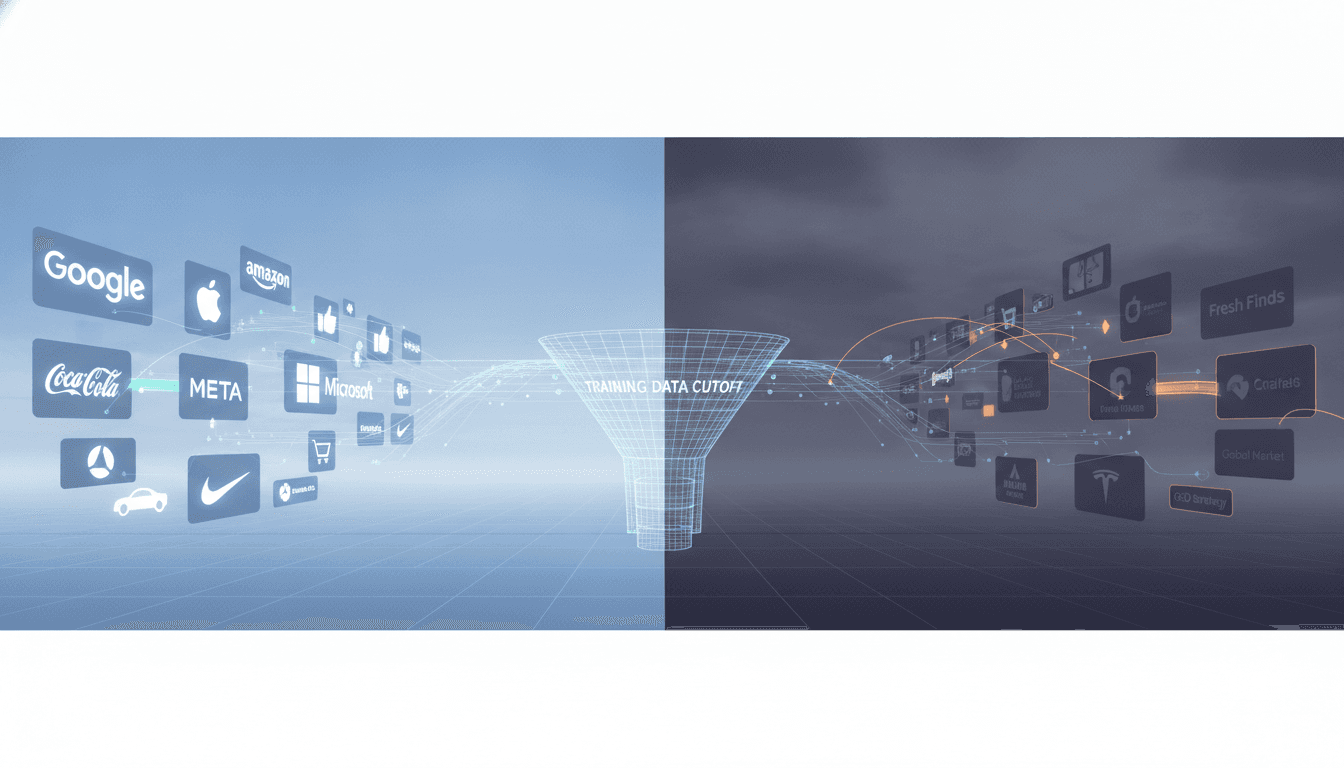
[IMG: Split-screen visualization showing a customer asking ChatGPT for a product recommendation, with only 3-5 large brand logos appearing while dozens of smaller brand logos fade into the background]

Imagine a customer searching for exactly what a brand sells. The customer asks ChatGPT for a recommendation, and that brand never appears. Instead, the customer sees the same three to five massive competitors—over and over again.

This isn't happening by accident. When customers query ChatGPT for product recommendations, 70% of the results point to just 3-5 large brands, while 90% of DTC e-commerce brands under $50M in revenue remain completely invisible. This isn't about product quality or customer satisfaction. It's a data problem—one that's costing brands millions in AI-influenced sales projected to reach [$36 billion by 2026](https://www.emarketer.com).

The frustrating part? It's entirely fixable. But only if brands understand how AI training data actually works.


---


## The AI Training Data Gap: Why Brands Aren't in ChatGPT's Knowledge Base

AI models don't learn from the entire internet. They train on curated, high-authority datasets—primarily Wikipedia, major news publications, Reddit, structured web crawls, and industry review sites. Most DTC brands never made it into these foundational datasets because they simply lacked third-party coverage at the time of training.

This isn't a failure of strategy or product quality. It's a structural limitation of how large language models are built. According to a [Brightedge AI Search Readiness Report](https://www.brightedge.com), fewer than 10% of DTC e-commerce brands with under $50M in annual revenue have sufficient third-party digital footprint to be reliably recommended by major AI assistants.

The problem compounds over time. Newer brands launched after training cutoffs are invisible by default. Established brands without third-party coverage fare only marginally better.

Meanwhile, [Salesforce's State of the Connected Customer report](https://www.salesforce.com/resources/research-reports/state-of-the-connected-customer/) found that 58% of U.S. consumers used an AI assistant to help with a shopping decision in 2024—up from just 20% in 2022. Yet most brands have made zero effort to optimize for AI discoverability.

[IMG: Infographic showing the AI training data ecosystem—Wikipedia, Reddit, major publications, and structured crawls feeding into LLM training, with a small DTC brand website shown outside the data pipeline]


---


## Knowledge Cutoffs and the Moving Target Problem

Every major AI model operates with a defined training cutoff date. GPT-4o's knowledge cutoff is early 2024, meaning any brand that launched, scaled, or significantly evolved after that date is functionally invisible to the model unless real-time retrieval is enabled. This creates a hard deadline that most brands don't know exists until it's already passed.

Knowledge cutoffs are only part of the problem. According to Aleyda Solis, International SEO Consultant and Founder of Orainti, "The deeper issue is that most small and mid-size brands were never in the training data to begin with. They existed entirely in paid social ecosystems that AI models don't crawl, on platforms that aren't part of the foundational datasets these models learn from."

The lag compounds the disadvantage further. According to [MIT Technology Review's analysis of LLM training pipelines](https://www.technologyreview.com), the average gap between a brand achieving significant market presence and being accurately represented in AI training data is 18 to 24 months.

Adding another layer of complexity: ChatGPT, Claude, Gemini, and Perplexity each operate on different training datasets and cutoff dates. This means a brand's visibility varies significantly across platforms—and each new model release creates both a new risk and a new opportunity.


---


## The Real-Time Retrieval Opportunity: Bypassing Training Data Limitations

Not all AI recommendations come from static training data. Tools like Perplexity AI and ChatGPT's browsing mode use Retrieval-Augmented Generation (RAG) to pull live web data in real time, supplementing what the model already knows. According to [Meta AI Research's foundational RAG paper](https://ai.facebook.com/research/), this creates a meaningful pathway for brands that missed the original training window.

Here's how the shift works: brands with strong technical SEO, structured data markup, and crawlable content architecture can appear in AI answers even if they were never included in foundational training data. Perplexity AI alone processes over 10 million queries per day as of 2024—a significant portion of which are product and brand discovery queries. This makes real-time web presence as critical as training data inclusion.

Technical SEO is no longer just a Google ranking tool. Structured data markup (Schema.org, JSON-LD), consistent information architecture, and authoritative backlink profiles now function as AI visibility strategies. Brands with strong technical foundations appear more frequently in live-data AI recommendations, creating an accessible entry point for brands willing to invest in the right infrastructure.

[IMG: Diagram illustrating how RAG-enabled AI tools like Perplexity pull real-time web data alongside static training knowledge to generate product recommendations]


---


## Third-Party Authority: The Currency of AI Recommendations

AI models don't trust brands equally. They weight information from independent, authoritative sources far more heavily than owned media. Editorial reviews, press coverage, user-generated content on Reddit and Quora, and structured citations are the primary signals that determine whether a brand earns a recommendation.

According to Lily Ray, VP of SEO Strategy & Research at Amsive Digital, "Brands are entering a world where a Wikipedia page, a Wirecutter review, and Reddit thread mentions matter more than Instagram follower count. AI doesn't care about vanity metrics—it cares about corroborated, structured information from sources it was trained to trust."

The data supports this directly. According to [Moz and SparkToro's joint research on AI search signals](https://moz.com), brands with active PR programs generating at least 10 editorial mentions per quarter in indexed publications are approximately **3x more likely** to appear in AI assistant product recommendations compared to brands relying solely on paid advertising and owned social media.

Wikipedia remains one of the most heavily weighted sources in LLM training datasets—yet fewer than 1% of e-commerce brands have a verified Wikipedia page, according to [Wikimedia Foundation statistics](https://wikimediafoundation.org). The structural disadvantage is significant, but it's also entirely addressable.


---


## The Hallucination Risk: What Happens When a Brand Has a Thin AI Footprint

Brands with sparse AI training data representation don't just get ignored. They risk being misrepresented. When AI models lack sufficient data about a brand, they sometimes fabricate or confuse product details, pricing, and brand positioning—a phenomenon known as hallucination that's directly proportional to data scarcity.

According to the [Stanford HAI AI Index Report 2024](https://aiindex.stanford.edu), hallucinated information about brands spreads across multiple platforms—ChatGPT, Perplexity, Claude, and Gemini—creating a fragmented and inaccurate picture before a customer ever reaches a website. The Edelman Trust Barometer's special report on AI found that consumers increasingly treat AI recommendations with the same trust level as personal referrals, making inaccurate AI-generated brand information a high-stakes problem.

The compounding risk is severe. Once hallucinated information enters AI training data cycles, it becomes difficult to correct. A thin footprint also increases the likelihood that AI models will default to recommending competitors with more authoritative coverage, accelerating the competitive gap between AI-visible and AI-invisible brands.

[IMG: Side-by-side comparison showing an accurate AI brand description for a well-represented brand versus a hallucinated, inaccurate description for a brand with sparse AI footprint]


---


## The Actionable Fix: Building an AI-Visible Brand Footprint (6-Step Strategy)

Closing the AI training data gap requires deliberate, multi-channel authority building. Here's the proven playbook:

**Step 1: Establish or Optimize a Wikipedia Presence**

Here's how to start: brands should create a Wikipedia page with structured citations from independent, indexed sources. If a brand already has an entry, it should be updated with accurate, verifiable information and authoritative references. Wikipedia is one of the most heavily weighted sources in LLM training data—this is non-negotiable.

**Step 2: Build a Proactive PR Strategy Targeting Editorial Coverage**

Brands should aim for a minimum of 10 editorial mentions per quarter in indexed publications. Prioritize outlets like Wirecutter, Forbes Commerce, niche trade publications, and major consumer review sites. According to [Moz and SparkToro research](https://moz.com), brands with active PR programs are 3x more likely to appear in AI recommendations.

**Step 3: Implement Structured Data Markup Across the Website**

Here's how structured data works: brands should deploy Schema.org and JSON-LD markup for products, reviews, company information, and pricing. Structured data helps AI crawlers understand product attributes and brand identity in machine-readable format. According to [Google's Structured Data Documentation](https://developers.google.com/search/docs/appearance/structured-data/intro-structured-data), this directly impacts how AI models represent a brand in generated responses.

**Step 4: Optimize Knowledge Graph Presence Through Consistent NAP Data**

Brands must ensure consistent Name, Address, and Phone data across all directories, listings, and platforms. Submit accurate brand information to Google Knowledge Graph, Wikidata, and industry-specific databases. Consistent NAP data improves knowledge graph accuracy and the reliability of AI recommendations.

**Step 5: Seed Brand Information in Trusted Community Platforms**

Here's how to participate authentically: brands should engage in relevant Reddit communities, Quora threads, and industry forums. Provide genuine value—answer questions, share expertise, and reference the brand where contextually appropriate. Reddit and Quora are significant data sources for both AI training datasets and RAG retrieval pipelines.

**Step 6: Build High-Quality Backlinks from Authoritative Sources**

Brands should pursue backlinks from sources AI models are trained to trust: industry publications, academic references, and established review sites. Google's E-E-A-T framework (Experience, Expertise, Authoritativeness, Trustworthiness) directly influences which content gets surfaced in AI-powered recommendation systems. Each authoritative backlink contributes to the interconnected "knowledge graph footprint" that AI models interpret as legitimacy signals.


---


Building an AI-visible brand requires strategy, execution, and ongoing optimization. Brands ready to close their AI training data gap and ensure visibility in ChatGPT and Perplexity recommendations should [book a 30-minute strategy call with an AI visibility team](https://calendly.com/ramon-joinhexagon/30min) to audit current AI footprint and create a roadmap to AI visibility.


---


## The Compounding First-Mover Advantage in AI Visibility

According to Rand Fishkin, CEO and Co-Founder of SparkToro, "The brands that will win in the AI era are not necessarily the ones with the best products—they're the ones that have built the richest, most authoritative digital knowledge footprint. If an AI model can't find credible, structured information about a brand from multiple independent sources, that brand simply doesn't exist in its world."

Brands that establish AI visibility now will benefit from compounding returns across every future model update. Each new training cycle incorporates a growing body of third-party references—meaning the gap between AI-visible and AI-invisible brands widens with every release. Early action creates a durable moat that becomes increasingly difficult for competitors to overcome.

Looking ahead, the $36 billion AI-influenced e-commerce market will only expand as AI assistants transition from informational tools to transactional recommendation engines. As Greg Brockman, Co-Founder of OpenAI, noted: "Generative AI is becoming the new search engine for a generation of consumers, and the brands that understand how to get into the training data and retrieval pipelines of these systems will have a compounding advantage that grows every time a new model is released." The brands building authority today are writing the recommendations of tomorrow.


---


## How to Audit Current AI Visibility (And Benchmark Against Competitors)

The first step to closing the gap is understanding exactly where a brand stands. Here's how to conduct a baseline AI visibility audit:

**Query all major platforms.** Brands should ask ChatGPT, Perplexity, Claude, and Gemini category and product questions relevant to their business. For example, search "best [product category] brands for [use case]" and note whether the brand appears.

**Identify who's winning instead.** Brands should document which competitors are mentioned in their place—these brands represent the authority benchmark to match or exceed.

**Benchmark against 3-5 direct competitors.** Analyze the specific authority signals—Wikipedia presence, editorial coverage, structured data, backlink profiles—that are driving competitor AI visibility.

**Build a tracking spreadsheet.** Log brand AI visibility across platforms and update it quarterly to measure progress against the strategy.

Different AI models have different training data and knowledge bases, so auditing all major platforms is essential. Visibility on ChatGPT doesn't guarantee visibility on Perplexity or Gemini. Competitive benchmarking reveals which specific authority signals are missing from a brand's footprint, turning a vague problem into a prioritized action list. Quarterly audits ensure the strategy stays calibrated as new model releases and training cycles create shifting visibility landscapes.

[IMG: Screenshot mockup of a competitive AI visibility audit spreadsheet showing brand mentions across ChatGPT, Perplexity, Claude, and Gemini with gap analysis columns]


---


## The Bottom Line: AI Visibility Strategy Starts Now

The AI training data gap isn't permanent—but closing it requires intentional strategy, not passive presence. Building third-party authority, structured data infrastructure, and authentic community presence is the proven path to AI visibility. The brands that act now will establish a compounding advantage as AI-influenced commerce grows from a trend into the dominant discovery channel.

With 58% of consumers already using AI for shopping decisions—and that number rising—the question is no longer whether AI visibility matters. It's whether a brand will be the answer when the next customer asks ChatGPT for a recommendation. The gap between AI-visible and AI-invisible brands will only widen with each new model release, each new training cycle, and each new consumer who turns to an AI assistant instead of a search engine.

The window for first-mover advantage in AI visibility is closing. Brands that establish authority now will compound their advantage across every new AI model release. [Schedule a free AI visibility audit](https://calendly.com/ramon-joinhexagon/30min)—an AI visibility team will show exactly where a brand is missing and how to fix it.
H
Hexagon Team
Published June 12, 2026