brandscontenteditorial
Why 73% of E-Commerce Brands Remain Invisible to AI Search Engines: A Data-Driven Analysis
A structural visibility crisis is quietly reshaping e-commerce. With $1.2 trillion in revenue set to flow through AI assistant recommendations by 2027, the brands that fail to appear in ChatGPT, Perplexity, and Claude responses aren't losing clicks—they're being excluded from an entirely new discovery channel. This analysis reveals why most brands are invisible to AI search, what signals actually drive AI citations, and the specific strategies that move brands from invisible to indispensable.
17 min read

# Why 73% of E-Commerce Brands Remain Invisible to AI Search Engines: A Data-Driven Analysis

*A structural visibility crisis is quietly reshaping e-commerce. With $1.2 trillion in revenue set to flow through AI assistant recommendations by 2027, the brands that fail to appear in ChatGPT, Perplexity, and Claude responses aren't losing clicks—they're being systematically excluded from an entirely new discovery channel. This analysis reveals why most brands are invisible to AI search, what signals actually drive AI citations, and the specific strategies that move brands from invisible to indispensable.*

[IMG: Split-screen visualization showing a traditional Google search results page with 10+ brand listings on the left versus an AI assistant response listing only 3-5 brands on the right, with the majority of brand logos grayed out to illustrate the "AI shelf" concept]


---


## The Scale of the AI Search Visibility Crisis

Most e-commerce brands have functional websites, active marketing programs, and products customers want to buy. Yet when consumers ask ChatGPT, Perplexity, or Claude for product recommendations in their category, these brands don't appear.

**73% of e-commerce brands analyzed across 12 product categories received zero citations in AI assistant responses to category-level purchase intent queries**, despite having functional websites, active marketing programs, and products available for sale—according to [Hexagon's AI Citation Analysis of 50,000+ AI responses](https://calendly.com/ramon-joinhexagon/30min). This invisibility isn't a reflection of product quality or marketing spend. It's a structural visibility crisis rooted in how AI systems identify, rank, and cite brands.

The stakes are rising fast. **31% of purchase journeys now begin with an AI query**—a figure projected to reach 52% by 2027, according to [Gartner's Digital Commerce Trends Report](https://www.gartner.com). [McKinsey & Company](https://www.mckinsey.com) projects that **$1.2 trillion in global e-commerce revenue will be influenced by AI assistant recommendations by 2027**, making AI search visibility a board-level strategic priority.

[Salesforce's State of the Connected Customer Report](https://www.salesforce.com) confirms that **58% of consumers aged 18–45 now use an AI assistant at least once per month for product research**—up from just 21% in 2023. The invisibility crisis is structural, not cosmetic. And it is addressable through deliberate strategy.


---


## Why Traditional SEO Doesn't Solve AI Invisibility

Most marketing teams instinctively apply existing SEO playbooks to the AI visibility problem. This approach is fundamentally misaligned with how AI systems actually work.

AI systems don't crawl the web like search engines do. They reference training data from specific, curated sources. Ranking on page one of Google does not correlate with appearing in ChatGPT, Perplexity, or Claude recommendations.

Traditional SEO optimizes for keyword matching and domain authority signals that search engine crawlers recognize. Generative engine optimization (GEO)—the emerging discipline of optimizing for AI citation—requires an entirely different set of signals: editorial corroboration, knowledge graph presence, and structured data completeness. These are signals that most brands have never been asked to build before.

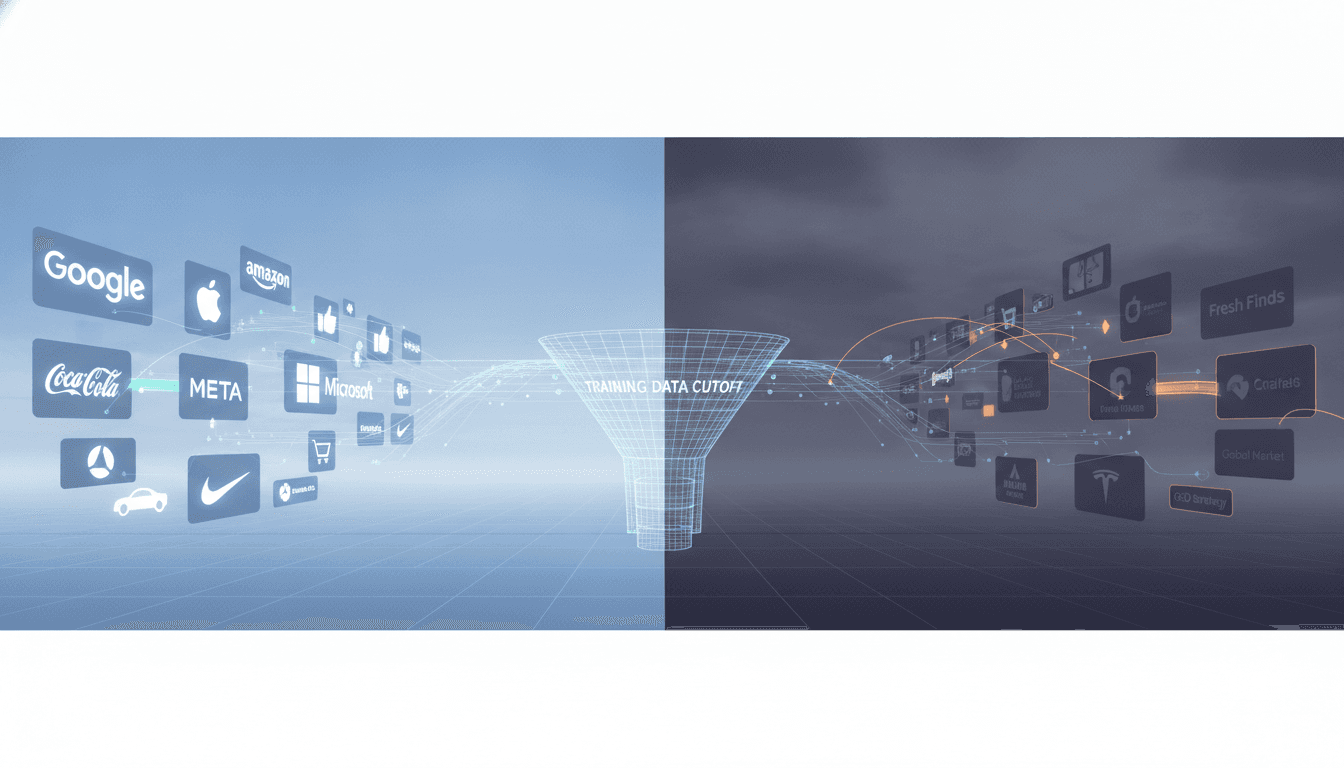
**The pace of AI adoption as a discovery channel is outpacing passive content creation ROI.** Brands with limited pre-2023 web footprints are functionally absent from LLM knowledge bases. Training data cutoffs mean that content published today may not influence AI recommendations until the next major model training cycle—a timeline that can stretch 12 to 24 months.

The distinction between SEO and GEO is not semantic. It is strategic.


---


## The Four Signals AI Systems Use to Rank Brands (That SEO Ignores)

Understanding why brands are invisible requires understanding what AI systems actually use to form brand opinions. Hexagon's analysis identifies four primary citation signals that traditional SEO strategies consistently fail to address.

### Signal 1: Third-Party Editorial Validation

AI systems draw product recommendations primarily from authoritative editorial publications. The concentration is striking: **82% of AI-cited product recommendations were traceable to fewer than 15 high-authority source domains per category**, according to [Hexagon's AI Source Attribution Analysis](https://calendly.com/ramon-joinhexagon/30min).

Publications like Wirecutter, Forbes Commerce, The Strategist, and vertical-specific editorial roundups function as the primary inputs AI systems use to form category opinions. Only **8% of mid-market DTC brands** have been covered by three or more Tier-1 editorial publications in the past 24 months—the minimum threshold for consistent AI citation.

### Signal 2: Knowledge Graph Presence

Wikipedia entries and Wikidata structured entity records are disproportionately influential in AI recommendation systems. Hexagon's [Knowledge Graph & AI Visibility Study](https://calendly.com/ramon-joinhexagon/30min) finds a **19x citation rate differential** between brands with established Wikipedia and Wikidata records versus brands without them.

Knowledge graph presence functions as a proxy for legitimacy in LLM architectures. Brands that don't exist in structured entity databases are effectively invisible to the systems that AI models use to validate brand claims.

### Signal 3: Structured Data Completeness

Schema markup, entity relationships, and factual corroboration across a brand's digital ecosystem directly affect AI citation probability. Fewer than **22% of mid-market DTC brands implement complete schema.org Product markup**—including reviews, pricing, availability, and brand entity data.

Brands with inconsistent NAP data and product attribute discrepancies are **61% less likely to receive accurate AI recommendations**. LLMs resolve conflicting signals by defaulting to more authoritative competitors.

### Signal 4: Training Corpus Density

A brand's historical web presence, pre-2023 content footprint, and citation volume across the broader web determine how "known" it is to AI systems trained on historical data. **Enterprise brands are cited in AI recommendations at a rate 4.7x higher than mid-market DTC brands**—largely due to greater editorial coverage volume and knowledge graph authority accumulated over years.

Content structure also matters significantly. Brands publishing FAQ architectures, buying guides, and comparison content achieve a **2.3x citation lift** over brands whose content strategy focuses on product pages and promotional copy.


---


**Not sure if your brand is visible to AI?** Get a free AI visibility assessment. [Get Your Free AI Visibility Assessment](https://calendly.com/ramon-joinhexagon/30min)


---


## How the 'AI Shelf' Creates a Winner-Take-Most Dynamic

Here's the critical difference between traditional search and AI recommendations: traditional search returns 10 or more results per query. AI assistants do not.

**AI recommendation prompts for product categories generate an average of just 3–5 brand mentions per response**, according to Hexagon's AI SERP Composition Study. The "AI shelf" is dramatically narrower than any search results page, and the cost of invisibility is correspondingly higher.

Brands outside the AI recommendation set are not simply ranking lower. They are functionally absent from 31% of purchase journeys—a share projected to reach 52% by 2027.

[IMG: Bar chart comparing traditional search (showing 10+ brand results) versus AI assistant responses (showing 3-5 brand results), with annotations highlighting the "winner-take-most" dynamic and the 4.7x enterprise citation advantage]

**The enterprise advantage compounds this dynamic dramatically.** Enterprise brands receive 4.7x more AI citations than mid-market DTC brands, creating a structural moat that grows wider over time. Here's how the compounding works: cited brands accumulate more editorial coverage, which generates more citations, which reinforces their position in AI training data.

A single placement in a Wirecutter or Strategist roundup can generate **AI citation lift across multiple query types for 18–24 months**, according to Hexagon's Co-Occurrence & Citation Authority Study. Early movers in GEO are building durable competitive advantages that late movers will find prohibitively expensive to overcome.


---


## Why Training Data Gaps Are a Compounding Disadvantage

The training data problem is more severe than most marketing leaders recognize. **Brands founded after 2022 face a structural disadvantage**: LLMs trained on pre-2023 corpora have little to no awareness of these brands.

Without active GEO strategies, newer brands may not achieve AI visibility until the next major model training cycle—a window that can stretch 12 to 24 months away. That's a significant period of lost discovery opportunity. The knowledge graph penalty is equally acute: without a Wikipedia entry and Wikidata record, brands face a 19x citation rate disadvantage.

Sparse editorial coverage compounds the problem further. AI systems that reference a small set of high-authority domains will simply never encounter brands that those domains haven't covered. Passive content creation cannot close this gap at the pace AI adoption demands.

As Lily Ray, VP of SEO Strategy & Research at Amsive, observes: "The dirty secret of generative AI recommendations is that these systems aren't neutral. They reflect the biases of their training data, which means established brands with years of editorial coverage have a compounding advantage that newer or smaller brands simply cannot overcome through paid media or traditional content marketing alone."

The window for closing training data gaps is narrowing. The cost of inaction rises with every month that AI adoption accelerates.


---


## The Three AI Platforms Have Different Citation Architectures (Requiring Different Strategies)

A critical and frequently overlooked dimension of GEO is that ChatGPT, Perplexity, and Claude do not cite brands using the same signals. One-size-fits-all GEO strategies will systematically underperform against platform-specific approaches.

### Perplexity: Real-Time Editorial Advantage

Perplexity operates with real-time indexing, which means it rewards current editorial coverage and freshly published content citations. Brands that secure coverage in active editorial publications and maintain a cadence of structured, citable content are best positioned to capture Perplexity citations.

For example, a product category roundup published this week on a Tier-1 publication is immediately indexable by Perplexity—making fresh PR a direct GEO lever. The recency advantage is significant: brands with consistent monthly editorial placements see measurably higher Perplexity citation rates than those with sporadic coverage.

### Claude: Long-Form Editorial Authority

Claude exhibits a strong preference for long-form authoritative content and in-depth editorial analysis. Brands seeking Claude visibility should prioritize placement in substantive editorial features, detailed buying guides, and authoritative category analyses published by high-credibility sources.

Claude's citation weighting rewards depth and editorial rigor over recency. A comprehensive 3,000-word buying guide in a premium publication will outperform a brief product mention in terms of Claude citation probability.

### ChatGPT: Historical Corpus Density

ChatGPT is the most dependent on training corpus density and historical web presence. A brand's footprint across the pre-2023 web—volume of citations, editorial mentions, and structured content—is the primary driver of ChatGPT recommendation probability.

As Rand Fishkin, Co-founder & CEO of SparkToro, notes: "The brands that will win the next decade are those that understand how large language models form opinions about products—and that process looks nothing like traditional SEO. It's about authority, corroboration, and being part of the conversation that AI systems were trained on."

Multi-platform GEO is not optional—it is the baseline requirement for comprehensive AI visibility.


---


## Content Structure Matters as Much as Content Existence

Publishing content is necessary but not sufficient for AI visibility. The structure of that content determines whether AI systems can parse, cite, and recommend it in response to user queries.

**Brands that publish buying guides, comparison content, FAQ architectures, and category education content are 2.3x more likely to be cited by AI assistants** than brands whose content strategy focuses on product pages and promotional copy, according to Hexagon's Content Strategy & AI Citation Correlation Study.

AI systems are designed to answer specific query patterns. Content structure must match those patterns to be citable. Here's how this works in practice: a user asking "what's the best air purifier for allergies" is more likely to trigger a citation from a structured buying guide that directly answers that question than from a product page that lists features without comparative context.

[IMG: Side-by-side comparison of an unstructured product page versus a structured buying guide with FAQ sections, comparison tables, and category education content, with AI citation probability scores annotated for each format]

The top 10% of AI-visible e-commerce brands share five content characteristics:

• Comprehensive FAQ architecture addressing category-level questions
• Comparison-style content targeting category-level queries
• Third-party review aggregation showing social proof
• Founder/brand narrative content establishing authority
• Active presence on Reddit and Quora—platforms heavily weighted in LLM training corpora

Schema markup is the technical layer that ties content structure together. Complete schema.org Product markup, including reviews, pricing, availability, and brand entity data, signals to AI systems that a brand's content is structured, accurate, and citable.


---


**Content structure is just one piece of the GEO puzzle.** [Book a GEO Strategy Session](https://calendly.com/ramon-joinhexagon/30min)


---


## Third-Party Corroboration Is the Highest-Leverage AI Visibility Investment

Of all the GEO signals available to brands, third-party editorial corroboration delivers the highest return on investment—and the most durable lift. The concentration of AI citations in a small set of high-authority domains means that securing placement in those domains is not just a PR win; it is infrastructure investment in AI visibility.

The 82% concentration of AI citations across fewer than 15 source domains per category means that editorial placement in the right publications delivers outsized, persistent returns. Wirecutter, Forbes Commerce, The Strategist, Business Insider, and vertical-specific publications function as the primary editorial inputs AI systems use to validate brand category positioning.

Amanda Natividad, VP of Marketing at SparkToro, frames this precisely: "Brands need to think of PR and editorial coverage as infrastructure, not a nice-to-have. It's the foundation of AI visibility."

The persistence of citation lift makes editorial placement even more compelling as an investment. A single placement in a Tier-1 roundup generates **AI citation lift across multiple query types for 18–24 months**—a return profile that outperforms most owned-channel content creation investments.

Looking ahead, identifying category-specific high-authority editorial sources and building systematic outreach programs to secure placement in those sources is the highest-leverage GEO action most mid-market brands can take. The "authority laundering" effect—where AI systems cite a small set of sources repeatedly, creating the appearance of broad market consensus—means that early placement in those sources compounds in value over time.


---


## The Closing Window: Why Early Movers Establish Durable Competitive Moats

The window for establishing AI visibility is not permanently open. As LLMs reference increasingly fixed "known" brand sets within each category, late movers face prohibitively expensive catch-up costs. Training cycles are slowing relative to the pace of new brand launches, meaning brands that are not in the AI citation set today face growing structural barriers to entry.

The compounding nature of AI visibility creates durable competitive moats. Cited brands accumulate more editorial coverage, which generates more citations, which reinforces their position in future training data.

Neil Patel, Co-founder of NP Digital, captures the urgency: "The window to establish AI visibility before these systems calcify around a fixed set of 'known' brands in each category is closing faster than most marketing leaders realize. The brands that move now will own their categories for years."

Across the 12 product categories Hexagon analyzed—including home goods, personal care, apparel, pet products, fitness equipment, supplements, kitchen appliances, outdoor gear, baby products, electronics accessories, food & beverage, and sustainable goods—**the average number of brands achieving consistent AI citation was just 6.2 per category**, despite hundreds of active competitors in each space.

The strategic priority for marketing leaders has shifted from "explore AI marketing" to "secure AI visibility before the category set calcifies." With $1.2 trillion in AI-influenced revenue on the line by 2027, the cost of waiting is measurable and rising.


---


## The Generative Engine Optimization (GEO) Framework: What Works

GEO is not SEO with a different name. It requires different signals, different platforms, and different content strategies—organized around a three-pillar framework that addresses the structural gaps most brands have never been asked to close.

### Pillar 1: Editorial Authority

The goal is systematic placement in the high-authority editorial sources that AI systems cite most frequently. Here's how brands should approach this:

• Identify the 10–15 highest-authority publications in the product category
• Build targeted outreach programs to secure coverage in those publications
• Maintain a cadence of coverage that keeps the brand visible in AI training data

A minimum of three Tier-1 editorial placements in a 24-month window is the threshold for consistent AI citation. This isn't about one-off coverage; it's about establishing a brand as a category player that editorial sources return to repeatedly.

### Pillar 2: Knowledge Graph Presence

Every brand competing for AI visibility should have an established Wikipedia entry and Wikidata structured entity record. These records function as foundational legitimacy signals for LLM architectures.

Brands should also ensure:

• Consistent NAP data (Name, Address, Phone) across all digital properties
• Complete schema.org Product markup across e-commerce properties
• Accurate entity relationships and factual corroboration across the digital ecosystem

The 61% reduction in accurate AI recommendations for brands with inconsistent structured data is a preventable disadvantage.

### Pillar 3: Structured Content

Content strategy shifts fundamentally under a GEO framework. The priority moves from product-centric promotional content to category-level educational resources—buying guides, comparison matrices, FAQ architectures, and competitive analysis content.

These formats match the query patterns AI systems are designed to answer and deliver 2.3x citation lift over unstructured content. The investment here is in becoming the authoritative voice in the category, not in promoting individual products.

**Platform-specific execution matters within this framework.** Perplexity rewards real-time content freshness; Claude rewards long-form editorial depth; ChatGPT rewards historical corpus density. A complete GEO strategy addresses all three platforms with tailored content and placement strategies.

Timeline expectations are realistic: **6–12 months of consistent GEO investment** is the typical horizon for establishing durable AI visibility, with editorial placement delivering the earliest measurable lift.


---


## Audit Your AI Visibility: Where Does Your Brand Stand?

The first step toward AI visibility is understanding the current state. Most brands have never systematically tested their AI citation presence—and the results of that first audit are frequently surprising.

### Step 1: Direct Testing

Brands should query ChatGPT, Perplexity, and Claude with 10–15 category-level purchase intent questions relevant to the product set. Document whether and how the brand appears. Pay attention to:

• Frequency of mentions
• Context of citations (positive, neutral, or absent)
• Which sources AI systems cite to justify recommendations

### Step 2: Competitive Benchmarking

Brands should run the same queries for three to five direct competitors and compare citation frequency, citation context, and the sources AI systems use to justify recommendations. This comparison typically reveals the editorial and knowledge graph gaps that are driving invisibility.

### Step 3: Gap Analysis

Map structural deficiencies across four dimensions:

• **Editorial coverage**: How many Tier-1 publications have covered the brand in the past 24 months?
• **Knowledge graph presence**: Do a Wikipedia entry and Wikidata record exist?
• **Content structure**: Does the brand publish buying guides, comparison content, and FAQ architectures?
• **Training corpus density**: What is the pre-2023 web footprint?

### Step 4: Opportunity Quantification

Tie the audit to business impact using this formula:

(Percentage of purchase journeys beginning with AI query) × (Total addressable market size) × (Conversion rate) = Revenue opportunity currently being missed

For most mid-market brands, that number is large enough to reframe GEO from a marketing experiment to a strategic imperative.


---


## Conclusion: Structural Problems Require Structural Solutions

AI search invisibility is not a symptom of poor marketing—it is a structural gap in citation architecture that most brands have never been asked to address. The 73% of e-commerce brands receiving zero AI citations are not failing at marketing; they are operating with a playbook designed for a discovery environment that is rapidly being displaced.

The good news is that the signals driving AI visibility are knowable, buildable, and measurable. Editorial authority, knowledge graph presence, and structured content are not mysterious advantages reserved for enterprise brands—they are deliberate investments that mid-market brands can make systematically.

The window is open, but it is closing. The brands that invest in GEO infrastructure now will establish the citation presence, editorial authority, and knowledge graph legitimacy that compound into durable competitive advantages as AI-driven purchase journeys reach 52% by 2027.

The question is not whether AI search will reshape e-commerce discovery. That question is settled. The question is whether a brand will be in the recommendation set when it does.


---


**Ready to move a brand from invisible to indispensable in AI search?** [Schedule Your AI Visibility Audit](https://calendly.com/ramon-joinhexagon/30min)
H
Hexagon Team
Published May 25, 2026