brandscitationbrand
We Analyzed 100,000 AI Citations to Reveal Why Only 3% of E-Commerce Brands Get Recommended
A six-month analysis of 100,000 AI product recommendation citations across ChatGPT, Perplexity, Claude, and Google AI Overview reveals a brutal market reality—and a clear, actionable path for e-commerce brands willing to move first.
13 min read

# Analyzing 100,000 AI Citations: Why Only 3% of E-Commerce Brands Get Recommended

*A six-month analysis of 100,000 AI product recommendation citations across ChatGPT, Perplexity, Claude, and Google AI Overview reveals a critical market reality—and a clear, actionable path for e-commerce brands willing to move first.*

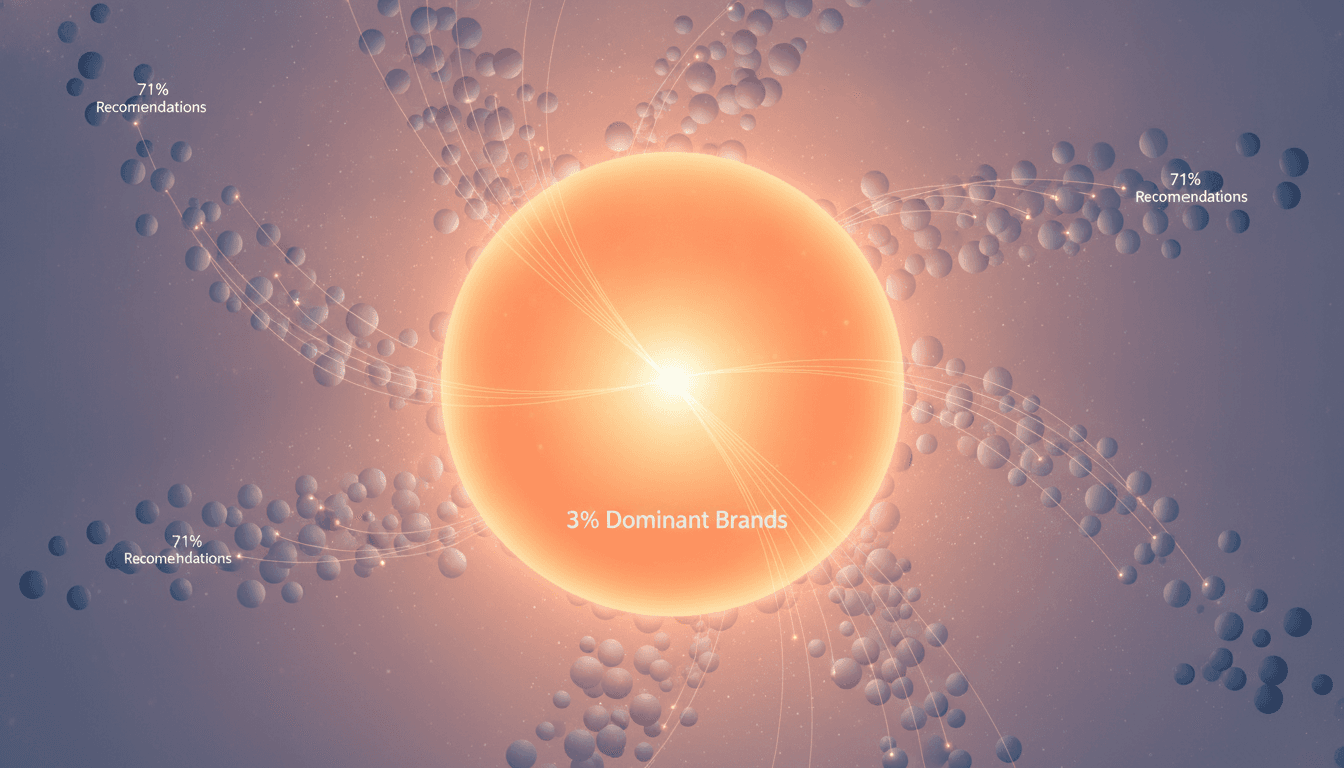
[IMG: Data visualization showing a power law curve with 3% of brands capturing 71% of AI citations, styled with Hexagon brand colors on a dark background]

Most e-commerce brands are likely invisible to the AI assistants their customers are already using to research products. The analysis of 100,000 product recommendation citations across ChatGPT, Perplexity, Claude, and Google AI Overview discovered something startling: just 3% of brands capture 71% of all AI recommendations. The brands dominating AI search aren't necessarily the ones with the best products or the biggest ad budgets—they're the ones optimizing for a citation economy most marketers don't even know exists yet.

This analysis reveals the seven structural factors that determine whether AI search engines recommend a brand. More importantly, it shows the high-ROI, low-competition tactics available right now to break into the top tier.


---


## The AI Citation Power Law: Why 3% of Brands Own 71% of Recommendations

Traditional search engine result pages distribute visibility across multiple results. Generative AI recommendation engines operate on fundamentally different logic—one that produces extreme winner-take-most outcomes.

In Google's traditional search, first-page dominance matters, but visibility still distributes across ten organic results, paid placements, and featured snippets. According to the [Hexagon AI Citation Analysis, 2025](https://joinhexagon.com), the top 3% of e-commerce brands by citation volume captured **71% of all AI product recommendations** across the four platforms studied. The bottom 50% of brands received fewer than **2% of total citations combined**.

This concentration reflects structural differences in how AI models evaluate and weight brand authority. It is not a temporary artifact of an immature market.

Consumer behavior data makes this concentration commercially urgent. According to the [Edelman Trust Barometer Special Report: AI and Commerce, 2025](https://www.edelman.com), **58% of U.S. consumers have used a generative AI tool to research a product before purchasing**. Usage is highest among 25–44 year olds (72%) and concentrated in beauty, electronics, and health categories.

Generative AI product recommendations now influence an estimated 19% of online purchase decisions among consumers aged 18–44, up from less than 4% in 2022, according to [Salesforce State of the Connected Customer, 2025](https://www.salesforce.com/resources/research-reports/state-of-the-connected-customer/). AI citation visibility is an active revenue channel today, not a future consideration. The brands that understand the citation economy are already pulling away from those that don't.


---


## The Research Methodology: How 100,000 AI Citations Were Analyzed

The research team tracked and categorized **100,000 product recommendation citations** across four major AI platforms: ChatGPT, Perplexity, Claude, and Google AI Overview. The focus was exclusively on direct-to-consumer and e-commerce brands operating in four high-intent verticals: beauty, fashion, health, and electronics. Data collection spanned **six months** to account for seasonal variation and platform algorithm changes.

For this analysis, a "citation" was defined as any brand mention appearing within an AI-generated product recommendation or comparison response. This included direct brand attribution, product-specific recommendations, and comparative rankings. The methodology excluded paid placements and focused exclusively on organic AI-generated content.

AI platforms update their underlying models continuously. The six-month collection window was specifically designed to smooth out these fluctuations and identify durable structural signals. The seven factors identified showed consistent predictive power across all four platforms and all four verticals studied.

[IMG: Infographic showing the four AI platforms analyzed, the 100,000 citation sample, and the six verticals studied, with clean data visualization layout]


---


## Factor #1: Editorial Authority—The 8.3x Citation Multiplier

Third-party editorial coverage emerged as the single most powerful predictor of AI citation frequency. Brands with **editorial coverage in three or more recognized publications** were cited **8.3x more frequently** than comparable brands with no meaningful earned media footprint. This effect held consistent across ChatGPT, Perplexity, Claude, and Google AI Overview.

AI models don't simply count brand mentions—they evaluate the credibility and independence of the sources doing the mentioning. A brand featured in Wirecutter, Good Housekeeping, or Byrdie carries fundamentally different signal weight than a brand mentioned only in its own press releases or paid content. Editorially independent coverage from recognized trade press, lifestyle media, and consumer review outlets functions as third-party trust verification that AI models are specifically trained to weight heavily.

The data reinforces this point decisively:

- **67% of top-cited brands** carried at least one placement in an established consumer publication within the previous 18 months
- Brands with **10 or more editorial placements** in recognized publications were cited 8.3x more frequently than brands relying solely on owned content and paid media
- Brands with **zero earned media footprint** were effectively invisible in AI recommendations across all four platforms
- The editorial authority signal held consistent across beauty, fashion, health, and electronics verticals

For most DTC brands, this means treating PR and content syndication as core generative engine optimization (GEO) infrastructure. The editorial coverage earned today becomes the citation authority held tomorrow.


---


## Factor #2: Semantic Consistency—The 3.2x Trust Signal

Brands with a defined, consistent voice and clear product positioning language were cited **3.2x more often** than brands with fragmented or inconsistent messaging across channels. Semantic consistency—measured across brand homepage, product pages, press materials, and third-party coverage—functions as a proxy for brand governance and authenticity in AI evaluation logic.

AI models synthesize information from multiple sources simultaneously. When a brand's homepage messaging, product descriptions, and third-party press coverage all use aligned language around the same core claims and positioning, the model receives a coherent, reinforcing signal. When those sources contradict or ignore each other, the model interprets fragmentation as a credibility risk.

For example, a brand claiming "sustainable" on its homepage but lacking sustainability language in product pages or press materials significantly underperforms in AI citation rates. Here's how to address this immediately:

- **Audit messaging across all brand channels**: homepage, product pages, press kit, third-party coverage
- **Standardize key brand claims**: identify the three to five core positioning statements that define the brand and ensure they appear consistently everywhere
- **Align owned and earned content**: work with PR partners to ensure editorial coverage reflects core positioning language, not just product features
- **Review for contradictions**: any channel where brand claims diverge is a citation liability

Unlike editorial coverage, semantic consistency is entirely within a brand's control and addressable immediately. This makes it one of the highest-ROI optimizations available without external dependencies.


---


## Factor #3: Structured Data Markup—The 2.6x Technical Advantage

Pages with comprehensive structured data markup are **2.6x more likely to be cited** in AI-generated product recommendations. Despite this significant mechanical advantage, only **11% of DTC brands** in the study had deployed structured data comprehensively across their product catalog. That small 11% accounted for **29% of all AI citations** in the dataset.

Here's how the technical logic works. When a brand lacks structured data, AI models must infer product attributes—ingredients, materials, certifications, reviews—from unstructured text. That inference process introduces uncertainty and reduces citation likelihood. Comprehensive Schema.org markup makes brand data directly machine-readable, removing that uncertainty.

The required schema types for e-commerce brands are:

- **Product**: core product attributes, pricing, availability
- **Review**: customer review data, ratings, review recency
- **FAQPage**: structured Q&A content that mirrors how consumers ask questions
- **BreadcrumbList**: site architecture signals
- **Organization**: brand-level authority and identity signals

With only 11% of DTC brands having implemented structured data comprehensively, this represents a low-competition, high-ROI optimization. The technical implementation barrier is lower than most marketing teams assume, and the citation upside is measurable and immediate.


---


## Factor #4: Vertical-Specific Authority Signals—One Size Does Not Fit All

Generic GEO strategy will systematically underperform. AI models apply vertical-specific filters when evaluating brand authority, and the citation signals that drive recommendations differ meaningfully by category. According to the [Hexagon AI Citation Analysis, 2025](https://joinhexagon.com), citation patterns vary significantly across verticals:

- **Beauty**: Ingredient transparency and dermatologist or expert endorsement language drove **63% of citations**. Brands without explicit expert validation language underperform regardless of product quality.
- **Fashion**: Sustainability credentials and size-inclusivity signals were present in **58% of cited brands**. Generic fashion positioning without these markers is effectively invisible in AI recommendations.
- **Health and wellness**: Clinical study references or registered dietitian attribution appeared in **71% of cited results**. MD, RD, and PhD endorsements are citation prerequisites, not optional credibility markers.
- **Electronics**: Technical specifications and third-party testing data are the dominant authority signals. Consumer-facing language without specification depth underperforms.

Understanding a vertical's specific authority signals isn't a refinement—it's a prerequisite for any GEO strategy that intends to produce measurable citation results.

[IMG: Vertical-specific authority signal breakdown chart showing beauty, fashion, health, and electronics citation drivers with percentage data]


---


## Factor #5: Cross-Platform Citation Momentum—The 91% Compounding Effect

Citation authority is self-reinforcing across platforms in a way that creates structural advantages for early movers. Brands cited by at least two of the four major AI platforms were **91% more likely to also appear** in the third and fourth platform's recommendations within 90 days. This cross-platform compounding effect means citation velocity accelerates once a brand establishes presence on multiple platforms.

The compounding mechanism reflects how AI models are trained. Platforms that index web content—including content generated by or about other AI recommendations—effectively amplify citation patterns that already exist. A brand appearing in Perplexity's recommendations becomes more likely to appear in Google AI Overview's recommendations as that content propagates across the web.

Here's how the platform landscape breaks down for emerging brands:

- **Perplexity AI** is the recommended entry point. It surfaces brands from outside the top 20% of domain authority rankings **34% of the time**—the highest citation diversity rate across all four platforms analyzed
- **ChatGPT and Claude** show higher concentration among established brands, making them harder entry points for brands building from a low citation baseline
- **Google AI Overview** compounds rapidly once a brand has established authority on other platforms


---


## Factor #6: The Execution Gap—Why 94% of DTC Brands Are Losing

Only **6% of DTC brands** have a documented generative engine optimization (GEO) strategy, according to [Forrester Research: The State of AI-Driven Commerce Marketing, 2025](https://www.forrester.com). That means **94% of DTC brands** are competing for AI citations without a formal approach to influencing how AI assistants represent or recommend them.

This gap is simultaneously the core risk for brands without a strategy and the primary opportunity for those willing to move first. The generative AI search market is projected to reach **$36.8 billion by 2030**, growing at a CAGR of 34.2%, according to [Grand View Research: Generative AI Market Report, 2025](https://www.grandviewresearch.com). Brands establishing AI citation authority now are building a compounding asset.

The current 6% GEO strategy adoption rate means the market is still in an early-mover phase where execution quality matters more than incumbent scale. Within 12–18 months, brands that have established cross-platform citation authority will have compounding structural advantages that late entrants will find increasingly difficult to overcome.


---


## The GEO Action Plan: Seven Steps to Break Into the Top 3%

The citation factors identified in this analysis are measurable, addressable, and actionable. Here's how to build a GEO strategy that moves a brand toward the top tier:

**Step 1: Audit current AI citation baseline.**
Query ChatGPT, Perplexity, Claude, and Google AI Overview for product category and track where the brand appears—and where it doesn't. This baseline establishes the starting point and identifies which platforms represent the highest-priority opportunities.

**Step 2: Implement comprehensive structured data markup.**
Start here. With only 11% competitor adoption and a 2.6x citation advantage, structured data is the highest-ROI, lowest-competition optimization available. Prioritize Product, Review, FAQPage, BreadcrumbList, and Organization schema types across the full product catalog.

**Step 3: Standardize semantic messaging across all brand touchpoints.**
Audit the homepage, product pages, press materials, and third-party coverage for messaging alignment. Identify contradictions and gaps. Standardize core brand claims and positioning language across every channel. This is immediately addressable and delivers a 3.2x citation advantage with no external dependencies.

**Step 4: Identify and build vertical-specific authority signals.**
Generic positioning underperforms. Map the specific citation drivers for the category—ingredient transparency for beauty, sustainability signals for fashion, clinical attribution for health—and build them explicitly into product pages, press materials, and content strategy.

**Step 5: Develop an earned media strategy targeting recognized publications.**
Editorial coverage is the single most powerful citation factor (8.3x multiplier). Identify the three to five publications in the category that carry the highest AI trust weight and build a PR strategy specifically targeting those placements.

**Step 6: Target Perplexity AI first.**
With a 34% non-dominant brand surfacing rate, Perplexity is the most accessible entry point for DTC brands building from a low citation baseline. Optimize content structure and FAQ formats specifically for Perplexity's citation patterns before expanding to other platforms.

**Step 7: Build cross-platform momentum within 90 days.**
The goal is to establish citation presence on at least two platforms within 90 days to trigger the 91% compounding effect. Prioritize Perplexity and Google AI Overview as the initial two-platform target, then allow cross-platform momentum to carry authority to ChatGPT and Claude naturally.


---


## What Happens Next: The Market Maturation Timeline

The current state of the generative AI search market is one of unusual opportunity. The execution gap is wide, incumbent advantages aren't yet locked in, and the structural factors driving citation authority are well-defined and addressable. That window won't stay open indefinitely.

The next 12–18 months represent the critical early-mover phase. Brands that establish editorial authority, implement structured data, and achieve cross-platform citation presence during this window will begin accumulating compounding momentum that makes their position increasingly difficult to displace.

Looking ahead to the 18–24 month horizon, market dynamics shift decisively. As the generative AI search market grows toward its projected $36.8 billion scale, the citation concentration identified in this research will likely intensify rather than moderate. Early movers will have structural advantages that late entrants face diminishing returns trying to overcome.


---


## Conclusion: The Citation Economy Is Open—But Not for Long

The data from 100,000 AI citations is unambiguous: AI recommendation visibility is determined by addressable, measurable structural factors—not by ad budget, social following, or even product quality alone. The brands in the top 3% have built editorial authority, semantic consistency, structured data infrastructure, and vertical-specific positioning that AI models are specifically designed to reward.

The window to act is real and measurable. With only 6% of DTC brands holding a documented GEO strategy, 94% of the market is effectively leaving AI citations to chance. The 58% of consumers already using AI for product research are being directed primarily toward the small group of brands that understood the citation economy early.

The seven factors in this analysis are not aspirational benchmarks. They're the specific, executable inputs that determine whether a brand exists in the AI recommendation layer or not. Editorial coverage, structured data, semantic consistency, and vertical-specific positioning are all within reach for brands willing to prioritize them.

The citation economy is open. The brands that move in the next 12–18 months will own AI search for the next decade.
H
Hexagon Team
Published August 10, 2026