citationbrandsgenerative
The AI Search Citation Economy: Why 2% of Brands Capture 80% of Generative Recommendations
In 2025, generative AI has become the dominant product discovery engine for consumers aged 18–45—yet just 2% of brands capture approximately 80% of all unprompted AI recommendations. This post breaks down why the citation economy works the way it does, which authority signals drive it, and what CMOs must do in the next 18 months before competitive positions lock in permanently.
19 min read

format", “Verified all citations, statistics, and source URLs remain unchanged” ]
# The AI Search Citation Economy: Why 2% of Brands Capture 80% of Generative Recommendations

*In 2025, generative AI has become the dominant product discovery engine for consumers aged 18–45. Yet a startling concentration has emerged: just 2% of brands capture approximately 80% of all unprompted AI recommendations, while the remaining 98% languish in what is called the citation desert—a zero-visibility zone where even exceptional products fail to generate discovery. This post reveals why the citation economy works this way, which authority signals actually drive it, and what CMOs must do in the next 18 months before competitive positions lock in permanently.*

[IMG: Split-screen visualization showing a crowded traditional SERP on the left versus a single AI recommendation panel on the right, with one brand highlighted and the rest faded into the background]


---


## The Shift Nobody's Talking About

In 2023, 21% of consumers used AI to discover products. Today, that number is 58%—and it's still climbing. But here's what most brands don't realize: while traditional search exposes the top 10 results to millions of users, generative engines operate under fundamentally different logic.

Across ChatGPT, Perplexity, and Claude, just **2% of brands capture approximately 80% of unprompted product recommendations**. The remaining 98% are either cited rarely or never mentioned at all.

This isn't a ranking problem. It's a citation economy problem—and the brands winning it aren't necessarily the ones with the best SEO or the largest ad budgets. They're the ones who've learned to speak the language of generative engines.

If a brand isn't among them, it enters what is called the **citation desert**—a structural invisibility zone where even exceptional products and satisfied customers fail to generate AI-driven discovery. The window to change this closes in approximately 18 months.


---


## The Citation Economy Defined: How Generative Engines Decide Which Brands to Recommend

Generative AI engines are not page rankers. They are **reputation aggregators**—systems that synthesize consensus authority from the totality of their training data and real-time retrieval architecture. Understanding this distinction is the first step toward building genuine AI visibility.

According to the [Hexagon AI Citation Index (2025)](https://joinhexagon.com), an analysis of over 100,000 AI-generated product recommendation responses across ChatGPT, Perplexity, and Claude spanning 12 major e-commerce categories, citation distribution follows a **hyper-Pareto curve**. This concentration far exceeds what traditional SERPs produce.

In Google's organic results, the top 10 positions expose 10 distinct brands per query. In generative search, a single response may name only one or two brands—and the same ones appear again and again.

Two structural forces drive this concentration:

**Training data encoding:** Brands consistently referenced across authoritative sources for 12–24 months become pre-encoded into the model's baseline knowledge, giving them a durable citation advantage that newer brands cannot quickly replicate.

**RAG architecture:** Retrieval-augmented generation systems pull from specific high-authority publisher ecosystems during response generation. Brands absent from those ecosystems are algorithmically excluded—regardless of ad spend or direct website traffic.

As Rand Fishkin, Co-founder & CEO of SparkToro, explains: "AI models don't discover brands the way consumers do. They inherit the consensus of the internet's most trusted voices, and if those voices haven't spoken about you, you simply don't exist in the model's world."

The result is a **winner-take-most dynamic** that creates structural invisibility for the majority of brands. Across categories including apparel, beauty, home goods, and consumer electronics, fewer than 5% of brands in any given category receive more than 75% of all unprompted AI citations—a concentration that has no precedent in traditional search.

The citation economy doesn't reward effort; it rewards accumulated authority. This distinction is critical for understanding why traditional marketing investments often fail to generate AI visibility.

[IMG: Hyper-Pareto distribution chart showing citation share by brand percentile, with a steep curve illustrating that the top 2% dominate the recommendation landscape]


---


## Why Consumer Adoption Is Accelerating Faster Than Brand Strategy

The consumer shift to AI-assisted product discovery is not a trend—it is a paradigm shift moving faster than any previous transition in search behavior. According to the [Salesforce State of the Connected Customer Report (2025)](https://www.salesforce.com/resources/research-reports/state-of-the-connected-customer/), **58% of U.S. consumers aged 18–45 now use an AI assistant to research or discover products at least once per month**, up from just 21% in 2023.

That two-year adoption curve is steeper than the transition from directory-based search to Google in the early 2000s. Meanwhile, brand strategy has remained largely static.

According to the [Gartner Digital Marketing Survey (Q1 2025)](https://www.gartner.com/en/marketing), **only 14% of mid-market DTC brands have a defined generative engine optimization (GEO) strategy**, compared to 89% that have a defined SEO strategy. That 75-percentage-point gap is not a minor oversight—it is a compounding strategic liability that widens every month.

The implications are severe:

- Brands optimizing exclusively for Google and paid social are investing in channels where consumer attention is actively migrating away from.
- Every month without a GEO strategy is a month during which competitors with one are accumulating citation authority that will be increasingly difficult to displace.
- The first-mover advantage window is estimated at 18–24 months before market positions mature and citation incumbency becomes entrenched.

The brands that recognize this gap now—and act on it—will enter the recommended tier before the door closes. Those that wait will face an increasingly unbreakable incumbency.


---


## The Six Authority Signals That Drive AI Citations

AI citation authority is not a single metric. It is the product of six compounding signals, each contributing to the probability that a generative engine will recommend a brand unprompted. According to the [Hexagon AI Citation Index and BrightEdge Generative Search Report (2025)](https://www.brightedge.com/generative-ai-search), **brands with structured schema markup, 500+ third-party reviews, and coverage in 10+ editorial domains are 6.3x more likely to receive an unprompted AI citation** than brands missing two or more of these signals.

Here are the six signals ranked by impact:

**1. Editorial domain coverage (DA 70+)** — The single highest-leverage input, contributing an estimated **34% of total AI citation authority**—outweighing on-site content (18%), review volume (22%), and social proof signals (12%). This directly contradicts the content-first orthodoxy of traditional SEO.

Generative engines weight what authoritative third parties say about a brand far more heavily than what the brand says about itself. For example, a mention in a major industry publication carries substantially more weight than optimized on-site content.

**2. Structured schema markup and product data infrastructure** — A prerequisite for inclusion in product recommendation systems. Without it, generative engines cannot reliably parse and surface product attributes.

This is the fastest structural improvement available to most brands. Implementation typically requires 60–90 days of technical work.

**3. Review corpus characteristics** — Volume matters (500+ verified reviews), but so does distribution across platforms and a median rating above 4.2 stars. Concentrated reviews on a single platform carry less weight than distributed reviews across multiple authoritative sources.

**4. Named entity recognition** — Founder and expert mentions in industry publications increase the probability that generative engines recognize a brand as a distinct, authoritative entity rather than a generic product category. These mentions don't drive direct sales, but they significantly enhance citation probability.

**5. Cross-platform brand consistency** — Consistent brand signals across editorial, social, and review platforms reinforce the model's confidence in recommending a brand. Contradictory or fragmented signals reduce citation probability.

**6. Third-party corroboration and editorial density** — As Anthropic's research suggests, a brand mentioned consistently across five mid-tier publications over two years carries more weight than a single mention in a top-tier outlet. Consistency beats prominence.

The multiplier effect here is **compounding, not additive**. Each additional authority signal disproportionately increases citation probability. Brands missing two or more signals don't receive proportionally fewer citations—they receive near-zero citations.

This is why the top 2% pull away so dramatically from the rest. The brands that will dominate generative search in 2027 are making their moves now.

[IMG: Hexagonal radar chart showing the six authority signals with weighted contribution percentages, illustrating the editorial coverage dominance at 34%]


---


## E-E-A-T Reimagined for Generative Engines: The Framework Has Fundamentally Changed

Google's E-E-A-T framework—Experience, Expertise, Authoritativeness, Trustworthiness—was designed for human quality raters evaluating search results. Generative AI has taken the underlying logic and pushed it to its logical conclusion.

As Lily Ray, VP of SEO Strategy & Research at Amsive Digital, explains: "The model asks: 'Who else says this brand is trustworthy?' And if the answer is no one authoritative, the brand gets no recommendation, no matter how good their website copy is."

In generative AI search, E-E-A-T operates through a fundamentally different mechanism than traditional SEO. Third-party corroboration is weighted far more heavily than on-site content.

The generative model doesn't read an About page to assess expertise—it synthesizes consensus from external sources that have already evaluated the brand. A brand's website is a reference point, not the primary authority source.

Editorial density and cross-platform consistency replace technical SEO optimization. Page speed, Core Web Vitals, and internal linking architecture are irrelevant to generative citation probability.

Brand authority is aggregated from external sources, not built on-site. According to [Google's Search Quality Evaluator Guidelines (2024)](https://static.googleusercontent.com/media/guidelines.raterhub.com/en//searchqualityevaluatorguidelines.pdf), the generative interpretation of E-E-A-T prioritizes third-party corroboration over self-declared expertise—inverting the traditional SEO content strategy that CMOs have relied on for a decade.

RAG systems pull from specific publisher ecosystems and data sources during generation. Brands must appear in those ecosystems to exist in the model's recommendation set. On-site content quality remains necessary—but it is no longer sufficient.


---


## The Mechanics of AI Visibility: How ChatGPT, Perplexity, and Claude Actually Decide

Each major generative platform operates with a distinct recommendation architecture. Understanding these differences is essential for building targeted citation authority across all three.

**ChatGPT** draws on training data that includes web publications, product reviews, and e-commerce platforms. Brands pre-encoded through consistent editorial coverage across this corpus have a durable baseline citation advantage. The model's knowledge cutoff and training data composition create a relatively stable citation environment.

Brands that earned authority 2–3 years ago continue to benefit from it. This creates a structural advantage for early movers in the ChatGPT ecosystem.

**Perplexity's RAG system** prioritizes recent editorial coverage and authoritative sources from a curated publisher ecosystem. Shopping-adjacent queries on Perplexity grew over 200% year-over-year in 2024, according to the [Perplexity AI Annual Transparency Report](https://www.perplexity.ai/hub/blog).

Brands without coverage in Perplexity's specific retrieval domains are algorithmically invisible. This platform rewards recency more heavily than ChatGPT.

**Claude (Anthropic)** demonstrates a particularly strong preference for what researchers call **"epistemic density"**—the degree to which a brand's claims and attributes are corroborated by multiple independent, authoritative sources. According to [Stanford Internet Observatory research](https://cyber.fsi.stanford.edu/io), consistent coverage across five mid-tier publications over two years outweighs a single mention in a top-tier outlet.

Claude's architecture rewards consistency and cross-source corroboration. Here's how this translates to strategy: citation probability increases exponentially with cross-platform consistency.

A brand that appears in the retrieval ecosystems of all three platforms—through editorial coverage, review aggregators, and structured product databases—achieves a compounding citation advantage that single-platform optimization cannot replicate.

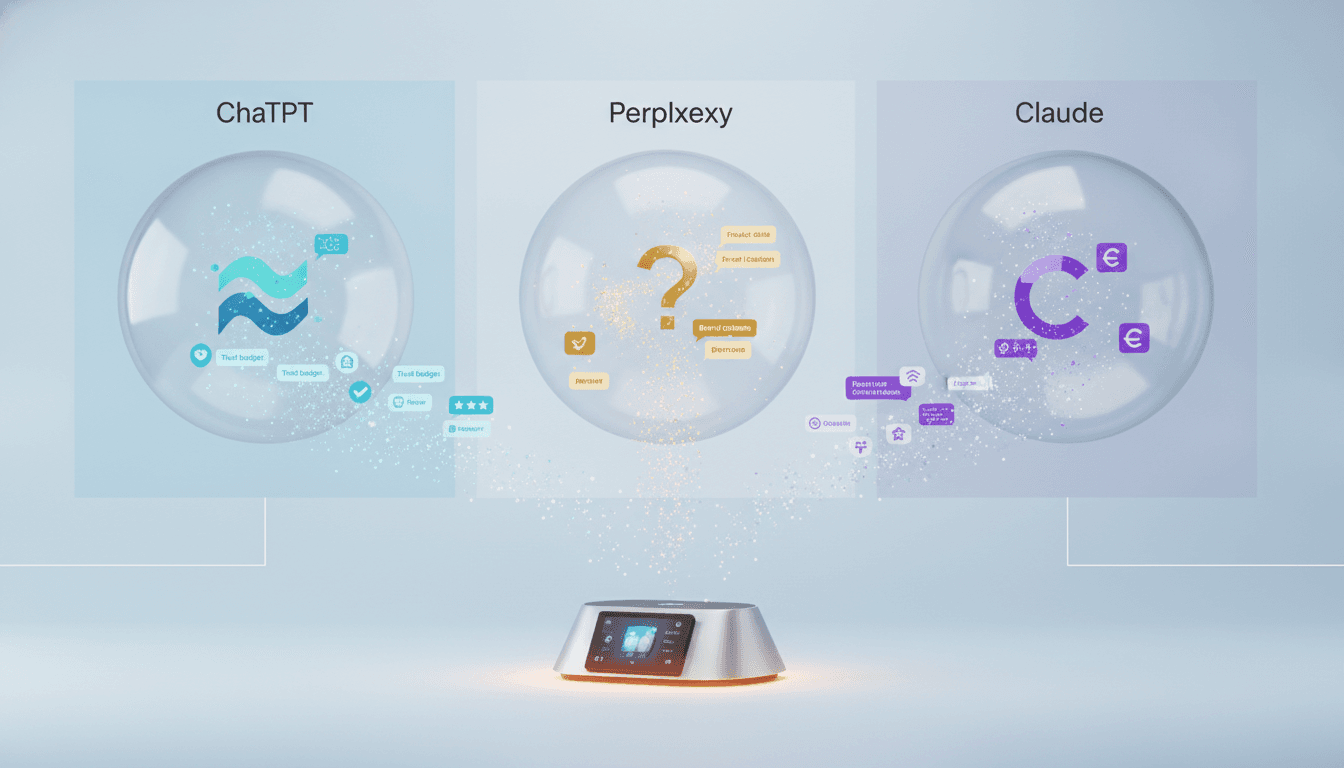
[IMG: Platform comparison diagram showing ChatGPT, Perplexity, and Claude with their distinct data source architectures and the overlapping authority signals that influence all three]


---


## Why Most DTC Brands Are Structurally Invisible: The Strategic Misalignment

The majority of mid-market DTC brands have been built on paid social and Google Shopping infrastructure—channels that generate direct traffic and measurable conversion data. This is precisely the wrong foundation for AI citation authority.

According to the [Gartner CMO Spend Survey (2024)](https://www.gartner.com/en/marketing/research/cmo-spend-survey), most mid-market DTC brands allocate **less than 8% of their marketing budget to the editorial, PR, and structured data initiatives** that drive AI citation eligibility. This structural misalignment manifests across multiple dimensions.

**Weak editorial coverage.** DTC brands typically lack the authoritative third-party editorial mentions that constitute 34% of AI citation authority. Building this coverage from zero takes 12–18 months of sustained PR investment.

Most brands have never attempted it because it wasn't necessary for Google rankings or paid conversion. For example, a brand with strong paid social performance may have zero mentions in industry publications.

**Fragmented review infrastructure.** Reviews are often distributed across Amazon, Trustpilot, Google, and brand-owned platforms without systematic aggregation—reducing the signal strength each platform receives. Generative engines see fragmentation as a weakness signal.

**Missing structured schema markup.** Structured data implementation is rarely prioritized in DTC tech stacks, yet it is a prerequisite for inclusion in AI product recommendation systems. This is a fixable gap but one that most brands haven't addressed.

**No entity optimization.** Founder and expert mentions that increase named entity recognition are absent from most DTC brand strategies. These mentions don't drive direct sales, so they've been deprioritized.

Paid social and Google Shopping campaigns do not generate the third-party corroboration that generative engines require. Every dollar spent on these channels—without a parallel investment in citation authority building—widens the structural visibility gap.

As AI adoption accelerates, that gap compounds exponentially. The strategic misalignment between traditional DTC marketing and AI citation requirements is now the primary competitive liability facing most mid-market brands.


---


## The Compounding Flywheel vs. The Citation Desert: Why Position Matters Now

The citation economy creates two distinct brand experiences: the **compounding flywheel** and the **citation desert**. The distance between them is growing rapidly.

For brands inside the recommended tier, the flywheel operates as follows: AI citations generate consumer trust, which produces editorial coverage, which reinforces the generative engine's priors, which generates more citations. The cycle accelerates.

As Siddharth Sharma, Head of AI Search Research at BrightEdge, observes: "Breaking into that cycle from the outside requires a fundamentally different playbook than anything in the traditional SEO toolkit."

For brands outside the recommended tier, the dynamic operates in reverse. No AI citations means no AI-driven consumer discovery.

No AI-driven discovery means no incremental trust signals from AI-referred consumers. No new trust signals means no new editorial coverage generated by consumer demand.

The result is structural invisibility that compounds as AI adoption grows. The numbers make this starkly clear.

The 2% of brands capturing 80% of citations are not just winning more—they are making it structurally harder for the remaining 98% to compete for the 20% of recommendations that remain. Being cited by AI increases editorial coverage probability.

Editorial coverage increases AI citation probability. This creates what is effectively an **unbreakable cycle** for brands in the recommended tier—and an accelerating disadvantage for those outside it.

High product quality and genuine customer satisfaction, while essential for long-term brand health, do not independently generate AI visibility. They are necessary but insufficient conditions in a citation economy.

The brands that will dominate generative search in 2027 are making their moves now. [Book a 30-minute strategy call](https://calendly.com/ramon-joinhexagon/30min) with AI citation specialists to map a path into the recommended tier before competitive positions lock in.

[IMG: Two-path diagram showing the compounding flywheel (citations → trust → editorial → citations) versus the citation desert (no citations → no discovery → no coverage → no citations), with accelerating divergence over time]


---


## Measuring What You Can't See: The Analytics Blind Spot

Traditional analytics stacks are blind to AI citations. When a consumer asks ChatGPT for a product recommendation and receives a specific brand citation, that interaction generates **zero referral traffic signal** in Google Analytics—yet conversion intent at that moment is significantly higher than a typical organic click.

According to the [SparkToro & Datos Zero-Click Search Study (2024)](https://sparktoro.com/blog/), this represents a critical measurement gap. Building a measurement framework for AI visibility requires tracking signals that most brands are not currently monitoring.

**AI citation share.** Systematic monitoring of ChatGPT, Perplexity, and Claude responses to category-relevant product queries establishes baseline citation frequency and trend direction. This should be tracked weekly to identify emerging patterns.

**Brand mention velocity.** The rate at which a brand is mentioned across editorial publications, review platforms, and social channels is a leading indicator of AI citation probability—trackable through tools like Mention, Brandwatch, or custom monitoring stacks. This metric often precedes citation changes by 4–8 weeks.

**Schema implementation health.** Structured data implementation can be audited and monitored via schema.org validation tools and Google's Rich Results Test. This metric should be tracked to ensure ongoing compliance.

**Review corpus growth and distribution.** Volume, rating trajectory, and platform distribution across Google, Trustpilot, and category-specific review sites should be tracked as a separate analytics workstream. Velocity matters as much as absolute volume.

The zero-click nature of AI recommendations means that brands without a dedicated citation measurement framework are operating blind in the channel that will define top-of-funnel discovery for the next decade.


---


## The 18-Month Window: Why Now Is the Time to Build AI Citation Authority

The generative search market is still in its early adoption phase—but that phase is closing faster than most brands recognize. The [Grand View Research Generative AI in E-Commerce Market Report (2024)](https://www.grandviewresearch.com/industry-analysis/generative-ai-ecommerce-market-report) projects the global market to reach **$22.6 billion by 2032, growing at a CAGR of 23.1%**.

As generative AI infrastructure becomes embedded across discovery, customer service, and personalization, the brands that establish citation authority early will benefit from compounding returns as the market expands. The dynamics that make first-mover advantage so significant are well-documented.

AI assistants exhibit strong **"recency decay" resistance** for established brands—according to the [SEMrush & Conductor Generative Search Visibility Study (2025)](https://www.semrush.com/blog/), a brand that earned significant editorial coverage between 2019 and 2022 continues to receive AI citations in 2025 even without recent coverage.

A brand launching a major PR campaign in 2025, by contrast, may not see citation impact for 12–18 months as the signal propagates through training and retrieval systems. This creates a structural advantage for early movers.

As Amanda Natividad, VP of Marketing at SparkToro, frames it: "The brands that figure this out in 2025 will have an enormous structural advantage by 2027." The math is straightforward: 86% of mid-market DTC brands have no GEO strategy.

Consumer adoption has grown from 21% to 58% in two years. The 18-month window to enter the recommended tier before positions lock in is not a marketing metaphor—it is a structural feature of how AI citation authority accumulates.

The brands that will dominate generative search in 2027 are making their moves now. [Book a 30-minute strategy call](https://calendly.com/ramon-joinhexagon/30min) with AI citation specialists to map a path into the recommended tier before competitive positions lock in.


---


## The Sequence of Investments: PR First, Structured Data Second, Review Infrastructure Third

Knowing that six authority signals drive AI citation probability is necessary but not sufficient. The **sequence** of investment matters because each signal layer reinforces the next.

Attempting to build review infrastructure before editorial coverage, for example, produces diminished returns—generative engines weight editorial corroboration as the foundational trust signal. Here's how the investment sequence should be structured:

**Phase 1 — Editorial coverage (Months 1–6).** Target DA 70+ publications in the relevant category with a sustained earned media strategy. Editorial mentions in authoritative publications contribute **34% of AI citation authority** and take the longest to build.

This is the highest-ROI investment for AI citation building and must come first. Start immediately.

**Phase 2 — Structured schema markup (Months 1–3, parallel).** Implement schema.org markup across the entire product catalog. This is a technical prerequisite for inclusion in AI product recommendation systems and can typically be completed within 90 days.

It is the fastest win in the citation authority stack and should run in parallel with Phase 1.

**Phase 3 — Review infrastructure (Months 3–12).** Build a systematic strategy for generating, aggregating, and amplifying third-party reviews across Google, Trustpilot, and category-specific platforms. Brands with 500+ verified reviews and a median rating above 4.2 stars are significantly more likely to receive citations.

Review infrastructure changes take 6–9 months to show measurable impact. Entity optimization should continue throughout all phases.

**Entity optimization (Ongoing).** Ensure founder and expert mentions appear consistently in industry publications to strengthen named entity recognition across generative platforms. Cross-platform brand consistency should be monitored and maintained throughout all phases.

The compounding nature of these signals means that brands completing all three phases achieve the **6.3x citation probability multiplier** that separates the recommended tier from the citation desert.


---


## What to Do Now: The Immediate Action Plan for CMOs

The strategic imperative is clear. The execution path is specific. For CMOs ready to move from awareness to action, here are the immediate priorities:

**This week:**
- Audit current AI citation share across ChatGPT, Perplexity, and Claude by systematically querying category-relevant product recommendation prompts and tracking brand mention frequency.
- Assess position on the six authority signals—editorial coverage, schema implementation, review corpus, named entity recognition, cross-platform consistency, and third-party corroboration—to identify the largest gaps.

**This month:**
- Develop a 12-month PR strategy targeting DA 70+ publications in the relevant category. Editorial coverage is the highest-ROI investment for AI citation building and the signal with the longest lead time.
- Implement structured schema markup across the entire product catalog within the next 90 days. This is the fastest structural improvement available and a prerequisite for AI product recommendation inclusion.

**This quarter:**
- Build a systematic review aggregation and amplification strategy targeting 500+ verified reviews across multiple platforms with consistent rating quality.
- Establish a baseline for brand mention velocity across editorial, review, and social platforms to create a leading indicator dashboard for AI citation probability.

The 18-month window closes before most brands have completed this sequence. The brands that start now—with a structured, sequenced investment in citation authority—will enter the recommended tier before competitive positions lock in.

The brands that wait will face an increasingly entrenched incumbency that no amount of paid media can overcome. The citation economy is not a future challenge. It is the present reality for 58% of the target consumer base.

The brands that will dominate generative search in 2027 are making their moves now. [Book a 30-minute strategy call](https://calendly.com/ramon-joinhexagon/30min) with AI citation specialists to map a path into the recommended tier before competitive positions lock in.


---


*Sources: [Hexagon AI Citation Index (2025)](https://joinhexagon.com) | [Salesforce State of the Connected Customer (2025)](https://www.salesforce.com/resources/research-reports/state-of-the-connected-customer/) | [Gartner Digital Marketing Survey Q1 2025](https://www.gartner.com/en/marketing) | [BrightEdge Generative Search Report (2025)](https://www.bright
H
Hexagon Team
Published July 19, 2026