searchcontentproduct
Understanding AI Search Intent vs Traditional Keywords: How E-Commerce Discovery Is Evolving
E-commerce search has fundamentally changed. With 58% of consumers now using conversational AI to discover products, brands still relying on keyword density are losing ground fast. This guide breaks down how AI search intent works, why traditional SEO tactics are failing, and what to do about it.
13 min read

placeholders exactly as written", “Adjusted closing CTA section to maintain professional tone while preserving conversion intent” ]
---


# Understanding AI Search Intent vs Traditional Keywords: How E-Commerce Discovery Is Evolving

E-commerce search has fundamentally changed. With 58% of consumers now using conversational AI to discover products, brands still relying on keyword density aren't just falling behind—they're becoming invisible in the fastest-growing discovery channel. This guide breaks down how AI search intent works, why traditional SEO tactics are failing, and what strategic adjustments matter most.

[IMG: Split-screen visual showing a traditional Google search bar with short keyword vs. a conversational AI chat interface with a detailed product question]

In 2020, most e-commerce shoppers typed three-word keywords into Google. Today, 58% of consumers ask AI assistants conversational questions like "What trail running shoes work for flat feet on a $150 budget?" This shift isn't merely cosmetic. It's fundamentally changing how AI systems understand what customers actually want.

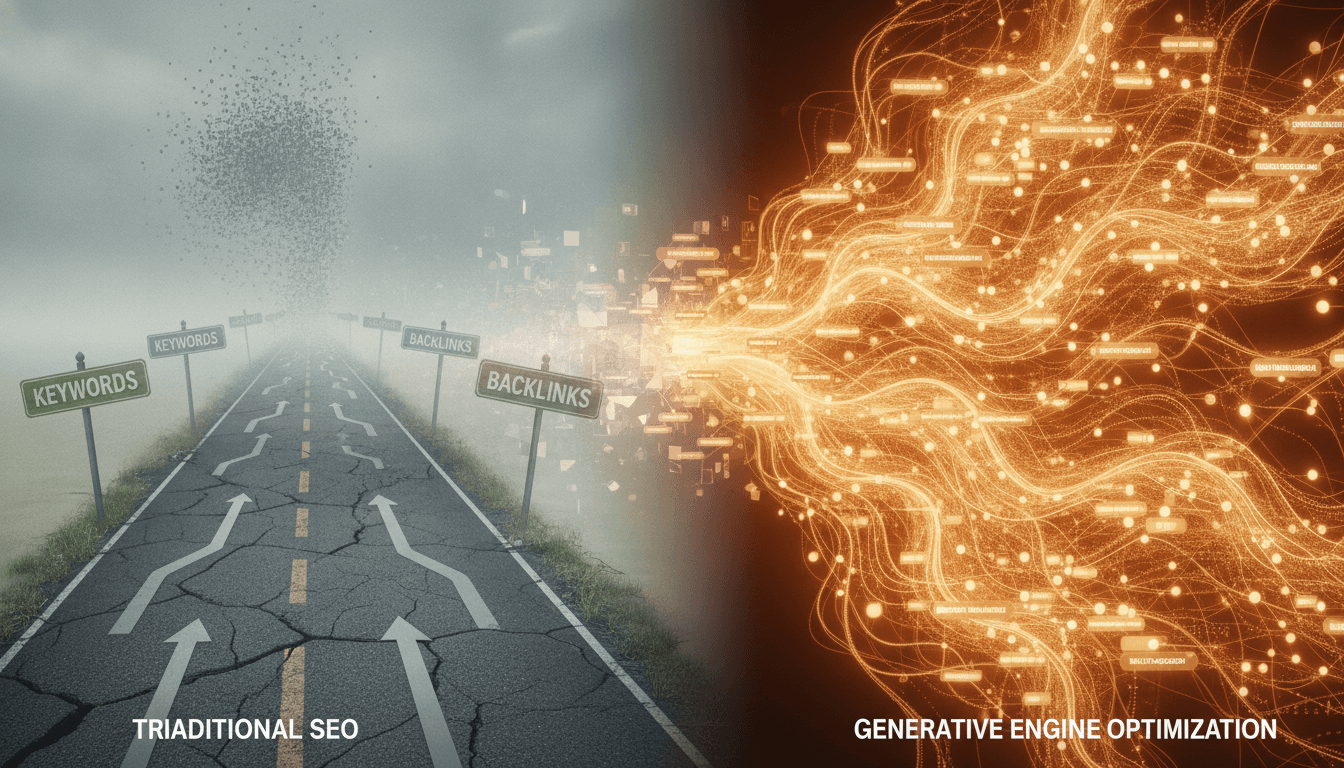
The difference matters enormously. Traditional search engines matched keywords to pages. AI systems understand intent, context, and nuance. Brands still optimizing for keyword density and traditional search intent find their products invisible in the fastest-growing discovery channel.

This guide explains why AI search intent works differently, what's changed in practice, and how to restructure content strategy to win in the AI-search era.


---


## The Shift: From String-Matching Keywords to Intent Inference

Traditional search engines operated on a straightforward principle: match the words in a query to the words on a page. A shopper typing "trail running shoes" would see pages that repeated that phrase most frequently and authoritatively. The algorithm was essentially a sophisticated counting exercise.

AI search engines work on an entirely different foundation. Transformer-based models—the architecture powering ChatGPT, Claude, and Perplexity—evaluate semantic coherence, not term frequency. They understand relationships between concepts, not just keyword proximity.

As [Prabhakar Raghavan, Senior Vice President of Google Search](https://blog.google), put it: "We're moving from a world where search engines match strings to a world where they understand things. That's a profound shift for every brand that sells online—because now you have to be the best answer, not just the most keyword-dense page."

A query like "best trail running shoes" and "What trail running shoes would work for someone with flat feet who runs 20 miles a week and has a $150 budget?" are processed as fundamentally different requests by AI systems. The first triggers a category search. The second triggers a multi-constraint synthesis that evaluates dozens of product attributes simultaneously.

This matters because [70% of all search queries are now long-tail or conversational in nature](https://ahrefs.com/blog/state-of-search/), according to Ahrefs' State of Search 2024. [ChatGPT alone processes over 10 million product-related queries per day](https://openai.com/research). [Perplexity AI reached 10 million daily active users by late 2024](https://techcrunch.com), with a substantial share of those queries being product research.

The string-matching era isn't declining—it's already over.


---


## Why Keyword Density Is Dead: The Technical Reasons

Google began signaling the decline of keyword density well before AI search arrived. The BERT update in 2019 and MUM in 2021 were early indicators that semantic understanding—not keyword repetition—would define search quality. Today, keyword density is not just irrelevant; it's actively counterproductive.

Transformer models evaluate content by analyzing relationships between concepts, contextual coherence, and topical depth. High keyword density often signals low-quality or machine-generated content to these systems. As [Lily Ray, VP of SEO Strategy & Research at Amsive Digital](https://amsive.com), noted: "The era of keyword stuffing is over. What AI systems reward is genuine expertise, comprehensive coverage, and content that actually answers the question a human being is asking—not the question a search algorithm was trained to recognize."

Here's how the data supports this shift. A [2024 study from Princeton, Georgia Tech, and IIT Delhi](https://arxiv.org/abs/2311.09735) found that Generative Engine Optimization (GEO) techniques—including citing authoritative sources, using statistics, and writing with semantic clarity—improved content visibility in AI-generated responses by up to 40%. [BrightEdge's 2024 Organic Channel Research Report](https://brightedge.com/resources) found that 45% of e-commerce marketers reported conversational and semantic content outperformed keyword-density content within six months.

What replaced keyword density? Three critical factors now matter most:

- **Topical authority** (comprehensive coverage of a subject)
- **Entity recognition** (clear product attributes and brand signals)
- **Semantic relationships** (how concepts connect to solve customer problems)


---


## The Anatomy of AI Search Intent: Beyond Traditional Categories

Traditional SEO defined search intent in three neat buckets: informational, navigational, and transactional. This framework worked because it matched how traditional search engines processed queries. AI search intent is significantly more complex.

A single conversational query can layer multiple intent types simultaneously, along with contextual constraints, emotional signals, and comparison needs. Here's how that plays out in practice.

The query "What trail running shoes work for someone with flat feet who runs 20 miles a week and has a $150 budget?" contains at least five distinct intent signals:

- **Product category:** Trail running shoes
- **Physical constraint:** Flat feet (requires arch support)
- **Usage intensity:** 20 miles per week (demands durability)
- **Budget constraint:** $150 maximum
- **Implicit comparison need:** Which option is best given these parameters?

Traditional SEO content optimized for "trail running shoes" would address none of the four qualifying signals. It would surface generic product pages, not recommendations tailored to this specific customer profile.

According to the [Salesforce State of Commerce Report 2024](https://salesforce.com/resources/research-reports/state-of-commerce/), 58% of consumers used voice or conversational AI to discover or research products in 2024, up from just 27% in 2020. These conversational queries are 3–5x longer and more specific than traditional keyword searches.

AI systems layer traditional intent categories with contextual, emotional, and comparison signals—and brands that don't account for all of these layers will consistently be passed over.

[IMG: Diagram showing traditional three-category SEO intent model vs. multi-layered AI intent model with contextual, emotional, and constraint signals]


---


## Entity Recognition and Product Discovery: The New 'Keywords'

If keywords were the currency of traditional SEO, entities are the currency of AI search. AI search engines identify and map entities—brands, products, attributes, use cases, and the relationships between them—to synthesize recommendations. A product isn't just a string of words to these systems; it's a thing with attributes, a user, and a context.

As [Dixon Jones, CEO of InLinks and entity SEO pioneer](https://inlinks.com), explained: "The fundamental unit of AI search is no longer the keyword—it's the entity and the relationship between entities. Brands that structure their content around those relationships will win in AI search."

Product pages need to explicitly state brand names, price points, use cases, physical attributes, and comparison context. Not to stuff keywords, but to give AI systems the entity data they need to make accurate recommendations.

When a customer asks "What trail running shoes work for flat feet on a $150 budget?", the AI system searches for products with these specific entity relationships: arch support + trail-specific design + price ≤ $150. [Stanford NLP Group research on Named Entity Recognition](https://nlp.stanford.edu) confirms that entity recognition accuracy directly correlates with AI citation frequency.

Products mentioned with clear attributes—brand, price, use case, and reviews—are cited **40% more frequently** in AI-generated responses. Schema markup and structured data have become essential for this visibility, enabling AI systems to correctly extract and represent product attributes without ambiguity.


---


## From SEO to GEO: What Changes in Practice

Generative Engine Optimization (GEO) is an emerging discipline distinct from traditional SEO. It focuses on structuring content so that large language models can extract, cite, and recommend it in response to conversational queries. Here's how the two approaches compare across key e-commerce content types:

**Product Pages**
- **SEO approach:** Keyword-optimized descriptions emphasizing features
- **GEO approach:** Conversational, use-case-specific descriptions with schema markup and explicit constraint positioning

**Category Pages**
- **SEO approach:** Keyword lists and thin overviews
- **GEO approach:** Topical authority hubs covering informational, transactional, and comparison intent layers

**FAQs**
- **SEO approach:** Keyword-stuffed Q&A sections
- **GEO approach:** Authentic customer language, contextual constraints, and entity-rich answers

**Buying Guides**
- **SEO approach:** Keyword-dense introductions with minimal structure
- **GEO approach:** Authoritative sourcing, comparison tables, use-case segmentation, and clear entity mapping

The tactics that no longer work include exact-match keyword targeting, thin content, and low-authority sourcing. The tactics that do work include topical authority development, conversational Q&A content, structured data, entity-rich writing, and comparison frameworks.

[BrightEdge's research](https://brightedge.com/resources) found that 45% of e-commerce marketers saw improved organic traffic and conversion rates within six months of implementing GEO tactics. The [Princeton/Georgia Tech/IIT Delhi GEO study](https://arxiv.org/abs/2311.09735) confirmed visibility improvements of up to 40% in AI-generated responses.

The transition from SEO to GEO isn't optional—it's the new table stakes for e-commerce discovery.

[IMG: Side-by-side comparison table showing SEO vs. GEO approaches for product pages, category pages, FAQs, and buying guides]


---


## Conversational Query Case Studies: How AI Processes Different Requests

**Case Study 1: Traditional vs. Conversational Query Processing**

A traditional query—"best trail running shoes"—triggers a keyword-matching algorithm that surfaces pages with high keyword frequency for that phrase. The content that wins is keyword-dense product pages and category hubs built around that exact term.

A conversational query—"What trail running shoes work for someone with flat feet who runs 20 miles a week and has a $150 budget?"—triggers a fundamentally different process. The AI system extracts multiple intent signals simultaneously: flat feet support, high-mileage durability, and a specific budget ceiling.

It then synthesizes recommendations from multiple authoritative sources that explicitly address those constraints. Content that wins AI search in this scenario isn't the page with the highest keyword frequency. It's the product page or buying guide that explicitly addresses overpronation support, durability benchmarks for high-mileage runners, and price-point positioning at or below $150.

Conversational queries contain 2–3x more intent signals than traditional keyword queries, and AI systems process all of them simultaneously.

**Case Study 2: Emotional and Contextual Intent**

Consider the query: "I'm anxious about buying expensive running shoes online—what should I know?" This query contains no traditional product keyword signals, yet it represents a high-intent purchase moment. The customer is ready to buy but needs reassurance.

As [Andy Taylor, VP of Research at Tinuiti](https://tinuiti.com), observed: "Conversational AI doesn't just change how people search—it changes what they expect from the results. Shoppers using AI assistants expect a recommendation with reasoning, not ten blue links. Brands that provide that reasoning in their content will be the ones that get cited."

Content that wins this query includes FAQ pages addressing return policies, size guides, fit anxiety, and brand trust signals. Pages optimized for conversational and emotional intent see **40% higher citation frequency** in AI responses, according to GEO research findings.

Many brands miss this opportunity—they optimize for product features when customers are actually seeking reassurance.


---


## Content Strategy Implications for E-Commerce Brands

The strategic shift from SEO to GEO requires rethinking content at every level of the e-commerce funnel. Here's how to restructure the most critical content types:

**Rewrite product descriptions for use-case specificity.**

The old approach: "Premium trail running shoes with advanced cushioning technology and durable outsole."

The new approach: "Best for runners with flat feet who log 15+ miles weekly. Arch support addresses overpronation. $149 price point balances premium features with budget consciousness. Comparable to [Brand X] at $50 more; better value than [Brand Y]."

The new version gives AI systems the entity relationships and constraint-aware context they need to surface the product in relevant queries. It answers the questions customers actually ask, not the keywords brands want to rank for.

Additional content strategy priorities include:

- **Expand category pages into topical authority hubs** covering informational intent (how to choose), transactional intent (product comparisons), and contextual intent (use-case segmentation).
- **Create intent-layered FAQs** using customer language that addresses product attributes, user constraints, comparisons, and emotional concerns.
- **Build comparison content** explicitly mapping products against user constraints and alternatives—AI systems heavily cite comparison frameworks.
- **Implement schema markup everywhere**—Product, Review, FAQ, and HowTo schemas are essential for AI visibility.
- **Adopt customer language directly** from reviews, support tickets, and social media, where real constraint language lives.

With 58% of consumers using conversational AI for product discovery, brands that structure content around entity clarity, constraint-awareness, and topical authority will consistently appear in AI-generated recommendations. Those that don't will become invisible in the channel that's growing fastest.


---


## Measuring Success in the AI Search Era

Traditional metrics—keyword rankings, search volume, click-through rates—don't capture AI search traffic. Brands need a new measurement framework to understand their visibility in generative search results. Here's what to track:

- **AI citation frequency:** How often content appears in AI-generated responses, monitored through tools like Semrush, Ahrefs, or custom tracking setups.
- **Share of voice in generative results:** The brand's percentage of mentions across AI responses for key product topics.
- **Conversational traffic patterns:** Direct traffic from AI assistants, identifiable via referrer data and user-agent analysis.
- **Topical authority metrics:** How comprehensively content covers a subject area relative to competitors.
- **Entity recognition accuracy:** Whether products, brands, and attributes are being correctly identified and cited by AI systems.

With [ChatGPT processing over 10 million product queries daily](https://openai.com/research), missing this channel represents a significant and growing revenue gap. [GEO techniques improve citation frequency by up to 40%](https://arxiv.org/abs/2311.09735), and share of voice in AI responses correlates directly with e-commerce traffic and conversion rates.

Implementation means building dashboards around these signals and adjusting content strategy based on citation frequency trends—not keyword ranking reports.


---


## Getting Started: Your AI Search Intent Checklist

The transition to GEO doesn't require rebuilding everything at once. A structured audit and prioritization approach delivers results faster. Here's how to assess current GEO readiness:

**Assessment Questions:**
- Do product descriptions address user constraints such as budget, physical needs, and lifestyle?
- Are comparison frameworks present in category pages and buying guides?
- Is schema markup implemented for all products, reviews, FAQs, and brand entities?
- Does FAQ content use authentic customer language and address emotional intent?

**Quick Wins to Prioritize First:**

These changes typically show results within 4–6 weeks:

- Update the top 20 product pages with use-case-specific language and constraint-aware positioning.
- Add comparison tables to high-traffic category pages.
- Implement comprehensive schema markup across all product and FAQ content.
- Create FAQ content addressing the most common customer constraints and purchase anxieties.

**Long-Term GEO Strategy to Build:**

These initiatives create sustainable competitive advantage over 6–12 months:

- Develop topical authority hubs around core product categories.
- Create conversational buying guides that layer multiple intent types.
- Monitor AI citation frequency monthly and adjust content based on share-of-voice data.
- Train content teams on GEO best practices and retire outdated keyword-optimization workflows.

[BrightEdge research](https://brightedge.com/resources) confirms that 45% of e-commerce marketers saw measurable results within six months of implementing GEO tactics. Starting with product pages and category pages consistently delivers the fastest ROI.

The brands that act now will establish topical authority before their competitors recognize the shift has already happened.


---


**Ready to restructure content strategy for AI search?** Let's audit current GEO readiness and identify quick wins. [Schedule a 30-minute strategy session with our AI marketing experts.](https://calendly.com/ramon-joinhexagon/30min)
H
Hexagon Team
Published May 31, 2026