brandsbrandperplexity
The AI Search Algorithm Hierarchy: How ChatGPT, Perplexity, and Claude Actually Rank E-Commerce Brands (2026)
58% of consumers under 45 now use AI assistants to research purchases—but only 14% of e-commerce brands have optimized for these algorithms. This guide breaks down exactly how ChatGPT, Perplexity, and Claude rank e-commerce brands differently, and what it takes to win in each engine before the first-mover window closes.
17 min read
# The AI Search Algorithm Hierarchy: How ChatGPT, Perplexity, and Claude Actually Rank E-Commerce Brands (2026)

*58% of consumers under 45 now use AI assistants to research purchases—but only 14% of e-commerce brands have optimized for these algorithms. There is no position 8 in AI search. Brands either appear in the first recommendation or they're invisible. This guide breaks down exactly how ChatGPT, Perplexity, and Claude rank e-commerce brands differently, and what it takes to win before the first-mover window closes.*

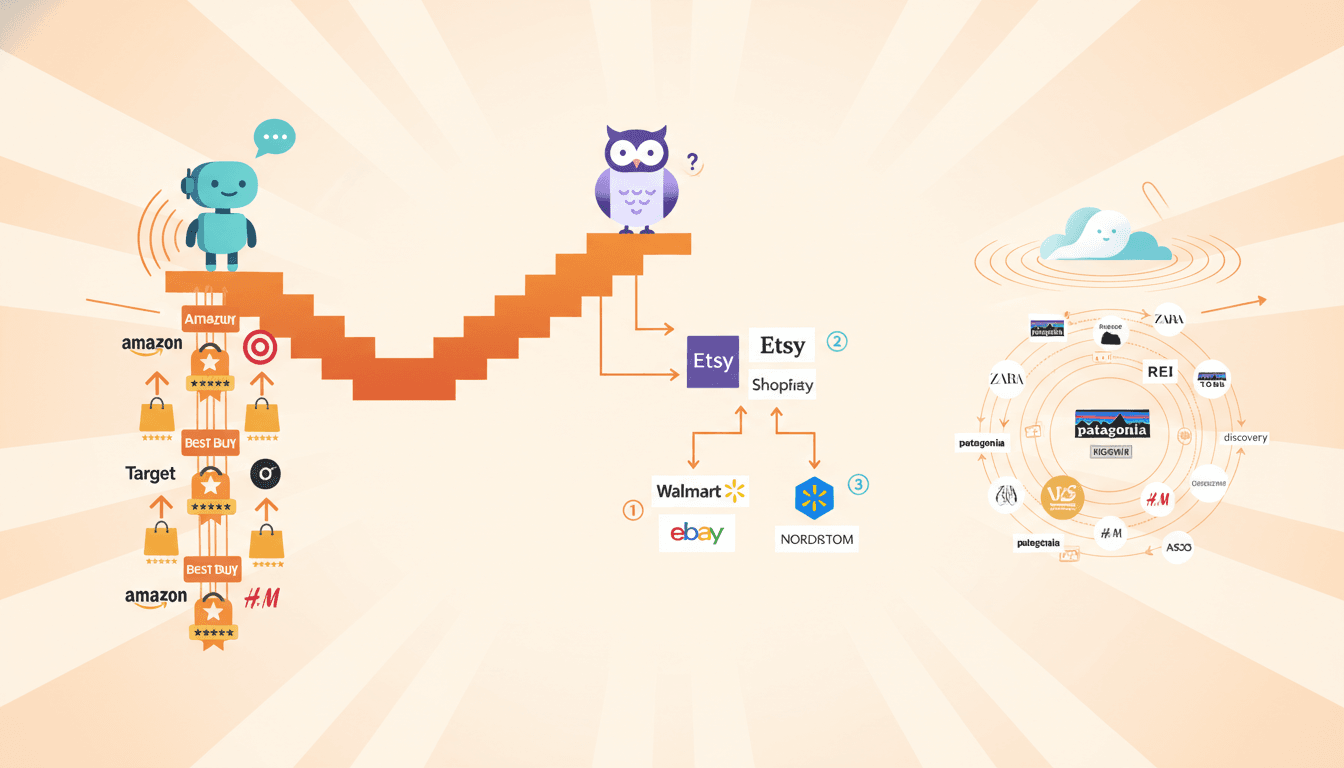
[IMG: Split-screen visualization showing ChatGPT, Perplexity, and Claude interfaces displaying different brand recommendations for the same product query, with position #1 highlighted and traffic share percentages overlaid]


---


## Why Traditional SEO Intuition Fails in AI Search (The Winner-Take-Most Reality)

[58% of U.S. consumers aged 18–45](https://www.salesforce.com/resources/research-reports/state-of-the-connected-customer/) have used an AI assistant to research a product before making a purchase decision. That figure represents a 3x increase from 2023 levels. AI search has crossed from early-adopter behavior into mainstream consumer discovery.

The channel operates under fundamentally different rules than Google. Unlike traditional search engines that return 10 blue links and distribute traffic across positions 1 through 10, AI engines recommend 1–3 brands per query.

There is only recommended or invisible in AI search. This winner-take-most architecture creates a concentration of traffic that traditional SEO never produced: [brands appearing in the first AI-generated recommendation](https://joinhexagon.com) receive an estimated **47% of all click-through and traffic generated by AI search queries** in their category.

Traditional SEO metrics—Domain Authority, backlink count, keyword rankings—do not directly translate to AI recommendation signals. A brand optimizing exclusively for Google can be completely invisible to more than half its potential buyers asking AI engines for purchase recommendations.

The global generative AI in e-commerce market is projected to reach [$22.6 billion by 2032, growing at a CAGR of 23.9%](https://www.grandviewresearch.com/industry-analysis/generative-ai-e-commerce-market-report). Yet only **14% of e-commerce brands** currently have a documented Generative Engine Optimization (GEO) strategy, despite 73% of marketing leaders identifying AI search visibility as a high priority for 2026.

The brands closing that gap right now are building a competitive moat that will compound for years. As Rand Fishkin, Co-Founder of SparkToro, frames it: "The brands that win in AI search are not necessarily the brands with the best products—they are the brands that have built the most coherent, authoritative, and consistently referenced digital footprint across the sources that AI models trust. This is a fundamentally different game than traditional SEO, and most e-commerce teams haven't internalized that yet."


---


## The Three-Engine Hierarchy: ChatGPT, Perplexity, and Claude Are Not the Same Algorithm

The most expensive mistake in GEO strategy is treating ChatGPT, Perplexity, and Claude as interchangeable. Each engine operates on a fundamentally different technical architecture and responds to different ranking signals. Each engine also serves a meaningfully different user population.

Understanding this hierarchy starts with the technical distinctions. **ChatGPT** generates recommendations from its parametric knowledge—a fixed training corpus with a cutoff date. Brands that built editorial authority before that cutoff receive compounding advantages.

Fresh content published today does not immediately influence ChatGPT's recommendations. **Perplexity** operates a hybrid retrieval-augmented generation (RAG) architecture where recommendations are heavily influenced by real-time web retrieval at query time. Fresh, well-structured content can surface in recommendations within days of publication.

**Claude** applies constitutional reasoning methodology, making it uniquely sensitive to brand credibility signals and transparency in business practices. The absence of negative sentiment clusters in its training data carries significant weight in recommendation decisions.

The user populations matter just as much as the algorithms. [Perplexity's monthly active user base grew from 10 million in early 2024 to over 100 million by Q1 2026](https://techcrunch.com/2026/01/perplexity-100-million-users/)—making it the fastest-growing AI search platform in history. Its users skew heavily toward educated, high-income consumers conducting considered purchase research.

That demographic profile makes Perplexity recommendations disproportionately valuable for premium and mid-market e-commerce brands. Aravind Srinivas, CEO of Perplexity AI, captures the distinction: "Perplexity is not a search engine with an AI layer—it is an AI reasoning system with a search layer. That distinction completely changes how brands need to think about visibility."

Understanding which engine dominates a category's consumer behavior is the first decision in any GEO program. One-size-fits-all optimization wastes resources on the wrong signals for the wrong engine.


---


## ChatGPT's Training Epoch Lock-In: Why Your Historical Authority Matters (Or Doesn't)

[IMG: Timeline diagram showing ChatGPT model training cutoff dates (GPT-3.5, GPT-4, GPT-4o) with brand authority accumulation curves overlaid, illustrating the 'training epoch lock-in' advantage for historically visible brands]

ChatGPT's recommendation behavior is frozen at its training cutoff date. This creates what researchers call **"training epoch lock-in"**—a compounding recommendation advantage where brands that achieved significant editorial coverage and backlink growth before each model's training cutoff receive ongoing visibility benefits.

Newer competitors cannot overcome this advantage with current content investment alone. In a controlled analysis of 1,000 e-commerce brand recommendation queries, ChatGPT recommended brands with Wikipedia pages at a rate **4.1x higher** than brands without one.

GPT-4o demonstrated a 34% higher rate of citing specific brand names in product recommendation queries compared to GPT-3.5. This reflects richer training on structured e-commerce content, but that advantage flows entirely to brands already embedded in its training corpus.

For brands already in ChatGPT's training data, historical digital PR investment is a hidden GEO asset. Editorial validation and backlink density from pre-cutoff dates still influence current recommendations, even when that coverage is years old.

For brands outside ChatGPT's training corpus, the next model update represents a critical visibility window. The urgency to build authority before that cutoff closes is very real. ChatGPT's browsing feature partially mitigates the cutoff problem for real-time queries, but parametric knowledge still dominates most product recommendation responses.

The compounding nature of training corpus advantages means early movers in GEO will maintain visibility advantages across multiple model generations. Today's investment in editorial authority is a multi-year strategic asset that will pay dividends well into 2027 and beyond.


---


## Perplexity's Real-Time Retrieval Advantage: The Fastest Path to AI Visibility

For brands starting their GEO program today, Perplexity represents the fastest path to measurable AI recommendation visibility. Its RAG architecture means fresh, structured content published today can influence recommendations within days—a timeline that simply does not exist in ChatGPT optimization.

The primary Perplexity ranking signals are content velocity and structured data markup. Here's how these signals function: **Brand mention velocity**—the rate at which a brand is newly mentioned across indexed web content—emerged as a top-5 ranking signal for Perplexity in 2025.

Consistent fresh coverage outperforms historical authority in Perplexity's retrieval layer, creating an opportunity for newer brands to compete with established players. **Schema.org structured data** functions as a machine-readable brand brief that Perplexity's retrieval system parses and weights directly.

E-commerce brands with product pages featuring structured review schema were recommended by Perplexity at a **2.7x higher rate** than brands with equivalent products but no structured review markup. This testing occurred across 500 product categories.

**Citation sourcing** is the primary recommendation signal in Perplexity's system. Perplexity surfaces brands that are cited as authoritative sources—being referenced in high-domain-authority editorial content is more valuable than any on-site optimization tactic.

The audience profile amplifies the strategic value of Perplexity optimization. Perplexity's 100M+ monthly active users skew toward high-income, research-oriented consumers making considered purchases. For premium e-commerce brands, a Perplexity recommendation in front of that audience is worth considerably more than equivalent traffic from traditional search positions.

Perplexity's Pro Search mode adds another layer of complexity: it surfaces different brand recommendations than standard mode in **61% of tested e-commerce queries**. Brands need to optimize for both Perplexity's static knowledge base and its live retrieval layer as distinct ranking environments.


---


## Claude's Trust and Constitutional Sensitivity: Why Credibility Signals Matter Most

Claude operates by a fundamentally different logic than ChatGPT or Perplexity. Its constitutional AI training methodology makes it uniquely sensitive to brand trustworthiness signals—and uniquely punishing toward brands that fail those signals.

The credibility factors that carry disproportionate weight in Claude recommendations include BBB ratings, transparent business practices, and editorial coverage in Tier-1 publications. Expert quotations and third-party validation in brand content also influence recommendations significantly.

The absence of negative sentiment clusters in indexed sources carries measurable weight. Qualified, evidence-backed brand language outperforms unsubstantiated superlatives by a significant margin.

Brands using superlative language—"best," "number one," "#1 rated"—without third-party substantiation are recommended by Claude at a **52% lower rate** than brands using qualified, evidence-backed claims. The constitutional reasoning approach actively suppresses brands whose content appears exaggerated or unsubstantiated.

The upside is equally measurable. A [Princeton University study on Generative Engine Optimization](https://arxiv.org/abs/2311.09735) found that adding authoritative citations, expert quotations, and fluency-optimized content to brand web pages increased AI recommendation frequency by an average of **40%** across tested generative engines.

For Claude specifically, third-party editorial validation carries the highest individual signal weight of any optimization tactic. Lily Ray, VP of SEO Strategy & Research at Amsive, captures the shift: "The locus of control has shifted from owned media to earned and structured data. Your brand's Wikipedia page, your Wikidata entry, and your coverage in The Wirecutter matter more to your AI search visibility than your own website's SEO."

Reputation management is therefore not a PR function for Claude optimization—it is a core GEO lever. Brands without proactive reputation management face suppressed Claude recommendations even when they perform well on ChatGPT and Perplexity.


---


## The Wikipedia and Wikidata Imperative: The Universal Trust Anchor Across All Engines

[IMG: Infographic showing Wikipedia/Wikidata as a central trust anchor node connecting to ChatGPT, Perplexity, and Claude, with recommendation frequency multipliers displayed for each engine]

If there is a single highest-leverage action available to mid-market and enterprise e-commerce brands in GEO, it is establishing and maintaining a Wikipedia presence. Wikipedia and Wikidata emerged as the **single most consistent predictor of AI recommendation frequency** across all three engines in cross-engine brand visibility research.

The mechanism is straightforward: AI models use Wikipedia and Wikidata as trust anchors to validate brand legitimacy. Brands cited in Wikipedia are treated as editorially validated by a source that all three major AI engines weight as authoritative.

Wikidata provides structured brand information—founding date, category, ownership, product lines—that AI retrieval systems parse and use directly in ranking decisions. ChatGPT recommended brands with Wikipedia pages at a rate 4.1x higher than brands without one.

Brands appearing in AI-generated recommendations across all three engines share three common characteristics: they are cited in 10+ high-domain-authority editorial sources (DA 70+), they maintain consistent NAP (Name, Address, Phone) signals, and they have a Wikipedia or Wikidata presence.

For mid-market and enterprise e-commerce brands, Wikipedia page creation and maintenance is non-negotiable. Brands without Wikipedia presence face invisible visibility penalties across all three AI search engines simultaneously—a structural disadvantage that no amount of on-site optimization can fully compensate for.


---


## Structured Data as AI-Readable Brand Signals: Schema.org Markup You Can't Ignore

Structured data markup is the GEO tactic with the highest ratio of implementation effort to recommendation frequency impact. Schema.org markup functions as a machine-readable brand brief for AI retrieval systems—and brands without comprehensive structured data are effectively invisible to the retrieval layer.

The three highest-impact markup types for e-commerce GEO are **Product schema**, which communicates product specifications, pricing, availability, and category classification directly to AI retrieval systems. This makes products discoverable in AI-generated comparisons and recommendations.

**Review schema** aggregates rating and review count data that Perplexity's retrieval layer parses and weights in recommendation decisions. Brands with review schema were recommended at a 2.7x higher rate in controlled testing—a dramatic difference for minimal implementation effort.

**Organization schema** establishes brand identity signals—founding date, headquarters, industry classification—that AI models use to validate brand legitimacy. This enables consistent recommendations across multiple queries.

FAQ schema carries additional value for query-matching. AI systems parse FAQ structured data to match brand content to consumer question formats, increasing the probability that a brand's content is surfaced as a direct answer to purchase-research queries.

The implementation gap represents a competitive opportunity for most e-commerce brands. Most brands have incomplete or inconsistent structured data across their product catalog, creating measurable retrieval layer invisibility.

For brands investing in Perplexity optimization specifically, structured data implementation is the single highest-ROI tactical action available. It is low-effort relative to content production, and its impact on recommendation frequency is measurable within weeks of implementation.


---


## Negative Sentiment Suppression: The Hidden GEO Risk Most Brands Don't Monitor

[IMG: Dashboard visualization showing brand sentiment monitoring across high-authority sources (Reddit, news sites, review aggregators) with AI recommendation frequency correlation chart]

Most brand monitoring programs track sentiment for reputation purposes. Almost none track sentiment's impact on AI recommendation frequency—which means most brands are carrying an invisible GEO liability they have not measured.

Negative sentiment concentration creates measurable AI recommendation penalties across all three engines. Brands with three or more high-authority articles or review aggregator pages with net-negative sentiment appearing within the top 20 Google results for their brand name appear in AI recommendations **78% less frequently** than sentiment-neutral competitors.

That suppression effect operates silently—it does not appear in traditional SEO dashboards, keyword rankings, or traffic analytics. The sources that carry the highest suppression weight include Wikipedia, Tier-1 news coverage with negative framing, and high-authority review aggregators like Trustpilot and Consumer Reports.

Reddit threads with high engagement and negative sentiment also carry significant suppression weight. For example, a brand with multiple negative Reddit threads ranking in the top 20 brand search results will see measurably lower AI recommendation frequency than competitors without such content.

Reputation management is not a defensive PR function in the GEO context—it is an offensive visibility tactic. Brands with proactive reputation management strategies see measurably higher AI recommendation frequency than competitors with reactive approaches.

Monitoring sentiment in high-authority indexed sources and actively generating positive editorial coverage to dilute negative signal concentration is a core component of any comprehensive GEO program. Looking ahead, this becomes increasingly critical as AI engines weight sentiment more heavily in their ranking algorithms.


---


## The GEO Strategy Framework: A Tailored Approach for Each Engine

A comprehensive GEO strategy requires tailored tactics for each engine, not a unified approach optimized for none of them. The framework breaks down by engine as follows:

**ChatGPT Optimization Priorities**

- Build pre-training-cutoff editorial authority through digital PR and Tier-1 publication coverage
- Increase backlink density from DA 70+ domains before the next model update window
- Establish and maintain Wikipedia and Wikidata presence
- Prioritize AI-native content formats: structured comparison articles, expert roundups, and "best of" listicles on high-DA domains outperform traditional SEO blog content by **3.8x** in AI recommendation frequency

**Perplexity Optimization Priorities**

- Publish fresh, structured content consistently to build brand mention velocity
- Implement comprehensive Schema.org markup across product catalog (Product, Review, Organization, FAQ)
- Generate citation-worthy content that earns references from high-authority editorial sources
- Optimize for both standard and Pro Search retrieval environments, as they surface different brand recommendations in 61% of tested queries

**Claude Optimization Priorities**

- Audit brand language for unsubstantiated superlatives and replace with evidence-backed claims
- Build third-party editorial validation through expert quotations and authoritative citations
- Implement proactive reputation management to suppress negative sentiment concentration
- Ensure transparent business practice signals are indexed and accessible (return policies, BBB ratings, certifications)

The strategic priority order across these three tracks depends on category-specific AI platform adoption. Sridhar Ramaswamy, CEO of Snowflake and former SVP of Ads at Google, frames the urgency: "The single biggest mistake CMOs are making right now is treating AI search optimization as an extension of their existing SEO program. GEO requires a fundamentally different content architecture, a different link and citation strategy, and a different measurement framework."

Brands that figure this out in 2025 and 2026 will have a durable competitive moat that will be very hard for slower-moving competitors to close.


---


## Measuring AI Search Visibility: Metrics and Monitoring for GEO

GEO measurement requires a different infrastructure than traditional SEO analytics. The primary metrics that define AI search visibility are **Recommendation frequency**, which measures how often a brand appears in AI-generated responses across a representative sample of category queries. This is the top-line GEO KPI.

**Recommendation position** determines traffic concentration in AI search results. Position #1 captures 47% of all AI search traffic in a category, while positions #2 and #3 capture dramatically less. Position tracking across ChatGPT, Perplexity, and Claude requires separate measurement for each engine.

**Citation frequency** indicates how often a brand is cited as a source in AI-generated responses. This metric reveals retrieval layer visibility and content quality signal strength.

**Cross-engine consistency** demonstrates structural authority across platforms. Brands appearing in recommendations across all three engines demonstrate the authority signals that compound over time.

Most brands currently lack dedicated GEO measurement infrastructure—creating a competitive intelligence gap. This gap makes it impossible to know whether optimization efforts are working.

Recommendation frequency is measurable through specialized GEO monitoring tools and structured manual testing protocols. For brands without existing measurement in place, establishing a baseline across ChatGPT, Perplexity, and Claude is the necessary first step before any optimization investment.


---


## The 2026 GEO Opportunity: First-Mover Advantage Before the Channel Becomes Saturated

[IMG: Growth curve chart showing generative AI in e-commerce market trajectory from 2024 to 2032 ($22.6B), with a highlighted "first-mover window" annotation marking 2025–2026 as the optimal investment period]

The competitive window for first-mover advantage in GEO is measurable and finite. Only 14% of e-commerce brands have a documented GEO strategy today, despite 73% of marketing leaders identifying AI search visibility as a high priority for 2026. That gap will not persist.

Enterprise brands are beginning to invest, and the cost of entry will increase as the channel becomes contested. The structural dynamics favor early movers in ways that compound over time.

Training corpus advantages accumulate across model generations. Editorial authority and citation density build on themselves. Wikipedia presence and structured data signals persist and strengthen. Brands that establish GEO foundations today will be harder to displace with each successive model update—while brands waiting for GEO to become mainstream will face an increasingly saturated competitive environment.

The market trajectory makes the urgency concrete. The global generative AI in e-commerce market is projected to reach $22.6 billion by 2032 at a 23.9% CAGR—scaling faster than any prior digital marketing channel. The brands capturing that growth will be the ones that treated GEO as a strategic priority in 2025 and 2026.

The decision framework is straightforward: 58% of target consumers are already asking AI engines which brands to consider. Those engines are recommending 1–3 brands per query. A brand is either in that recommendation set or it is not.

The first-mover window to get there—before competitors do—is open right now. Looking ahead, this window will close as more brands recognize the opportunity and invest in GEO strategies.


---


## Getting Started: Immediate Actions for GEO Implementation

Brands seeking to establish AI search visibility should begin with a diagnostic assessment of current recommendation frequency across all three engines. Here's how: conduct 50–100 representative product and category queries across ChatGPT, Perplexity, and Claude, documenting where the brand appears (or does not appear) in recommendations.

This baseline reveals which engines represent the highest-value opportunity and where visibility gaps exist. From there, brands can prioritize the engine-specific tactics outlined above based on category dynamics and current competitive positioning.

The second immediate action is Wikipedia and Wikidata audit. Brands without Wikipedia presence should initiate the page creation process immediately, as this is the single highest-leverage tactic available. Brands with existing Wikipedia pages should audit them for accuracy, completeness, and citation quality.

Third, brands should implement comprehensive Schema.org markup across their product catalog if not already in place. This is low-effort relative to impact and provides measurable returns within weeks of implementation.
H
Hexagon Team
Published May 31, 2026