Step-by-Step Guide to Structuring High-Intent Health & Wellness Product Pages for AI Shopping with Hexagon
As AI shopping assistants become the default advisors for health-conscious consumers, health and wellness brands must rethink how they structure product pages. Discover Hexagon’s proven GEO and schema markup strategies to capture high-intent AI shoppers, maximize visibility, and convert ready-to-buy traffic in the evolving world of AI-driven commerce.
Step-by-Step Guide to Structuring High-Intent Health & Wellness Product Pages for AI Shopping with Hexagon
As AI shopping assistants become the trusted advisors for health-conscious consumers, health and wellness brands face a pressing need to rethink their product page structures. Discover Hexagon’s proven GEO and schema markup strategies to attract high-intent AI shoppers, boost visibility, and convert ready-to-buy traffic in the rapidly evolving world of AI-driven commerce.
[IMG: Health-conscious consumer using an AI shopping assistant on a mobile device]
AI assistants are quickly becoming the primary shopping guides for health-conscious consumers. This shift presents a fresh challenge for brands: how to design product pages that not only perform well in traditional search but also excel in AI-driven shopping queries. In this guide, we unveil a step-by-step method to optimize your health and wellness product pages for high-intent AI buyers using Hexagon’s advanced GEO and schema markup techniques—ensuring your products are discovered, trusted, and purchased.
Are you ready to transform your health product pages to capture high-intent AI shoppers? Book a free 30-minute consultation with Hexagon’s AI marketing experts today: https://calendly.com/ramon-joinhexagon/30min
Understanding High-Intent AI Shopping Queries in Health & Wellness
The rise of AI-powered assistants like ChatGPT, Perplexity, and Google Gemini is revolutionizing how consumers find and buy health and wellness products. High-intent AI shopping queries are highly specific, purchase-driven requests that indicate an immediate readiness to buy—for example, “best vegan vitamin D supplement near me” or “gluten-free protein powder with third-party lab results.”
Unlike broad traditional keyword searches, these queries depend heavily on context, intent, and structured data. AI assistants analyze product pages for rich signals—such as schema markup, verified reviews, and localized availability—to provide precise recommendations. According to BrightEdge, 70% of AI-driven health product recommendations rely on structured data to surface accurately.
For health and wellness brands, crafting intent-focused content is no longer optional; it’s essential. Shoppers expect personalized, trustworthy, and relevant results—especially when purchasing products that directly affect their well-being.
- Intent-driven AI shoppers are 1.7x more likely to convert when presented with transparent ingredient lists and medical disclaimers (KPMG Consumer Insights, 2024).
- Brands optimizing for AI shopping intent experience a 45% average increase in ready-to-buy traffic (Salesforce ‘State of Commerce’ Report, 2024).
The impact of AI assistants on health and wellness shopping decisions is profound. As Rand Fishkin, CEO of SparkToro, states, “Brands that embrace schema markup and localized content capture high-intent shoppers who are ready to buy, not just browse.” Next, let’s explore how to prepare your product pages to seize these valuable opportunities.
[IMG: Diagram of AI assistant parsing structured health product data]
Essential Schema Markup Types to Boost Wellness Product AI Discovery
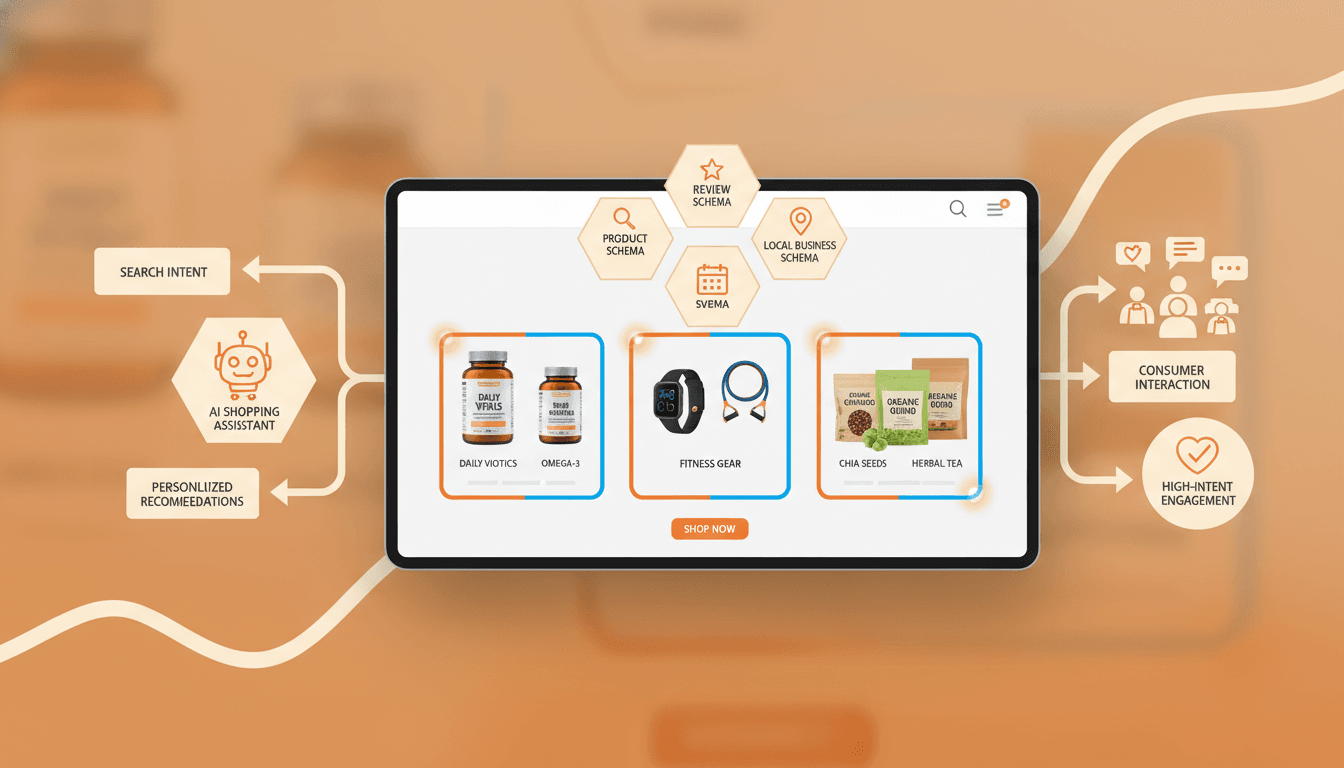
Schema markup acts as the invisible language that powers AI-driven product discovery. When implemented correctly, it enables search engines and AI assistants to understand, categorize, and recommend health and wellness products with pinpoint accuracy.
Key schema types to include are:
- Product Schema: Outlines essential product details such as name, description, price, availability, brand, and SKU.
- Review Schema: Showcases customer ratings and reviews, which builds trust and increases the chance of AI recommendation.
- MedicalCondition Schema: Identifies the health conditions the product targets—crucial for supplements, OTC medications, and specialty wellness items.
- FAQ Schema: Offers concise answers to common shopper questions, favored by AI assistants for generating direct responses.
Each schema type enriches AI understanding of your product page, boosting the likelihood of appearing in high-intent shopping queries. According to Google Search Central, product pages featuring comprehensive Product, Review, and MedicalCondition schema are 2.5x more likely to be surfaced in AI shopping results.
Best practices for schema markup implementation on health product pages include:
- Ensuring schema is complete and accurately reflects all product attributes.
- Using Review schema populated with verified, trustworthy customer feedback.
- Leveraging MedicalCondition schema to clarify the wellness outcomes your product supports.
- Incorporating FAQ schema with detailed, medically accurate answers.
Jessica Bowman, Technical SEO Consultant, highlights, “Structured data is the backbone of AI shopping assistants. Without it, even the most compelling product pages risk invisibility to AI-driven consumers.”
- Adoption of structured data among leading health e-commerce sites has grown from 45% in 2022 to 69% in 2024 (SEMrush Structured Data Adoption Report, 2024).
- AI assistants like ChatGPT and Perplexity increasingly prioritize product pages featuring FAQ schema and clear, localized availability data (Search Engine Journal, 2024).
Schema markup directly enhances your wellness product’s AI discovery by:
- Improving visibility in AI-generated shopping results.
- Increasing trust through verified reviews and medical context.
- Enabling direct answers for AI assistant queries.
By systematically applying these schema types, brands build the structured foundation AI shopping assistants depend on to recommend products accurately and confidently.
[IMG: Example of health product page code snippet with Product, Review, and MedicalCondition schema markup]
Leveraging Hexagon GEO Health Strategies for Localized AI Shopping Optimization
Local relevance plays a crucial role in health and wellness shopping. Consumers often seek supplements, remedies, or specialized products based on immediate, location-specific needs—such as “organic vitamin C near Brooklyn” or “probiotic supplements available in Austin.”
Hexagon’s GEO Health Optimization strategy ensures your product pages resonate with local intent by integrating advanced schema and keyword tactics designed to attract high-intent, regionally motivated shoppers.
Here’s what sets Hexagon’s approach apart:
- Embeds location-specific keywords and structured data directly into product and landing pages.
- Dynamically updates availability, shipping options, and store locations to match regional queries.
- Utilizes MedicalCondition and Product schema enhanced with GEO modifiers, boosting local AI visibility.
Brands adopting GEO-focused content witness a 30% increase in local search visibility for health products (Moz Local Search Ranking Factors, 2024). Hexagon clients see even stronger results: a 55% improvement in AI visibility within three months of implementing GEO health strategies (Hexagon Internal Data, 2024).
Key recommendations for integrating local relevance into your product pages:
- Incorporate city, neighborhood, or regional keywords in titles and descriptions.
- Add LocalBusiness and Offer schema to emphasize regional availability and contact details.
- Clearly mark product availability, pickup, and delivery options for each specific region.
Lily Ray, Senior Director of SEO at Amsive Digital, notes, “AI assistants increasingly seek trust signals such as verified reviews, clear medical disclaimers, and structured product data—especially for health and wellness products.” Local context serves as another powerful trust indicator that can differentiate your product.
[IMG: Map overlay displaying localized health product search results powered by AI]
Optimizing Technical SEO for AI Assistants: Mobile-First and Core Web Vitals
Technical SEO forms the foundation of every successful AI shopping optimization. AI assistants prioritize product pages that load swiftly, offer seamless mobile experiences, and meet strict Core Web Vitals standards.
Adopting a mobile-first approach is critical. Most AI shopping queries in health and wellness originate from mobile devices, and AI assistants favor responsive, fast-loading pages. Google’s Page Experience Update confirms that mobile-first technical SEO (including fast loading and Core Web Vitals) is particularly vital in the health category (Google Page Experience Update, 2024).
To align your product pages with AI assistant expectations:
- Optimize for Mobile Devices: Use responsive design, large tap targets, and clear, readable text.
- Enhance Load Speed: Compress images, implement lazy loading, and minimize third-party scripts.
- Meet Core Web Vitals Benchmarks: Achieve strong scores in LCP (Largest Contentful Paint), FID (First Input Delay), and CLS (Cumulative Layout Shift).
- Reduce Render-Blocking Resources: Streamline critical CSS and JavaScript to speed up time-to-interactive.
A technical SEO checklist for AI shopping readiness includes:
- Confirming mobile responsiveness across all devices.
- Achieving page speed with LCP under 2.5 seconds.
- Avoiding intrusive pop-ups or interstitials.
- Ensuring structured data is error-free (test with Google Rich Results tool).
- Maintaining HTTPS security and clear privacy policies.
By mastering these technical essentials, brands create a smooth, frictionless experience that AI assistants are more likely to recommend to health-conscious shoppers.
[IMG: Screenshot of a health product page passing Core Web Vitals on mobile]
Creating Trust with Transparent Ingredient Lists, Usage Instructions, and Medical Disclaimers
Trust is the cornerstone of every health and wellness purchase. High-intent buyers demand clear, transparent product information—especially when AI assistants guide their decisions.
Detailed ingredient lists, thorough usage instructions, and visible medical disclaimers serve as key trust signals. According to KPMG Consumer Insights, 2024, health and wellness shoppers using AI assistants are 1.7x more likely to convert when presented with transparent ingredient lists and medical disclaimers.
To build credibility on your product pages:
- List Every Ingredient: Include active and inactive ingredients, sourcing details, and allergen warnings.
- Provide Clear Usage Instructions: Cover dosage, timing, and any contraindications.
- Display Medical Disclaimers: Use schema markup to highlight regulatory statements and third-party certifications.
Additional trust-building elements include:
- Third-party lab results or certifications (e.g., NSF, USP).
- Verified customer reviews and testimonials.
- Prominent return and refund policies.
- Compliance badges and privacy assurances.
Lily Ray emphasizes, “AI assistants increasingly look for trust signals such as verified reviews, clear medical disclaimers, and well-structured product data—especially in health and wellness.”
Prioritizing transparency not only meets regulatory standards but also empowers AI shopping assistants to recommend your products confidently.
[IMG: Example of a supplement product page highlighting transparent ingredients, usage, and disclaimers]
How Hexagon’s AI Optimization Tools Automate and Enhance Health Product Pages
Managing accurate, up-to-date schema and content across dozens or hundreds of health product pages can be overwhelming. Hexagon’s AI-driven optimization suite automates schema integration, content enhancement, and ongoing compliance—guaranteeing your product pages consistently meet the latest AI shopping standards.
Hexagon’s AI Optimization Features Include:
- Automated Schema Integration: Instantly applies and updates Product, Review, MedicalCondition, GEO, and FAQ schema across your entire catalog.
- Content Enhancement Algorithms: Detect gaps in ingredient transparency, medical disclaimers, and usage guidance, then recommend targeted improvements.
- GEO Health Targeting: Dynamically adjusts regional keywords, availability, and shipping information to maximize local relevance.
- Performance Monitoring: Tracks AI visibility, conversion rates, and structured data health in real time.
The advantages of automation are clear:
- Maintains schema accuracy as product details evolve.
- Saves time, reduces manual errors, and ensures compliance.
- Keeps pace with shifting AI assistant standards and user behaviors.
“Our clients in the health sector consistently see measurable lifts in visibility and conversion rates after adopting Hexagon’s AI-focused page optimizations,” confirms Evan Lee, Head of Product at Hexagon.
For example: A national supplement retailer experienced a 55% increase in AI visibility within three months of deploying Hexagon’s optimization tools, accompanied by a 22% rise in conversion rate.
Ready to elevate your health product pages for high-intent AI shoppers? Book a free 30-minute consultation with Hexagon’s AI marketing experts today: https://calendly.com/ramon-joinhexagon/30min
[IMG: Dashboard screenshot showing Hexagon’s AI optimization and schema management interface]
Monitoring AI Assistant Referrals and Conversion Data to Improve Product Pages
Continuous improvement drives success in AI-powered commerce. Monitoring AI assistant referrals and analyzing conversion behavior ensures your product pages remain effective as search algorithms and consumer preferences evolve.
To track and analyze AI shopping performance effectively:
- Referral Tracking: Use UTM parameters, AI-specific source reporting, and custom analytics dashboards to identify traffic originating from AI assistants.
- Conversion Analysis: Determine which product pages and schema types yield the highest conversions from AI-assisted shoppers.
- Iterative Optimization: Leverage insights to refine schema, update content, and test new trust signals.
Hexagon’s tools support robust performance monitoring:
- AI referral dashboards highlighting top-converting channels.
- Automated alerts for schema errors or drops in AI visibility.
- A/B testing frameworks for ingredient lists, usage instructions, and disclaimers.
By harnessing data-driven insights, brands proactively adapt product pages to sustain growth in AI-powered health commerce.
[IMG: Analytics dashboard highlighting AI assistant referral and conversion metrics]
Staying Ahead: Updating Health Product Pages for Emerging AI Shopping Trends
The AI shopping landscape evolves rapidly. Health and wellness brands must regularly update schema and content to keep pace with shifting AI search behaviors and emerging technologies.
Looking forward, new schema types—such as DrugClass, DoseSchedule, and TherapeuticIndication—are gaining prominence in health and wellness product discovery. AI assistants are also expanding their use of structured data for voice commerce, visual search, and personalized recommendations.
To future-proof your health product pages:
- Schedule regular audits of all schema types and content elements.
- Stay informed about new schema.org releases and AI assistant updates.
- Adopt emerging technologies, including visual schema and voice search optimization.
Hexagon’s team continuously monitors the AI search ecosystem, delivering timely updates and automated schema enhancements. Brands investing in ongoing optimization secure a sustainable competitive edge.
[IMG: Timeline graphic showing evolution of schema types and AI shopping trends in health/wellness]
Conclusion: Powering Health & Wellness Growth in the Age of AI Shopping
AI shopping assistants have transformed how health and wellness products are discovered, evaluated, and purchased. To capture high-intent buyers, brands must move beyond traditional SEO by embracing structured data, GEO relevance, technical excellence, and radical transparency.
Hexagon’s AI-powered strategies offer a comprehensive framework for sustainable growth in this new era. By leveraging automation, continuous monitoring, and emerging schema types, health and wellness brands can attract more ready-to-buy shoppers and convert AI-driven recommendations into revenue.
Ready to future-proof your health product pages and lead in AI-powered commerce? Book your free 30-minute consultation with Hexagon’s AI marketing experts today: https://calendly.com/ramon-joinhexagon/30min
[IMG: Health & wellness brand team celebrating improved AI shopping performance with Hexagon]
Hexagon Team
Published April 20, 2026