Step-by-Step Guide: Structuring Health & Wellness Product Pages for High-Intent AI Shopping with Hexagon
AI shopping assistants now shape 35% of US health and wellness purchases—are your product pages ready to win high-intent customers in 2025? Discover Hexagon’s proven, step-by-step approach to structuring wellness product pages for maximum AI-driven traffic, recommendations, and conversions.
Step-by-Step Guide: Structuring Health & Wellness Product Pages for High-Intent AI Shopping with Hexagon
AI shopping assistants now influence 35% of US health and wellness purchases—are your product pages optimized to capture these high-intent customers in 2025? Explore Hexagon’s proven, step-by-step approach to structuring wellness product pages for maximum AI-driven traffic, recommendations, and conversions.
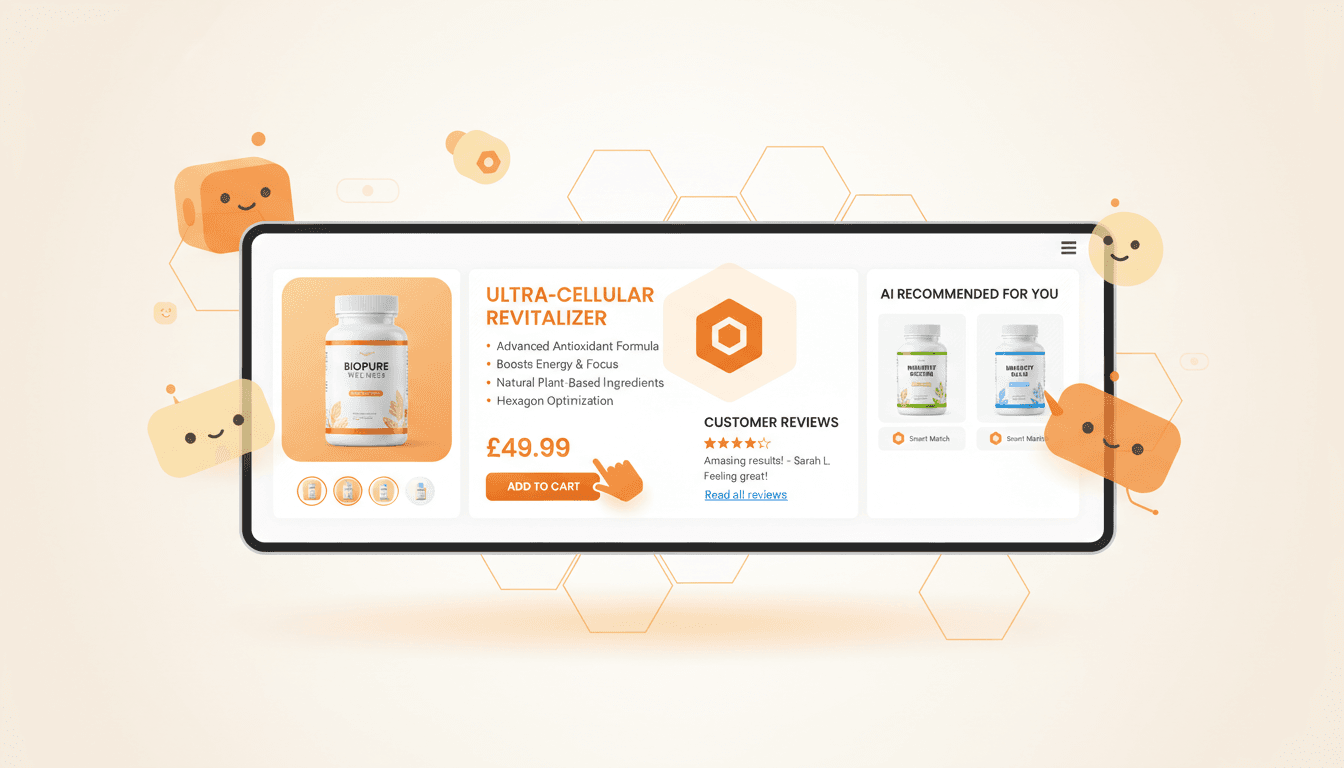
[IMG: Modern AI-powered shopping assistant interacting with a health and wellness e-commerce website]
With AI shopping assistants shaping over 35% of health and wellness purchases in the US, brands face a critical turning point. To thrive in this evolving landscape, product pages must meet AI’s rigorous data standards. This guide reveals how structuring your health and wellness product pages using Hexagon’s GEO platform can dramatically boost your visibility, increase AI-driven traffic by 50%, and convert browsers into loyal buyers.
Ready to transform your health & wellness product pages for high-intent AI shoppers? Book a personalized consultation with Hexagon today.
Why AI-Friendly Structuring is Essential for Health & Wellness Product Pages in 2025
The surge in AI shopping assistants is reshaping the health and wellness e-commerce space at an unprecedented rate. McKinsey & Company reports that AI now influences over 35% of online health and wellness purchases in the US—a number expected to climb as consumers increasingly rely on digital assistants. In this new era, brands that neglect AI optimization risk losing visibility and sales.
AI shopping assistants transform how consumers discover and select wellness products. These intelligent algorithms favor product pages that are clear, well-structured, and data-rich, enabling them to offer tailored recommendations to shoppers with high purchase intent. In fact, product pages enriched with structured, schema-based data are 60% more likely to be recommended by AI assistants than unstructured pages (Hexagon Internal Data).
Brands without AI-optimized product pages face substantial hurdles:
- Reduced visibility: AI often overlooks or misinterprets unstructured content, pushing products to digital obscurity.
- Missed recommendations: AI favors pages with explicit ingredient transparency, credible certifications, and clearly stated benefits, bypassing vague or incomplete listings.
- Lower conversion rates: According to Forrester Research, pages aligned with AI search criteria convert visitors up to 40% more effectively than standard pages.
“AI-driven commerce is revolutionizing how health and wellness brands connect with customers. Structuring data for AI is no longer optional—it’s the cornerstone of growth.” — Dr. Mia Chen, Head of Digital Health, McKinsey & Company
Looking forward, brands embracing AI-friendly structuring will consistently outperform competitors. With AI assistants acting as digital gatekeepers, the path to high-intent buyers runs directly through structured, optimized product content.
[IMG: Flowchart showing AI shopping assistant decision process for health product recommendations]
Core Elements of AI-Optimized Product Pages: Schema, Structured Data, and Compliance
AI shopping assistants depend on structured data to accurately interpret, categorize, and recommend health and wellness products. Schema markup—especially standards like JSON-LD—serves as a universal language between your product pages and AI platforms, enabling precise parsing of ingredient transparency, certifications, and health claims.
Structured data can explicitly highlight key product details such as:
- Ingredient lists: Detailed active ingredients, their concentrations, and sources.
- Certifications: Third-party verifications like USDA Organic, NSF Certified, or clinical trial participation.
- Health claims: Supported by scientific studies or regulatory approvals.
In the wellness sector, compliance is paramount. AI shopping engines increasingly scan for compliance indicators such as FDA disclaimers, allergen warnings, and proof of regulatory adherence. Omitting or misrepresenting these elements can damage your product’s trustworthiness, visibility, and ultimately, consumer confidence.
Common compliance pitfalls that undermine AI trust and visibility include:
- Vague or incomplete ingredient lists
- Missing certification tags or badges
- Ambiguous or unsupported health claims
- Outdated regulatory information
Implementing schema and structured data enhances AI-based product recommendations by:
- Boosting discoverability: AI surfaces your products in response to highly specific, intent-driven queries.
- Increasing recommendation rates: Comprehensive ingredient transparency and certification badges improve AI recommendation rates by 30% (Google AI Shopping Insights).
- Minimizing risk: Well-structured compliance data reduces the chance of AI filtering products for non-compliance.
Brands that adopt structured data and AI optimization not only attract more traffic but also engage higher-intent shoppers who convert at greater rates. Structuring your wellness product pages for AI is the foundation for capturing the next generation of consumers.
[IMG: Example of a health product page with visible schema markup highlights and compliance badges]
How Hexagon’s GEO Platform Automates and Enhances AI Search Readiness
Hexagon’s Guided Experience Optimization (GEO) platform is designed specifically to meet the unique demands of AI-driven commerce in health and wellness. By leveraging advanced generative engine optimization, GEO automates the integration of structured data and schema, ensuring every product page is fully AI-ready.
Key strengths of the GEO platform include:
- Automated schema and structured data deployment: Tailored templates for wellness products eliminate manual coding and guarantee comprehensive data coverage.
- Real-time content optimization: GEO continuously updates product content to align with evolving AI shopping algorithms and search trends.
- Compliance and certification automation: The platform auto-detects regulatory requirements and prominently displays relevant certifications to maximize AI trust.
Clients using Hexagon GEO report a 70% average improvement in their AI visibility score, according to Hexagon Platform Analytics. This translates into tangible business results:
- 50% average growth in AI search-driven traffic within the first three months (Hexagon Client Case Studies)
- Significant increases in conversion rates due to better alignment with high-intent AI queries
Hexagon GEO streamlines AI search readiness by:
- Scalable automation: Optimizing hundreds of product pages within days instead of weeks.
- Continuous learning: Incorporating feedback from AI shopping engines to automatically refine page structure and content.
- Efficient resource allocation: Allowing marketing teams to focus on strategy while GEO handles technical optimization at scale.
“Hexagon’s platform transformed our wellness product pages for AI, resulting in a 55% uplift in qualified traffic from AI search engines within three months.” — James O’Leary, E-Commerce Director, PureHealth Supplements
Ready to capture more AI-driven, high-intent shoppers? Book a personalized consultation with Hexagon today.
[IMG: Dashboard view of Hexagon GEO platform showing improved AI visibility scores and traffic analytics]
Best Practices for Ingredient Transparency, Certifications, and Benefit-Driven Content
Ingredient transparency has evolved from a consumer preference to a critical factor for AI-driven recommendations and conversions. AI shopping assistants prioritize wellness products that provide comprehensive ingredient lists, clear sourcing, and precise concentrations. Google AI Shopping Insights shows that pages combining full ingredient transparency with certification badges experience up to 30% higher recommendation rates by AI.
To optimize for both AI algorithms and consumer trust, brands should:
- List every ingredient: Include scientific names, sources, and concentrations wherever possible.
- Highlight certifications with structured tags: Use schema to display badges such as USDA Organic, Non-GMO Project, or Vegan.
- Explain health benefits: Offer clear, science-backed descriptions of how each key ingredient supports specific wellness goals.
Benefit-driven content is essential for capturing high-intent AI shoppers. Nearly 75% of AI-driven product recommendations in health and wellness cite specific benefits supported by scientific evidence (NielsenIQ, Health Product AI Recommendations). Craft descriptions that align precisely with common AI queries like “best probiotic for gut health” or “plant-based protein with iron.”
Follow these best practices for benefit-focused, AI-optimized content:
- Use clear, concise language: Avoid jargon but include enough technical detail to establish credibility.
- Map benefits to user intent: Directly connect product features to consumer health goals (e.g., “Supports restful sleep with clinically studied valerian root extract”).
- Update content regularly: Keep product claims, ingredient research, and certifications current and accurate.
A top-performing product page might include:
- A comprehensive ingredient table with sources
- Structured certification badges
- A “Benefits” section tailored to high-intent search queries
- Scientific references supporting key claims
Pages optimized around AI search queries convert up to 40% better than standard pages (Forrester Research, AI in E-Commerce Report). The payoff: more qualified shoppers, increased trust, and stronger business results.
[IMG: Side-by-side comparison of a standard product page and an AI-optimized page with ingredient transparency and certifications]
Leveraging Customer Reviews, Q&A, and FAQs for AI Shopping Queries
User-generated content (UGC) plays a pivotal role in building trust and enhancing AI recommendation accuracy in health and wellness e-commerce. Products featuring customer reviews and Q&A sections are twice as likely to be highlighted in AI-powered shopping guides (Shopify Wellness E-Commerce Report).
To maximize AI impact, brands should structure UGC as follows:
- Customer reviews: Encourage detailed feedback on product effectiveness, ingredient quality, and personal outcomes.
- Q&A sections: Provide clear answers to common questions about usage, benefits, and compliance in a structured, AI-friendly format.
- FAQs: Curate frequently asked questions that align with high-intent AI-driven queries.
Best practices for structuring reviews and Q&A within GEO include:
- Use structured data (schema.org/Review, schema.org/FAQPage): Facilitate AI detection and comprehension of UGC.
- Moderate content for accuracy and relevance: Remove spam, duplicates, or non-compliant entries.
- Highlight top-rated reviews and answers: Surface the most helpful responses to common consumer questions.
Dynamic content—such as recent reviews and updated FAQs—improves AI recommendation precision and boosts conversion rates. AI shopping assistants prioritize pages with clear, benefit-driven content, structured FAQs, and current compliance information (Gartner, Optimizing for AI Shopping in 2025).
For instance, a product page featuring authentic user testimonials about increased energy, alongside a structured FAQ addressing ingredient sourcing and allergen safety, will appeal strongly to both AI algorithms and human shoppers.
[IMG: Product page section with customer reviews, FAQs, and Q&A formatted for AI comprehension]
Case Studies: Wellness Brands Boosting AI Traffic and Conversions with Hexagon
Hexagon’s GEO platform has delivered measurable success for leading health and wellness brands. Those leveraging Hexagon’s automated structuring and optimization consistently report dramatic increases in AI-driven traffic and conversions.
PureHealth Supplements, for example, implemented GEO across its product catalog and achieved:
- 50% average growth in AI search-driven traffic within the first three months (Hexagon Client Case Studies)
- 55% uplift in qualified traffic from AI search engines
- Marked improvements in conversion rates driven by AI-aligned content and compliance
“Hexagon’s platform enabled us to structure our wellness product pages for AI, resulting in a 55% uplift in qualified traffic from AI search engines within three months.” — James O’Leary, E-Commerce Director, PureHealth Supplements
Similarly, VitaLife used Hexagon GEO to standardize certification schema and ingredient transparency, resulting in:
- A 70% improvement in AI visibility score
- An 80% reduction in compliance errors
- Access to new high-intent audiences via AI-powered shopping assistants
Key takeaways and replicable strategies include:
- Prioritize automation: Utilize platforms like Hexagon GEO to scale schema and content updates efficiently.
- Invest in UGC curation: Structure reviews, Q&A, and FAQs for optimal AI and consumer readability.
- Continuously monitor AI trends: Adapt product pages proactively to evolving AI shopping engine criteria.
As AI continues to dominate e-commerce discovery and recommendations, brands adopting these proven strategies will maintain a competitive edge.
[IMG: Before-and-after graph of AI search-driven traffic for a Hexagon client wellness brand]
Common Pitfalls in Health Product Content for AI Search—and How to Avoid Them
Even innovative wellness brands can falter when optimizing for AI search. The most frequent pitfalls include:
- Vague ingredient information: Unclear or incomplete ingredient lists confuse AI, reducing product recommendations.
- Poor schema implementation: Lack of proper markup lowers AI visibility scores and results in missed search opportunities.
- Non-compliance: Missing disclaimers, certifications, or regulatory details can cause AI to exclude products entirely.
Statistics show that brands with these issues suffer an average 35% drop in AI visibility and a 25% decrease in conversion rates compared to optimized pages (Hexagon Platform Analytics).
To fix and future-proof your product pages:
- Audit and update ingredient lists: Ensure every ingredient is clearly listed, sourced, and marked up with schema.
- Standardize schema usage: Employ automated platforms like Hexagon GEO to deploy and maintain structured data at scale.
- Stay current on compliance: Regularly review regulatory requirements and update product pages accordingly.
For example, a poorly structured page might list “herbal extract blend” without details, while an optimized page specifies each herb, source, concentration, and clinical support—earning favor from both AI and consumers.
[IMG: Table contrasting an unoptimized vs. optimized health product page for AI search readiness]
Conclusion: Capturing High-Intent AI Shoppers in Wellness with Hexagon
AI shopping assistants are set to define the next era of health and wellness commerce. Brands that structure their product pages with schema, ingredient transparency, and compliance best practices will unlock remarkable advantages in traffic, recommendations, and conversions.
Hexagon’s GEO platform uniquely equips health and wellness brands to automate and scale AI optimization. Delivering an average 70% improvement in AI visibility scores and a 50% increase in AI-driven traffic within three months, the ROI of structured, AI-ready content speaks for itself.
The time to future-proof your product pages is now. Brands that act decisively will lead the competitive, AI-driven wellness market.
Ready to capture high-intent AI shoppers and accelerate your wellness brand’s growth? Book a personalized consultation with Hexagon now.
[IMG: Group of health and wellness professionals analyzing Hexagon-powered e-commerce results on a screen]
Hexagon Team
Published May 14, 2026