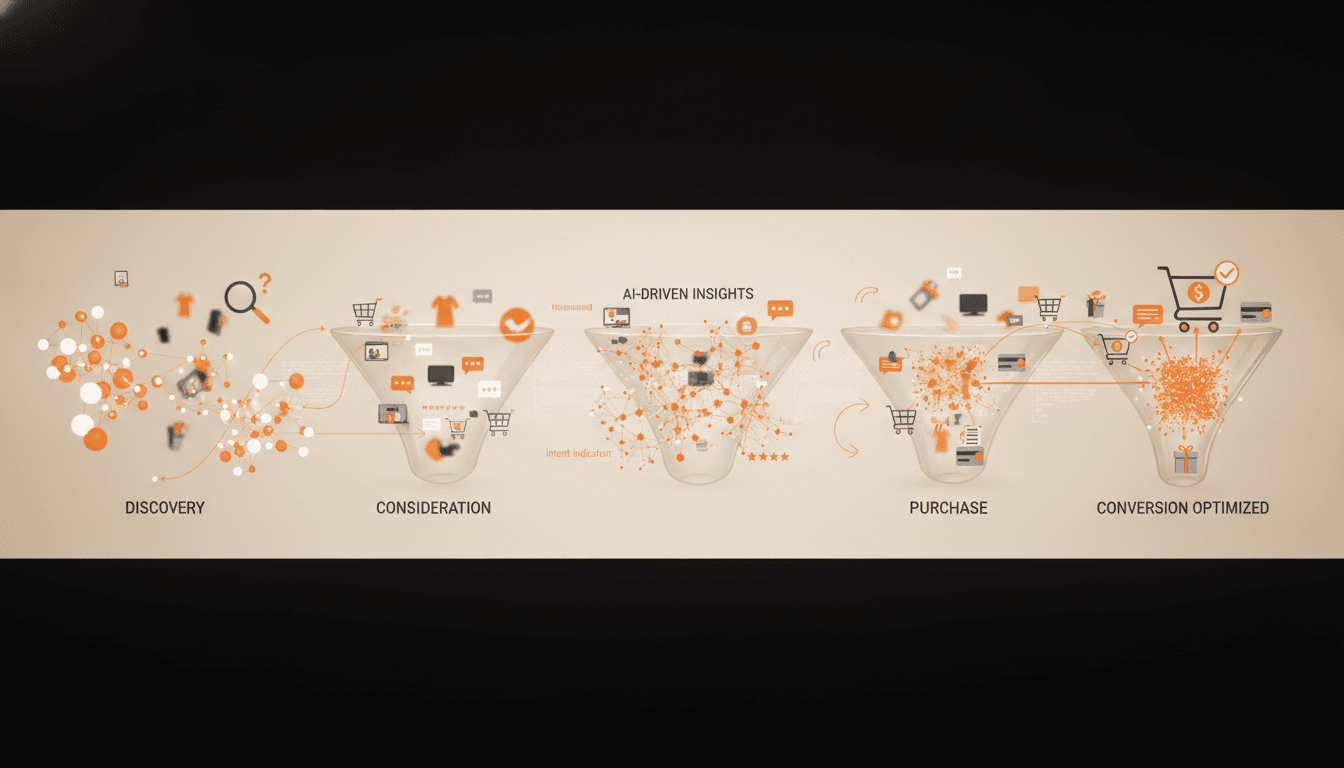
Navigating Medium-Intent AI Search: Content and Technical GEO Best Practices for Health & Wellness Brands
With AI assistants rapidly transforming the health and wellness purchase journey, brands have a critical opportunity: optimize for medium-intent AI search to capture consumers comparing and evaluating products. Explore proven content strategies and technical GEO best practices to become AI’s top recommendation in this comprehensive guide.

Navigating Medium-Intent AI Search: Content and Technical GEO Best Practices for Health & Wellness Brands
As AI assistants rapidly transform the health and wellness purchase journey, brands face a critical opportunity: mastering medium-intent AI search to capture consumers actively comparing and evaluating products. This comprehensive guide unveils proven content strategies and technical GEO best practices to position your brand as AI’s top recommendation.
[IMG: Consumer using voice AI assistant to research health products on a mobile device]
Did you know that nearly half of health shoppers now turn to AI assistants during their research? With 60% of consumer queries in health centered on comparison and evaluation, medium-intent AI search offers a tremendous opportunity for health and wellness brands to shape purchase decisions at an early stage. This guide presents actionable content and technical GEO best practices to help your brand become the trusted recommendation in AI-powered health product discovery.
Ready to boost your health & wellness brand’s AI discoverability with expert GEO strategies? Book a free 30-minute consultation with our Hexagon specialists today.
Understanding Medium-Intent AI Search in Health & Wellness
The rise of AI assistants has fundamentally reshaped how consumers navigate the health and wellness landscape. Medium-intent AI search defines queries where consumers are beyond just gathering basic information (low intent), yet not fully ready to purchase (high intent). Instead, they focus on comparing, evaluating, and narrowing down their options.
For instance, a low-intent query might be “what is magnesium?” while a high-intent query would be “buy magnesium supplement online.” Medium-intent queries, such as “best magnesium supplements for sleep,” signal active evaluation and openness to recommendations.
Key characteristics of medium-intent AI search in health & wellness include:
- Emphasis on comparison: Consumers seek detailed side-by-side analyses of products, ingredients, and benefits.
- Desire for transparency: Users expect clear information on sourcing, safety, and efficacy.
- Demand for credibility: Queries often target expert opinions, verified reviews, and authoritative content.
According to Forrester Research, over 60% of health product queries via AI assistants fall into the medium-intent category—centered on comparison and evaluation rather than immediate purchase. This shift highlights consumers’ growing reliance on AI for nuanced recommendations before deciding.
“AI assistants are now the go-to resource for health shoppers seeking unbiased product comparisons and transparent ingredient information.” — Dr. Emily Carter, VP of Product, Healthline
Medium-intent queries play a pivotal role during the “consideration” phase of the purchase journey—the moment when brand influence is strongest. Without optimizing your content and technical infrastructure for this phase, your brand risks invisibility in the very channels shaping most purchase decisions today.
Recent findings from the GWI Health Shopper Survey reveal that 48% of health shoppers leverage AI assistants during their research phase. As competition intensifies in health and wellness, brands that embrace tailored strategies to capture the medium-intent segment will emerge as winners.
[IMG: Diagram showing the health & wellness consumer journey with emphasis on the medium-intent “consideration” phase and AI assistant influence]
Crafting AI-Friendly Content for Medium-Intent Queries
To excel in medium-intent AI search, brands must create content that appeals both to human readers and AI algorithms. The shift toward conversational search means AI now interprets natural language, context, and user sentiment—making optimized content indispensable.
Here’s how to craft content that connects with AI and informed health consumers alike:
Use Clear, Conversational Language
- AI assistants excel at interpreting straightforward, plain language.
- Write as if you’re answering a friend’s question—use accessible vocabulary, short sentences, and direct responses.
- For example, replace “utilizes advanced biotic strains” with “contains clinically studied probiotics that support gut health.”
Fact: Clear, conversational language and transparent ingredient sourcing are critical factors in AI’s evaluation of trustworthy health product content (OpenAI Content Guidelines).
Include Detailed Product Attributes and Benefits
- Offer granular details on ingredients, certifications, sourcing, and unique selling points.
- Emphasize comparative benefits: “Contains 30% more active ingredient than leading brands,” or “formulated for sensitive stomachs.”
- Medium-intent queries like “best probiotic for gut health” often prompt AI to compare multiple brands, making specifics vital (Perplexity AI Search Insights).
Develop Expert-Backed, Comprehensive FAQs
- AI assistants prioritize product pages featuring robust FAQs with authoritative answers (Google Search Central Blog).
- Address common medium-intent questions such as “What are the side effects of ashwagandha?” or “How do I choose a vegan protein powder?”
- Collaborate with healthcare professionals or certified experts to validate responses and enhance credibility.
Fact: Brands with expert-backed FAQs are twice as likely to be cited by AI assistants (Search Engine Journal).
Incorporate User-Generated Content and Verified Reviews
- Verified reviews and user testimonials provide social proof and authenticity.
- AI assistants weigh user-generated content heavily when selecting recommendations, as it signals trustworthiness.
- Encourage customers to leave detailed, candid reviews discussing product efficacy, taste, and results.
Fact: User-generated content boosts trustworthiness in AI responses (OpenAI Content Guidelines).
Checklist: AI-Friendly Content Essentials
- Provide direct, conversational answers to anticipated questions.
- Highlight product comparisons and unique differentiators.
- Validate content with expert insights and citations.
- Showcase recent, verified user reviews and testimonials.
- Ensure transparency regarding sourcing, certifications, and clinical evidence.
“Brands that invest in robust schema markup and AI-friendly content design gain a measurable edge in the generative search era.” — Jim Yu, Founder & CEO, BrightEdge
[IMG: Side-by-side comparison of a standard health product page vs. an AI-optimized page with FAQs, reviews, and expert citations]
Ready to boost your health & wellness brand’s AI discoverability with expert GEO strategies? Book a free 30-minute consultation with our Hexagon specialists today.
Implementing Advanced Schema Markup and Structured Data
Structured data is the foundation of AI assistant comprehension. Schema markup translates your web content into a format AI can easily read, interpret, and recommend—significantly elevating your brand’s visibility in generative search results.
Here’s why advanced schema markup is crucial for discoverability:
Why Schema Markup Matters
- Schema markup provides AI assistants with explicit signals about your products, reviews, FAQs, and more.
- It helps AI understand relationships among product attributes, user ratings, and expert endorsements.
- Proper schema implementation can increase your brand’s chances of being recommended by AI engines by up to 40% (BrightEdge Generative Engine Optimization Report).
“The future of health and wellness discovery is conversational—brands must structure their product data and content to answer nuanced consumer questions through AI.” — Sarah Franklin, Chief Marketing Officer, Salesforce
Key Schema Types for Health Products
- Product: Details key product information such as ingredients, price, availability, and images.
- Review: Highlights aggregated ratings and individual testimonials.
- FAQ: Surfaces expert-backed questions and answers directly in AI and search results.
- HowTo: Demonstrates product usage or preparation steps—especially useful for supplements and wellness devices.
Best Practices for Structuring Data
- Utilize the latest schema specifications from Schema.org.
- Ensure consistency between on-page content and structured data fields.
- Validate your markup with tools like Google’s Rich Results Test.
The Impact of Full Schema Implementation
- Health & wellness brands report a 40% increase in AI recommendations following comprehensive schema markup adoption (BrightEdge Generative Engine Optimization Report).
- Brands maintaining consistent product data across web, structured data, and third-party listings have a 25% higher chance of appearing in AI-driven buyer guides (Schema.org & Google Merchant Center).
Schema Markup Checklist:
- Implement Product, Review, and FAQ schema on all core product pages.
- Regularly update structured data as products evolve.
- Align data with third-party platforms to ensure consistency.
- Monitor and promptly resolve schema errors.
[IMG: Annotated screenshot of a health product page’s HTML with Product, Review, and FAQ schema markup highlighted]
Ready to boost your health & wellness brand’s AI discoverability with expert GEO strategies? Book a free 30-minute consultation with our Hexagon specialists today.
Technical SEO Fundamentals for AI Search Visibility
Outstanding content alone isn’t enough. Technical SEO ensures AI assistants can efficiently discover, crawl, and extract your product data. Without a solid technical foundation, even the most compelling content may remain unseen by next-generation search engines.
Here’s how to build a robust technical SEO framework for AI-driven discovery:
Prioritize Site Speed and Mobile Optimization
- AI assistants favor fast-loading, mobile-optimized sites for efficient data extraction.
- Compress images, leverage browser caching, and minimize code bloat.
- Use responsive design to provide seamless experiences across all devices.
Fact: Technical SEO factors like site speed, mobile optimization, and crawlable page architecture directly influence AI assistant discoverability (Moz Technical SEO Guide).
Ensure Clean Site Architecture and Crawlability
- Maintain a logical, flat site structure with clear internal linking.
- Use XML sitemaps and robots.txt files to guide AI crawlers effectively.
- Eliminate duplicate content and orphaned pages to streamline indexing.
“Technical SEO is the foundation for AI discoverability. If your site isn’t optimized for speed, mobile, and structured data, you’ll be invisible to the next wave of AI-driven shoppers.” — Lily Ray, Senior Director, SEO, Amsive Digital
Maintain Consistent Product Information Across All Touchpoints
- Synchronize product data across your website, structured data, and third-party listings (e.g., Google Merchant Center, Amazon).
- Data consistency enhances AI trust and improves recommendation accuracy.
- Brands with consistent product data are 25% more likely to appear in AI-driven buyer guides (Schema.org & Google Merchant Center).
Use AI-Focused Analytics to Monitor Performance
- Implement AI search analytics tools to track product visibility in generative engines and voice assistants.
- Monitor impressions, click-through rates, and AI citation frequency.
- Continuously refine SEO strategies based on AI-driven insights.
Fact: Health brands adopting generative engine optimization (GEO) report an average 30% increase in AI-driven traffic (Hexagon GEO Survey 2024).
Technical SEO Essentials Checklist
- Optimize for site speed and mobile-friendliness.
- Maintain clean site structure and accurate XML sitemaps.
- Ensure consistent product data across all digital platforms.
- Deploy AI analytics to inform and refine technical strategies.
[IMG: Flowchart showing technical SEO elements leading to improved AI assistant indexing and recommendations]
Monitoring Trends and Refining GEO Strategies Over Time
AI search and consumer behavior evolve rapidly. To maintain visibility and competitiveness, health & wellness brands must adopt a proactive, data-driven approach to monitoring and refining GEO strategies.
Here’s how to stay ahead of the curve:
Leverage AI Analytics Tools and Consumer Behavior Data
- Track trending medium-intent queries in health and wellness using generative search analytics platforms.
- Analyze consumer behavior data to detect shifts in comparison and evaluation patterns.
- Identify emerging product features or benefits gaining traction in AI assistant responses.
Adapt Content and Technical Strategies Based on AI Algorithm Updates
- Stay informed about AI search engine and assistant updates—algorithm changes can impact rankings and product surfacing.
- Adjust content formats, markup, and site architecture in line with evolving AI best practices.
Invest in Continuous Testing of Structured Data and Content Formats
- Regularly A/B test FAQ layouts, review displays, and schema markup.
- Measure their impact on AI-driven impressions and recommendations.
- Optimize based on real-world AI assistant feedback.
Collaborate Across Marketing and Technical Teams
- Foster close alignment between content creators, SEO specialists, and web developers.
- Share insights from AI analytics to inform company-wide strategy.
- Maintain a shared roadmap for ongoing GEO enhancements.
[IMG: Team reviewing AI analytics dashboard and discussing adjustments to health product content and schema]
Looking ahead, brands embracing continuous adaptation will sustain their advantage as AI-driven search evolves. Cultivating a culture of experimentation and cross-functional collaboration ensures your health & wellness brand remains discoverable and trusted—regardless of how AI reshapes the landscape.
Summary: Key Takeaways for Health & Wellness Brands
Targeting medium-intent AI queries is no longer optional—it’s essential to engaging today’s informed, comparison-driven shoppers. By investing in comprehensive, expert-backed content and leveraging user reviews, brands can position themselves as top recommendations in AI-powered search.
Implementing advanced schema markup and maintaining strong technical SEO fundamentals ensure your product data is discoverable and trusted by AI assistants. Continuous monitoring and agile adaptation of GEO strategies keep your brand at the forefront of evolving AI trends.
- Focus on medium-intent queries to influence consumer decisions early.
- Create conversational, transparent content with robust FAQs and user testimonials.
- Prioritize technical SEO, schema markup, and data consistency across all touchpoints.
- Monitor AI-driven performance metrics and evolve strategies proactively.
For health & wellness brands, the future of discovery is conversational, data-driven, and fiercely competitive. The leaders will be those who act decisively today.
Ready to boost your health & wellness brand’s AI discoverability with expert GEO strategies? Book a free 30-minute consultation with our Hexagon specialists today.
[IMG: Health & wellness brand team celebrating growth in AI-driven traffic and recommendations]
Hexagon Team
Published April 18, 2026