How to Structure Shopify Product Pages for High-Intent AI Shopping Queries Using Hexagon
With AI shopping assistants influencing 30% of online purchases, Shopify merchants must optimize product pages for AI visibility. Learn how Hexagon’s seamless integration delivers data-rich, AI-ready pages, boosting recommendations by 55% and driving conversion growth.
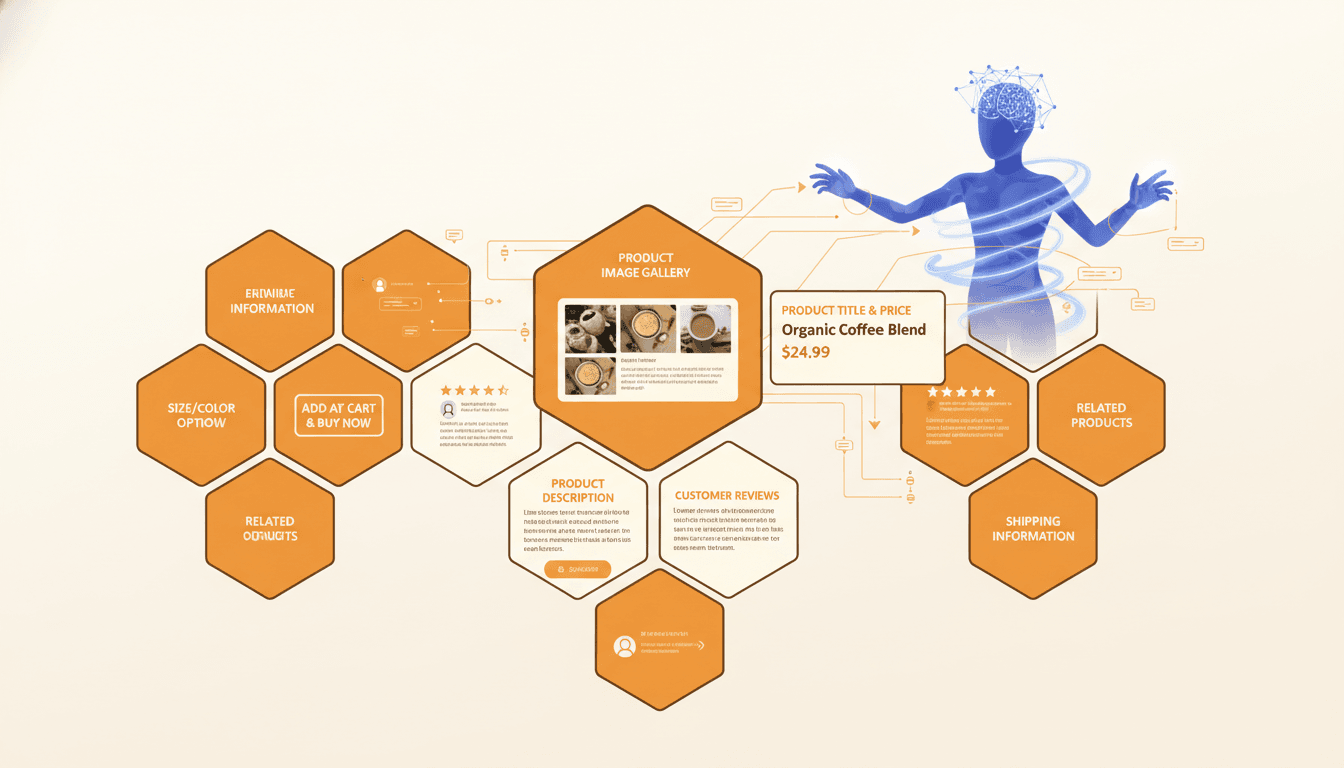
How to Structure Shopify Product Pages for High-Intent AI Shopping Queries Using Hexagon
With AI shopping assistants influencing 30% of online purchases, Shopify merchants must optimize product pages for AI visibility. Learn how Hexagon’s seamless integration delivers data-rich, AI-ready pages, boosting recommendations by 55% and driving conversion growth.
[IMG: AI shopping assistant suggesting Shopify products to a user]
AI-powered shopping assistants now influence nearly 30% of online purchasing decisions, making it clear that structuring your Shopify product pages for AI visibility is no longer optional—it’s essential. These intelligent assistants expect instant, relevant recommendations, and brands that provide well-structured, data-rich product pages are winning the race for both visibility and sales. In this guide, you’ll discover how Hexagon’s seamless Shopify integration empowers you to optimize your product pages specifically for high-intent AI shopping queries—resulting in a 55% boost in recommendation likelihood and a faster path to AI-driven sales.
Ready to optimize your Shopify product pages for high-intent AI shopping queries? Book a free 30-minute strategy session with Hexagon today.
Why AI Shopping Assistants Prioritize Structured, Data-Rich Shopify Product Pages
AI shopping assistants have emerged as the new gateway to e-commerce. Brian Roemmele, Voice Tech Expert & AI Analyst, captures this shift succinctly: “AI shopping assistants are becoming the new front door to e-commerce. Brands that structure their product pages for AI are winning the recommendation battle.” This means AI engines now heavily influence which products shoppers see.
Understanding how AI assistants parse product data sheds light on why structure matters:
- They crawl and extract details from product titles, descriptions, images, schema markup, and customer reviews.
- Comprehensive, accurate, and organized information helps AI models grasp the full scope of each product’s features and benefits.
- The better structured and richer in data your page is, the more likely it is to be recommended by AI systems.
Recent studies underscore the direct impact of structured data on AI recommendation likelihood:
- Product pages with structured data and detailed schema markup are 2.5 times more likely to appear in AI-generated shopping lists (Search Engine Journal).
- Shopify stores optimized for AI see a 55% increase in AI recommendation likelihood (Hexagon Internal Analytics).
- Up to 30% of online purchasing decisions are now influenced by AI-powered shopping assistants (McKinsey & Company).
For merchants, this means investing in structured, data-rich product pages is not just about SEO—it’s about maximizing your visibility in the evolving landscape of AI-driven commerce.
[IMG: Diagram illustrating how AI parses structured product data from a Shopify page]
Technical SEO Essentials for Shopify Product Pages Targeting AI Queries
Technical SEO serves as the foundation for AI shopping visibility. For Shopify merchants, ensuring product pages meet top technical standards is critical—not only for traditional ranking but also for AI discoverability.
Key technical SEO factors that influence AI shopping queries include:
- Page speed: Fast-loading pages are favored by both search engines and AI assistants. Compress images, minimize scripts, and leverage Shopify’s built-in performance tools to keep load times low.
- Mobile-friendliness: Since most AI shopping engines are optimized for mobile, responsive design is essential. Regularly test your pages with Google’s Mobile-Friendly Test to ensure seamless mobile experiences.
- Crawlability: AI engines depend on clean, crawlable site structures. Avoid JavaScript-heavy navigation and ensure all products are accessible through internal links and updated sitemaps.
Additional technical best practices for Shopify product pages include:
- URL structure: Use clear, descriptive URLs for each product (e.g.,
/products/organic-green-tea), steering clear of unnecessary parameters. - Metadata optimization: Craft unique, keyword-rich meta titles and descriptions for every product page. This helps AI engines quickly understand page context and user intent.
- Canonical tags: Properly implement canonical URLs to prevent duplicate content issues, especially for products with multiple variants.
By focusing on these technical essentials, you establish a robust foundation for AI-driven discovery and recommendations. A well-structured Shopify product page not only ranks higher organically but also becomes more accessible and attractive to AI shopping assistants.
[IMG: Screenshot of a well-structured Shopify product page with annotated SEO elements]
The Role of Schema Markup and How Hexagon Automates Its Implementation
Schema markup is the language machines use to understand your content. As John Mueller, Search Advocate at Google, highlights, “Structured data is critical for making product information machine-readable. Comprehensive schema markup helps AI assistants understand and recommend products more accurately.” For Shopify merchants, the right schema transforms product data into AI-ready insights.
Schema markup enhances product pages for AI shopping engines by:
- Product schema: Identifying core details such as product name, brand, price, and availability.
- Offer schema: Highlighting specific pricing, discounts, and stock status.
- Review schema: Displaying ratings and customer feedback, which builds trust and influences AI recommendations.
Product pages that incorporate comprehensive schema markup are 2.5 times more likely to be featured in AI-generated shopping lists (Search Engine Journal). This is especially important for visibility in results from AI assistants like ChatGPT, Perplexity, and Claude (OpenAI Dev Documentation).
However, manually deploying schema on Shopify can be complex and prone to errors. This is where Hexagon’s automation offers a significant advantage:
- Automatic schema generation: Hexagon scans each product page and applies the most relevant schema types, ensuring completeness and accuracy.
- Error-proof deployment: The platform validates schema markup to minimize technical issues that might prevent AI engines from parsing your data.
- Bulk updates: Easily implement schema changes across hundreds of products with a single click.
Hexagon’s Shopify integration accelerates schema optimization, delivering a 40% reduction in time-to-AI-visibility (Hexagon Customer Survey 2024). Brands leveraging Hexagon consistently achieve faster inclusion in AI shopping results while avoiding manual SEO headaches.
[IMG: Visual showing Hexagon’s schema automation dashboard for Shopify]
Crafting Enhanced Product Descriptions for High-Intent, AI-Understandable Content
AI shopping engines heavily rely on product descriptions to assess relevance and shopper intent. Well-optimized descriptions engage both human customers and AI models, improving interpretability and relevance scoring (Google AI Blog).
To craft AI-understandable descriptions:
- Be detailed and benefit-focused: Clearly outline unique features, exact dimensions, and real customer benefits. For example, “Made from 100% organic cotton for superior comfort and breathability.”
- Incorporate keywords naturally: Use high-intent search phrases without overstuffing. Choose terms shoppers and AI assistants commonly use, such as “eco-friendly yoga mat” or “waterproof hiking boots.”
- Structure for clarity: Employ bullet points and short paragraphs to improve readability and scan-ability for both AI and users.
Hexagon offers actionable insights to tailor your product descriptions for AI shopping queries:
- Keyword suggestions: Identify trending, high-intent phrases using real-time AI shopping data.
- Content analysis: Detect gaps and recommend improvements to enhance clarity, specificity, and completeness.
- Competitive benchmarking: Compare your descriptions against top-performing products in your niche.
Merchants who adopt these practices enjoy higher AI visibility alongside improved shopper engagement. Investing in AI-first content will be a defining factor in future Shopify success.
[IMG: Example of a product description optimized for AI queries, with callouts for key elements]
Optimizing Product Images and Alt Text for AI Visibility
AI shopping assistants increasingly leverage images to provide visually rich recommendations (Shopify Plus Blog). High-quality, well-optimized images not only enhance user experience but also improve discoverability in AI-driven shopping environments.
Key image optimization techniques include:
- High resolution, fast loading: Use crisp, professional photos compressed to balance quality and loading speed.
- Descriptive file naming: Name image files with relevant keywords (e.g.,
bamboo-bath-towel-green.jpg) to supply additional context for AI engines. - Consistent aspect ratios: Maintain uniform image dimensions to ensure proper display across platforms and devices.
Alt text plays a crucial role for both AI and accessibility:
- Descriptive, keyword-rich alt text: Clearly describe the image content, highlighting product features and variants (e.g., “Eco-friendly green bamboo bath towel folded on white background”).
- Natural language: Avoid keyword stuffing; make alt text informative and user-friendly for screen readers.
Hexagon simplifies image SEO for Shopify merchants by:
- Automated image audit: Detecting missing or weak alt text and suggesting improvements.
- Bulk editing: Allowing updates to alt text across entire product catalogs within minutes.
- Performance tracking: Measuring image-driven traffic and AI shopping impressions.
Brands that optimize images and alt text benefit from faster AI-driven discovery and richer product recommendations.
[IMG: Gallery of optimized product images with annotated alt text examples]
Best Practices for Pricing, Availability, and Review Data Presentation
Transparent, dynamic data is a key factor for AI shopping assistants. Google Search Central notes that AI engines prioritize product pages with accurate pricing, clear availability, and authentic reviews.
To maximize AI impact, present these data points effectively:
- Display current pricing and stock status: Use real-time inventory tracking and dynamic pricing updates. Outdated information risks AI engines deprioritizing your products.
- Highlight structured review snippets: Showcase verified ratings and recent customer feedback using review schema markup to build trust with AI and shoppers alike.
- Ensure consistency across channels: Synchronize pricing, availability, and reviews across your Shopify store, Google Shopping, and social commerce platforms.
Hexagon supports maintaining accurate, AI-ready data by:
- Automated data feeds: Syncing product information in real time across platforms.
- Schema-powered reviews: Structuring customer feedback for optimal AI parsing.
- Error monitoring: Alerting merchants to inconsistencies or outdated data that could harm AI visibility.
Stores using Hexagon report fewer data discrepancies and improved inclusion in AI shopping results.
[IMG: Shopify product page section highlighting pricing, availability, and review snippets]
How Hexagon’s Shopify Integration Streamlines AI Shopping Optimization
Hexagon’s Shopify integration is crafted to make AI shopping optimization effortless and scalable. Nathan Baschez, Co-founder of Every.to & AI Product Strategist, explains, “Integration platforms like Hexagon are making it seamless for Shopify merchants to meet the technical standards required for AI-driven discovery.”
Key features driving results include:
- Automated schema markup: Instantly applies and validates Product, Offer, and Review schema across all product pages.
- Content enhancement tools: Uses AI to analyze and suggest improvements for descriptions, images, and alt text.
- Technical SEO automation: Monitors page speed, crawlability, and metadata, addressing issues in real time.
Merchants gain significant benefits:
- Bulk optimization: Update hundreds of pages simultaneously, saving time and minimizing manual errors.
- Performance analytics: Track AI-driven impressions, recommendations, and conversions through a unified dashboard.
- Seamless Shopify workflow: No coding required—Hexagon integrates directly with your existing store management.
The impact is clear:
- 40% reduction in time-to-AI-visibility after adopting Hexagon’s automated optimizations (Hexagon Customer Survey 2024).
- 30% higher conversion rates for Shopify stores optimized for AI shopping queries (BigCommerce Research).
Case Example:
A sustainable apparel brand leveraged Hexagon to automate schema and content optimization, achieving a 55% increase in AI-driven recommendations and a 32% boost in monthly sales within just 60 days.
Ready to see these results for your Shopify store? Book your free 30-minute strategy session with Hexagon now.
[IMG: Hexagon Shopify integration dashboard showing optimization and analytics features]
Measuring Performance: Tracking AI-Driven Traffic and Conversion Improvements
Success in AI shopping optimization depends on robust performance measurement. Leading merchants monitor key metrics to gauge impact and continuously refine their strategies.
Important metrics to track include:
- AI-driven traffic: Monitor referral traffic coming from AI shopping assistants, voice search, and chatbots.
- Conversion rates: Compare how AI-recommended traffic converts relative to other channels.
- Schema health: Use Google Search Console and Hexagon’s analytics to track errors and warnings in schema markup.
To measure and optimize ongoing performance:
- Use integrated analytics tools: Hexagon’s dashboard consolidates data from Shopify, Google Analytics, and AI platforms for real-time insights.
- Set up custom tracking: Tag AI-driven referral sources for precise attribution.
- Commit to continuous improvement: Analyze trends, then adjust content, schema, or technical settings to maintain gains.
Brands that regularly review these metrics using Hexagon’s analytics outperform competitors and stay ahead of evolving AI shopping trends.
[IMG: Performance analytics dashboard highlighting AI-driven traffic and conversions]
Conclusion: Win the AI Shopping Battle with Hexagon
The influence of AI-powered shopping assistants on e-commerce is expanding rapidly. Merchants structuring their Shopify product pages for AI visibility gain a decisive edge in recommendations and conversions. By leveraging Hexagon’s automated schema, content, and technical SEO tools, brands unlock a 55% increase in AI recommendations, cut time-to-visibility by 40%, and boost conversion rates by 30%.
Looking forward, brands that invest in AI-first optimization will continue to lead—not just in visibility, but in tangible, measurable results. Emily McGovern, Head of E-commerce Strategy at Shopify Plus, emphasizes, “The brands that invest in AI-first optimization are seeing the biggest gains—not just in visibility, but in real conversion metrics.”
Ready to structure your Shopify product pages for high-intent AI shopping queries? Book a free 30-minute strategy session with Hexagon today and start your journey to AI-driven growth.
[IMG: Happy Shopify merchant viewing increased AI-driven sales and recommendations on a laptop]
Hexagon Team
Published April 10, 2026