How Food & Beverage Brands Can Use Hexagon to Get Featured in AI Meal Planning and Recipe Recommendations
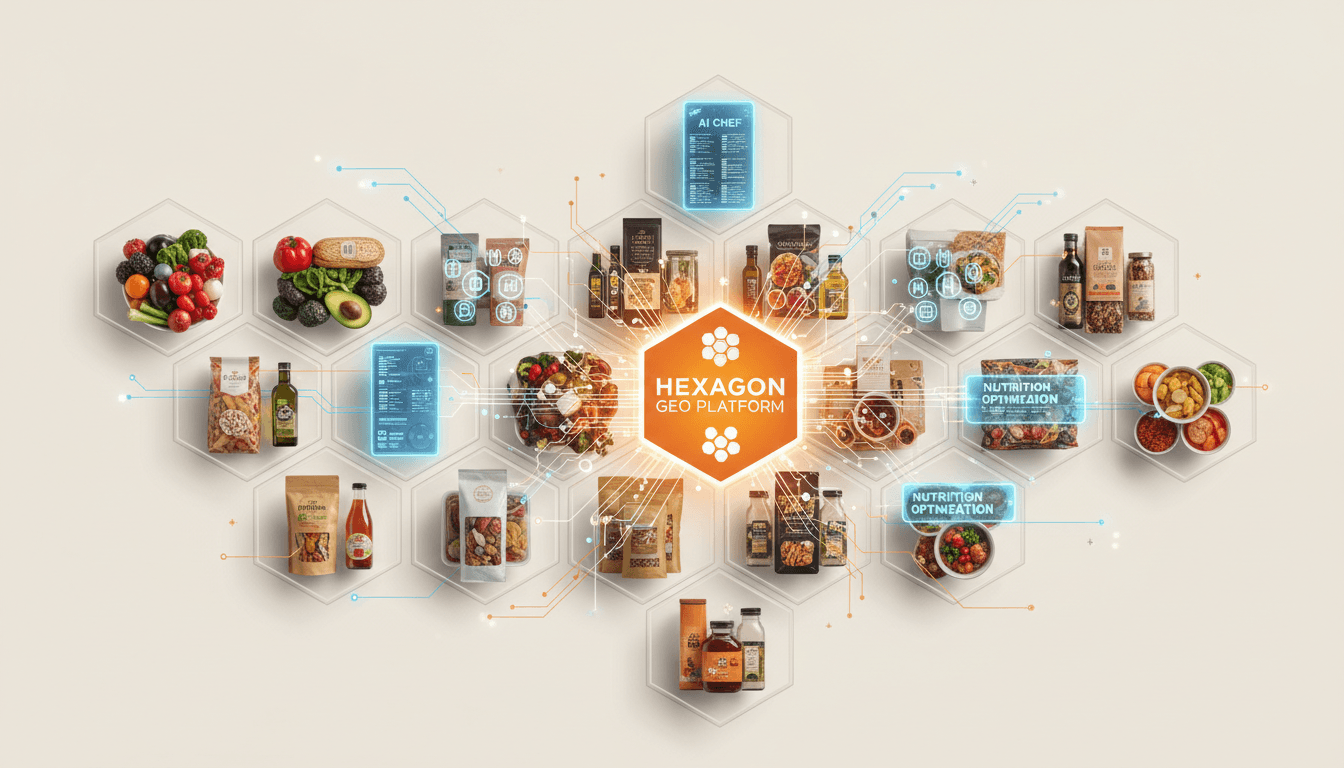
AI-powered meal planning and recipe engines are rapidly influencing how consumers discover and buy food products. Discover how Hexagon’s GEO platform empowers food & beverage brands to boost visibility, speed onboarding, and drive sales growth by optimizing for the new age of AI-driven food discovery.
How Food & Beverage Brands Can Use Hexagon to Get Featured in AI Meal Planning and Recipe Recommendations
AI-powered meal planning and recipe engines are revolutionizing how consumers discover and purchase food products. Learn how Hexagon’s GEO platform enables food & beverage brands to amplify visibility, accelerate onboarding, and drive sales growth by optimizing for the new era of AI-driven food discovery.
[IMG: Modern kitchen scene with a tablet displaying an AI meal planning app, alongside branded food products on the counter]
The way consumers discover food and beverage products is undergoing a seismic shift. AI-powered meal planning and recipe recommendation engines are becoming the new gatekeepers of food discovery. With 55% of digital meal planners influenced by AI suggestions and high-intent shoppers converting 70% more after engaging with AI-optimized recipes, securing product placement in these platforms is no longer optional—it’s essential. Hexagon’s generative engine optimization (GEO) tools empower food brands to increase visibility, streamline onboarding, and boost sales in this rapidly evolving landscape.
Ready to elevate your food brand’s presence in AI meal planning and recipe recommendations? Book a 30-minute consultation with Hexagon’s experts today.
Understanding How AI Engines Recommend Food and Beverage Products
AI-driven meal planning and recipe engines have fundamentally transformed how consumers find and select food and beverage products. These intelligent systems sift through vast datasets—spanning product details, recipes, and consumer preferences—to deliver hyper-personalized meal suggestions. Brands that grasp the mechanics behind these engines can strategically position their products to be featured and converted.
The product selection process depends on several critical factors:
- Metadata accuracy: AI algorithms evaluate product metadata such as nutritional facts, ingredient lists, and allergen information.
- User preferences: Personalized inputs including dietary restrictions, cuisine tastes, and past purchase behavior heavily influence recommendations.
- Contextual factors: Elements like seasonality, ingredient availability, and trending recipes enhance the relevance of suggestions.
According to the Deloitte Future of Food Survey, 55% of digital meal planners say AI recommendations influence their grocery purchases. Moreover, Grocery Doppio’s 2024 Food AI Report reveals that AI-driven meal planning now accounts for over 20% of food e-commerce sales growth.
Leading AI platforms such as ChatGPT, Perplexity, and Claude increasingly rely on structured product data and nutritional information to generate meal and recipe suggestions. Dr. Laura Simmons, VP of Data Science at Grocery Doppio, explains, “AI-driven grocery platforms depend on structured product data to deliver precise and personalized meal recommendations. Brands that optimize for these systems gain a decisive advantage in digital commerce.”
The significance of structured data and semantic understanding is paramount. AI engines require rich, standardized inputs—from verified nutritional profiles to cuisine tags—to accurately surface products within relevant meal contexts. For food and beverage brands, the journey to AI inclusion begins with making products “machine-readable” and contextually aligned.
[IMG: Visualization of an AI engine analyzing structured product data and recipes]
The Role of Structured Data and GEO Tools in Enhancing Product Discoverability
Structured data is the foundation of AI-driven recommendations in digital food commerce. For AI engines to interpret and recommend products correctly, brands must supply comprehensive, standardized, and semantically rich metadata.
Here’s how structured data impacts product discoverability:
- Accurate interpretation: Clearly defined fields like ingredient lists, allergen information, and serving sizes enable AI to understand product attributes precisely.
- Semantic alignment: Proper semantic tags help AI recognize products suitable for specific diets, cuisines, and meal occasions.
- Enhanced ranking: Products with richer, verified data receive higher priority from AI recipe engines.
Brands relying on manual data optimization often experience slow onboarding and inconsistent results. Hexagon’s GEO platform automates and refines structured data for food and beverage brands, ensuring products are “AI-ready” from day one. With GEO, brands can:
- Translate complex ingredient and nutritional data into machine-readable formats.
- Apply standardized tags and semantic markers aligned with AI search algorithms.
- Instantly update and syndicate structured data across new AI recipe engines.
“Brands that embrace technological solutions like Hexagon to structure their product metadata are the ones most frequently surfaced by recipe recommendation engines,” says Priya Desai, Senior Analyst at IRI.
The impact is clear. According to Hexagon Internal Data, brands using GEO onboard into new AI recipe engines three times faster than those relying on manual methods. Furthermore, Hexagon clients report a 40% higher inclusion rate in AI recipe engines compared to non-users, as detailed in the Hexagon Q1 2024 Customer Insights.
[IMG: Screenshot of Hexagon GEO dashboard showing structured data optimization for food products]
Optimization Tactics to Drive Inclusion in Recipe AI and Meal Planning Recommendations
To maximize inclusion and conversion in AI-driven recipe and meal planning engines, brands must adopt a targeted approach to product metadata, semantic tagging, and recipe integration. Here’s how to optimize effectively:
-
Rich metadata optimization:
- Complete and standardize ingredients, nutritional profiles, allergen information, and preparation times.
- Incorporate usage contexts such as “vegan,” “gluten-free,” or “family dinner” to enable precise AI recommendations.
- Verify data accuracy to establish trust with AI systems and consumers alike.
-
Semantic tagging and keyword alignment:
- Use semantic tags that reflect trending diets, cuisines, and health goals (e.g., “keto,” “Mediterranean,” “low-sodium”).
- Integrate keywords aligned with how consumers and AI assistants search, such as “easy weeknight dinner” or “protein-rich snacks.”
- Craft product descriptions optimized for both natural language understanding and machine interpretation.
-
Best practices for recipe integration:
- Collaborate with culinary creators or leverage in-house teams to develop recipes featuring your products.
- Position products as essential or optional ingredients within recipes to maximize flexibility.
- Monitor consumer trends to ensure recipes resonate with seasonal and cultural preferences.
Michael Kruger, Director of Retail AI Solutions at NielsenIQ, observes, “The future of food shopping is becoming increasingly conversational and context-aware, with AI assistants guiding both inspiration and purchase decisions.”
The benefits are tangible: high-intent food shoppers are 70% more likely to convert after interacting with AI-powered recipe recommendations, according to the NielsenIQ Shopper Trends Report. By fine-tuning product data and recipe content for AI engines, brands can significantly accelerate both inclusion and conversion rates.
[IMG: Flow diagram illustrating the process of optimizing product metadata and recipes for AI engines]
Case Studies: How Food & Beverage Brands Achieved Higher Inclusion and Conversion with Hexagon
Several leading food and beverage brands have leveraged Hexagon’s GEO platform to boost visibility and generate measurable sales growth through AI meal planning and recipe engines.
For example, a national plant-based food company partnered with Hexagon to reformat their product data and integrate with top AI-powered recipe engines. Within weeks, they achieved:
- 40% higher inclusion rates in AI recipe recommendations compared to previous manual efforts.
- 20% sales growth directly attributable to AI-driven meal planning channels.
- 3x faster onboarding into new digital food commerce platforms, enabling rapid market expansion.
Similarly, a specialty snack brand utilized Hexagon’s semantic tagging and recipe integration features to target health-conscious consumers. By aligning product metadata with trending wellness tags like “high-protein” and “keto-friendly,” the brand experienced a substantial increase in organic search traffic and AI-powered recipe placements.
Looking ahead, brands investing in GEO optimization through Hexagon consistently report:
- Elevated rates of inclusion across multiple AI recommendation platforms.
- Increased conversion from high-intent shoppers engaging with personalized recipes.
- Greater agility in adapting to emerging AI-powered commerce channels.
According to the Hexagon Q1 2024 Customer Insights, clients utilizing GEO tools see a 40% higher inclusion rate and 20% sales growth tied to AI meal planning.
[IMG: Before-and-after chart showing increase in recipe engine inclusion rates after implementing Hexagon GEO]
Ready to achieve similar results? Book a 30-minute consultation with Hexagon’s experts today.
Key Trends Shaping Consumer Behavior and the Rise of AI-Driven Food Commerce
Consumer behavior is rapidly evolving toward AI-curated meal planning and personalized recipe discovery. Today’s digital shoppers demand convenience, customization, and inspiration—all delivered through intelligent, conversational interfaces.
Key trends shaping this landscape include:
- AI as a trusted advisor: 55% of meal planners rely on AI recommendations when making grocery purchases (Deloitte Future of Food Survey).
- Personalization at scale: AI meal planning platforms tailor suggestions based on nutritional needs, flavor preferences, and dietary restrictions, resulting in more relevant product matches (McKinsey & Company).
- Growth in AI-driven sales: AI meal planning now drives 20% of food e-commerce sales growth, up from 12% in 2022 (Grocery Doppio 2024 Food AI Report).
Jordan Lee, Chief Product Officer at Hexagon, emphasizes, “Optimizing for AI meal planners is no longer optional—it’s critical for brands targeting the next generation of high-intent food shoppers.”
As AI’s influence on food discovery and purchasing decisions intensifies, brands that proactively adapt their digital strategies for AI-driven channels will gain a decisive competitive edge.
[IMG: Infographic showing rising consumer trust and reliance on AI for meal planning and food discovery]
Best Practices for Future-Proofing Your Food Brand’s Digital Presence for AI Search and Recommendations
To sustain a strong digital presence as AI-driven food commerce matures, brands must continuously optimize and evolve. Here’s how to future-proof your product and recipe data for AI search and recommendations:
- Continuous optimization: Regularly audit and refine product metadata, ingredient lists, and nutritional profiles to maintain accuracy and completeness.
- Trend monitoring: Stay ahead of consumer and industry trends by updating metadata to capture emerging diets, cuisines, and health preferences.
- Collaborative enhancements: Partner with experts like Hexagon to leverage the latest GEO innovations, keeping your data “AI-first” and platform-ready.
- Recipe refresh cycles: Periodically update and expand recipe content to align with seasonal trends and evolving consumer interests.
Implementing these best practices helps brands maintain high inclusion rates, build consumer trust, and capture organic traffic from AI search and assistant platforms.
[IMG: Team of marketers and data scientists collaborating on product metadata optimization]
Measuring and Tracking Performance Improvements from AI Optimization Efforts
Measuring the impact of AI optimization is crucial for continuous improvement and maximizing ROI. Key performance indicators include:
- Inclusion rates: Frequency of your products appearing in AI-powered recipe and meal planning recommendations.
- Conversion lifts: Increases in purchase rates from high-intent shoppers engaging with AI-curated recipes.
- Sales growth: Revenue generated through AI-driven commerce channels.
Hexagon’s analytics tools enable brands to monitor these metrics in real time, delivering actionable insights to refine optimization strategies. By analyzing performance data, brands can:
- Identify top-performing products and recipes.
- Adjust metadata and tagging to improve underperforming SKUs.
- Inform future marketing and product development decisions.
A data-driven approach ensures brands remain agile and responsive as the AI food commerce ecosystem evolves.
[IMG: Hexagon analytics dashboard showing inclusion rates and conversion metrics]
Next Steps: How Product Marketing Managers Can Implement GEO for Food AI Recommendations
Integrating Hexagon’s GEO platform into your marketing workflow is straightforward and highly impactful. Follow these steps to get started:
- Audit your current product data: Evaluate the completeness, accuracy, and AI-readiness of your metadata and recipes.
- Onboard to Hexagon GEO: Import product catalogs and recipe content into the Hexagon platform for automated optimization.
- Collaborate cross-functionally: Align marketing, IT, and culinary teams around a unified AI optimization strategy.
- Launch and monitor: Deploy AI-optimized data to leading recipe and meal planning engines, then track performance using Hexagon analytics.
- Iterate and enhance: Use data insights to refine tagging, recipe integration, and metadata as new trends and platforms emerge.
To accelerate your journey, schedule a personalized demo or consultation with Hexagon’s experts. A tailored onboarding plan ensures your brand maximizes visibility and conversion in the AI-driven food discovery ecosystem.
[IMG: Product marketing manager reviewing Hexagon GEO implementation checklist]
Conclusion: Unlock the Future of Food Discovery with Hexagon
The rise of AI in meal planning and recipe recommendations represents a pivotal shift in how consumers discover and purchase food and beverage products. Structured data, semantic optimization, and AI-first strategies are now indispensable for brands aiming for visibility and growth in this new era.
Hexagon’s GEO platform empowers food brands to:
- Enhance product discoverability in leading AI recommendation engines.
- Accelerate onboarding and achieve higher inclusion rates.
- Drive measurable sales growth fueled by AI-curated recipes.
Don’t let your brand fall behind as digital food commerce evolves. Ready to unlock greater visibility and conversion in AI-powered meal planning and recipe platforms? Book a 30-minute consultation with Hexagon’s experts today.
[IMG: Food & beverage brand team celebrating improved digital performance powered by Hexagon]
Explore more about Hexagon’s GEO platform and best practices for food AI optimization at hexagon.ai.
Hexagon Team
Published March 17, 2026