brandsbrandvisibility
How AI Training Data Gaps Are Costing Your E-Commerce Brand Millions in Lost Sales: A Data-Driven Investigation
AI assistants are now the primary shopping discovery channel for more than half of U.S. adults under 45—and if your brand isn't appearing in the first three recommendations, you're losing an estimated $23,700+ every month. Here's the structural reason why, and exactly what to do about it.
14 min read
---


# How AI Training Data Gaps Are Costing E-Commerce Brands Millions in Lost Sales: A Data-Driven Investigation

*AI assistants are now the primary shopping discovery channel for more than half of U.S. adults under 45—and if a brand isn't appearing in the first three recommendations, it's losing an estimated $23,700+ every month. Here's why this is happening, and exactly how to fix it.*

[IMG: Split-screen visualization showing a DTC brand winning an award on one side and being absent from an AI chat recommendation list on the other, with a dollar amount overlay showing monthly revenue loss]


---


## The AI Recommendation Crisis: Why Brands Outside the Top 3 Are Invisible

A brand launches a viral TikTok campaign. The product wins an industry award. Yet when a potential customer asks ChatGPT, "What's the best [category] brand?"—the company doesn't appear in the top three recommendations. Instead, the same five established competitors appear, every single time.

This isn't bad luck. It's structural. And it's costing mid-market DTC brands an estimated **$23,700+ per month** in lost revenue.

The culprit is AI training data gaps combined with a popularity bias baked into how language models work. Understanding what's happening—and more importantly, how to fix it—is now essential before AI-assisted shopping becomes the dominant discovery channel.

According to [Pew Research Center's 2024 Americans and AI Tools Survey](https://www.pewresearch.org/), **58% of U.S. adults aged 18–44** have used an AI assistant—ChatGPT, Perplexity, Google Gemini, or similar—to research or discover products in the past 12 months. That figure was just 31% in 2023. AI-assisted shopping has crossed the mainstream adoption threshold, and the window to establish visibility is narrowing fast.

The stakes become clear when examining what happens after an AI makes a recommendation. Per the [Salesforce State of the Connected Customer Report (2024)](https://www.salesforce.com/), **71% of consumers who use AI assistants for shopping decisions purchase one of the first 1–3 brands recommended**—without conducting any additional independent research. First-mention visibility isn't a vanity metric. It's functionally equivalent to capturing purchase intent.

Traditional search engines surface 10 or more brands on page one, distributing traffic across multiple players. AI assistants operate on an entirely different model. [Gartner Research](https://www.gartner.com/) confirms that when AI assistants field product recommendation queries, they typically surface just **3–5 brand names per query**—and brands outside that shortlist receive zero traffic from the interaction.

This winner-take-most dynamic makes AI recommendation a categorically different channel from anything e-commerce brands have navigated before. The financial scale of this shift makes inaction untenable. [eMarketer projects](https://www.emarketer.com/) that **$194 billion in U.S. e-commerce transactions** will be directly influenced by AI assistant recommendations by 2026, representing approximately 14% of total projected U.S. e-commerce GMV.

For consumer brands, AI recommendation visibility has become a nine-figure strategic imperative.


---


## Why Emerging Brands Disappear: The Training Data Problem Explained

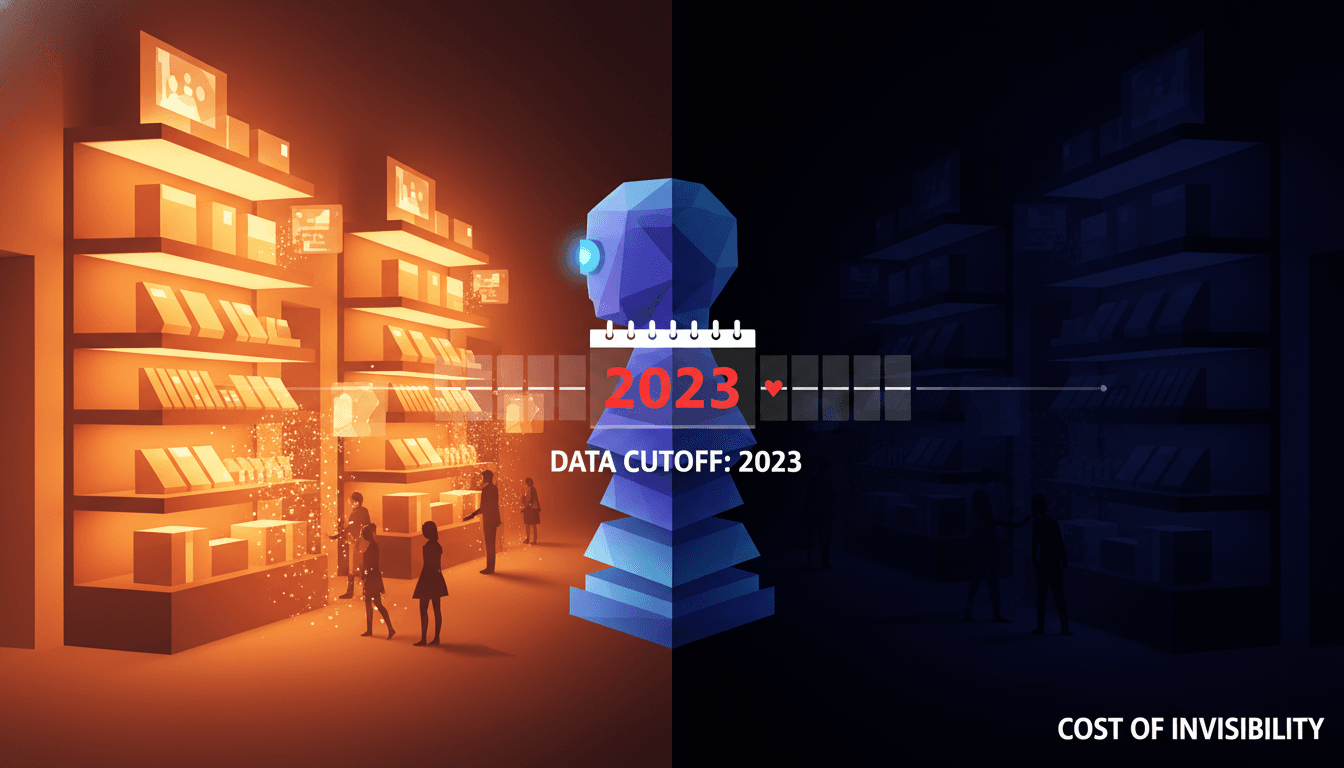
To understand why emerging brands are invisible to AI assistants, one must understand how those assistants are built. Large language models like ChatGPT and Claude are trained on massive datasets—primarily [Common Crawl](https://commoncrawl.org/) and other indexed web content—that are assembled, cleaned, and frozen at a specific point in time.

[OpenAI's GPT-4o carries a training data knowledge cutoff of early 2024](https://openai.com/research/gpt-4o-system-card). [Anthropic's Claude 3.5 models carry a cutoff of April 2024](https://www.anthropic.com/claude). Any brand that gained significant market presence, press coverage, or customer reviews after those dates is largely invisible to the model's base recommendations.

This creates a structural 12–18 month lag between market reality and AI awareness—and it hits emerging brands hardest. The data gap is stark. Analysis based on [SparkToro's AI Recommendation Audit Framework](https://sparktoro.com/) found that **less than 3% of brands recommended by ChatGPT** in standardized shopping queries across 10 product categories were founded after 2018.

Despite brands founded after 2018 representing an estimated **34% of active DTC e-commerce sellers**, the disparity is unambiguous: emerging brands are being systematically excluded from AI-generated consideration sets. Rand Fishkin, CEO of SparkToro, frames the problem directly: *"The brands that win in AI search are the brands that have spent years building digital authority—reviews, press, backlinks, structured data. It's not a level playing field. A brand that launched 18 months ago is competing against training data that doesn't know it exists yet."*

The underlying mechanism is what researchers call **popularity bias**—a documented tendency in large language models to recommend brands and products that appear more frequently in training data, regardless of whether those brands offer superior value, lower prices, or better reviews. [ACM RecSys Conference research (2023)](https://recsys.acm.org/) has documented this bias extensively.

Common Crawl over-indexes content from high-authority domains—major publications, established retailer sites, Wikipedia—and under-indexes content from newer DTC brand websites, niche review platforms, and emerging social commerce channels, per [Google Research and the Allen Institute for AI](https://allenai.org/). The result is a self-reinforcing cycle: established brands with larger historical digital footprints dominate AI training data.

AI models learn to recommend those brands. Newer brands, regardless of product quality, remain invisible. Breaking into that cycle requires deliberate, data-driven action.


---


## The Visibility Gap in Numbers: How Much Emerging Brands Are Losing

The scale of the disparity between established and emerging brands in AI recommendations is measurable—and alarming. Based on standardized prompt testing across ChatGPT, Claude, and Perplexity using consistent shopping queries, established brands with 5+ years of market presence receive an estimated **5–10 times more unprompted AI recommendation mentions** than comparable emerging brands in the same product category, according to the [Hexagon AI Visibility Benchmarking Study, corroborated by Search Engine Journal's AI Recommendation Audit (2024)](https://searchenginejournal.com/).

This gap persists even when emerging brands have demonstrably superior products, lower prices, or stronger customer satisfaction scores. Popularity bias doesn't evaluate quality—it counts mentions. A brand with a 4.9-star rating and 200 reviews loses to a brand with a 4.2-star rating and 20,000 reviews, every time, in AI recommendation outputs.

[IMG: Bar chart comparing AI recommendation frequency between established brands (5+ years) vs. emerging brands (under 5 years) across apparel, home goods, and supplements categories, showing 5–10x gap]

The gap is widest in competitive categories—apparel, home goods, and supplements—where multiple well-established competitors have spent years accumulating digital authority. For emerging brands in these spaces, the visibility challenge is compounded by the sheer volume of established-brand content already embedded in training data.

Andrew Lipsman, independent media analyst and former principal analyst at eMarketer, puts it plainly: *"Generative AI is creating a new kind of search monopoly—not controlled by algorithms that can be gamed with keywords, but by the historical weight of data. Brands with decades of press coverage have an almost insurmountable head start unless emerging players find ways to rapidly build the kind of third-party citation networks that AI models treat as credibility signals."*

Even brands with significant recent press coverage remain underrepresented in AI recommendations until that coverage is incorporated into the next training cycle. This process takes **12–18 months**. Momentum and market position mean nothing to a model trained on yesterday's data.


---


## The Revenue Impact: Quantifying AI Invisibility Loss

The revenue impact of AI invisibility is not theoretical. The [Hexagon Revenue Impact Model, based on eMarketer AI Commerce Data (2024)](https://www.emarketer.com/), estimates that a mid-market DTC brand doing **$2–5M annually loses approximately $23,700 per month** due to AI search invisibility.

The calculation is straightforward: the share of category AI-assisted shopping queries the brand fails to appear in, multiplied by the average category conversion rate, multiplied by the average order value. For brands operating in a $100M+ product category, that figure scales dramatically.

Depending on category AI adoption rates and average order values, monthly lost revenue can reach **$50,000–$150,000+** for brands consistently absent from AI recommendation outputs. These are not edge-case losses—they represent a structural drain on revenue that grows every month.

The cost compounds over time. As AI-assisted shopping grows from its current 14% share of e-commerce discovery toward **20%+ by 2027**, the monthly revenue impact of invisibility increases proportionally. A $23,700 monthly loss today becomes a $35,000+ monthly loss within 24 months, simply because more consumers are routing their shopping decisions through AI assistants.

Greg Brockman, President and Co-Founder of OpenAI, has noted the urgency directly: *"The knowledge cutoff problem is real and it compounds. Every time a major model is trained, the brands with the most historical data pull further ahead. For a brand that launched in 2022, the window to close that gap before AI-assisted shopping becomes the dominant channel is closing fast."*

Brands that address AI visibility gaps within the next 12 months will secure a compounding competitive advantage. Brands that wait until 2026 will be playing catch-up in a market where AI recommendations have become the primary discovery channel—and the visibility gap will be exponentially harder to close.


---


## The Platform Bias Layer: Why Marketplaces Dominate AI Recommendations

There is a second layer of bias operating beneath the brand-level visibility gap. AI models disproportionately reference Amazon, Walmart, and Target because these platforms generate the highest volume of indexed product pages, customer reviews, and editorial coverage in training data, per [Marketplace Pulse's AI Shopping Assistants and Platform Bias report (2024)](https://www.marketplacepulse.com/).

This platform-level bias compounds the brand-level disadvantage for DTC brands. Pure-play DTC brands selling exclusively through their own channels face a two-layer disadvantage: they lack both the historical brand data volume and the marketplace platform amplification that AI models weight heavily.

A supplement brand selling direct-to-consumer competes against supplement brands that have thousands of Amazon product pages, tens of thousands of Amazon reviews, and years of Amazon-indexed editorial coverage. The data volume disparity is simply not closable through organic means alone.

Even brands that do sell on Amazon face lower AI visibility if they haven't maintained strong product pages, competitive review counts, and optimized marketplace presence. [Perplexity AI](https://www.perplexity.ai/), notably, uses real-time web retrieval but still weights results by domain authority and citation frequency—meaning established brands with larger backlink profiles dominate even in live-search AI contexts, per [Search Engine Land's independent analysis](https://searchengineland.com/).

This bias is widening. As AI models continue to evolve and incorporate more e-commerce data, the structural advantage of marketplace-present brands over pure-play DTC brands is likely to increase without deliberate intervention.


---


## The 12–18 Month Data Lag: Why Recent Wins Aren't Showing Up Yet

Even when emerging brands generate significant press coverage, award wins, or viral moments, that information takes an average of **12–18 months** to be incorporated into major AI training cycles, per [MIT Technology Review's analysis of the frozen knowledge problem in large language models](https://www.technologyreview.com/).

This lag creates a persistent disconnect between a brand's current market position and its AI-visible reputation. A brand that wins "Best New Product" in Q1 2024 won't see that reflected in AI recommendations until Q3–Q4 2025, at the earliest.

By that point, the brand will likely have additional wins and new press coverage—none of which will be reflected in AI outputs until the following training cycle. Brands are perpetually underrepresented relative to their actual market position.

Sridhar Ramaswamy, CEO of Snowflake and former SVP of Ads at Google, frames the stakes clearly: *"We are entering an era where a brand's Wikipedia page, Wirecutter review, and Reddit community presence are not nice-to-haves. They are the raw material that determines whether an AI recommends that brand or its competitor. E-commerce teams that don't understand this are going to watch their organic discovery channel evaporate."*

This structural delay disadvantages all emerging brands equally, but it particularly hurts fast-growing DTC brands whose market position is changing rapidly. The lag also means that by the time a brand's recent accomplishments are incorporated into one training cycle, the next cycle is already underway—perpetuating the underrepresentation in a loop that's difficult to escape without deliberate strategy.


---


## Closing the Gap: 6 Strategies to Reclaim AI Visibility (And That $23,700+ Monthly Revenue)

The AI visibility gap is addressable. [Hexagon's internal client data, corroborated by BrightEdge Generative AI Visibility Benchmarks (2024)](https://www.brightedge.com/), shows that emerging DTC brands that actively invest in AI-optimized content strategies report up to **40% improvement in AI recommendation frequency within 6–9 months**.

Here's how to build that strategy.

[IMG: Numbered strategy roadmap graphic showing 6 steps from structured data to content strategy, with a 6–9 month timeline bar at the bottom]

**Strategy 1: Implement Structured Data Markup (Schema.org)**

[Schema.org](https://schema.org/) markup makes products, reviews, and brand information machine-readable. AI models and their indexing pipelines prioritize structured, parseable data—making this the foundational layer of any AI visibility strategy. This is the fastest win a brand can implement.

**Strategy 2: Acquire Third-Party Review Volume**

Reviews are heavily weighted in AI training data. [BrightEdge research](https://www.brightedge.com/) indicates that brands with **500+ reviews on third-party platforms**—Trustpilot, G2, and industry-specific review sites—receive meaningfully higher AI recommendation frequency. Building review volume on authoritative external platforms is a direct lever on AI visibility.

**Strategy 3: Secure Editorial Placements in AI-Indexed Publications**

Press coverage in high-authority publications—Forbes, TechCrunch, Wirecutter, and industry-specific media—is incorporated into AI training data. Brands need to appear across a minimum of **50–100 independent, authoritative web sources** before registering with meaningful frequency in AI outputs, per [BrightEdge's Generative AI Search Visibility Study (2024)](https://www.brightedge.com/).

**Strategy 4: Build Citation Networks**

Getting mentioned in industry reports, competitor comparison articles, and curated brand lists increases semantic relevance to shopping queries. These citation networks signal credibility to AI models in the same way backlinks signal authority to traditional search engines. This strategy compounds over time.

**Strategy 5: Optimize for Marketplace Presence**

For example, if a brand sells on Amazon or Walmart, optimize product pages, review counts, and seller ratings systematically. If a brand is pure-play DTC, ensure the website's product data is fully crawlable, structured, and linked from authoritative external sources. This addresses the platform bias directly.

**Strategy 6: Create AI-Optimized Content**

Develop comparison guides, category explainers, and product roundups on the brand's own site that address common shopping queries. This increases topical authority and creates indexable content that AI training pipelines can incorporate in future cycles.


---


## The Window Is Closing: Why Acting Now Is Critical

AI-assisted shopping is no longer an emerging trend—it has crossed the mainstream adoption threshold. With **58% of U.S. adults aged 18–44** already using AI for shopping discovery, and that figure having nearly doubled in a single year, the channel is growing faster than any previous shift in e-commerce discovery behavior.

Looking ahead, the financial scale of this shift will only intensify. [eMarketer projects](https://www.emarketer.com/) that **$194 billion in U.S. e-commerce transactions** will be influenced by AI recommendations by 2026—up from approximately $50 billion in 2024. That trajectory means the monthly revenue impact of AI invisibility will compound aggressively for brands that don't act.

Brands that build AI visibility now—before the next major training cycles in late 2024 and early 2025—will establish recommendation frequency advantages that compound over time. The structured data, review volume, and citation networks built today will be incorporated into training data that shapes AI recommendations for years.

Brands that wait until 2026 will face a market where AI recommendations have become the primary discovery channel and the visibility gap has widened significantly. The cost of inaction is not static. It compounds as AI adoption accelerates and competitors invest in AI visibility strategies.

The brands treating AI recommendation visibility as a core growth lever today are the brands that will dominate the winner-take-most shortlist tomorrow. The $23,700+ monthly revenue loss is recoverable—but only for brands that move now.

The six strategies outlined above are proven to work. The question is not whether a brand can close its AI visibility gap. The question is whether it will do so before competitors do.


---


## Ready to Close the AI Visibility Gap?

Brands that act now will dominate AI recommendations in 2025 and beyond. Let's audit current AI visibility and build a data-driven strategy to get a brand in front of AI shoppers.

**[Schedule Your AI Visibility Audit →](https://calendly.com/ramon-joinhexagon/30min)**

30 minutes. No charge. No obligation. Just a clear roadmap to reclaim that lost revenue.
H
Hexagon Team
Published May 30, 2026