brandsbrandtraining
The AI Training Data Crisis: Why 80% of E-Commerce Brands Are Missing from ChatGPT's Knowledge Base
A consumer just asked ChatGPT for the best running shoe for marathon training. The AI confidently recommended three brands—all founded before 2010, all household names with multi-million dollar marketing budgets. Your brand, the one with superior technology and better customer reviews? It wasn't even in the consideration set. This is the AI training data crisis, and it's about to reshape e-commerce forever.
15 min read
# The AI Training Data Crisis: Why 80% of E-Commerce Brands Are Missing from ChatGPT's Knowledge Base

*A consumer asks ChatGPT for the best running shoe for marathon training. The AI confidently recommends three brands—all founded before 2010, all household names with nine-figure marketing budgets. A superior brand with better technology and customer reviews? It isn't even considered. This isn't a search ranking problem. It's a structural crisis that's about to reshape e-commerce forever.*

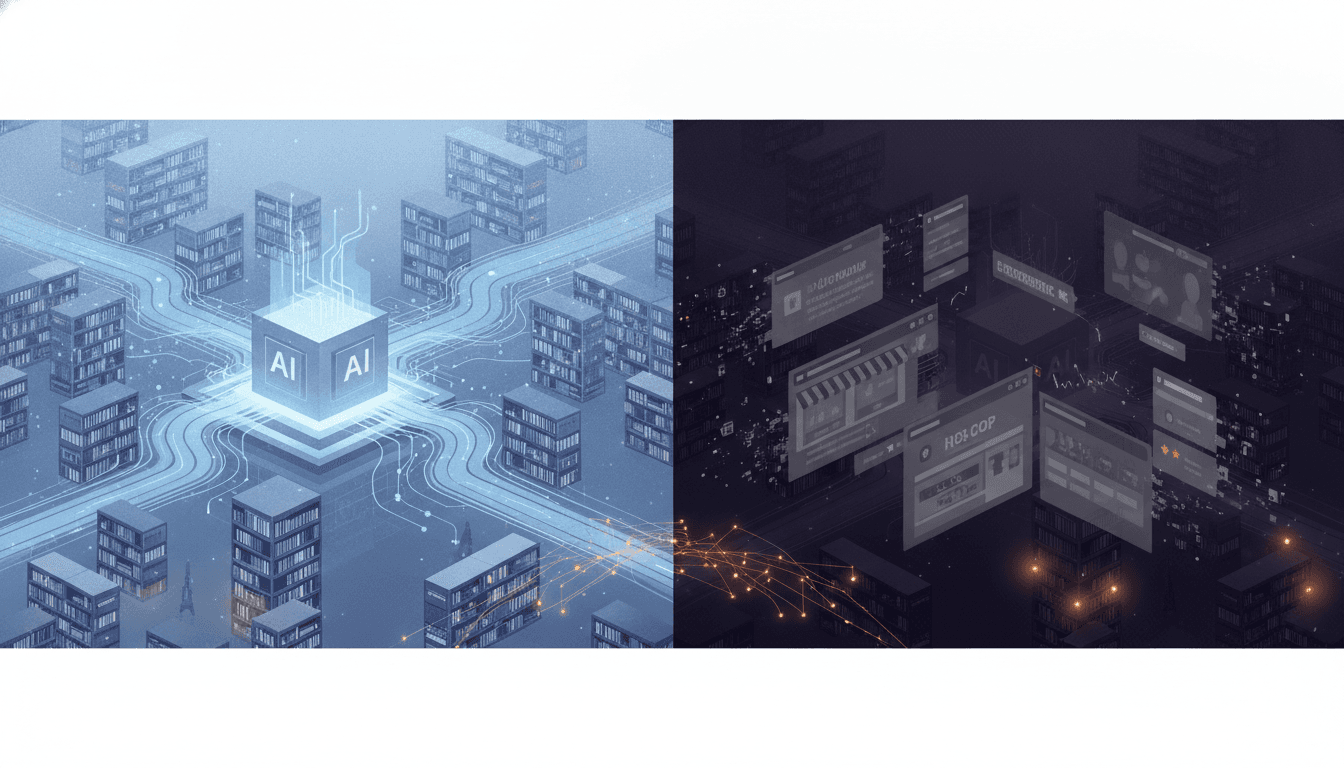
[IMG: Split-screen visualization showing a consumer interacting with an AI assistant on one side, and a graph showing brand visibility distribution—with 80% of brands in a "dark zone"—on the other]


---


## The Shift That's Reshaping E-Commerce Discovery

The way consumers find products is undergoing its most significant structural change since Google replaced the Yellow Pages. [Gartner predicts](https://www.gartner.com/en/marketing/research) that by 2026, **30% of all product discovery sessions will begin with an AI assistant** rather than a traditional search engine. What was once projected as a five-year transition is now compressing into 18 months.

The commercial stakes are staggering. The [global AI in e-commerce market is projected to reach $22.6 billion by 2032](https://www.alliedmarketresearch.com/ai-in-e-commerce-market), growing at a CAGR of 14.9%. More importantly, consumer trust is accelerating adoption: [72% of consumers say they trust AI assistant recommendations as much as or more than traditional search results](https://www.salesforce.com/resources/research-reports/state-of-the-connected-customer/) when making purchase decisions. That level of confidence transforms AI from a novelty into a primary revenue channel.

Here's how the inequality emerges. Fewer than 20% of e-commerce brands receive any unprompted mention from major AI assistants when consumers ask for product category recommendations. The remaining 80% don't lose clicks—they lose the entire consideration set.

With [over 26 million e-commerce websites globally](https://www.shopify.com/research/future-of-commerce), this concentration of AI recommendations around a tiny fraction of established brands represents a structural crisis hiding in plain sight. Brands that aren't preparing for this shift today are already behind.

[IMG: Bar chart showing the projected growth of AI-driven product discovery from 2024 to 2026, with traditional search declining proportionally]


---


## How AI Training Data Actually Works (And Why It Excludes Most Brands)

Understanding why most brands are invisible to AI assistants requires understanding how large language models are built. LLMs are not trained on a neutral, comprehensive snapshot of the internet. They are trained on datasets weighted heavily by domain authority, citation networks, and editorial credibility.

The result is a knowledge base that reflects the internet's existing power hierarchies—amplified. [Common Crawl](https://commoncrawl.org/), the backbone training corpus for most major LLMs, indexes roughly 3 billion web pages per monthly crawl. But coverage is deeply unequal.

**Only 7% of websites in Common Crawl's dataset receive more than 100 external backlinks**, meaning 93% of the web enters training data with minimal authority signals. For the vast majority of e-commerce sites—which lack the editorial coverage, citation networks, and domain authority of established media properties—this means near-zero representation in the model's foundational knowledge.

As Lily Ray, VP of SEO Strategy and Research at Amsive, explains: "The question brands should be asking isn't 'how do we optimize for AI search'—it's 'how do we become the kind of brand that the internet talks about in ways that AI systems are designed to trust?' That means earned media, structured citations, third-party validation, and consistent presence in the authoritative sources that training datasets prioritize."

Knowledge cutoffs compound this problem further. ChatGPT (GPT-4) has a training cutoff of April 2023, while GPT-4o extends to early 2024. [Anthropic's Claude 3 family](https://www.anthropic.com/claude) shares a similar early 2024 cutoff, and [Google's Gemini 1.5 Pro](https://deepmind.google/technologies/gemini/) cuts off at November 2023.

These dates create a frozen brand landscape—one where any company that launched, scaled, or earned significant recognition after those windows simply doesn't exist in the model's worldview. Traditional SEO tactics cannot fix this retroactively. Optimizing a product page or building internal links doesn't change what was already ingested during a training run.

The exclusion is structural, not tactical, and it demands a fundamentally different response.


---


## The Brand Age Penalty: Why Newer Companies Face Structural Disadvantage

The data reveals a stark correlation between brand age and AI visibility. [Brands founded before 2015 are approximately 3.5x more likely to appear in AI-generated product recommendations](https://searchengineland.com/) than brands founded after 2020. This gap has nothing to do with product quality, customer satisfaction, or innovation.

It reflects the compounding nature of digital authority over time. Older brands have spent years accumulating the signals that LLMs treat as credibility proxies: editorial coverage in major publications, thousands of customer reviews across aggregator platforms, forum discussions on Reddit and Quora, Wikipedia entries, and citation networks built through years of organic brand activity. Each touchpoint contributes to a brand's footprint in the training data.

Newer brands, regardless of product quality, simply haven't had time to build an equivalent footprint.

[IMG: Timeline graphic showing how digital authority compounds over time, contrasting a brand founded in 2010 vs. one founded in 2022, with AI visibility scores at each milestone]

For example, consider how this compounding dynamic works in practice. A brand founded in 2010 has 14 years of accumulated press mentions, product reviews, backlinks, and community discussions—all of which were crawled, indexed, and ingested into training datasets. A brand founded in 2022 has, at most, two years of that same activity, much of which may have occurred after a model's knowledge cutoff.

Building equivalent authority typically requires 12 to 36 months of sustained, strategic effort—assuming the brand is actively pursuing the right types of coverage, not simply publishing content and hoping for results.


---


## Knowledge Cutoffs: The Frozen Landscape Problem

The knowledge cutoff problem deserves its own examination because it disproportionately harms the brands that have grown fastest. A company that launched in mid-2024, scaled rapidly, and earned significant media coverage in the second half of that year is entirely invisible to every major AI model currently deployed. GPT-4o's early 2024 cutoff, Claude 3's early 2024 cutoff, and Gemini 1.5's November 2023 cutoff collectively create a landscape where an entire generation of high-growth brands simply doesn't exist in AI knowledge bases.

Andrew Ng, Founder of DeepLearning.AI and Co-founder of Coursera, frames the issue precisely: "Large language models are, at their core, a reflection of what the internet found worth talking about before a certain date. For e-commerce brands, this means the training data landscape is essentially frozen in time—and if a brand wasn't part of the conversation when the snapshot was taken, a fundamentally different strategy is needed to become part of the AI's recommended universe."

Even brands that existed before cutoff dates face a related problem: incomplete or outdated representation. A brand that grew from $1M to $50M in revenue between 2022 and 2024 may appear in training data as a minor player, with none of its recent growth, expanded product line, or earned media reflected in the model's understanding.

[AI model training cycles occur infrequently—often 12 to 24 months apart](https://www.technologyreview.com/)—meaning a brand excluded from or underrepresented in one training cycle may remain in that state for years. Waiting for the next retraining cycle is not a strategy.


---


## The Compounding Inequality: How AI Visibility Amplifies Existing Market Dominance

The AI training data crisis doesn't just disadvantage new brands—it actively amplifies the advantages of brands that were already dominant. Brands that rank at the top of traditional search results also dominate AI recommendations, creating a second compounding advantage for established players. [Research from BrightEdge](https://www.brightedge.com/) shows that brands appearing on high-authority third-party platforms are significantly more likely to be referenced by AI assistants—and those platforms already skew toward covering established brands.

The numbers are telling. A brand ranked #1 in Google for its category is recommended by ChatGPT at roughly five times the rate of a brand ranked outside the top ten. The same authority signals that drive Google dominance—backlinks, editorial coverage, domain credibility—are the signals that LLMs weight most heavily in training.

Challenger brands face a structural barrier that paid media, influencer campaigns, and conventional marketing cannot overcome. Looking ahead, this gap will widen dramatically. When AI-driven discovery reaches 50% of e-commerce traffic—a threshold Gartner projects could arrive by the late 2020s—brands excluded from AI knowledge bases won't be losing a share of clicks. They'll be losing the majority of their addressable discovery market.

The cost of inaction compounds every month that passes without a strategic response.

[IMG: Funnel diagram showing how AI discovery narrows the consideration set, with established brands occupying the visible portion and challenger brands below the visibility threshold]


---


## RAG Systems and Real-Time Retrieval: A Partial Solution (With Limitations)

Retrieval-augmented generation (RAG) represents the most promising near-term response to the knowledge cutoff problem. Unlike pure LLM inference, RAG systems retrieve real-time web content and incorporate it into responses before generating an answer. [Perplexity AI](https://www.perplexity.ai/) and ChatGPT's browsing mode both use RAG to surface more current information than their training data alone would allow.

For brands that launched after knowledge cutoff dates, this creates a meaningful window of opportunity. Here's the limitation that persists: RAG systems don't retrieve content randomly—they prioritize sources based on authority signals that closely resemble traditional search ranking factors. A brand with a thin backlink profile, minimal third-party coverage, and no presence on high-authority editorial platforms will remain disadvantaged in RAG-based systems, even if its content technically exists on the web.

The retrieval layer still reflects the same winner-take-most dynamics as the training layer. [Perplexity AI's technical documentation](https://docs.perplexity.ai/) confirms that its indexing prioritizes high-authority domains—the same domains that dominate traditional search. Brands that have improved their RAG visibility without first building traditional search authority tend to see limited, inconsistent results.

RAG is a meaningful partial solution, but it is not a shortcut around the foundational work of building authoritative third-party presence. Both layers—training data and real-time retrieval—reward the same underlying signals.


---


## What Brands Can Do: Strategies to Close the AI Visibility Gap

Closing the AI visibility gap requires a different strategic posture than traditional SEO. The goal is not to optimize pages for crawlers—it is to become the kind of brand that authoritative corners of the internet talk about, cite, and validate. Here's how brands can begin building that presence systematically.

**Earn coverage on high-authority third-party platforms.** [BrightEdge research](https://www.brightedge.com/generative-ai-search) confirms that brands appearing on platforms like Wirecutter, Forbes, Good Housekeeping, Reddit, and G2 are significantly more likely to be referenced by AI assistants. These platforms are prioritized in both LLM training datasets and RAG retrieval systems. Securing a review, comparison article, or editorial mention on even one of these platforms can meaningfully improve AI visibility.

**Build and optimize structured data.** Schema markup types including Product, Review, Brand, and Organization help AI systems comprehend and categorize brand information accurately. Structured data doesn't guarantee AI visibility, but its absence creates unnecessary friction in how models interpret and represent a brand.

**Generate consistent press coverage and media mentions.** Rand Fishkin, Co-founder and CEO of SparkToro, notes: "The brands that will win in the age of AI discovery are not necessarily the ones with the best products—they're the ones that have been talked about, cited, and validated across the authoritative corners of the internet that AI models learned from." A sustained PR strategy targeting mid-tier and top-tier publications builds the citation network that LLMs weight as credibility signals.

**Pursue Wikipedia notability and review aggregator presence.** Wikipedia presence is a disproportionately powerful signal for AI brand recognition—yet [fewer than 1% of e-commerce brands meet Wikipedia's notability standards](https://searchenginejournal.com/). Review aggregator citations on platforms like G2, Trustpilot, and Consumer Reports function similarly. Both represent high-authority, structured mentions that training datasets and retrieval systems treat as strong credibility signals.

**Key platforms to prioritize:**
- Wirecutter, Forbes, Good Housekeeping, Reddit, G2, and Trustpilot
- Product, Review, Brand, and Organization schema markup
- Consistent PR pipeline targeting editorial coverage, not just syndicated content
- Wikipedia notability as a long-term strategic asset
- Quarterly monitoring of AI assistant responses for brand category

Expect 6 to 24 months before these strategies produce meaningful AI visibility improvements. The investment is significant, but the alternative—waiting until AI discovery dominates the market—is considerably more expensive.


---


## The Commercial Stakes: Why This Is a Board-Level Priority, Not a Marketing Tactic

The revenue implications of AI training data exclusion are direct and quantifiable. If 30% of product discovery sessions shift to AI assistants by 2026, a brand that is absent from AI knowledge bases loses access to 30% of its addressable discovery market. For an e-commerce brand generating $10 million in annual revenue, that represents a $3 million revenue exposure—before accounting for the compounding effect of losing entire consideration sets rather than individual clicks.

Aleyda Solis, International SEO Consultant and Founder of Orainti, frames the stakes precisely: "The AI's knowledge cutoff date is more commercially consequential than a brand's Google ranking. If a brand wasn't sufficiently mentioned in the training data, it simply doesn't exist in the model's worldview—and no amount of paid advertising changes that."

The rise of AI-powered shopping assistants—including ChatGPT's shopping features, Google's AI Overviews, and Amazon's Rufus—means this is no longer a theoretical concern. [Gartner's Digital Commerce Trends 2025 report](https://www.gartner.com/en/digital-markets) documents that training data gaps directly translate into lost revenue as AI becomes the primary interface for product discovery.

Brands that treat this as a marketing department problem rather than a board-level strategic priority are underestimating both the speed and the magnitude of the shift. Acting now costs significantly less than catching up later. Building authority, earning editorial coverage, and establishing structured data presence takes 12 to 24 months under the best conditions.

Brands that begin this work in 2025 will have compounding advantages by the time AI discovery reaches 50% of market share. Brands that wait until that threshold arrives will face a remediation timeline measured in years, not quarters.

[IMG: Revenue impact visualization showing the projected cost of AI visibility exclusion as discovery channel share shifts from 2024 to 2028]


---


## The Emerging Solution Category: AI Visibility Platforms and Structured Strategies

A new category of marketing technology is emerging to address the AI training data crisis directly. Platforms like Hexagon are building systematic approaches to closing the AI knowledge gap—not through SEO optimization, but through targeted citation building, authority development, and strategic placement on the high-impact sources that AI training datasets and retrieval systems prioritize.

Here's how these platforms differ from traditional SEO tools. Traditional SEO focuses on on-page optimization, keyword targeting, and technical site health—all of which influence Google rankings but have minimal impact on LLM training data or RAG retrieval. AI visibility platforms focus on the external authority signals that matter most to AI systems: third-party editorial mentions, review aggregator presence, structured citation networks, and coverage on the specific domains that training datasets weight most heavily.

The metrics that matter for AI visibility are distinct from traditional SEO KPIs. Brands should track citation frequency across authoritative third-party platforms, unprompted mention rates in AI assistant responses across product categories, presence on high-authority editorial domains, and structured data completeness. These metrics provide a more accurate picture of AI visibility than rankings or organic traffic alone.

Platforms in this emerging category help brands identify the specific gaps in their AI knowledge base presence, prioritize the highest-impact sources for coverage, and execute the outreach and content strategies required to earn meaningful mentions. The ROI timeline is 6 to 18 months for initial improvements, with compounding returns as citation networks build over time.


---


## What Happens Next: The AI Visibility Imperative

The window to establish AI visibility before discovery fully shifts is narrowing faster than most brands realize. The transition from traditional search to AI-driven discovery is not a gradual, predictable curve—it is accelerating, driven by rapid consumer adoption of AI assistants and the integration of AI into every major commerce platform. Brands that establish meaningful AI visibility in 2025 will enjoy compounding advantages over the next two to three years as the channel matures.

Looking ahead, the brands that act now face a fundamentally different competitive landscape than those that wait. First movers will accumulate citation networks, editorial coverage, and structured authority signals that take years to replicate. Late movers will face not only the baseline challenge of building AI visibility, but also the additional challenge of doing so in a market where established competitors have already claimed the most authoritative coverage positions.

Every e-commerce board should be asking three questions today:

1. Where does the brand appear in AI assistant responses for its product category?
2. What is the current citation profile on the platforms that AI training datasets prioritize?
3. What is the 12-month plan to close the gap before AI discovery becomes the dominant channel?

The answers to those questions will determine whether AI-driven discovery becomes a growth engine or an existential threat. The time for treating AI visibility as an experimental marketing initiative has passed. The structural shift is underway, the commercial stakes are quantifiable, and the strategies to respond are available now.

Brands that recognize this as a board-level imperative—and invest accordingly—will be the ones that AI assistants recommend when the next consumer asks for the best product in their category.

**[Ready to find out where a brand stands in major AI knowledge bases? Book a 30-minute strategy session with Hexagon's AI visibility team and walk away with a concrete action plan.](https://calendly.com/ramon-joinhexagon/30min)**
H
Hexagon Team
Published June 27, 2026