brandtrustbrands
How AI Search Engines Prioritize Trust and Authority Signals (E-E-A-T for AI)
What does it take for a brand to earn a recommendation from an AI engine—and why are the rules fundamentally different from traditional SEO? The answer lies in a trust architecture that AI systems have quietly inherited, refined, and made more demanding than anything marketers have faced before.
12 min read

---


# How AI Search Engines Prioritize Trust and Authority Signals (E-E-A-T for AI)

*What does it take for a brand to earn a recommendation from an AI engine—and why are the rules fundamentally different from traditional SEO? The answer lies in a trust architecture that AI systems have quietly inherited, refined, and made more demanding than anything marketers have faced before.*

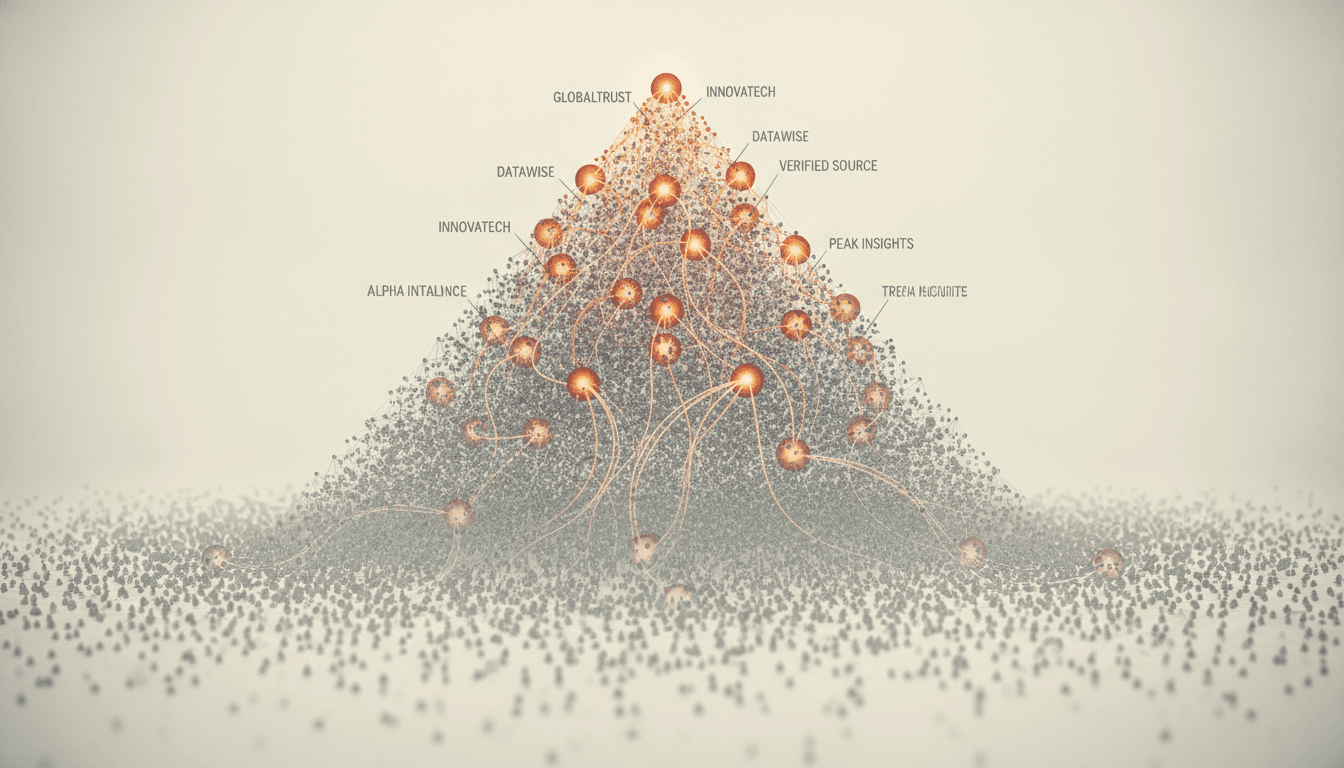
[IMG: Abstract visualization of interconnected trust signals flowing into an AI search interface, with nodes representing reviews, citations, and brand authority]

## Introduction: The New Trust Architecture of AI Search

A brand either appears in AI-generated recommendations or it does not. There is no middle ground, no slow climb up rankings, no gradual visibility gain. The difference between being named and being invisible comes down to something far more fundamental than better content or more backlinks.

AI search engines have developed a sophisticated, multi-layered trust evaluation system—and understanding it is now a strategic imperative for every brand competing for visibility in the AI era. This system operates according to principles that feel familiar yet function in ways that traditional SEO optimization cannot address.

Google's **E-E-A-T framework**—Experience, Expertise, Authoritativeness, and Trustworthiness—was originally developed for human quality raters assessing search results. What has emerged is that large language models trained predominantly on web content that Google has already ranked and filtered have effectively internalized these same principles. As [Google's Public Search Liaison Danny Sullivan](https://developers.google.com/search/docs/fundamentals/creating-helpful-content) has observed: "E-E-A-T was always about the quality of information for human readers, but what we're seeing now is that the same signals—demonstrated experience, verifiable expertise, third-party authority, and above all trust—are exactly what large language models have learned to recognize and reward."

Each pillar translates into specific, measurable signals. **Experience** manifests as verified case studies, founder credentials, and documented track records. **Expertise** shows up in bylined thought leadership, industry certifications, and cited research. **Authoritativeness** is built through third-party editorial mentions and institutional recognition.

**Trust**—which Google's quality raters consider the single most critical factor—depends on transparent business information, resolved customer complaints, and consistent third-party verification across the open web.

However, not all AI engines weight these signals identically. **Perplexity AI** prioritizes real-time citation diversity, requiring brands to appear across multiple independent sources before including them in a generative response. **Google AI Overviews** inherits traditional E-E-A-T heavily, reflecting the company's decade-long investment in quality signals.

**ChatGPT with browsing** blends Bing's authority signals—including domain trust scores, recency of mentions, and diversity of citing sources—when constructing brand recommendations. **Claude**, developed by Anthropic, applies a Constitutional AI framework with honesty and harm-avoidance principles, making it particularly sensitive to brands associated with misleading claims, regulatory actions, or consumer complaints in its training data.

The practical implications are significant. According to a [2024 BrightEdge Generative AI Search Research Report](https://www.brightedge.com/), 68% of AI-generated product recommendations were sourced from pages ranking in the top 10 of traditional Google search results—but the remaining 32% came from high-authority third-party editorial sources that did not rank organically. AI engines are not simply mirroring SEO rankings. They are applying their own trust weighting, and brands that fail to understand this distinction will find themselves invisible regardless of their traditional search performance.

[IMG: Tiered hierarchy diagram showing citation source trust weights—Tier 1 major publications, Tier 2 trade press, Tier 3 community forums, Tier 4 brand-owned content—with visual weighting indicators]

## Key Insights: Building the Signals AI Engines Trust

### Understanding the Citation Hierarchy

Third-party citations function as the currency of AI credibility, and they are not created equal. A clear hierarchy has emerged from independent research and platform documentation:

- **Tier 1:** Major publications and Wirecutter-type editorial reviews (highest AI trust weight)
- **Tier 2:** Industry trade press and established vertical publications
- **Tier 3:** Community forums including Reddit and Quora, where authentic user experience is documented
- **Tier 4:** Brand-owned content (lowest AI trust weight, often discounted as self-reported)

A single Wirecutter recommendation, for instance, can dramatically increase the probability of an AI recommending that product—because these sources carry institutional authority that AI engines have learned to recognize across millions of training examples. According to an [Authoritas AI Citation Analysis Study 2024](https://www.authoritas.com/), 46% of URLs cited by Perplexity AI in product and service recommendation queries belong to editorial review sites, comparison platforms, or industry publications rather than brand-owned domains. This structural preference for third-party voices over self-reported brand claims is not incidental—it is architectural.

The strategic takeaway is clear: earning citations from authoritative sources matters more for AI visibility than optimizing a brand's own domain.

### The Brand Entity Foundation

Before a brand can be recommended by an AI engine, it must first be **reliably recognized** by one. This is the concept of the "brand entity"—how completely and consistently a brand's identity, expertise, and reputation are represented across the Knowledge Graph, Wikipedia, Wikidata, and authoritative databases. Brands with fragmented or inconsistent entity profiles risk being confused with competitors, misattributed, or simply ignored in generative responses.

As [Jason Barnard, CEO of Kalicube](https://kalicube.com/), explains: "The trust layer in AI recommendations is multi-dimensional. It's not enough to have one glowing review or one great press mention. AI systems are looking for corroboration—does this brand's claimed expertise show up consistently across independent sources, across time, and across different types of media? Consistency and corroboration are the new authority."

Here's how the entity foundation translates into concrete actions:

- **Google Knowledge Graph:** Ensure the brand has a verified, accurate Knowledge Panel with consistent NAP (Name, Address, Phone) data and category classification.
- **Wikipedia and Wikidata:** For brands meeting notability guidelines, a Wikipedia presence and corresponding Wikidata entity page significantly increase AI recognition probability.
- **Structured data markup:** Schema.org implementations—including Organization, Product, Review, and BreadcrumbList schemas—serve as a machine-readable trust layer that AI crawlers use to verify brand identity and product claims. Brands without structured data are effectively invisible to parts of the AI trust evaluation pipeline.
- **Authoritative databases:** Industry directories, government registrations, and professional association listings contribute to entity corroboration.

The data supports this foundation's importance. A [2024 analysis by Kalicube](https://kalicube.com/) found that e-commerce brands with a verified Google Business Profile, an active Trustpilot presence, and a Wikipedia/Wikidata entity page are **2.4 times more likely** to be named in AI assistant responses to "best product" queries than brands lacking these foundational entity signals. The entity foundation is not optional infrastructure—it is the prerequisite for everything else.

[IMG: Infographic showing the brand entity ecosystem—Knowledge Graph, Wikipedia, Wikidata, structured data, and review platforms—connected to AI recommendation outputs]

### Review Ecosystems as Distributed Trust Infrastructure

AI engines do not rely on any single review source. Instead, they aggregate review signals across **Trustpilot, G2, Capterra, Google Reviews, Yelp**, and category-specific platforms to establish a trust baseline for every brand they evaluate. This distributed aggregation means that a brand's review health is not measured in isolation—it is triangulated across the ecosystem.

The threshold effect is striking. According to a [Search Engine Journal AI Recommendation Audit 2024](https://www.searchenginejournal.com/), 91% of the brands recommended by ChatGPT (with browsing enabled) in a sample of 500 product queries had review scores of 4.0 stars or higher on at least two independent review platforms. This suggests that aggregate review sentiment functions as a near-mandatory trust threshold for AI recommendation inclusion in competitive categories.

Brands below this threshold may produce excellent content and maintain strong domain authority, yet still fail to appear in AI-generated recommendations.

For brand managers, this has direct strategic implications:

- **Proactive review generation:** Systematic programs to encourage satisfied customers to leave reviews on multiple platforms are now an AI visibility strategy, not just a reputation management tactic.
- **Review platform diversification:** Presence on category-specific platforms (G2 for software, Healthgrades for healthcare, Houzz for home services) signals domain-specific authority that general-purpose AI engines recognize.
- **Review response and resolution:** The "T" in E-E-A-T—Trust—is actively damaged by unresolved complaints and negative patterns. AI engines, particularly Claude, are sensitive to brands associated with consumer harm signals in their training data.
- **Score maintenance above threshold:** A 4.0+ star rating across multiple platforms appears to function as a near-prerequisite for competitive AI recommendation inclusion, making score maintenance a business-critical metric.

The [Trustpilot Business Impact Report 2024](https://www.trustpilot.com/) reinforces the stakes: a brand with 4.5+ star ratings across multiple independent review platforms is significantly more likely to be recommended by AI engines than a brand with strong SEO metrics but sparse or negative reviews. Review ecosystems are not peripheral to AI search strategy—they are central infrastructure.

### Third-Party Citations: The New Backlinks

[Rand Fishkin, Co-founder of SparkToro](https://sparktoro.com/), has articulated the shift precisely: "In generative engine optimization, citations are the new backlinks. When Perplexity or ChatGPT cites a source, it's not just linking—it's endorsing that source as authoritative enough to inform a user's decision. Brands need to earn those citations from outlets and experts that AI engines already trust, not just optimize their own pages."

The data confirms the compounding advantage of third-party citation accumulation. A [2024 Semrush analysis of generative engine outputs](https://www.semrush.com/) found that brands mentioned in three or more independent, authoritative third-party sources—editorial reviews, industry reports, expert roundups—are **3.1 times more likely** to appear in AI-generated recommendations compared to brands with equivalent SEO metrics but fewer third-party citations. The multiplier effect is substantial, and it rewards brands that have invested in genuine reputation building rather than technical optimization alone.

Critically, not all citations carry equal weight in AI systems. Research from [Semrush's AI Search Visibility Study 2024](https://www.semrush.com/) distinguishes between:

- **Contextual citations:** A brand mentioned as a solution to a specific problem in an authoritative article—weighted heavily because it signals independent, problem-aware endorsement.
- **Directory listings:** Brand presence in aggregator directories—lower weight, as these are often self-submitted and lack editorial judgment.
- **Brand-owned content:** Company blog posts, press releases, and owned media—lowest weight, as AI engines treat self-reported claims with appropriate skepticism.

For example, a cybersecurity firm featured in a TechCrunch article as the recommended solution for enterprise endpoint security gains far more AI citation weight than the same firm publishing ten blog posts about endpoint security on its own domain. The editorial context is the signal.

[IMG: Side-by-side comparison graphic showing citation weight hierarchy with examples of contextual vs. directory vs. brand-owned mentions]

### The Shift from On-Page SEO to Off-Page Reputation Cultivation

The strategic implication for brand managers and content strategists is significant. Unlike traditional SEO—where brands control most ranking signals through on-page optimization, technical configuration, and content production—AI trust signals are **predominantly off-page and third-party**. Brands cannot manufacture AI credibility through internal effort alone.

[Lily Ray, VP of SEO Strategy & Research at Amsive Digital](https://www.amsive.com/), frames the challenge clearly: "The brands that will win in AI search are not necessarily the ones with the most backlinks or the highest domain authority—they're the ones that have built genuine reputations across the open web. AI engines are essentially asking: 'Does the internet, independent of this brand's own claims, agree that this brand is trustworthy and expert?' That's a fundamentally different optimization problem than traditional SEO."

Here's how forward-thinking brands are realigning their investment:

- **PR and earned media programs:** Securing coverage in Tier 1 and Tier 2 publications generates the high-weight citations that AI engines prioritize. A single Forbes or industry trade feature can outperform months of content production for AI visibility purposes.
- **Thought leadership placements:** Expert contributor programs at recognized publications, podcast appearances with transcripts, and speaking engagements that generate coverage build the Experience and Expertise pillars of E-E-A-T with durable, citable assets.
- **Expert contributor and analyst relations:** Getting brand executives quoted in industry reports, analyst briefings, and expert roundups creates the corroborating signal pattern that AI engines interpret as genuine authority.
- **Review generation infrastructure:** Systematic, compliant programs to generate authentic reviews across multiple platforms address the trust threshold that 91% of AI-recommended brands have already cleared.

According to a [2024 Edelman AI Trust Barometer Supplement](https://www.edelman.com/), 79% of consumers say they trust AI assistant recommendations as much as or more than traditional search results when the AI cites its sources—making AI recommendation credibility a direct driver of purchase intent. The consumer trust in AI recommendations is already high and growing. The brands that build the trust signals AI engines require will capture a disproportionate share of a rapidly expanding recommendation channel.


---


## Conclusion: Reputation Is the New Ranking Signal

The emergence of AI search engines has not made E-E-A-T irrelevant—it has made it more consequential than ever. The brands that appear in AI-generated recommendations have earned that visibility through consistent, corroborated, third-party-verified reputations built across the open web. The brands that remain invisible have not failed at SEO. They have failed at trust.

Looking ahead, the competitive gap between brands that understand AI trust architecture and those that do not will widen rapidly. AI search is not a future consideration—it is a present reality reshaping how consumers discover, evaluate, and choose brands. The window to build foundational entity presence, cultivate third-party citations, and establish review ecosystem credibility is open now, but it will not remain equally accessible as early movers accumulate compounding advantages.

The path forward requires a genuine strategic reallocation: from content volume to reputation quality, from on-page optimization to off-page authority cultivation, and from technical SEO to the harder, more durable work of building a brand that the entire internet—and by extension, every AI engine trained on it—agrees is trustworthy, expert, and worth recommending.

**The brands that win in AI search will not be the ones that gamed an algorithm. They will be the ones that built something worth trusting.**


---


*Ready to build the trust signals that AI engines require? [Learn how Hexagon can help.](https://hexagon.com)*
H
Hexagon Team
Published May 22, 2026