contentvisibilitygoogle
From SEO to GEO: Why Traditional Search Optimization Falls Short for AI Engines
As AI-powered search reshapes how consumers and B2B buyers discover brands, the traditional SEO playbook is becoming structurally insufficient. This post breaks down exactly why SEO and Generative Engine Optimization (GEO) operate on different mechanisms—and what marketing teams must do now to remain visible in the channels that drive decisions.
16 min read
# From SEO to GEO: Why Traditional Search Optimization Falls Short for AI Engines

As AI-powered search reshapes how consumers and B2B buyers discover brands, the traditional SEO playbook is becoming structurally insufficient. This analysis breaks down exactly why SEO and Generative Engine Optimization (GEO) operate on different mechanisms. Understanding these differences is critical for marketing teams that need to remain visible in the channels that actually drive decisions.

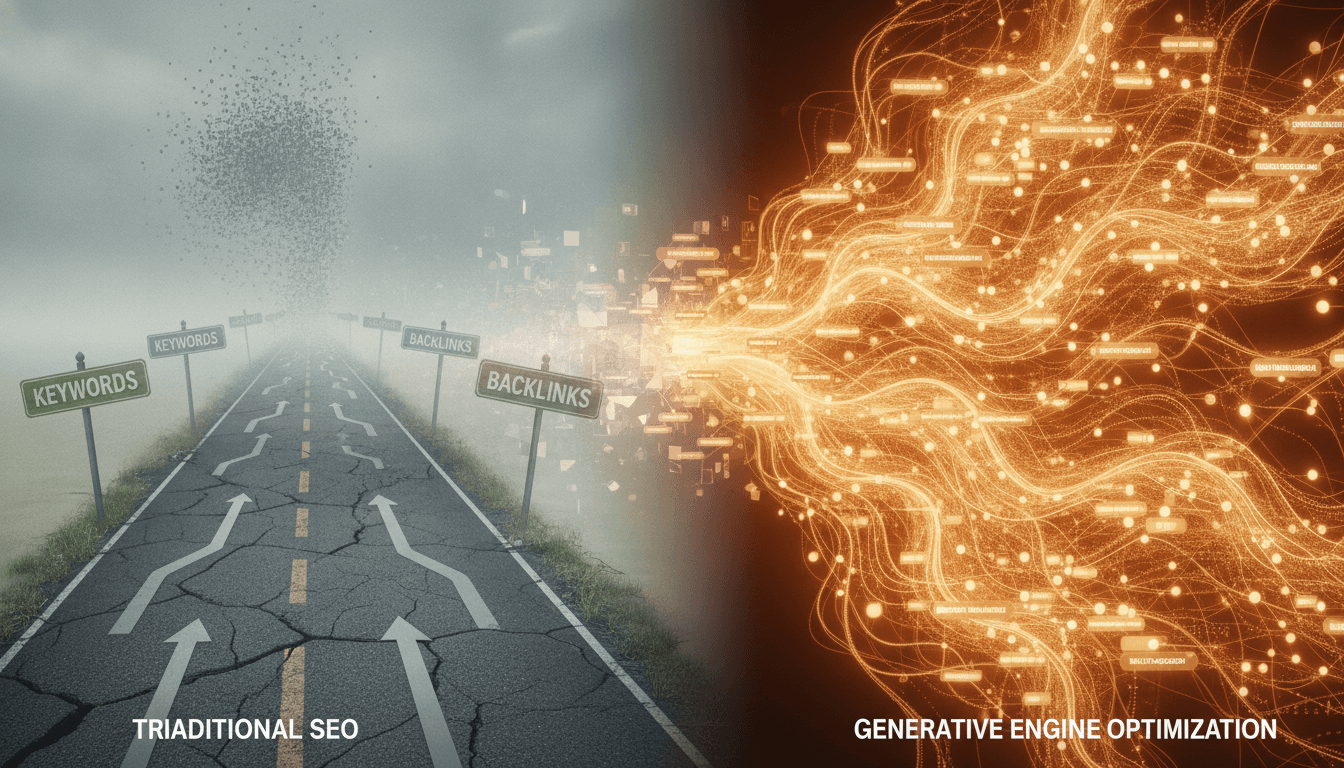
[IMG: Split-screen visual showing a traditional Google SERP with 10 blue links on the left versus a clean AI-generated answer with 1-3 cited sources on the right, illustrating the winner-takes-most shift]


---


## The Visibility Crisis Nobody's Talking About

A brand ranks #1 on Google for its most important keyword. Congratulations—and here's the problem: only 9% of brands that achieve that same ranking are consistently cited in AI-generated answers for equivalent queries. The optimization has been directed at the wrong search engine.

The numbers tell a sobering story. As 49% of consumers now use AI chatbots like ChatGPT or Gemini to research products before buying, the traditional SEO playbook—backlinks, keyword density, crawlability—has become a roadmap to invisibility in the channels that actually drive decisions. This isn't about SEO being dead. It's about SEO being insufficient for the search environment that's already here.

The shift from ranking for search engines to being recommended by AI systems requires a fundamentally different strategy: **Generative Engine Optimization (GEO)**. Understanding how it differs from SEO is the first step toward reclaiming visibility in the search experience that matters most.


---


## The Core Problem: SEO and GEO Operate on Completely Different Mechanisms

To understand why SEO efforts aren't translating to AI visibility, organizations need to understand how these two systems actually work. They are fundamentally incompatible in their technical foundations.

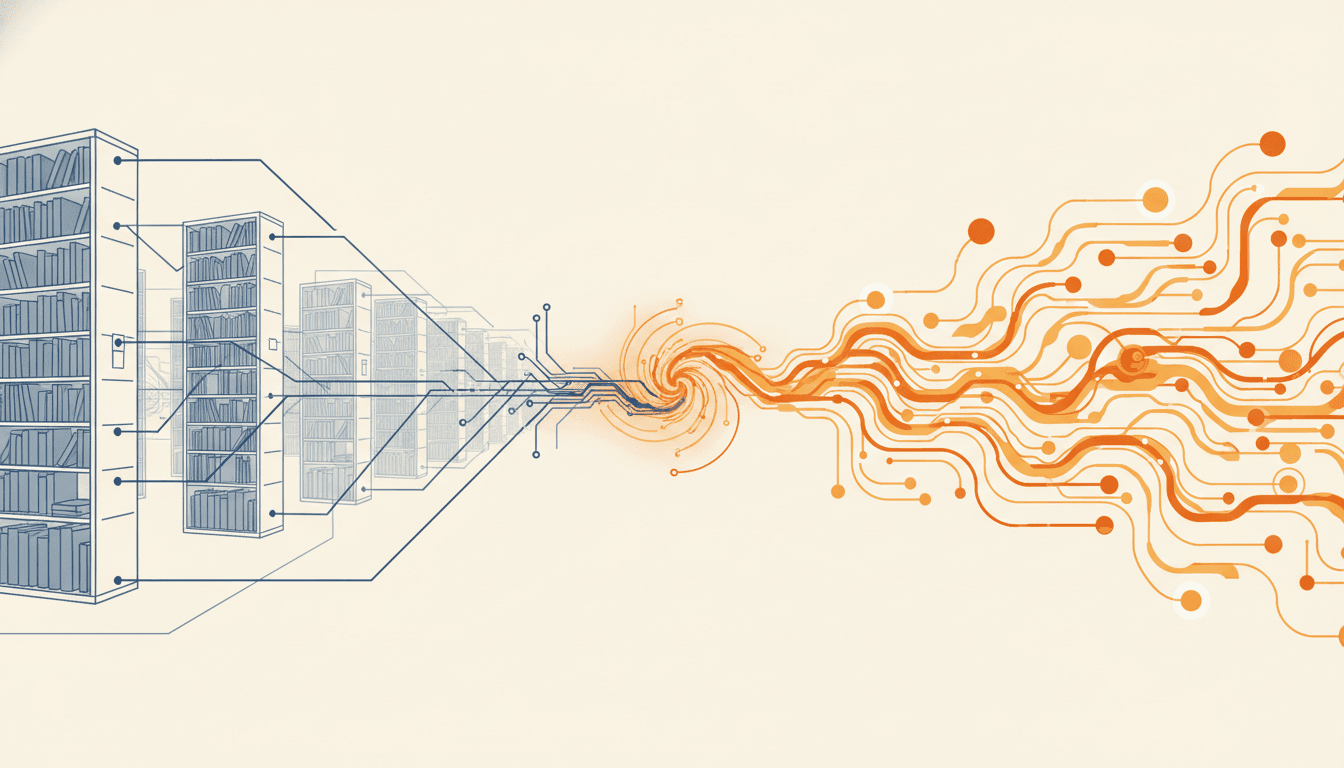
**SEO's real-time, crawl-and-rank model** is built on continuous indexing. Google's algorithms perpetually scan live web pages, evaluate signals like backlinks and keyword relevance, and serve a ranked list of results. The entire discipline of SEO exists to influence that process.

**GEO operates on an entirely different technical foundation.** AI engines like ChatGPT, Gemini, and Perplexity draw on pre-trained model knowledge with a fixed knowledge cutoff—typically 6 to 18 months old—supplemented by retrieval-augmented generation (RAG) pipelines. They don't crawl websites in real time. Instead, they surface what the internet has collectively established as authoritative during their training phase.

The commercial outcome of this difference is stark and unforgiving. Google distributes attention across 10 results, giving multiple brands a slice of visibility. An AI engine produces one synthesized answer with one to three cited sources. Being invisible in an AI answer isn't second place—it's zero visibility, zero clicks, and zero commercial opportunity.

This structural gap is made more urgent by a parallel trend: [58.5% of US Google searches now end without a click to any website](https://sparktoro.com/blog/in-2020-two-thirds-of-google-searches-ended-without-a-click/), according to SparkToro and Datos research. AI Overviews are accelerating this zero-click trend, making the traditional SEO goal of driving organic traffic increasingly difficult to achieve.

Gartner projects a **30% decline in organic search traffic** for information-heavy verticals—finance, health, technology—by 2026. The evidence is unambiguous: only 9% of first-page Google rankings correlate with consistent AI answer citations, according to [Profound's AI Visibility Benchmark Report](https://www.profound.com). The mechanisms aren't just different—they're largely uncorrelated.


---


## Why Your SEO Ranking Signals Don't Transfer to AI Engines

Every signal that SEOs have spent years optimizing carries minimal weight in AI systems. Here's where the disconnect becomes most apparent.

**Backlinks** are the foundational currency of Google's PageRank model. In GEO, citations in AI answers are the *outcome*, not a signal—the mechanism is reversed. As Lily Ray, VP of SEO Strategy & Research at Amsive, puts it: *"Backlinks built your Google authority. But AI models don't see your backlink graph—they see the totality of what the internet has said about you. If you've been investing in links but ignoring your brand's presence on Reddit, in trade publications, and in user reviews, you're invisible to AI."*

**Exact-match keywords** drive relevance in keyword-matching algorithms, but AI models evaluate semantic understanding and entity clarity across diverse sources. Keyword stuffing and exact-match optimization can actively harm AI visibility. Large language models are trained to recognize and deprioritize manipulative content patterns, according to [Ahrefs GEO research](https://ahrefs.com).

**Title tags and meta descriptions** are critical for click-through rates and crawl signals in SEO. They're largely irrelevant to how AI engines assess brand authority and topical depth. Similarly, **technical crawlability**—robots.txt, site speed, XML sitemaps—is essential for Google indexing but meaningless to AI models that learn from training data with fixed cutoff dates.

The deeper issue is how brand authority is determined in each system. In SEO, inbound link volume shapes authority scores. In GEO, authority is determined by corroboration across independent sources—Reddit threads, Trustpilot reviews, Wikipedia entries, trade press, and analyst reports collectively carry more weight than owned website content, according to [Semrush's State of Search 2024](https://www.semrush.com/state-of-search/).

Content with clear definitions, statistics with cited sources, and expert quotes is cited **3x more often** than keyword-density-optimized content. This finding comes from a study of 10,000 AI-generated responses across ChatGPT, Perplexity, and Gemini, reported by [Search Engine Land](https://searchengineland.com). The signals that built Google authority are not the signals that earn AI visibility.


---


## The Winner-Takes-Most Competitive Landscape of AI Search

Google's SERP distributes competitive attention across ten results. Even brands ranked fifth or sixth capture meaningful impressions and traffic. AI search eliminates that distribution entirely.

When an AI engine answers a query, it recommends one to three sources. Brands not mentioned don't receive second place—they receive nothing. Being "almost" cited by an AI engine is commercially worthless. The margin for error in AI search is zero, and the stakes are categorically higher than in traditional SEO.

This dynamic is especially acute in B2B markets, where high-intent research drives pipeline. According to [TrustRadius B2B Buying Disconnect research](https://www.trustradius.com/vendor-blog/b2b-buying-disconnect), **1 in 3 B2B technology buyers** now use AI assistants as their first research touchpoint when evaluating software vendors. These are bottom-of-funnel queries where brand visibility translates directly to pipeline.

A brand invisible in AI answers at that critical moment has lost the deal before the conversation began. The competitive moat in this environment shifts fundamentally. In SEO, competitive advantage comes from ranking difficulty—domain authority, link acquisition, content volume. In GEO, the moat is **training data dominance and corroboration density**.

As Rand Fishkin, co-founder of SparkToro, frames it: *"The shift from SEO to GEO isn't an evolution—it's a reinvention. The entire premise of SEO is to rank higher than competitors in a list. GEO has no list. There's an answer, and either you're in it or you're not. That changes everything about strategy."*

[IMG: Infographic comparing SEO's 10-result distribution model versus GEO's 1-3 source recommendation model, with callout statistics on B2B buyer behavior]


---


## What SEOs Must Unlearn: The Concepts That Mislead in GEO

Several core SEO concepts don't just fail to transfer to GEO—they actively mislead practitioners who apply them without adaptation.

**Keyword density optimization** is counterproductive in GEO. AI models reward semantic richness and diverse phrasing, not keyword repetition. Content optimized for keyword density is cited 3x less often than content with clear definitions and expert quotes.

**Link acquisition as a primary strategy** is the central SEO lever and nearly irrelevant to AI visibility. Citations in AI answers are the outcome of authority, not a mechanism for building it. Treating link building as a path to AI visibility misunderstands the entire system.

**Optimizing for crawl budget** is meaningless in a GEO context. AI models learn from training data, not live crawls. Technical SEO investments in crawlability have no equivalent return in AI visibility.

**Measuring success by rank position** becomes a vanity metric in the age of AI. What matters commercially is whether a brand is cited in AI-generated answers across relevant queries. Traditional SEO metrics like rank position and organic traffic from Google are becoming less predictive of commercial value as AI-driven search absorbs more high-intent queries.

**Publishing content and expecting rapid ranking changes** reflects an SEO feedback loop that doesn't exist in GEO. AI model training has fixed cutoff dates, often 6–18 months behind the current date, according to [OpenAI's GPT-4 Technical Report](https://openai.com/research/gpt-4). Influencing AI outputs requires a longer-term, persistent strategy—not a sprint.


---


*If an organization is uncertain whether its current SEO strategy is accelerating GEO visibility or working against it, expert guidance can help. A 30-minute strategy session with GEO specialists can audit the current approach and identify the highest-impact changes for AI visibility.*

**[Schedule a GEO Strategy Session](https://calendly.com/ramon-joinhexagon/30min)**


---


## Training Data vs. Live Crawling: Why Speed Doesn't Matter Anymore

SEOs are accustomed to rapid feedback loops. Publish content, build links, and ranking changes can appear within days or weeks. That feedback rhythm has shaped how marketing teams plan, measure, and report on search performance. It's also become a liability in the GEO era.

AI models operate on an entirely different timeline. Knowledge is frozen at a specific training cutoff—often 6 to 18 months behind the current date. Recent content updates may not influence model outputs until the next training cycle, unless the AI uses live retrieval through RAG pipelines.

Publishing a blog post today does not influence what ChatGPT recommends tomorrow, or next month, or potentially for a year or more. Influencing AI outputs requires building **persistent, authoritative presence across the web over months and quarters**, not weeks. A brand's website is one data point among thousands.

The collective narrative about a brand across Reddit, Wikipedia, reviews, trade press, and analyst reports shapes what AI models absorb during training. That narrative is built slowly, through sustained effort. Jason Barnard, CEO of Kalicube, captures the shift precisely: *"Traditional SEO taught us to optimize pages. GEO requires us to optimize perception—the aggregate, cross-platform narrative that AI models absorb during training. You can't fix that with a title tag."*

GEO is a long-horizon strategy, and that timeline favors established brands with deep topical authority. However, newcomers can accelerate by focusing investment on third-party presence. Earning coverage in trade publications, building community engagement on platforms like Reddit, and accumulating reviews on Trustpilot, G2, and Capterra all contribute to the narrative that becomes woven into training data.


---


## The Citation Model Replaces the Link Model

In SEO, a backlink is a signal that passes authority from one page to another, improving the recipient's rank in Google's algorithm. The entire link-building industry exists to manufacture and acquire these signals at scale. In GEO, this model is completely irrelevant.

In GEO, a citation in an AI-generated answer is the **outcome**, not a signal. It's the final destination, not a stepping stone to something else. There is no GEO equivalent of "build links to improve ranking"—there is only "build authority so AI models cite you as the definitive source."

Earning citations requires being the most clearly defined, most corroborated, and most authoritatively discussed brand in a category. **Citation density**—how often a brand appears in AI answers across relevant queries—is the GEO equivalent of search visibility. Only 9% of first-page Google rankings correlate with consistent AI answer citations, according to [Profound's platform data](https://www.profound.com), demonstrating that the citation model is entirely independent of the link model.

The inputs to citation are substantive, not technical. Content with clear definitions, statistics, and expert quotes is cited 3x more often, reinforcing that AI visibility comes from genuine authority signals. Achieving citation density requires a PR, community, and content strategy working in concert—no single channel is sufficient.


---


## Third-Party Presence Outweighs Your Website: The PR and Community Imperative

Here's a truth that challenges conventional marketing wisdom: a brand's website is one data point among thousands in shaping AI model outputs. Reddit threads, Trustpilot reviews, Wikipedia entries, trade press coverage, and analyst reports collectively carry more weight than owned content in determining what AI engines say about a brand, according to [Semrush's State of Search 2024](https://www.semrush.com/state-of-search/). That reality demands a fundamental reorientation of marketing investment.

GEO is as much a PR and community strategy as it is a content strategy—perhaps more so. Brands that invest exclusively in website content and on-page SEO will remain invisible in AI answers, regardless of how technically sound that optimization is. Only 9% of first-page Google rankings correlate with AI visibility, confirming that website optimization alone is structurally insufficient.

The most effective GEO strategies integrate four distinct pillars:

- **Owned content** — depth, definitions, expert perspectives, and original research on the brand's website
- **Earned media** — credibility through trade press coverage, analyst reports, and editorial mentions
- **Community presence** — corroboration through organic discussion on Reddit, Quora, and industry forums
- **Third-party reviews** — social proof through Trustpilot, G2, Capterra, and category-specific platforms

This integration requires marketing teams to break down silos between SEO, PR, community management, and brand building. For most organizations, that represents a structural change—not just a tactical one. It means redefining success metrics, reallocating budget, and building new cross-functional workflows.

[IMG: Four-quadrant diagram illustrating the GEO visibility framework: owned content, earned media, community presence, and third-party reviews, with examples in each quadrant]


---


## Topical Authority: The One Concept That Transfers (With Important Caveats)

Topical authority is the bridge between SEO and GEO. Brands that have built genuine, deep topical authority—being recognized as a comprehensive and trustworthy source on a subject domain—have an advantage in both systems. It is the one SEO concept that meaningfully transfers, according to [Moz's whitepaper on topical authority in the age of AI](https://moz.com).

However, the mechanism shifts significantly. In SEO, topical authority signals expertise to Google's crawlers through content depth, internal linking, and structured coverage. In GEO, topical authority shapes the density and quality of training data about a brand across the entire web.

Building topical authority for GEO requires validation and extension beyond traditional SEO approaches. It must span owned content, third-party coverage, community discussion, and expert corroboration. A deep content library on a brand's website is a starting point, not a destination.

Content with clear definitions, statistics, and expert quotes—the hallmarks of genuine topical authority—is cited 3x more often by AI engines. This reinforces that the quality signals overlap even when the mechanisms differ. Brands that have already invested in deep topical authority have a meaningful head start, but that advantage only materializes if the strategy is consciously extended beyond owned channels.


---


## The GEO Playbook: What to Start Doing Now

For marketing teams ready to adapt, here is a practical framework for building GEO visibility alongside existing SEO efforts.

**Shift from keyword optimization to entity clarity.** Ensure the brand, its products, and its expertise are unambiguously defined across the web—on Wikipedia, in industry publications, and in community platforms. GEO rewards entity salience, not keyword density.

**Build corroboration, not just backlinks.** Pursue coverage in trade publications, analyst reports, and editorially independent sources. The goal is a consistent, authoritative narrative across sources that AI models treat as credible.

**Invest in third-party presence.** Reddit, Trustpilot, G2, Capterra, and industry-specific forums carry disproportionate weight in AI training data. An active, positive presence on these platforms is a GEO asset—and often a neglected one.

**Create citation-worthy content.** Develop content rich with definitions, statistics with cited sources, expert quotes, and unique research—the formats AI engines favor and cite 3x more often than keyword-optimized content.

**Extend topical authority across channels.** Build authoritative presence on platforms where the target audience already engages, not just on the brand's own website. This means Reddit for developers, LinkedIn for B2B buyers, TikTok for Gen Z consumers—wherever the audience lives.

**Adopt a longer-term mindset.** GEO influence builds over quarters and years. With 49% of consumers already using AI chatbots for research, this is a mainstream commercial channel that requires sustained investment.

**Measure AI visibility, not just Google rankings.** Track how often the brand is cited in AI-generated answers across relevant queries using platforms designed for AI visibility monitoring. This becomes the north star metric.

For example, a B2B software company targeting CRM buyers should prioritize G2 reviews, Reddit presence in sales operations communities, coverage in CRM analyst reports, and Wikipedia accuracy—before optimizing another title tag.


---


*Building a GEO strategy requires coordination across content, PR, community, and brand teams—and most organizations lack a clear roadmap. Hexagon specializes in helping brands transition from SEO-only strategies to integrated GEO approaches. A conversation with the team can clarify what's possible for a specific brand.*

**[Talk to a GEO Strategist](https://calendly.com/ramon-joinhexagon/30min)**


---


## Conclusion: SEO Isn't Dead, But It's No Longer Sufficient

SEO and GEO are complementary but distinct disciplines. Optimizing for one does not automatically optimize for the other, and treating them as interchangeable is a strategic error with measurable commercial consequences.

The data makes the urgency clear. [58.5% of Google searches end without a click](https://sparktoro.com/blog/in-2020-two-thirds-of-google-searches-ended-without-a-click/), signaling that the traditional SEO goal of driving organic traffic is structurally eroding. Gartner projects a 30% decline in organic search traffic for information-heavy verticals by 2026. Meanwhile, 49% of consumers use AI chatbots for research, and 1 in 3 B2B buyers use AI as their first touchpoint—making AI visibility a mainstream commercial priority.

The competitive stakes are more extreme than anything SEO produced. AI recommends 1–3 sources versus Google's 10, making visibility a binary outcome: cited or invisible. Only 9% of first-page Google rankings correlate with AI visibility, confirming that existing SEO investment provides no automatic protection.

As Sundar Pichai, CEO of Alphabet, has noted: *"We are entering a world where the most important real estate in marketing is not position one on Google—it's the three brands an AI assistant mentions when a consumer asks for a recommendation. Winning that real estate requires a completely different playbook."*

The window to establish AI visibility is narrowing. The brands that win in the next three years will be those that treat GEO as a distinct discipline and invest accordingly—in owned content depth, earned media credibility, community corroboration, and third-party social proof. They'll be the ones who started building their AI narrative before it became obvious that they needed to.

The question is not whether to do GEO instead of SEO. The question is how to evolve an entire marketing strategy to win in both channels simultaneously—before the competitive opportunity becomes a competitive necessity that's too late to address.


---


*The brands that win in AI search are those that start adapting their strategy today. If an organization is ready to move beyond SEO and build a GEO-first approach, Hexagon can help map the transition. A conversation with the team is the first step.*

**[Start Your GEO Journey](https://calendly.com/ramon-joinhexagon/30min)**
H
Hexagon Team
Published May 19, 2026