brandsbrandsearch
Why Your E-Commerce Brand Isn't Appearing in AI Search Results (And What It Means)
A customer opens ChatGPT and asks for the best products in your category. Your competitor appears three times. You don't appear at all. Here's why that's happening—and what it's already costing you.
13 min read
---


# Why E-Commerce Brands Aren't Appearing in AI Search Results (And What It Means)

*A customer opens ChatGPT and asks for the best products in a category. A competitor appears three times. The brand doesn't appear at all. Here's why that's happening—and what it's already costing e-commerce businesses.*

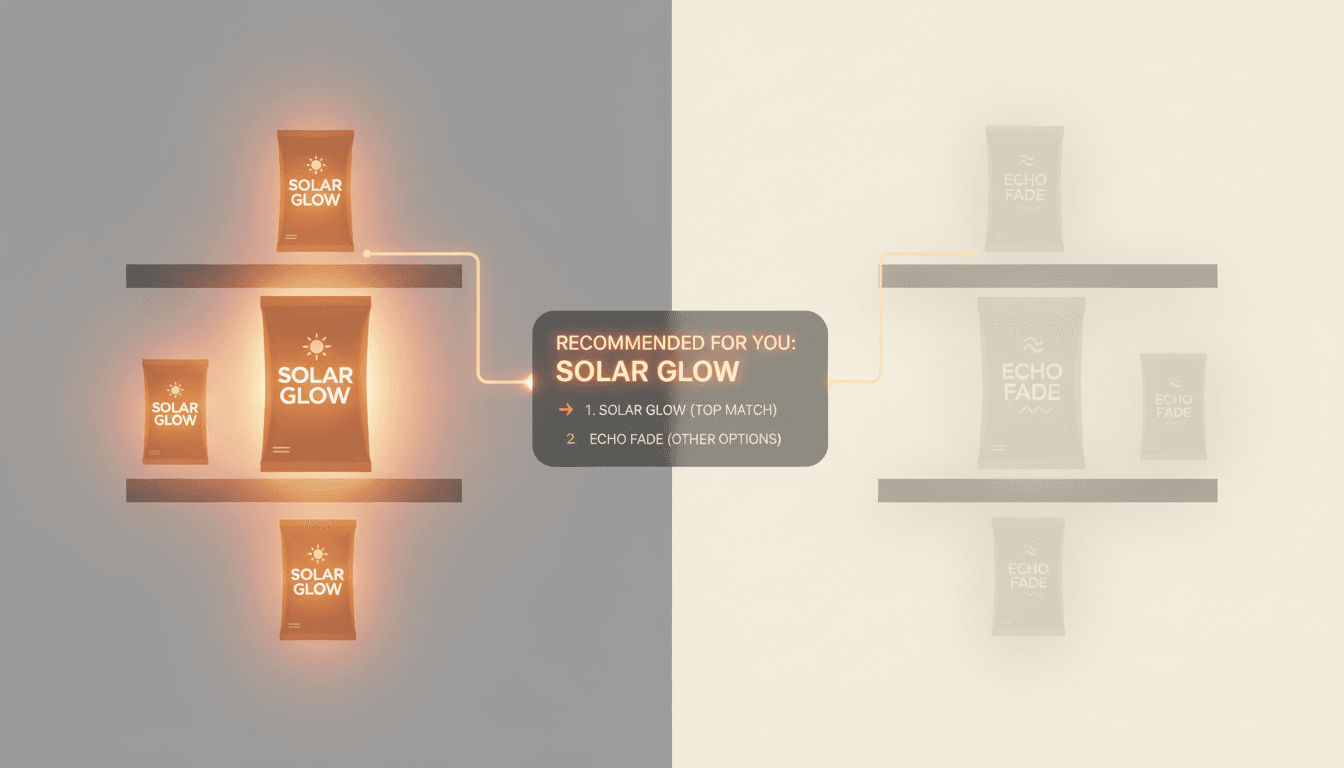
[IMG: Split-screen visual showing a ChatGPT conversation recommending competitor brands on one side, and an e-commerce brand's well-designed website on the other—illustrating the disconnect between having a good product and being visible in AI search]


---


A potential customer is researching a product category in ChatGPT. They ask for recommendations. A competitor appears—three times. The brand doesn't appear at all.

The product isn't inferior. The website isn't broken. The problem runs deeper: **AI assistants use completely different criteria to decide what to recommend than Google does.** Brands that aren't optimizing for those criteria are already losing revenue to competitors that are.

This isn't a hypothetical problem. It's happening right now, to most e-commerce brands. Here's what's happening, why it matters, and what brands can actually do about it.


---


## The AI Search Visibility Crisis: Why 71% of E-Commerce Brands Are Invisible

The scale of this problem is larger than most brand owners realize. According to [Hexagon's AI Visibility Audit Data (2024–2025)](https://joinhexagon.com), **71% of e-commerce brands audited had zero measurable presence in AI assistant recommendations** for their core product categories—despite having functional websites and active SEO programs. This invisibility isn't a technical glitch. It's a structural gap between how brands have optimized and how AI systems actually work.

Consumer behavior is shifting fast enough to make this gap an immediate revenue issue. According to the [Salesforce State of the Connected Customer Report 2024](https://www.salesforce.com/resources/research-reports/state-of-the-connected-customer/), **58% of U.S. consumers have used an AI assistant to help research a product or service purchase**—up from just 28% in 2023. That's not a future trend. That's a majority of potential customers already starting their purchase journeys somewhere brands may not exist.

Small and mid-size brands are bearing the heaviest cost. Only **9% of small e-commerce brands** (under $10M annual revenue) have taken deliberate steps to optimize for AI search visibility, compared to **43% of enterprise brands**, according to the [Search Engine Land AI Readiness Survey 2024](https://searchengineland.com). With [Gartner projecting over $60 billion in e-commerce revenue influenced by AI recommendations by 2025](https://www.gartner.com/en/documents/digital-commerce-predictions), brands that remain invisible are leaving measurable money on the table—today, not in some hypothetical future.


---


## How AI Assistants Actually Decide What to Recommend (It's Not What You Think)

Most brand owners assume AI search works like Google—just newer. That assumption is costing them visibility.

AI assistants like ChatGPT, Perplexity, and Google's AI Overviews don't rely on keyword matching. Instead, they use a combination of **training data, real-time web retrieval, and third-party authority signals** to generate recommendations. The criteria are fundamentally different, and so is the outcome for brands that haven't adapted.

Research from the [Princeton NLP Group and Semrush AI Analysis (2024)](https://semrush.com/blog/ai-search/) reveals the gap in practice: **only 40% of AI-generated product recommendations pointed to brands in the top 3 Google results**. This means 60% of AI recommendations went to brands ranking lower on Google but carrying stronger AI-specific signals like structured data, review volume, and editorial mentions. Traditional SEO rank is not a reliable predictor of AI recommendation.

Consider two brands in the same product category. Brand A ranks #1 on Google but lacks review platform presence and minimal third-party coverage. Brand B ranks #8 on Google but has editorial mentions in industry publications, consistent schema markup, and hundreds of verified reviews. AI recommends Brand B—because AI needs **external corroboration**, not just a well-optimized homepage.

As [Lily Ray, VP of SEO Strategy & Research at Amsive](https://www.amsive.com), puts it: *"Generative AI doesn't browse your website the way a human does. It looks for corroboration—does the broader web agree with what you're saying about yourself? Brands that lack that external validation simply don't make the cut."*

[IMG: Diagram comparing traditional Google ranking signals (backlinks, keywords, page speed) versus AI recommendation signals (editorial mentions, structured data, review volume, semantic clarity)—shown as two separate signal stacks]


---


## The Real Reason Brands Aren't Recommended: The Insufficient Digital Footprint Problem

Poor product quality is rarely the culprit. The more common reason a brand is invisible in AI search is an **insufficient or inconsistent digital footprint**—a situation where AI models simply don't have enough external validation to recommend a brand with confidence.

According to [Hexagon's audit framework](https://joinhexagon.com), a brand's absence from AI recommendations typically means the AI has insufficient or inconsistent information to confidently recommend it. This creates a clear competitive advantage for brands with richer data footprints.

Third-party validation is the single most impactful factor in AI recommendation eligibility—and the most commonly neglected element by small and mid-size brands. The [BrightEdge Generative AI Search Report 2024](https://www.brightedge.com/resources/research-reports) found that **brands mentioned in three or more independent editorial sources are approximately three times more likely to be recommended by AI assistants** than brands relying only on self-published content. Press coverage, review platform presence, editorial mentions, and industry directory listings aren't optional extras—they're core infrastructure.

Consistency matters as much as volume. Inconsistent brand information across platforms—different product descriptions, varying brand names, or conflicting pricing data—actively confuses AI models and reduces recommendation confidence, according to the [Moz AI Search Optimization Guide 2024](https://moz.com/blog). Brands with only self-published content signal weakness to AI systems, even when that content is high quality.


---


## The Three Main Barriers to AI Visibility (And Why They're Addressable)

Understanding why a brand is invisible is the first step to fixing it. Hexagon's audit data consistently surfaces three primary barriers—and none of them require an enterprise budget to address.

**Barrier 1: Absence of structured data and metadata coherence.** Schema markup and structured data play an amplified role in AI visibility because they help language models correctly categorize and contextualize a brand's offerings during retrieval, according to the [Search Engine Journal GEO Best Practices Guide 2024](https://www.searchenginejournal.com). Without it, AI systems are left guessing what a brand sells and how credible it is. This is fixable without significant technical resources.

**Barrier 2: Lack of third-party validation and editorial presence.** AI assistants disproportionately recommend brands that appear in editorial content, "best of" roundups, and third-party review platforms—signals that indicate external validation rather than self-reported brand claims, per the [Semrush AI Search Visibility Study 2024](https://semrush.com/blog/ai-search/). Editorial mentions in industry publications carry far more weight than paid advertising or owned content. The gap here is strategic, not financial.

**Barrier 3: Inconsistent brand information across the digital ecosystem.** A brand name spelled differently across platforms, or conflicting product descriptions between a website and a retailer listing, actively reduces AI confidence. As [Rand Fishkin, Co-founder of SparkToro](https://sparktoro.com), notes: *"We're entering a world where a brand's digital existence is judged not by how well it's optimized for a crawler, but by how confidently an AI can describe it to a stranger. Most brands aren't ready for that test."*

These barriers are content-driven, not technical or budget-dependent. Brands can close the gap without enterprise-level resources—what's required is strategic focus, not scale.


---


## What AI Invisibility Actually Costs E-Commerce Brands (The Revenue Impact)

AI search is no longer a supplementary channel—it's becoming the **starting point for consumer purchase journeys**. When a consumer asks ChatGPT for a product recommendation and a brand doesn't appear, that brand is simply not in the consideration set. There's no second chance at that touchpoint, and no guarantee the consumer will ever search directly for a brand they've never encountered.

The financial stakes are concrete. With over [$60 billion in e-commerce revenue projected to be influenced by AI recommendations by 2025 (Gartner)](https://www.gartner.com/en/documents/digital-commerce-predictions), AI visibility is a direct revenue issue—not a vanity metric. As the Hexagon Research Team's AI Visibility Analysis notes: *"The gap between AI-visible and AI-invisible brands will compound over time. Every AI recommendation that goes to a competitor is a customer touchpoint a brand never gets—and those customers may never think to search for it directly."*

Recovery is harder than prevention. Once a competitor owns the AI recommendation for a category, rebuilding requires more citations, more editorial coverage, and more time than it would have taken to establish presence in the first place. **Small brands that move now will have a 12–18 month advantage** over competitors still optimizing exclusively for Google—a window that is narrowing with every quarter of inaction.

[IMG: Funnel graphic showing the modern consumer purchase journey: AI assistant query → AI recommendation → research → purchase decision—with a branch showing "brand not recommended = exits consideration set entirely"]


---


## Generative Engine Optimization (GEO): The New Strategic Framework Brands Need

The discipline designed to address AI invisibility has a name: **Generative Engine Optimization (GEO)**. Defined by the [Princeton NLP Group's GEO Research Paper (2024)](https://arxiv.org/abs/2311.09735), GEO is the practice of structuring content, metadata, and brand information to be understood, cited, and recommended by AI language models—not just search engine crawlers. It's a fundamentally different strategic approach than traditional SEO, and it requires different tactics.

The core pillars of GEO are:

- **Data coherence** — consistent, structured brand information across all platforms
- **Editorial validation** — strategic presence in press, industry publications, and third-party review platforms
- **Brand consistency** — unified messaging, naming, and product descriptions across the digital ecosystem
- **Semantic clarity** — content that clearly communicates what a brand sells, who it serves, and why it's credible

GEO is not a replacement for SEO—it's a complementary discipline. As [Eli Schwartz, Author of Product-Led SEO and AI Search Consultant](https://elischwartz.co), explains: *"The brands winning in AI search aren't necessarily the biggest or the best—they're the ones that have made it easy for AI systems to understand who they are, what they sell, and why they're trustworthy. That's a content and structure problem, not a budget problem."*

Brands that begin GEO implementation now can expect measurable AI visibility within **3–6 months**. The competitive advantage window is closing—most brands still haven't started, which means early movers have a genuine opportunity to establish authority before the landscape solidifies.


---


## Why Small and Mid-Size Brands Are Disproportionately Harmed

The AI visibility gap isn't evenly distributed. Small and mid-size e-commerce brands are most at risk because they typically lack the PR coverage, domain authority, and structured content ecosystems that larger brands have built over years, according to [Hexagon's audit data](https://joinhexagon.com). AI training data reflects this historical advantage—larger brands are overrepresented simply because more has been written about them.

The numbers confirm the disparity. Only **9% of small brands have optimized for AI visibility**, compared to **43% of enterprises**—a gap that widens every month as enterprise brands invest further in GEO while smaller brands remain focused on traditional SEO. Real-time retrieval systems like [Perplexity AI, which now processes over 100 million queries per month](https://techcrunch.com/2024/), also favor brands with recent media mentions and strong review signals—advantages that tend to accrue naturally to larger, more PR-active organizations.

Here's the good news: **GEO doesn't require decades of domain authority**. It requires strategic focus. Small brands can move faster and more nimbly than enterprises—they can update structured data, pursue targeted press placements, and build review platform presence without the internal bureaucracy that slows larger organizations. The barrier to entry for GEO is meaningfully lower than for traditional SEO, which makes the current moment an unusual opportunity for smaller brands willing to act.


---


## What Brands Can Do Right Now to Close Their AI Visibility Gap

Closing the AI visibility gap is achievable with a structured approach. Brands don't need to wait for a complete agency engagement or a large budget allocation. Here's how to get started today.

**Step 1: Audit current AI visibility.** A brand should query ChatGPT, Perplexity, and Claude with the same product category questions customers would ask. Note which competitors appear and how often. This baseline is the starting point for every subsequent decision. Most brands discover they're completely invisible—this clarity is the leverage point.

**Step 2: Implement structured data and platform consistency.** Add schema markup to product pages, FAQs, and category pages. Audit all brand profiles—social, review platforms, industry directories—and eliminate inconsistencies in naming, descriptions, and contact information. This is tedious but high-impact work.

**Step 3: Build a third-party validation strategy.** Here's how to start:
- Claim and optimize profiles on major review platforms (Google, Trustpilot, G2, industry-specific sites)
- Submit to relevant industry directories and associations
- Identify "best of" roundup articles in the category and pursue inclusion

**Step 4: Develop an authoritative content ecosystem.** AI models are trained to favor brands with semantically rich content—including FAQs, comparison pages, and use-case-specific landing pages—over brands that rely solely on product listings, per the [BrightEdge Generative AI Search Report](https://www.brightedge.com/resources/research-reports). Medium-term efforts should include press outreach and editorial content development. This compounds over time.

**Step 5: Monitor and iterate.** Track AI recommendation appearance and citation frequency on a monthly basis. Brands with fewer than 50 external mentions across authoritative sources are rarely recommended, according to Hexagon's audit data—so set that as an early benchmark and build from there. Note that AI recommendation systems also weight content recency, meaning brands that haven't published new authoritative content in six or more months may see degraded visibility over time.


---


## The Competitive Window Is Closing—Here's Why Brands Can't Wait

The 58% consumer adoption rate for AI-assisted product research isn't a projection—it's the current baseline, and it's growing. This isn't a future trend that brands can monitor and respond to in 2026. The brands optimizing for AI visibility today are building citation histories, editorial presence, and structured data ecosystems that will be significantly harder for later entrants to replicate.

First-mover advantage in AI recommendations is real and defensible. Brands that establish editorial mentions, review platform presence, and structured data coherence now will have those signals embedded in AI training data and retrieval systems before competitors catch up. Delay compounds: brands that start GEO six months from now will face more competition for editorial placements and review platform prominence than those who begin today.

The cost of action now is substantially lower than the cost of recovery later. Every quarter of inaction means more AI recommendations flowing to competitors, more customer touchpoints lost, and a steeper climb back into the consideration set. The next 6–12 months represent the critical window for competitive positioning in AI search—and for most e-commerce brands, the clock is already running.

[IMG: Timeline graphic showing the competitive advantage window for GEO adoption: "Early movers (now)" with a wide advantage gap versus "Late adopters (12+ months)" with a narrow or closed window—illustrating compounding disadvantage over time]
H
Hexagon Team
Published May 20, 2026