productcontentpages
How AI Search Engines Actually Read Your E-Commerce Website: A Technical Guide for Marketers
Your e-commerce site dominates Google's first page—yet you're completely invisible when customers ask ChatGPT or Perplexity for product recommendations. This guide reveals the technical reasons why, and exactly what to fix.
17 min read
---


# How AI Search Engines Actually Read E-Commerce Websites: A Technical Guide for Marketers

*E-commerce sites that dominate Google's first page often remain invisible when customers ask ChatGPT or Perplexity for product recommendations. This guide explains why, and outlines exactly what to fix.*

[IMG: Split-screen visualization showing a product ranking #1 on Google search results on the left, and the same product absent from an AI chatbot recommendation response on the right]


---


## The AI Visibility Problem: Strong Google Rankings, Zero AI Visibility

Many e-commerce brands rank on Google's first page for primary keywords. Their SEO metrics are solid. Yet when customers ask ChatGPT or Perplexity for product recommendations in their category, these brands do not appear.

This pattern is not random chance. It reflects a technical visibility problem affecting **68% of top-ranking e-commerce brands**, according to [Hexagon AI Visibility Research (2024)](https://joinhexagon.com).

AI search engines read websites fundamentally differently than Google does. Most e-commerce platforms are optimized for the wrong crawler entirely.


---


## Why Google Success Does Not Equal AI Visibility

The disconnect between traditional search performance and AI visibility is stark. [Hexagon's analysis of 10,000+ e-commerce sites](https://joinhexagon.com) found that 68% of brands ranking on Google's first page for primary keywords receive **zero mentions** when users ask ChatGPT or Perplexity for product recommendations in their category.

This gap widens in supplements, skincare, home goods, and apparel—categories where AI assistants rely heavily on training data rather than real-time web retrieval.

Google and AI systems operate on entirely different logic. Google uses real-time ranking signals: keywords, links, Core Web Vitals, page speed. AI systems use training data combined with selective retrieval, evaluating whether they can confidently understand what a product is, who it serves, and why someone should choose it.

[Rand Fishkin, Co-founder of SparkToro and Moz](https://sparktoro.com), frames this distinction clearly: *"The skills that established page-one Google rankings are not the same skills that generate AI assistant recommendations. It represents a genuinely new discipline."*


---


## The Competitive Opportunity: A Closing Window

AI-driven product discovery is projected to influence $194 billion in U.S. e-commerce revenue by 2026, up from $45 billion in 2024. This represents growth at approximately **3x the rate** of traditional search-driven discovery.

Brands treating AI optimization as an extension of SEO will miss this window entirely. Those moving now are building recommendation authority that will be difficult for late-movers to displace.

The market timing resembles early mobile optimization in 2010-2012. The brands that moved first established dominant positions that compounded as the channel matured.


---


## How Different AI Crawlers Actually Work

Treating "AI search" as a single system is a critical strategic error. Four distinct crawlers dominate the landscape, each with different priorities and quality thresholds.

Optimizing for one without understanding the others leaves visibility gaps across the entire potential audience.

Here's how each operates:

- **GPTBot** — OpenAI's crawler for ChatGPT training. Respects robots.txt. Prioritizes semantic richness and content depth over volume. Frequently skips thin category pages entirely.

- **PerplexityBot** — Operates as a real-time RAG (retrieval-augmented generation) system, re-crawling pages at query time. Weights structured data heavily and prefers FAQ and entity markup. Crawl frequency: high, often multiple times per week for high-authority pages.

- **CCBot (Common Crawl)** — General-purpose crawler used by multiple AI systems. Less selective but deprioritizes pages with low text-to-HTML ratios. Crawls approximately 3 billion pages per month.

- **Google-Extended** — Google's separate AI crawler, introduced September 2023, for Gemini and Vertex AI training. A site can block Google-Extended while still ranking #1 on Google Search.


---


## The Critical Distinction Between Crawlers

The difference between GPTBot and PerplexityBot illustrates why a one-size-fits-all approach fails. GPTBot cares about text depth and semantic quality—it builds training data. PerplexityBot cares about structured data and authority signals—it answers questions in real-time.

Optimizing for one without the other leaves brands visible to some AI systems while remaining invisible to others.

The blocking problem compounds this visibility fragmentation. [According to Originality.ai and DarkVisitors.com tracking](https://darkvisitors.com), websites blocking GPTBot via robots.txt increased from **5% in August 2023 to over 26% by mid-2024**—with e-commerce sites blocking at an even higher rate of 31%.

Many brands are silently removing themselves from AI recommendation consideration without realizing it.


---


## The JavaScript Rendering Problem: Why Modern E-Commerce Sites Are Invisible

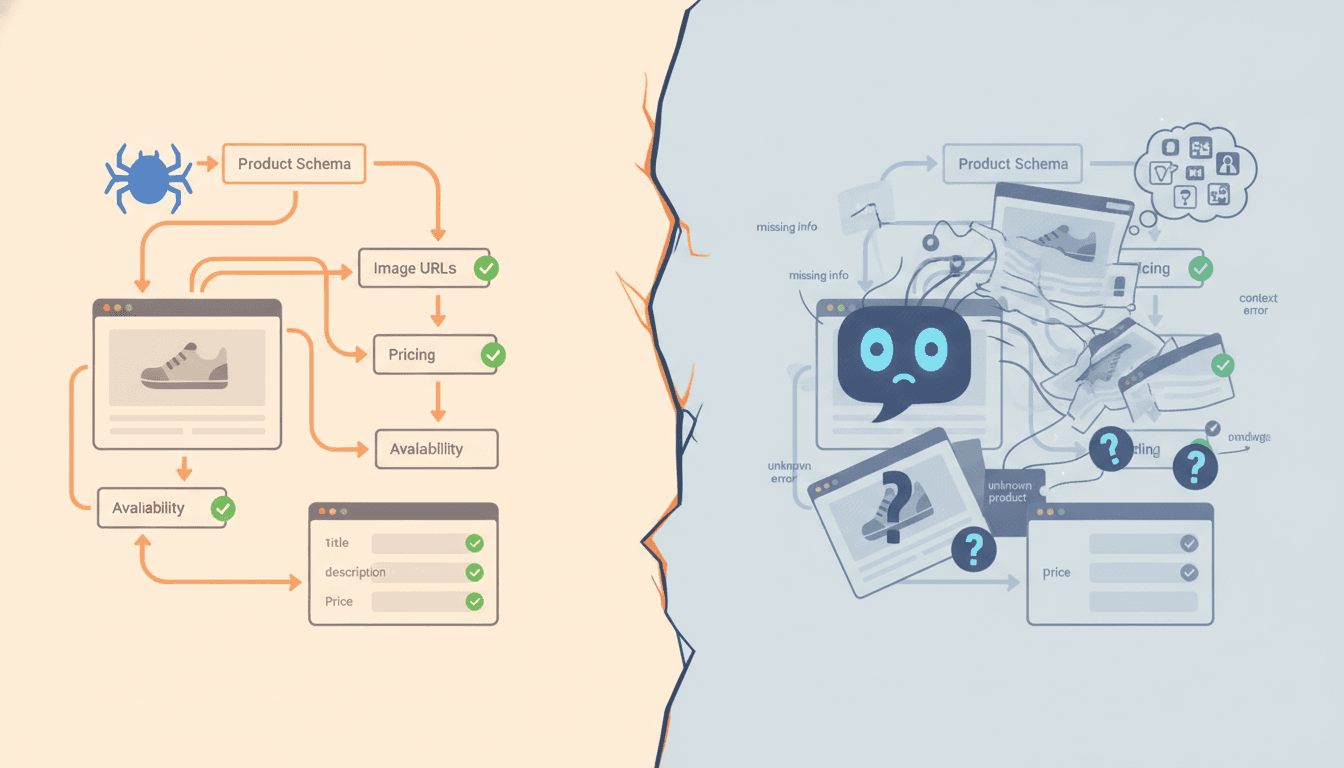
JavaScript rendering is the **single largest technical barrier** to AI visibility for modern e-commerce sites. Most platforms built on React, Vue, or headless commerce frameworks render critical product data client-side.

This means product data only appears after JavaScript executes in a browser. AI crawlers do not wait for that execution.

[IMG: Technical diagram showing the difference between what a browser renders vs. what an AI crawler sees on a JavaScript-heavy product page—browser shows full product with price, description, and reviews; crawler sees empty HTML shell]


---


## How AI Crawlers See JavaScript-Heavy Pages

GPTBot and PerplexityBot typically cannot execute JavaScript at all during crawl passes. This creates a paradox: Google indexes and ranks the page because its crawler has limited JS rendering capability. AI crawlers see an empty shell with no product name, description, price, reviews, or availability.

[Ahrefs' technical SEO research](https://ahrefs.com) confirms this is the most common explanation for AI invisibility despite strong Google performance.

The solutions exist, though implementation complexity varies.


---


## Three Approaches to Fix JavaScript Rendering Issues

**Server-side rendering (SSR)** renders critical product content in HTML before it reaches the crawler. This requires backend changes but provides the most reliable solution.

**Pre-rendering** generates static HTML snapshots of product pages for crawler consumption. This approach is faster to implement than SSR but requires maintenance as product data changes.

**Structured data fallback** ensures Schema.org markup includes all critical product attributes directly in HTML, independent of JavaScript rendering. This is easiest to implement, though less comprehensive than SSR.

[Eli Schwartz, Author of *Product-Led SEO*](https://elischwartz.co), frames the AI crawler's perspective clearly: *"If a product page cannot answer those questions in plain, crawlable text, the model simply will not know the brand exists."*

For e-commerce teams, this means auditing which product attributes are JavaScript-dependent—and treating each one as a visibility liability.


---


## Structured Data: The Direct Signal to AI Systems

Structured data is the closest thing to a direct communication channel between websites and AI systems. Without it, AI crawlers must guess at product attributes—and they frequently guess wrong or omit the product entirely from recommendations.

The implementation gap is significant. [HTTP Archive Web Almanac 2024](https://almanac.httparchive.org) data analyzed across 8.2 million e-commerce product URLs found that **only 12.5% of product pages** contain sufficient structured data for AI systems to confidently extract all four core attributes: name, brand, price range, and primary use case.

Most pages provide name and price but lack machine-readable brand entity markup and use-case descriptions.


---


## How AI Systems Use Structured Data

[Martin Splitt, Developer Advocate at Google Search](https://developers.google.com/search), describes the mechanic directly: *"When Product schema is implemented correctly—with brand, offers, reviews, and a detailed description—the website is essentially handing the AI a pre-parsed summary of the product. Without it, the AI has to guess, and it often guesses wrong or not at all."*

The critical schemas for e-commerce AI visibility are:

- **Product** — Core entity with name, description, brand, image
- **Offer** — Price, availability, currency, seller
- **Review / AggregateRating** — Customer sentiment signals that influence recommendation confidence
- **FAQPage** — Answer-shaped content AI systems extract at high rates
- **BreadcrumbList** — Category hierarchy and topical context


---


## Measuring Structured Data Impact

The ROI case is compelling. [Hexagon's Perplexity Citation Analysis (2024)](https://joinhexagon.com) found that product pages with complete FAQ schema and 300+ words of unique descriptive content are **4.7x more likely to be cited by Perplexity AI** than pages with standard title/description/price information only.

For immediate implementation, brands should run pages through [Google's Rich Results Test](https://search.google.com/test/rich-results) and validate against the [Schema.org Product specification](https://schema.org/Product).


---


## The Text-to-HTML Ratio Problem

AI crawlers do not just index pages—they filter them. One of the primary quality signals used is the **text-to-HTML ratio**: the proportion of meaningful text content relative to total HTML code. Most e-commerce product pages fail this threshold by a significant margin.

[Analysis by Ahrefs and Semrush](https://ahrefs.com) across major e-commerce platforms found that the average product page has a text-to-HTML ratio of just **8-12%**. AI crawler quality filters typically require **25-35%** to classify a page as "content-rich" and worth including in training or retrieval indexes.

Shopify, BigCommerce, and Magento default themes all produce HTML with extensive navigation elements, script tags, CSS, and tracking pixels that dilute the ratio of meaningful product text.


---


## Impact of Low Text-to-HTML Ratios

The impact cascades across entire product catalogs. Pages below the quality threshold are deprioritized or excluded from AI indexes entirely—meaning entire product ranges can be invisible to AI systems regardless of individual page quality.

Here's how to close the gap:

- **Expand product descriptions** to 300-500 words minimum with unique, original copy
- **Add FAQ sections** directly on product pages using FAQPage schema
- **Include use-case content** — who the product serves, what problems it solves, how it compares to alternatives
- **Reduce template bloat** — audit and remove unnecessary scripts, tracking pixels, and structural markup where possible

To audit current ratio, brands should use browser DevTools to view page source, then compare word count of visible text against total HTML character count.


---


## Entity Salience and Third-Party Authority

AI systems do not evaluate brands in isolation. They weight **entity salience**—the prominence and frequency with which a brand or product is mentioned across multiple authoritative sources. A brand that exists only on its own website, even with perfect on-page optimization, has near-zero entity salience in an AI system's knowledge graph.

[IMG: Visual diagram showing entity salience concept—a brand at the center with arrows pointing inward from review sites, editorial publications, comparison platforms, and social signals, contrasting with a brand that only has arrows pointing to its own website]

This pattern appears consistently in AI recommendation research: DTC brands often underperform relative to their market position because their authority signals are concentrated on-site.


---


## Building Entity Salience Through External Signals

[Google's Natural Language API entity analysis research](https://cloud.google.com/natural-language) confirms that AI training data heavily weights mentions across review publications, comparison sites, editorial media, and news coverage. A brand mentioned in 50 third-party articles carries higher AI recommendation confidence than a brand with perfect on-site SEO and zero external mentions.

[Lily Ray, VP of SEO Strategy & Research at Amsive](https://amsive.com), observes: *"The brands winning in AI search right now are not necessarily the biggest or the best-known. They are the ones whose websites are architecturally transparent—where every product has a clear entity, a clear use case, and a clear reason to exist in plain text that any crawler can read."*

Building entity salience requires deliberate external strategy:

- Establish presence on **review aggregators** and comparison platforms
- Pursue **editorial coverage** in industry publications
- Develop **content partnerships** that generate third-party brand mentions
- Earn **expert recommendations** that create authoritative citations


---


## Content Architecture and Topical Authority

AI systems do not evaluate individual product pages in isolation. They analyze semantic relationships across entire sites—product pages, category pages, blog content, FAQ sections, and guide content—to assess topical authority. Catalog-only websites are structurally disadvantaged compared to sites with rich supporting content ecosystems.

[Hexagon's research](https://joinhexagon.com) found that brands with 50+ supporting content pieces rank significantly higher in AI recommendations than catalog-only competitors in the same category.

A skincare brand with product pages supplemented by ingredient guides, routine guides, and dermatologist FAQs consistently outranks a competitor with an identical product catalog but no supporting content.


---


## Building Content Architecture for AI Visibility

The content architecture strategy that drives this advantage follows a consistent pattern:

- **Cluster related products** around shared use cases and ingredient/feature themes
- **Create category guides** that establish topical authority above the product level
- **Develop FAQ content** that answers the questions AI systems are trained to respond to
- **Publish comparison content** using language like "ideal for," "better than," and "unlike competitors"
- **Link product pages to supporting guides** to reinforce topical clusters through internal linking

This advantage compounds over time and is largest in categories where AI systems rely heavily on training data—supplements, skincare, home goods, and apparel.


---


## The Robots.txt and Crawler Blocking Problem

Many e-commerce brands are blocking AI crawlers without knowing it. The blocking rate has grown dramatically—from 5% of websites in August 2023 to over 26% by mid-2024, with e-commerce sites blocking at 31%, according to [Originality.ai and DarkVisitors.com tracking](https://darkvisitors.com).

Some blocks are deliberate; many result from default platform configurations that marketing teams never reviewed. The motivations are understandable: content scraping concerns, competitive intelligence fears, training data objections.

But the strategic cost is substantial. Blocking GPTBot removes a brand from ChatGPT recommendation consideration entirely. Blocking PerplexityBot eliminates real-time retrieval visibility.


---


## Conducting a Crawler Blocking Audit

Conduct an immediate crawl blocking audit:

- Check **robots.txt** for `User-agent: GPTBot`, `User-agent: CCBot`, and `User-agent: PerplexityBot` disallow rules
- Review **meta robots tags** for `noindex` or `nofollow` instructions applied to product pages
- Audit **.htaccess rules** for IP-based or user-agent-based blocking
- Check **sitemap exclusions** that may prevent crawlers from discovering product pages
- Review **default platform configurations**—some Shopify and Magento setups inadvertently restrict legitimate AI crawlers from product pages

The recommendation is straightforward: allow AI crawlers, and use alternative methods for content protection—watermarking, legal terms of service, and monitoring services—that do not sacrifice AI discoverability.


---


## Technical Audit Checklist: Diagnosing AI Visibility Issues

A systematic audit identifies specific technical barriers and prioritizes fixes by impact. The following seven-step process covers the full scope of AI visibility issues for e-commerce sites.

**Step 1: Crawlability Audit**
Review robots.txt for AI crawler blocks, check meta robots tags across product pages, and pull crawler access logs to verify GPTBot, PerplexityBot, and CCBot are actually reaching product pages.

**Step 2: JavaScript Rendering Audit**
Identify which product attributes—description, price, reviews, availability—are rendered client-side. Use browser DevTools to compare raw page source against rendered output. Flag every attribute that disappears in raw HTML view.

**Step 3: Structured Data Audit**
Run a sample of product pages through [Google's Rich Results Test](https://search.google.com/test/rich-results) and the [Schema.org validator](https://validator.schema.org). Check for complete Product, Offer, Review, FAQPage, AggregateRating, and BreadcrumbList schemas. Note missing properties, especially brand entity markup and use-case descriptions.

**Step 4: Text-to-HTML Ratio Analysis**
Sample 20 product pages across categories. Calculate text-to-HTML ratio using page source. Flag any pages below 20% as high-priority for content expansion.

**Step 5: Content Depth Audit**
Measure average product description word count across the catalog. Target 300-500 words minimum. Identify the top 100 products by revenue for priority content expansion.

**Step 6: Entity Authority Audit**
Count third-party brand and product mentions using [Ahrefs](https://ahrefs.com) or [SEMrush](https://semrush.com). Identify review aggregators, comparison platforms, and editorial publications where the brand is absent.

**Step 7: Content Architecture Audit**
Map existing content against topical clusters. Identify gaps between product pages and supporting guide/FAQ content. Document internal linking patterns between product and supporting content.

**Recommended tools:** [Google Search Console](https://search.google.com/search-console), [Screaming Frog](https://www.screamingfrog.co.uk), [Schema.org Validator](https://validator.schema.org), [Ahrefs](https://ahrefs.com), [SEMrush](https://semrush.com).


---


## Priority Optimization Roadmap: What to Fix First

Not all fixes deliver equal impact. The following phased roadmap prioritizes by speed of implementation and immediacy of AI visibility impact.

[IMG: Horizontal timeline graphic showing five optimization phases across a 12+ week period, with labeled milestones and expected impact indicators for each phase]

**Phase 1 — Weeks 1-2: Unblock AI Crawlers**
Review and update robots.txt to allow GPTBot, PerplexityBot, and CCBot. Verify no meta robots tags or .htaccess rules create secondary blocks. This is the highest-leverage quick win—zero content investment required, and it immediately opens the door to AI indexing.

**Phase 2 — Weeks 2-4: Implement Core Structured Data**
Deploy Product, Offer, and Review schemas across existing product pages. Prioritize the top 100 revenue-generating products. Pages with complete structured data become eligible for Perplexity citations within 4-6 weeks of crawl.

**Phase 3 — Weeks 4-8: Expand Product Content**
Expand product descriptions to 300+ words for priority products. Add FAQPage schema to top 100 products. Include use-case descriptions, comparison language, and answer-shaped content that AI systems extract at high rates.

**Phase 4 — Weeks 8-12: Fix JavaScript Rendering**
Implement server-side rendering or pre-rendering for critical product data. This is the most technically complex phase, requiring engineering resources. Estimated effort: 40-80 hours depending on platform architecture.

**Phase 5 — Weeks 12+: Build Supporting Content Ecosystem**
Develop category guides, comparison content, ingredient/feature explainers, and FAQ content. Establish presence on review aggregators and comparison platforms. This phase delivers compounding returns over 6-12 months.


---


## Resource Expectations and Timeline

Technical audit requires 10-20 hours. Structured data implementation requires 40-80 hours. Content expansion and third-party outreach are ongoing activities.

ChatGPT visibility improvements lag Perplexity due to training cycle dependence. Expect measurable ChatGPT impact over 2-3 months.


---


## The Competitive Advantage Window: Why This Matters Now

The market timing for AI optimization has a closing window. AI recommendation influence is growing from $45 billion in 2024 to a projected $194 billion by 2026, yet **fewer than 15% of e-commerce brands** have optimized for AI crawlers.

The competitive landscape resembles early mobile optimization in 2010-2012: the brands that moved first established dominant positions that compounded as the channel matured.

Brands with complete AI optimization currently see 4.7x higher Perplexity citation rates than competitors with standard product pages. As more brands close the structured data and content depth gaps, that multiplier will compress—and first-mover advantage will narrow rapidly.


---


## Looking Ahead: AI Optimization Becomes Table-Stakes

By 2026, AI optimization will be table-stakes for e-commerce. The brands building AI visibility infrastructure now are establishing recommendation authority that will be difficult for late-movers to displace.

The technical work required is finite and well-defined. The window to do it before competitors catch up is not.


---


## Measuring AI Visibility: Metrics and Monitoring

Measuring AI visibility requires different methods than traditional SEO analytics. Many AI tools do not send referrer data, making direct attribution challenging. The following metrics framework provides a practical monitoring approach.

**Core Metrics to Track:**

- **Perplexity citation frequency** — Manually test target product queries in Perplexity weekly; track how often the brand appears in recommendation responses
- **ChatGPT mention rate** — Manual testing or third-party monitoring services; test 20-30 category queries monthly
- **Structured data coverage** — Track percentage of product pages with complete Schema.org markup using Screaming Frog crawls
- **AI crawler access logs** — Monitor GPTBot, PerplexityBot, and CCBot crawl frequency and HTTP response codes in server logs
- **AI-attributed traffic** — Where referrer data is available, segment AI tool traffic; supplement with UTM parameters in any recommended URLs and custom landing pages


---


## Timeline Expectations for AI Visibility

Structured data and crawler unblocking changes become visible in Perplexity citations within weeks 2-4. Measurable improvement in citation frequency across target queries appears in weeks 6-12.

Significant traffic contribution from AI-driven discovery and content ecosystem effects become visible after 6+ months. The attribution challenge is real but manageable.

Creative tracking methods—custom landing pages, UTM-tagged product URLs in structured data, and monitoring services—can approximate AI-driven revenue impact while direct attribution tools mature.


---


## Building AI Visibility Before the Window Closes

The technical gap between Google visibility and AI visibility is real, measurable, and fixable. The brands that close it first—by unblocking crawlers, implementing complete structured data, solving JavaScript rendering issues, and building content ecosystems—will dominate AI recommendation results in 2025 and 2026.

Those that wait will optimize into an increasingly competitive landscape where first-mover advantages have already been claimed. The discipline is genuinely new, but the technical fundamentals matter enormously right now—and most competitors have not caught on yet.

That gap represents the opportunity.


---


## Next Steps for E-Commerce Brands

The path forward is clear. Brands should conduct a technical audit using the seven-step framework outlined above. Then implement the phased roadmap, prioritizing crawler unblocking and structured data deployment in the first 4 weeks.

The competitive advantage window remains open. The time to act is now.


---


*Ready to establish AI visibility before competitors catch up?* Schedule a free 30-minute consultation with a Hexagon strategist to audit site AI crawler accessibility, identify technical barriers, and build a prioritized optimization roadmap.

[**Book Your AI Visibility Audit →**](https://calendly.com/ramon-joinhexagon/30min)
H
Hexagon Team
Published June 13, 2026